This is a download from BBC Learning English.
To find out more visit our website.
Hello. This is 6 Minute English from BBC Learning English.
I'm Rob. And I'm Sam.
Here at 6 Minute English we love to chat about new technology.
One of our favourite topics is VR, or virtual reality and the ways it's shaping life in the future.
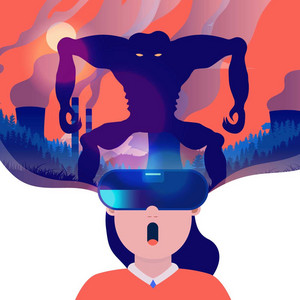
VR allows you to put on a headset and escape into a completely different world.
In this programme, we'll be hearing about some of the ways VR is tackling serious problems like domestic violence and helping people overcome phobias, the strong inter -rational fear of something.
And of course, we'll be learning some useful, related vocabulary along the way.
People who use VR often describe the experience as intense.
Putting on the headset makes you feel you're really there in whatever new world you've chosen.
And it's this intensity that inventors, scientists and therapists are using to help people overcome their problems. We'll hear more soon but first I have a question for you Sam.
One of the phobias VR can help with is the fear of heights.
But what is the proper name for this psychological disorder?
Is the fear of heights called a.
alectrophobia, b. arachnophobia or c.
acrophobia? I'll say a.
alectrophobia. OK, Sam – we'll find out the answer at the end of the programme.
Now, if, like me, you're not very good with heights, you'll be happy to know that a company called Oxford VR has designed a system to help with precisely that problem.
In the safety of your own home, you put on a headset and are guided through a series of tasks, moving you higher and higher off the ground.
You start by taking an elevator to the top floor of tall buildings and move on to harder challenges like climbing a rope.
Daniel Freeman is a professor of clinical psychology at Oxford University.
Listen as he explains how the VR experience works to BBC World Service programme People Fixing the World.
Even though you're consciously aware it's a simulation, it doesn't stop all your habitual reactions to heights happening, and that's really important, and that's why it's got such a potential to be therapeutic.
The art of successful therapy and what you can do really, really well in VR is enable someone to drop those defences, and VR, the person is more able to drop them because they know there's no real height there.
Although the VR experience seems real, the person using it knows it's only a simulation – a pretend copy of the real thing.
This gives them confidence to go higher, knowing they can't really get hurt.
But although it's simulated, the experience is real enough to trick your mind into acting in its habitual way – the way it usually typically works.
Although your brain knows you have both feet on the ground, VR is so realistic that to complete the tasks you have to drop your defences, a phrase meaning to relax and trust people by lowering the psychological barriers you have built to protect yourself.
Oxford VR's Fear of Heights experience uses VR to put people into another world, but the next project we'll hear about takes things even further, pushing people into someone else's body.
In Barcelona, a VR simulation is being used in prisons to make men convicted of domestic violence aware of what it feels like to be in the position of their victims. The project, called Virtual Embodiment is led by neuroscientist Mavi Sanchez -Vives of Barcelona's Institute for Biomedical Research. So in a virtual world we can be someone different and have a first person embodied perspective From the point of view, for example, of a different person, different gender, different age, one can go through different situations and have the experience from this totally novel perspective.
Many of the prisoners lack empathy for their victims. Virtual embodiment works by giving these men the experience of abuse in the first person from the perspective of someone who actually experiences an event in person.
In VR, the men have the insults and abuse they gave to others turn back on them.
It's a novel – a new and original – experience for them and not a pleasant one either.
But the VR therapy seems to be working and Dr Sanchez -Vivez reports more and more of the prisoners successfully reintegrating into their communities after their release from prison.
The experience VR creates of seeing things from someone else's point of view can be for serious problems. And speaking of problems, what was the answer to your question, Rob?
I asked Sam whether the correct name for the fear of heights was electrophobia, arachnophobia or acrophobia.
I guessed it was electrophobia.
Which was the wrong answer – electrophobia is the fear of chickens!
The correct answer was c, acrophobia – a fear of heights and a good example of a phobia!
Let's recap the rest of the vocabulary we've learned, starting with simulation – a pretend copy of something that looks real but is not.
Herbitial describes the usual, typical way something works.
The phrase, drop your defences, means to relax and trust something by lowering your psychological barriers.
Rob In the first person means talking about something from the perspective of the person who actually experienced an event themselves.
Sam And finally, the adjective novel means completely new and original, unlike anything that's happened before.
Rob Ah, well once again our six minutes are really and virtually over.
Goodbye for now. Sam Bye.