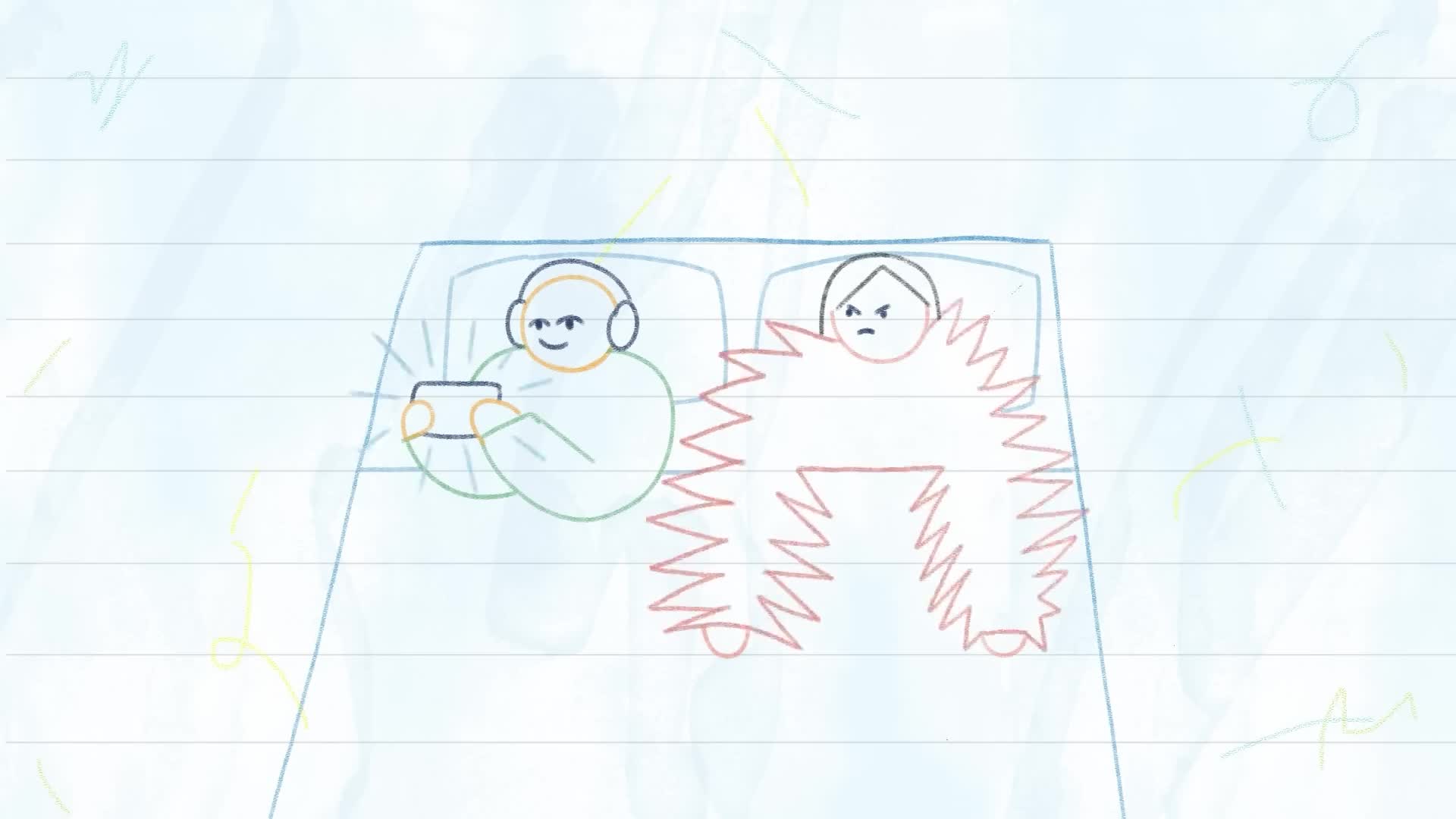
In many relationships we may find ourselves asking with continually renewed frustration, puzzlement and pain why can't they change?
We ask because there's so much at stake, because we've invested so much in them and they in us.
We ask also because we know that they're intelligent.
They understand so much, they follow arguments.
They ordinarily communicate in fairly sophisticated ways.
They may have attended a good university.
Surely, surely then, they will be able to hear us and grasp what needs to be done.
It isn't, after all, very complicated.
We need them to be more reliable.
We need them to call us when they say they will.
We need them to kiss us more.
We need them to ask us about our day.
We need them to initiate sex sometimes.
We need them to be softer and more focused.
These are the signs that we need from them and upon which everything else hangs.
The survival of the relationship or a marriage where children go to school?
Who owns a house?
What's in a will?
The pain and strangeness is deepened because they don't say a flat-out no.
They insist repeatedly that they do love us.
At points they appear to listen to us.
They don't want the connection to unravel either.
The things we're trying to get them to do have an elemental simplicity.
A few more words here and there, not those annoying behaviours, some more gestures at key moments.
You'd think this was entirely obvious.
So many people, we included, have absolutely no problem with such matters.
They come to us as readily as to some does the gift of mental arithmetic or a facility with language.
We suffer because we can't, unlike in other areas of endeavour, see or grasp the effort required to change psychologically.
We know it's hard to climb a very tall mountain.
We know the limitations of our limbs and intuit how hard those granite sides will be.
And so we don't find ourselves crossly saying just go and climb K2.
But in the emotional realm there are no visible markers of challenge.
Why don't they just reach out to us more, think of us more, hold us more?
It's so simple.
Except it's not, not for them at least.
It would be as hard for these people to take this on board as it would be for us to run up a cliff, face levitate a car or fly between buildings.
The difficulty may be traceless, it's every bit as real and as incontestable.
We have to accept something beyond the evidence of our senses, in the way we have to accept a principle of physics that defies the naked eye.
We have to accept that for a certain sort of person to say a sentence like I can't live without you, I need you so much, though it's made up of ten commonplace, non-syntactically arduous words, is as much of a challenge as would be lifting up a tree with one's little finger or flawlessly translating a text from Finnish to Korean in an instant.
When we protest and say why don't they just in our disbelief?
There is so much that we're not at that moment seeing.
The decades, especially the first one, that very slowly, over thousands of small incidents, with some of the patience of water shaping stone, moulded them into who they are now.
We're not seeing the small boy or girl who had to cope with a father who left the family or a mother who undermined them across long years.
We're not seeing how they had to adapt to make it through and why certain learned responses made sense.
We're not seeing that character is a substance as tough as catgut and as hard to alter as muscle.
This has nothing to do with intelligence in the standard sense of an ability to understand an argument and respond to information.
They can do this extremely well every day in their work, as we know.
But this is of another order.
It has to do with the way that they were assembled as an emotional being.
It touches on the wiring of their soul.
We can no more just become a person who runs at a certain emotional temperature than we can be a person who just competes in the Olympics or just changes their eye colour.
The difficulty doesn't signal itself.
It is every bit as concrete and as unbudgeable as the most strenuous feats of the visible world.
We shouldn't add to our suffering by believing that we are up against some kind of stubbornness or wilfulness, that they're doing it on purpose, that we're destroying years on something that could change tomorrow.
We need to dignify our problems.
Our lives haven't become unmoored by a haphazard matter or a nastiness of character or a streak of spite.
We're up against what we might as well learn to see as one of the central tripwires of existence.
We're facing the pyramids of Giza or the direction of flow of the Rhine.
They function in one kind of emotional way We function in another.
Despite a lack of visual evidence, we are fundamentally different people.
We would to change them, need to put them in a time machine, fly back to the past and give them an entirely different upbringing.
We're insulting ourselves and the process by which people become who they are to keep assuming that a few more paragraphs or one or two more chats will do it.
If we need to leave them and we may let's not compound our suffering by assuming it's caused by negligible factors.
We were trying to remake a human being.
We were trying to bend the laws of time and space.
We were attempting to retool emotional DNA with our bare hands.
How noble and how brave of us to try.
How very normal that we ran into difficulties.