It's the Book Club for Kids.
It's the Book Club for Kids.
It's the Book Club for Kids.
It's the Book Club for Kids podcast.
It's a bonus edition of the Book Club for Kids.
Hi, I'm Kitty Felde.
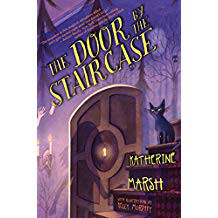
Last week we spoke with writer Catherine Marsh about her novel, The Door by the Staircase.
It's her own take on the Baba Yaga story.
But Catherine has a few more thoughts on the topic and about writing itself.
Let's begin with the role her son played in the creation of the book.
Both he and my daughter went to this local French school and had to go through this very difficult immersion where they had to learn to speak French.
They had to learn to use a fountain pen, which is what the children use there.
They had to get used to a lot of different cultural expectations.
For example, the kids even at the age of four.
My daughter went on a two-day overnight class trip, So there's a lot of different things and that experience of watching them go through it helped inspire the book.
And my son actually helped by reading the book and making sure things were correct, vis-a-vis his experience as a kid who had done this.
Was there anything in particular he had you change?
That is a good question.
There are some smaller details because I really based the book at the school the children attended, which was called École de Bonheur, which is the School of Happiness.
And I just love that poetic name.
It's such a wonderful name.
And so he definitely made sure that all of my descriptions of where things were and how the day worked were accurate.
So how did you stumble into writing?
Oh, that's a hard one.
I mean, I always liked to do fiction writing when I was a teenager and I became an English major.
And then I was a journalist.
And so I was always doing something around writing.
And I stumbled into fiction writing partly because after September 11th, I was living in New York.
I had experienced September 11th in New York.
And shortly after that, my grandmother, the Ukrainian one who helped raise me and inspired Door by the Staircase she passed away.
And I was just feeling so sad and so anxious.
And I found that writing a story was a way for me to kind of work out some of my anxieties and explore some of the things that I loved, including history, because I work history into all my books and you know my ethnic background and various other things that you know geography and places that I loved.
And so for me, it was very therapeutic.
When you make that shift from being a journalist to being a fiction writer, there's some rules you have to set aside.
Did you find that difficult?
Yes, although I always did narrative.
The type of journalism I did is I was a narrative feature journalist.
So I was always telling stories even when I was using fax.
And I still like to incorporate that.
And with my latest book, With Nowhere Boy, it really is a highly reported and researched story.
And I used a lot of those journalism tools by interviewing Syrian refugees, by interviewing as many people as I could in Belgium, to give a sort of aversive multitude and a real feeling of being there.
Well, did you have to give yourself permission to then lie?
Because that's what fiction is.
Well, I would object to that, actually, because I think fiction is not lies.
I think fiction is emotional truth.
I think you're going for emotional truth.
And I think in that way, fiction can sometimes be even truer than life.
And so I don't think of it as lying.
I think of it as finding a story that's true and then using details.
And in the case of that book, a lot of real details that would bring it alive for a reader.
What is your very best... suggestion for a younger person who wants to write?
Well, everybody says read, and I think that that is probably what you're going to hear the most.
And I agree with that.
But the other thing I would say is to to, to actually think about the things that frighten you the most, and to start there, because I think a lot of great writing comes out of dark places and comes out of fears and worries and things that you don't want to necessarily admit to other people.
And if you start there, you'll find something that is really true.
We have conversations with lots of other writers at our website, bookclubforkids.org.
And that's also where you can hear our episode of Catherine Marsh's novel The Door by the Staircase.
This episode is funded in part by the D.C.
Commission on the Arts and Humanities, an agency supported in part by the National Endowment for the Arts and by a grant from the Nora Roberts Foundation.
We'll be back again next week with a brand new full-length episode.
I'm Kitty Felde.
Thanks again for listening.
Thank you.
Thank you.