
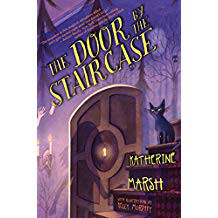
[The Intersection of Life, Truth, and Fiction: A Conversation with Catherine Marsh]-[Bonus Episode - Katherine Marsh]
📋 Summary
The Intersection of Life, Truth, and Fiction: A Conversation with Catherine Marsh
In this bonus edition of the Book Club for Kids podcast, host Kitty Felde sits down with author Catherine Marsh to delve deeper into the inspirations behind her novel, The Door by the Staircase, and her broader philosophy on the craft of writing.
Drawing Inspiration from Real-Life Experiences
Marsh reveals that her writing is deeply rooted in personal experience. She credits her children’s attendance at a local French school—which she poetically refers to as École de Bonheur (the School of Happiness)—as a primary influence for the setting of her book. The intense cultural expectations, such as the use of fountain pens and demanding immersion programs, provided a rich backdrop for her narrative. Her son, who had lived through these experiences, played a crucial role in the creative process by ensuring the accuracy of her descriptions, verifying the "day worked" and the spatial layout of the school to maintain authenticity.
The Transition from Journalism to Fiction
When asked about her shift from journalism to fiction, Marsh explains that she was always a "narrative feature journalist," meaning her career was built on the foundation of "telling stories even when I was using facts." She argues that the transition was not about abandoning her past, but rather evolving her methods. For her, writing became a "therapeutic" outlet following the trauma of September 11th and the loss of the Ukrainian grandmother who helped raise her. By channeling her "anxieties" and "sadness" into fiction, she was able to explore history, geography, and her own ethnic background in a meaningful way.
Fiction as Emotional Truth
One of the most compelling parts of the discussion arises when the host asks if Marsh had to give herself permission to "lie" as a fiction writer. Marsh strongly objects to this characterization, asserting that "fiction is not lies." Instead, she posits that fiction is "emotional truth." She believes that through the use of specific, real-world details—such as those gathered during her extensive research for her book Nowhere Boy, where she interviewed Syrian refugees—fiction can be "even truer than life." By grounding her narratives in "real details," she aims to make the experience feel visceral and alive for the reader.
Advice for Aspiring Writers: Confronting the Dark Places
For young writers seeking guidance, Marsh offers a piece of advice that goes beyond the standard recommendation to simply "read." She encourages aspiring authors to "think about the things that frighten you the most, and to start there." Marsh believes that "a lot of great writing comes out of dark places" and from the "fears and worries" that people are often reluctant to admit. By confronting these internal conflicts, writers can unearth stories that are "really true" and resonate deeply with an audience.
Ultimately, Catherine Marsh’s insights highlight that effective writing is not about escapism, but about the courageous pursuit of emotional honesty, whether one is drawing from the classroom experiences of a child or the complex realities of global displacement.

Deep Learning with ListenLeap


