N .P .R. You know, many of us did a lot of binge -watching during the thick of the pandemic.
That includes economists like Mark Taylor, who's a professor at Washington University in St.
Louis. I think I was watching Downton Abbey.
So that's the classic British drama set during the early 1900s.
And Mark recalls this one scene between the Earl of Grantham and his American wife.
They're talking about their daughter.
Do you think she would have been happy with a fortune under?
It might have been.
I was. It was a little rebuke pointing out that her fortune had actually saved Downton Abbey from ruin a couple of decades earlier when she married into the family.
The family in Downton Abbey is fictional.
But for a few decades, beginning in the late 1800s, around 100 real -life American women did marry British aristocrats.
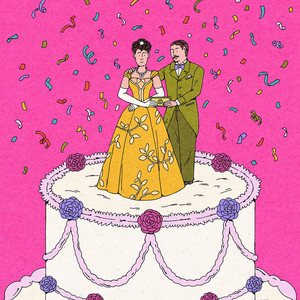
These brides became known as dollar princesses.
And their marriages were matches made in economic heaven.
This is The Indicator from Planet Money.
I'm Waylon Wong. And I'm Darian Woods.
It is Love Week on The Indicator, our series about the economics of love and romance.
Today on the show, we explain how rich American women ended up in the British aristocracy during the Gilded Age.
It is a transatlantic historical saga that involves plummeting crop prices, crumbling mansions, calls for economic protectionism, and a baby Winston Churchill.
The British aristocracy has always been a very exclusive club.
It's this small group of men with titles, you know, your barons and your vicounts.
And in the late 1800s, they were firmly established as the largest landowners in Britain.
They owned estates spanning tens of thousands of acres.
Their income came from the labor of tenant farmers who grew crops on the land.
But then economist Mark Taylor says the system got disrupted.
The problem is that the aristocracy needed money and it was all it's all the fault of the Americans.
What do we do? Well, there are there are several factors, economic factors.
The big economic factor was an influx of cheap agricultural products from the US into Britain.
American agriculture was booming.
The US government had opened up a number of states, including prairie states like Oklahoma and Nebraska to homesteaders.
Farmers were using the recently invented steel plow to cultivate that tough prairie soil.
They could then send their grain across the country by rail and then on to Britain via steamships.
All of this caused British crop prices to tank and aristocratic families found themselves short of the money they needed for things like maintaining their big country homes.
The landowners, including the aristocracy, found that their income fell, their tenant farmers went bust, they couldn't pay their rent, and they were strapped for cash.
One way that money traditionally flowed between these wealthy families was through marriage.
The families of brides would pay a dowry, basically a pile of cash, to the groom's family.
Now, in rosier economic times, aristocratic men married daughters of fellow aristocratic families.
Or, they would go a step down the social ladder to wealthy families who owned land but didn't have a noble title.
The problem was that all these land -owning families were hurting for cash.
What's the next best thing?
Well, perhaps we could find a very rich American heiress who could inject some money into this system and help out these impecunious aristocracy towards the end of the 19th century, and that's exactly what happened.
So, cash strapped British aristocrats represented the demand side of the Dollar Princess marriage equation.
For the supply side, we have to cross the Atlantic to the US where some families were emerging as the nouveau riche new money.
Whenever you ask me what they did, I'm like, railroads, horse breeding.
Horses. I always say horses, railroads, minerals.
Kristen Richardson is the author of a book called The Season, a social history of the debutante.
The debutante ball was the elaborate social custom through which wealthy parents brokered marriages between their children.
Kristen says for the daughters of these families, marriage was their only career path.
We look at it now and we think, wow, that's crazy.
But there wasn't another option.
If you didn't get married, you were either a drain on your family's resources by being at home or you were ruined in some way.
So it was about status and status just protected you, basically.
These new money American families coveted status, but they couldn't get it.
They were shunned by American high society, which was ruled by old money families in New York.
One of these new money families was the Jerome's.
Mr and Mrs Jerome had three daughters who couldn't break into the social elite of the US.
So Mrs Jerome took her girls first to Paris, then to London.
They kind of sneaked into London society like they came in through the side door with all their amazing American fresh manners and good looks.
They were beautiful.
So they hit the scene and Jenny, the middle daughter at a regatta, met the son of the Duke of Marlborough.
The couple fell in love immediately, dancing a quadrille.
What does the drill look like, Waylon?
I'm not exactly sure.
I imagine it's like the electric slide of its time.
Yeah, like the 19th century version.
I didn't go to a lot of regattas growing up, but it seemed to have worked.
The couple got engaged and then it was time for their fathers to haggle over the dowry.
How much money would the Jerome's pay?
Kristen says negotiations got pretty tense.
One issue was that Jenny's father wanted to give her a separate allowance that she would get to control.
The Duke of Marlborough was aghast at this idea.
Yeah, he had grievances.
But you know what else he had?
A son with a gambling problem and a palace with 14 acres of roof that required constant maintenance.
He needed the cash and that meant he and his wife would have to marry off one of their sons to Jenny Jerome.
Eventually, they were worn down as their house was crumbling from disrepair and needing Jenny's money.
Jenny's dowry would be worth around seven and a half million dollars in today's money, according to economist Mark Taylor.
And she got her allowance too.
The couple got married in 1874.
They named their firstborn son Winston and he grew up to be the prime minister of Britain.
Yeah, he's that Winston Churchill.
Yeah, and his mother Jenny Jerome is considered the first dollar princess.
Kristen says that Jerome's were the pioneers.
They prototyped a way to marry into the British aristocracy the ultimate status symbol after Jenny.
Dozens more American nurses followed suit.
They included the great great grandmother of Prince William, the heir to the British throne.
Other American heiresses found husbands among European aristocratic families outside of Britain.
All told, Kristen says some 500 American women marry European aristocrats between Jenny's marriage and World War One.
Their dowries were estimated at more than four billion dollars in today's money.
It's a lot of money flowing from the U .S.
to Europe. Kristen says some commentators in the U .S.
saw these marriages as an unpatriotic transfer of wealth.
There's even talk of putting an export tariff on the brides so that their families would pay a tax on their daughters as they left the country.
And there was this kind of idea circulating in in the press at the time of, well, these girls are like a mineral deposit or something, and we should all benefit from it.
Oh, how romantic. I know, it's very romantic.
It's very romantic.
The wave of transatlantic marriages came to a halt with the outbreak of World War One, which upended life for people across socioeconomic classes.
The resulting cultural and economic changes meant that women could have jobs other than getting married.
They didn't have to be mineral deposits anymore, but there's still gems in their husband's eyes.
Oh, that's very nice.
You know, and maybe they could even marry for love.
What? I know what an idea.
But they didn't have dating apps back then.
Yeah, how'd they do it?
And that brings us to tomorrow's episode, which is all about the dating app backlash.
I'm going to interview the CEO of the dating app Hinge about what might have gone wrong in online dating and how he's trying to fix it.
This episode was produced by Julia Richie with engineering by Kwesi Lee.
It was fact checked by Ciara Juarez.
Kagan Cannon is our editor.
Grant Lee Phillips wrote our Love Week theme song and the indicators of production of NPR.