Welcome to Spotlight Advanced.
I'm Megan Nolet.
And I'm Bruce Gulland.
Spotlight uses a special English method of broadcasting.
It is easier for people to understand, no matter where in the world they live.
The night breeze cools the shore of the ocean.
Waves crash against the rocks.
A full moon is in the sky.
Its light shines off the water.
You notice a strange-looking animal coming out of the water.
From far away, it looks just like one of the rocks.
But as it gets closer, you notice its long tail and nine eyes.
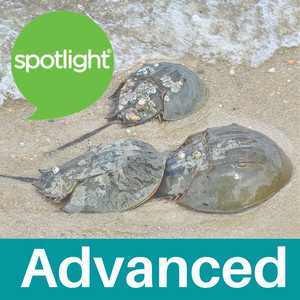
This is a horseshoe crab.
It has come up from the water to bury its eggs in the sand.
Many people may never see this strange creature.
But this horseshoe crab is one of the most important animals in the world.
Its strange blue blood may even save your life.
Today's Spotlight is on the amazing horseshoe crab.
There are only four different kinds of horseshoe crab.
Most live in waters around Asia.
One kind lives in the Atlantic Ocean.
They spend most of their lives underwater, but they do come to the surface to mate and to place their eggs on land.
Horseshoe crabs are also a very old kind of animal.
Scientists have found fossils of horseshoe crabs.
Some scientists suggest these fossils may be 450 million years old.
They look quite a bit like today's horseshoe crabs.
The animals have not changed much over all that time.
But horseshoe crabs are not just interesting.
They are also very important for the medical industry.
Every year, companies catch thousands of horseshoe crabs.
They transport them to laboratories.
There they collect the crabs' blue blood in bottles.
Then the companies release them back into the sea.
This may seem cruel, but it may be necessary.
For many years, horseshoe crab blood was the only way to make sure medicine was safe.
This is because a horseshoe crab's blood contains a special chemical called limulus amabokite lysate, or LAL.
LAL reacts in the presence of dangerous bacteria called gram-negative bacteria.
Gram-negative bacteria are a very big problem in medicine.
To be safe, medicines need to be free of disease.
Medicines and vaccines go through a long process to make sure every batch of medication is safe.
But gram-negative bacteria are very hard to get rid of.
They do not die under high heat like other bacteria.
They resist normal cleaning methods.
And they contain a poison that can harm people even after the bacteria is destroyed.
But for a long time scientists at medical companies did not have a good way to test for gram negative bacteria.
Instead, they would test new medicines on rabbits.
They would inject the rabbits with new medicines.
If the rabbits lived, the medicine was safe.
But if these got sick, the scientists would need to try again.
Medical companies needed to keep thousands of rabbits for this process.
And the test was not always correct.
But the discovery of LAL in horseshoe crab blood changed this.
Fred Bang and Jack Levin were scientists from the United States.
In 1965, they created the LAL test for new medicines.
It used horseshoe crab blood to test for gram-negative bacteria.
It was safer and much faster than other tests.
The test results were almost always correct.
Soon the LAL test was used in most countries for developing medicine.
And every test used horseshoe crab blood.
Barbara Brummer leads the Nature Conservancy in New Jersey.
She told National Geographic magazine, All medical companies around the world need these crabs.
When you think about it, your mind is amazed by how much we depend on such an ancient creature.
If you have ever had medical work or received a vaccine, horseshoe crabs were involved.
If their blood has not saved your life yet, it probably will in the future.
However, harvesting horseshoe crab blood may be more dangerous to the survival of these crabs than scientists first thought.
Most medical companies do not kill horseshoe crabs when they harvest them.
They only take about a third of the animal's blood.
Then they release the crabs back into the ocean.
At first, scientists believed that this would keep the population healthy.
But in the 1990s, horseshoe crabs began to disappear.
Winn Watson is a scientist at the University of New Hampshire.
He believes that horseshoe crabs are dying out because of blood harvesting.
Horseshoe crabs are used to living in cool water, but they can survive on land for several days.
However, most people harvesting them do not keep them in water.
They do not keep them cool.
This laboratory treatment may cause permanent damage.
Horseshoe crabs that return from harvesting do not give birth to as many babies, and almost a third of them die soon after their stay in the laboratory.
Watson spoke to the magazine Popular Mechanics.
Name me another sea creature who breathes under the water, who can survive on land the way they can.
You cannot do that with a fish.
You cannot do that with a lobster.
Horseshoe crabs are very strong.
But I think they lose a lot because of it.
Horseshoe crabs are also hurt when the places they live are destroyed.
People use them as bait to catch fish.
And in some countries, people consider them a special food.
But there is hope for the horseshoe crab.
Dingjie Ling is a scientist at the National University of Singapore.
In the year 2000, she created a new test.
It comes from horseshoe crab genes.
It also identifies gram-negative bacteria, but it does not need horseshoe crab blood to make.
The new test is just as safe as LAL.
Today, many people use Jing Ling's test.
Lonza is a medical company from Switzerland.
In 2020, they worked together with Moderna to create a vaccine against COVID-19.
To test their vaccines, they used Jake Ling's new method.
Still, people continue to harvest horseshoe crabs.
Some do not believe that Jake Ling's test is as good as the LAL test.
Some make a lot of money harvesting horseshoe crabs.
They do not want to change.
But Jigling's tests are easier to make.
They take less effort than fishing for thousands of crabs.
There may even come a day when harvesting horseshoe crabs may no longer be necessary.
They will be able to go back to their lives on the bottom of the ocean and They will live in peace, just as they have for thousands of years.
You can leave a comment on our website or email us at radio at radioenglish.net.
You can also comment on Facebook at facebook.com slash spotlightradio.
The writer and producer of this program was Dan Chrisman.
The voices you heard were from the United States and the United Kingdom.
All quotes were adapted for this program and voiced by Spotlight.
You can listen to this program again and read it on the Internet at www.radioenglish.net.
This program is called The Amazing Horseshoe Crab.
You can also get our programs delivered directly to your Android or Apple device through our free official Spotlight English app.
We hope you can join us again for the next Spotlight program.
Goodbye.