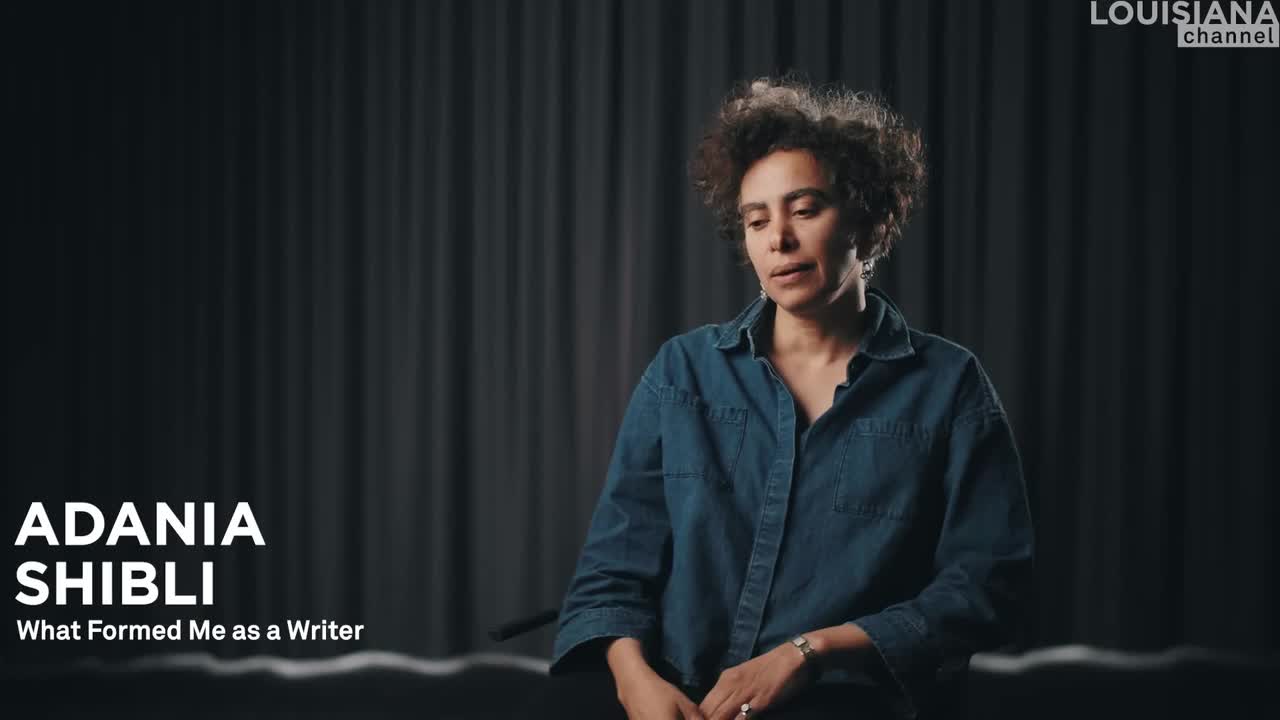
As a kid growing with books, surrounded by books, for me it was an idea that everybody should be a writer, that learning to read and to write will only lead to books.
I still think that every one of us somehow is a writer. in the ways that how we write, we exchange.
It's just how this writing comes together or comes to be an essential part of our life.
Sometimes we push it back.
And as a kid, for me, learning to write meant taking part in this practice of writing.
Somehow it came mainly from reading, being surrounded by these books as a reader.
And it was immediately this writing while reading for me as a kid, where what is written in these books came to maybe haunt me.
I used to be a lonely kid.
I preferred to be alone.
And these times I would wander in nature carrying a book and thinking a continuation of these books.
So I sort of was writing them. or what's possible to be there while not reading.
So it was a companion of the act of reading.
And I remember the first notebook.
My father used to travel to Jenin and leave us at a bookshop until he does, he finishes his work.
So we would hang around between books and magazines.
And one visit after I was able to write and not only read, my sister bought me a notebook.
And she told me, yeah, you can write inside this notebook.
And it was immediately writing fiction, kind of bringing reality of what I was encountering back to these books, renaming people around me by characters in the book, but having these characters have new acts.
It was a sort of a game.
It felt like playing.
As a kid, you would play with maybe toys.
But for me, it was playing in this notebook and writing.
And this, in fact, continued all of my life that until now, perhaps.
It's a playing, but it is a serious playing.
It's a committed playing, a sincere playing.
And I don't know why this element of playing so essential to my thinking when writing.
A few years ago, in fact, I remember 15 years ago I came across a text by Brecht called The Five Difficulties, which I think he wrote during the period of the rise of fascism, and how you can counter fascism or tyranny, state tyranny.
And he brings the idea of playing and being cunning as ways to counter the difficulties.
And perhaps intuitively as a kid, you realize the importance of playing and writing as ways to maneuver or to transform certain situations or difficult encounters.
And I remember this when I took these characters from the book I was reading and turned them of renamed people around me with the names of these characters, I also gave them new roles and forms to play and this way really to move away from reality, such as just fights in the classroom.
But before that, also, this game of fiction was a companion.
We grew up without objects for play.
So we were inventing these modes of playing that relied on performance.
We played with stones and rearranging them, becoming houses and neighborhoods and cities.
And now I think of it, it's also playing in the sense of playing theater.
So it was immediately this idea that you can engage in fiction as part of your daily practice or return to reality by taking it elsewhere was there as an act of joy and an act of inspiration and movement from what is in reality and the limits of reality.
My parents were 15 when the Nakba took place in 1948.
But this is something they never spoke about.
Until now, they don't find the words for that or to narrate that experience.
So narration or the impossibility of narration was so much present in our daily life.
And it seemed like books somehow soothed this difficulty.
You're lost for words.
But then you have all these books somehow bring something back to you with your loss of words.
I remember, for instance, the type of novels that were on the first shelf of our library at home.
Parts of these were European classics that were narrating difficulties.
Tolstoy and War and Peace was one of the first books you would notice.
Huge book lying there.
And as if we all needed to go through reading Tolstoy in order to imagine something that was inaccessible to us but was always also removed.
It was always another landscape.
And this is fascinating about literature how a faraway landscape suddenly comes so close to you without making you feel intimidated by your inability to narrate.
And then, of course, we had more books expanding, further classics.
But there was the third shelf that included novels written by Palestinian authors such as Ghassan Kanafani and Emil Habibi.
These, I remember, were off the limit to me.
I was not allowed to read them.
And they tried to ask why I cannot read these books.
And I think the answer from my father and my sisters, who decided together that I was too young for these books, was Not yet.
And this not yet was very, very mysterious.
I was constantly imagining what is in these books that makes them feel that I'm not ready yet for that reading experience.
And this adds to the element of reading being even a dangerous act.
It's not an act of entertainment.
It's an act that you need to grow to be able to carry.
And what type of literature?
It was quite funny now to think about it that Lolita was on the first shelf but not Ghassan Kanafani and Emil Habibi, that they were a little higher.
And I think that...
Like now the order of our library at home remains the same.
It has not changed.
Which makes me think also.
It becomes an inherited practice to me when I'm thinking of what is there possible to access, even in writing and not only in reading.
There is a distance.
There is always a not yet.
And this not yet is very important.
I don't take it as an act of prevention, but an act of thinking, a prolonged thinking growing with this impossibility, until you realize why it's possible now, what makes it possible now?
It was very interesting when I was able to read Ghassan Kanafani, for instance.
It didn't emerge to me a book or his books.
His writing is about Palestine, but about an existential question of how we are in the world.
So it was Also the experiences growing to that reading compose part of reading these books, or Emil Habibi.
It's no longer about the experience of after 1948 in Palestine, but it becomes playing with language and how.
Playing with language is also a possibility to transcend the conditions of oppression you experience.
And these things come, I think, because you are not looking for what the narrative is, but what it does, what it does to you as a reader.
Yeah, these books also continued to be more difficult and more impossible to remove from this experience of not yet.