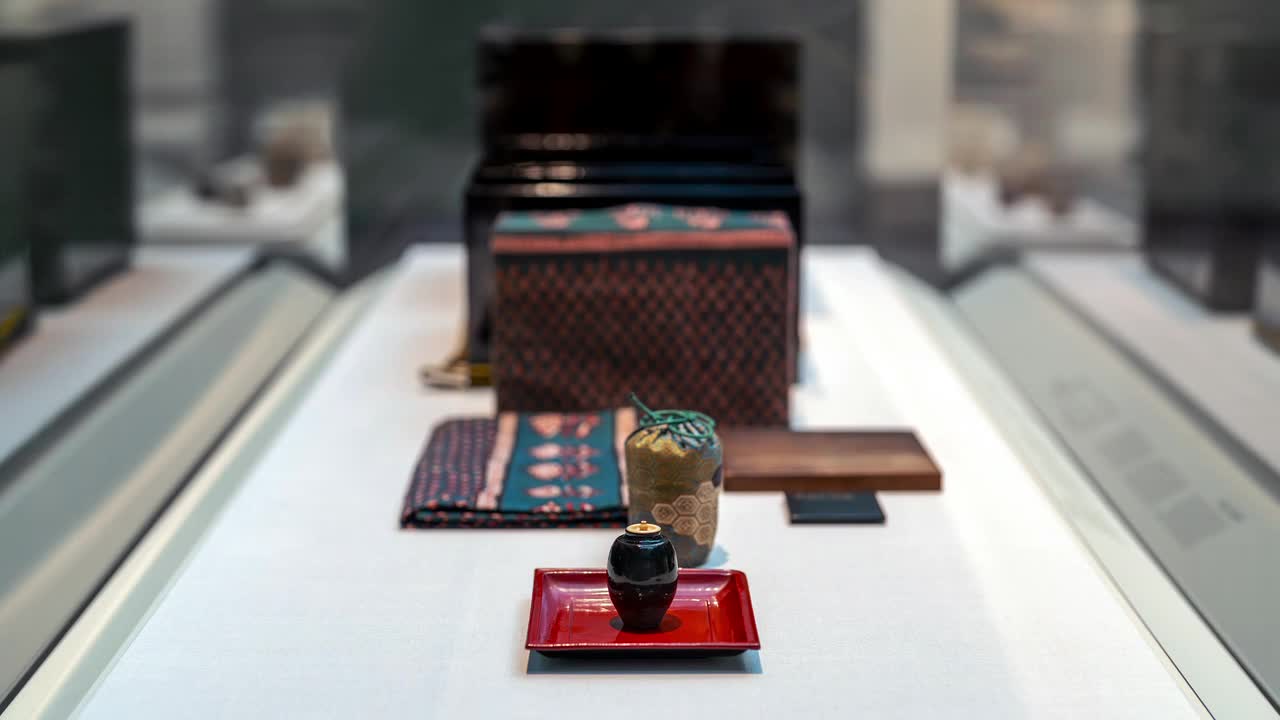
We're in the National Museum of Asian Art in Washington DC, in a gallery devoted to an exhibition titled Reasons to Gather Japanese Tea Practice Unwrapped.
And it's a perfect title because we're here to look at this tiny tea caddy.
That is a little ceramic vessel with an ivory top that is meant to hold tea.
And this is an object that would have been stored very carefully.
The ceramic itself is from China, from the Yuan Dynasty.
So by the time that it reached Japan, it would have been a rare antique.
This speaks to the beginnings of what we now understand as Japanese tea practice called chanoyu.
So chanoyu translates to hot water for tea.
It's a very humble term.
It refers to this practice of preparing a beverage called matcha.
You may have enjoyed some at your local cafe.
It's essentially ground green tea leaves whisked with water.
What we might be more familiar with is the thin tea version, which is frothy.
But the type of matcha put inside the tea caddy is a grade of matcha for preparing a style of tea called thick tea.
So it's, as you might imagine, thicker, but they also use a different type of matcha.
And that thick tea or thin would be served at a tea gathering where one enjoys not only the tea and each other's company, but also the objects themselves, such as this tea caddy.
There are layers of boxes, there are layers of pouches that are meant to protect these objects.
These layers of accessories and boxes became an opportunity for tea practitioners to document the history of the object.
So there are lots of inscriptions and with each layer a collector would also be adding their own personal taste and take on the object, and this assemblage preserves that history and preserves the lineage of this tea caddy.
And it's a testament to the care and the importance that is being given to these objects and it is a way of distinguishing their value.
But also it speaks to the historic and cultural significance of a Chinese ceramic like this that has been used for tea in Japan from at least the 15th century.
Thick tea is more formal than thin tea, and thick tea tends to feature these older Chinese ceramics that were either originally used in China for preparing tea, but it also speaks to the value that Japanese tea practitioners and collectors placed on these Chinese antiques.
And this particular piece of ceramic is beautiful.
If you look closely, you'll see that right around its midsection there is a subtle indentation that divides the vessel.
And riding over that indentation is this thick, almost drop of glaze that makes the entire object feel liquid and not finished, in a sense.
That glaze drip is something that the tea practitioners really enjoyed.
Going back to the 16th century, you'll see tea diaries that merchant tea practitioners kept.
They will focus on those drips, the color of the glaze.
It became something that the Japanese tea practitioners really enjoyed.
It came to define the aesthetics of the tea ceramics that are used for Chanyu.
So what's so interesting to me is the way that a fairly utilitarian object made in Yuan China, would have been imported into Japan, seen as particularly important.
And given a new set of associations, a new set of meanings, in a sense the object is transformed.
That's a really important part of Japanese tea practice is the fact that the elites took a Chinese practice of preparing tea, but they added new Chinese objects that were not originally used for tea in China to form this new practice, and over time you see the incorporation of objects from other cultures as well.
In this case you'll notice block printed indian textiles.
Chinese silks were incorporated in making silk pouches for different containers, but also we have this wooden Korean box with metal fittings.
And there are also Korean ceramics that were included into Japanese tea practice.
So you see this very cosmopolitan approach to collecting, to enjoying a collection, assemblage of different cultures, not just for one object like the tea caddy, but in terms of the different options that you have for the utensils that you use at a tea gathering.