Hi, I'm Dave Isay, founder of StoryCorps.
Support for this podcast and the following message come from Dignity Memorial.
Did you know that a prepaid funeral plan is one of the greatest gifts you can give your family?
Plan your life celebration in advance to protect your loved ones.
For additional information, visit dignity memorial .com.
Hey there listeners, it's Jasmine Morris, and this is the StoryCorps podcast from NPR.
We love hearing the stories you've been leaving on our voicemail.
Keep them coming at 702 -706 -TALK.
Again, that's 702 -706 -T -A -L -K.
We're thinking about veterans this week, so we thought we'd share a story from our military voices initiative.
For some, leaving the military and rejoining civilian life can be isolating.
That's where a group called Team Rubicon comes in.
They deploy teams of veterans who use their experience to go into the fray when natural disasters strike, like Lieutenant Commander Michael Davidson, who after 23 years in the Navy, struggled to adapt.
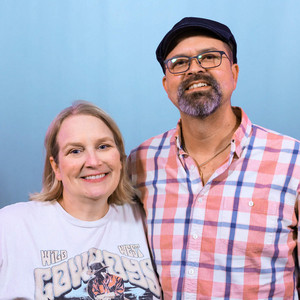
He came to StoryCorps with fellow Navy veteran, hull maintenance technician fireman Windy Barton and recalled the person who first inspired his steep sense of duty.
Can you tell me about your grandfather?
Yeah, I called him P -PAW.
World War II veteran, he was why I joined the Navy.
He taught me how to be vulnerable.
He was the first man I ever saw cry and made it okay.
What was P -PAW's nickname for you?
Nub, nubbin, nubs, and when I joined the Navy and got stationed on my first submarine, I was going down the ladder and the topside watch looked at me and said, get hot, nub.
And I'm like, why would he call me nub?
I asked him, so I did my grandfather call the boat.
And he's like, why would you ask me that?
I'm like, well, because only my grandfather calls me nub.
And he started to laugh.
And he just said, well, that's a Navy acronym for non -usable body.
I was devastated. I went and got a roll of quarters at the Boeing Alley.
And I called my grandfather, told him I had made it to the boat and checked in.
And I also knew what nub meant.
I'm like, you've been calling me a non -usable body my entire life.
And he said, yeah, you kind of have been.
Go do something with it.
And I think I have and continue to do so.
I would agree with that.
Definitely. Changed a lot of lives.
Thank you, mine included.
I remember when I just got out of the Navy and I had lost that community and my identity and so had like zero purpose.
And, you know, at the time, like I was having suicidal ideation.
So to go out there and help people, it got me to looking forward instead of looking back.
Yeah, definitely. You know, after the Navy, I was able to be a mom, be a part of every little thing that my children have done.
But I missed firefighting and emergency response stuff.
I just felt like I had let myself wither.
And so I kind of jumped feet first.
And my strongest memory on deployments was when we were in Louisiana because there was a flood in Baton Rouge.
I happened to knock on a door.
The homeowner answered and she was angry.
We were three weeks post disaster and nobody had shown up yet.
Their whole house was still covered in water and her son's autistic.
Well, the next day we had two straight teams out there and they were helping that lady.
And she was crying.
And I remember the relief because she wanted to be in her home.
And it goes back to immediate impact.
When I get on a disaster, I can pack my entire bag in less than 20 minutes and be out the door.
You need boots. You need three pairs of pants.
You need 18 pairs of socks.
Yeah. And a lot of veterans have seen the bad side of a non -natural disaster with war.
And I think being able to help something go back together is really the call to their hearts.
Yeah. I wish I would have had this when I transitioned down.
I'll agree with that.
And you know, you've taught me that I still got a lot in the tank in terms of belief of people because you're a damn good shipmate.
And I didn't know how much I missed that.
I appreciate that a lot.
You bet. That was Navy veterans Michael Davidson and Wendy Barton in Arlington, Texas.
Don't forget to call our voicemail line and share your stories with us.
This week, we want you to tell us about the moment you realized what your calling was.
Give us that story in a voicemail at 702 -706 -TALK.
Again, that's 702 -706 -TALK.
The story was produced by J.
Bourne and edited by Von Dies.
Maxión Rice is our producer.
Jadesti Kendall is our senior producer.
Our technical director is Jarrett Floyd.
And our executive producer is Amy Drosdowska.
Special thanks to facilitator Stephanie Claros.
We'll be back for you.