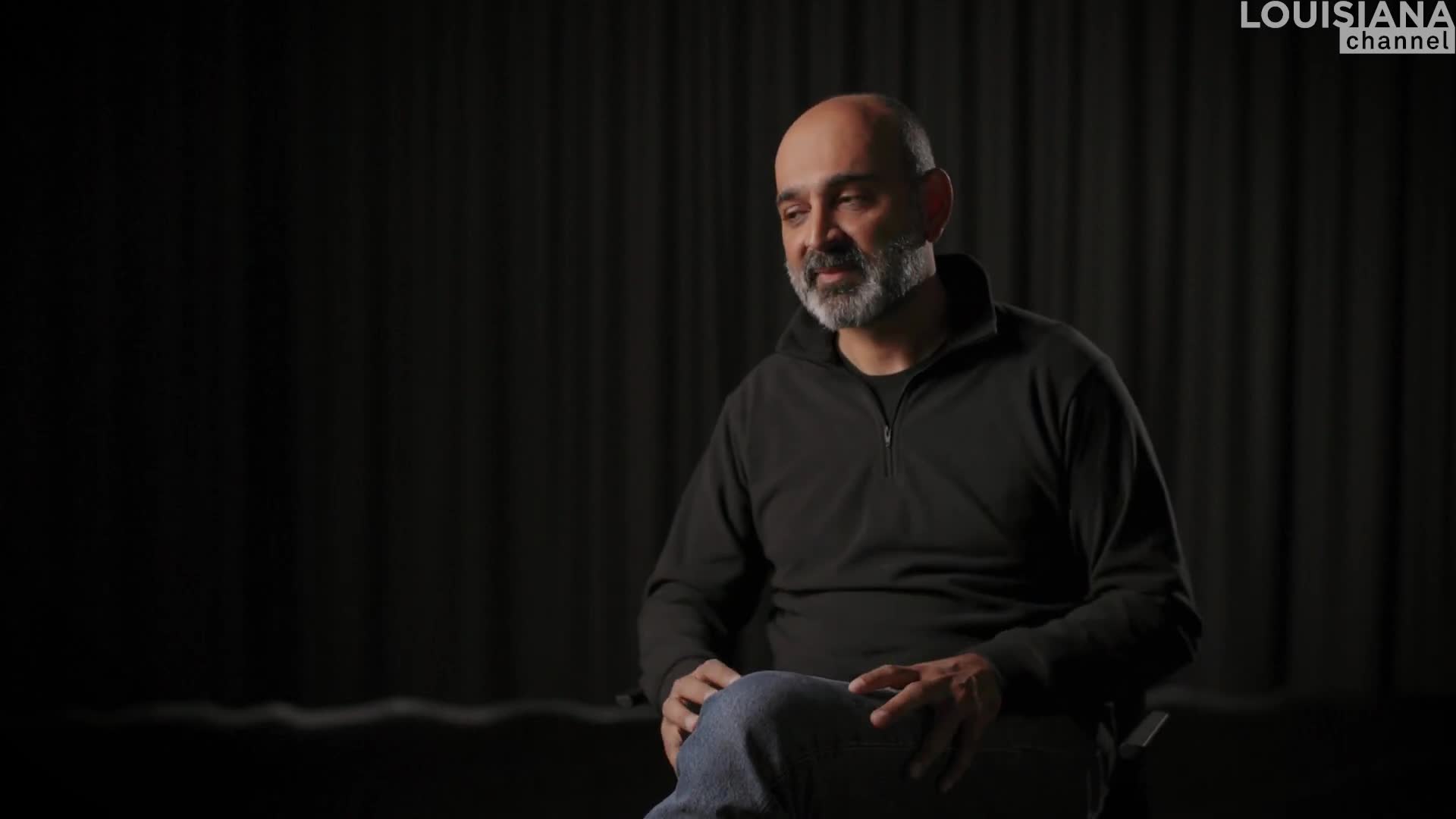
How do you see your role as a storyteller when you tackle not only important but seemingly unsolvable issues like race or migration?
What can the novel do?
When we read a book, a work of fiction, we are in a unique position where we are both ourself and somebody else.
In other words, we are alone, so of course we can only be ourselves.
I can only be me reading this book.
And yet the thoughts in our mind are not our own thoughts.
They are thoughts from somebody else.
And so we are in this very strange hybrid position of both being ourself and being somebody else at the same time.
And I think that that is an incredibly fertile position, that position of simultaneously being and not being yourself, of having your thoughts and having someone else's thoughts and doing it alone.
So not in a performative way.
You aren't reading for someone else.
You aren't having those thoughts for someone else.
There's nobody observing this experience.
And so that fertility for me, gives rise to possibility.
And whether that's a child trying to make sense of the country they've moved to, where they should know the language but don't, or an adult looking at the world around them and trying to make sense of where it's headed and feeling they don't speak the language of the future and would like to author something differently.
They're similar impulses.
But the hope is that that fertile position that readers and writers occupy, which bridges, of course, the distance between people, but also bridges time,
An author, when they're writing, is also themselves and not themselves, because the words, the characters are coming from you, but yet they are intended to come alive inside somebody else.
And so even if that person isn't present, there is a relationship in the moment of writing.
And for me, that intimate creative relationship between reader and writer is where all the potency of fiction comes from.
When you were three, your family moved from Lahore to California, where your father was doing a graduate degree in economics at Stanford.
You have a remarkable story that you've suggested might have shaped who you are.
I'm quoting here and your nomadic, multicultural view of life.
What happened?
When I was three, we flew from Pakistan to California my father, mother and I.
My sister would be born there some years later.
And I had never left Pakistan, didn't speak a word of English.
And my father was doing his PhD at a grad school in California.
And when we arrived on the campus of this school, we were put into one of the identical townhouses in which graduate students with families lived.
And I was playing outside the townhouse one day and my mother heard some crying.
And so then she came outside and she saw that I was standing in front of the neighbor's door thinking that was our house.
And the neighbors looking down, little Pakistani child thinking, you know, who is this kid?
I was looking up at the neighbor thinking, you know, you're not my mother.
And I was surrounded by children from all over the world, the children of the graduate students of this campus.
And they were saying to my mother, you know, what's wrong with him?
Why can't he speak?
And she says, he can speak.
He just doesn't know English yet.
And after this incident, I came into the house clearly terrified.
You know, I suppose I imagined I would never see my family again.
Uh, and for a month after that i didn't speak.
And i was a child who began speaking very early.
I was speaking in full sentences at one, you know, and so not speaking for a month was very strange, and i was just seated in front of our television.
And when i next spoke, a month later, my parents were surprised to find that i spoke in english um, in full sentences, with an american accent.
And it was only six and a half years later, when we moved back to Pakistan, they discovered I had completely forgotten my Urdu.
So I was a child who came to America as a Pakistani child, moved to Pakistan at the age of nine as an American child.
And twice I had to deal with discovering a language I didn't know.
So for me, I'm a person that English is my best language, the language I write in.
But it's my second language.
And Urdu, which is my third language, was once my first language.
And that gives me, I think, a slightly strange relationship to language, trying to figure out how might I communicate something.
How do you figure out how to say what you want to say?
And also a slightly strange, I suppose, relationship to home.
Where do I come from?
Because I've had different homes.
And the Pakistan that was my first home before the age of three is one I don't really remember.
But it has certain echoes in my life.
I know you're only three and obviously your parents must have told you this story, because you wouldn't have understood what was being said.
But do you remember inhabiting that baffled three-year-old and the fact that you didn't speak at all, not in Urdu and not even Punjabi, which you also knew?
So it's unclear to me how much of this story, when I was three, comes from my memories and how much is told to me.
And as I get older, I'm 53 now, so there's been 50 years since that three-year-old incident.
That's true of many memories.
I find that when we are told stories, they can shape our memories.
But also when we tell stories, they shape our memories.
The way I've described a situation, over time begins to become what I imagined that situation to have been.
So it's very hard for me to disentangle how much of that three-year-old story is something that I've been told and how much is something that I remember.
I feel I remember, but I don't know.
Now, all of that said, I think the echoes of it are apparent to me.
So that feeling of being on the outside, of a sense of threat, from not fitting in, being hypersensitive and hypervigilant to standing out to signs of hostility, signs of rejection.
That's something I think I've taken with me my entire life.
And like many people who've lived in different places, I became something of a chameleon as a child.
So I was.
You could put me kind of anywhere and I would quite quickly begin to speak like the people and figure out how they moved and talked and how they thought, which is a nice, I suppose, self-preservation instinct, but also relates to a kind of proto-novelistic instinct, which is that sense of observation also carries with it a kind of empathy.
You know, what is that person across from me thinking?
What's going on in their head?
Who are they?
And so, in a sense, the feeling of a fear of being outcast rejected threatened has, as its flip side for me, a sense that it's possible to imagine being other people, to connect with other people, even people who seem, on their surface, very different from me.
When you returned to Pakistan, your family returned to Lahore and you had to relearn Urdu.
How difficult was it for you to adjust to being Pakistani again?
When I returned to Pakistan, it was quite strange, because on the one hand, I looked Pakistani.
I was a brown, Pakistani-looking kid.
I had 30-odd first cousins.
So I immediately had this giant family that, although I was subjected to all the little tests that cousins subject you to when you're a kid all the jokes, the pranks, the little testing, Nothing hostile, or it wasn't like going to some, you know, abusive boarding school.
It wasn't hazing.
It wasn't hazing.
I think it was a bit of checking out, kicking the tires.
What's up with this kid?
Who is he really?
You know a few nicknames, a few jokes, a few.
You know I was the foreigner and there hadn't been one before among my cousins.
Very quickly, a tight clan formed and friends formed.
I had a degree of insulation, I suppose, from the world around me, coming from a large family.
That said, the world around me did strike me as very peculiar.
I remember asking my parents about a cleaning lady who worked in the house.
I said, who is this?
Is she a slave?
And they said, no, no, she's a servant.
I'd never encountered servants before, at least certainly in my own life in California.
And I came from an American context in which my mind jumped to somebody held against their will and forced to do work, and have a very different category of person.
Of course, this woman wasn't a slave, and yet the word servant certainly did conceal a great deal.
I found that, having this gaze that was partly Californian but also being accepted as Pakistani.
As the time went by, I had a binocular vision where I could see things from a Pakistani standpoint.
I could see things from a Californian standpoint, which is both disorienting but also quite useful, because having two eyes gives you depth perception.
And that, I think, began something that has stayed with me since, which is It's very difficult for me to look at situations from, you know, sort of purely one cultural perspective.
I tend to very quickly think okay well, these people might think this and these people might think that.
What do I think?
And so I puzzle about stuff more than simply accept stuff.
So in my fiction, what I tend to do differently in each book, but it seems to be a recurring theme for me is to take reality, something that feels real, and put a slight crack into it, a slight skew.
In Mott's Milk, my first novel.
It was a trial where the reader was the judge of this trial and the characters are telling their stories.
Otherwise, the stories are realistic.
In Dr Fundamentalist, my second novel.
It was a Pakistani meeting presumably an American and then telling his story.
The story feels real, but that frame feels almost staged.
In How to Get Filthy Rich in Rising Asia.
There's no names, but there's also no passage of historical time.
There's sort of CDs and computers when the child is a child.
And 70 years later, we're in the same moment.
And so is it one person's life or a composite of lives in the present moment?
In my two most recent novels.
In a sense, what I've noticed is those are the two novels where many more readers have become aware of this, because the novels play with physics and chemistry and biology.
It's not a formal crack.
It's not a crack in the form of the story, but a crack in the nature of what reality is that people are reacting to.
In Exit West, that crack takes the shape of these doors, where you might wake up one day and discover that the closet in your bedroom, instead of having a door, has an opaque black rectangle.
And if you were to push yourself through, you would leave Denmark and find yourself in Pakistan, or you would leave New York and find yourself in Kinshasa.
And this begins to happen more and more, and the whole world begins to move through these doors.
Now, on the one hand, of course, that doesn't correspond to physics, the way we understand physics as working.
On the other hand, all of us do carry around with us, many of us do carry around with us, these little black rectangles, and we stare into them.
Our consciousness is transported from New York to Pakistan, from Denmark to Westeros, to Mars, to the ancient Chinese or Roman empires.
There is this gray portal, this black portal that has been manifested by technology which, in technology, of course, is a sense of human desire.
In the same way that aircraft are invented because people want to fly.
And these portals have been invented because we want to be wherever we want to be.
Now, we have engineered our planet in such a way that we don't let people move like this.
We have various checks and controls.
But if we wanted people to move freely across the planet, they could move almost as easily as the ones in the book.
So the novel, while it tweaks physics in the form of these doors, it in a sense is corresponding quite closely to what our world feels like a world where people can move or would like to move, and are being forced not to move.
Organisms move.
And only recently have we come up with this idea that there's these borders and these passports.
So that novel explores the fundamental human nature, which is to be migratory, which occurs, of course, by moving through geography.
But the novel also explores the notion that the inescapable part of that migration is that we go through time.
That I wasn't always 53.
In fact, I was never 53 before.
I'll never be 53 again.
We are all in this moment just for an instant, and then the next moment has begun.
Life is a continuous migration.
This novel really is a novel which opens up the possibility of migration to these doors.
And then hopefully opens up the possibility of a degree of compassion towards ourselves as migrants, to the experience that we each have of getting older or old, of losing the people that we knew in our childhood, of losing so many things and, by the end, losing everything.
I think that there is a denial of self-compassion that lies at the heart of the inability to extend compassion towards others.
So in a sense the doors in the novel are doors not just in the novel, but they're hopefully doors within the psyche of the reader.
Now, my most recent novel, The Last White Man, does something similar in the sense that it too, unlike my earlier novels, tweaks physical reality.
In this case, people who think of themselves as white wake up one day dark.
And this begins to spread.
And for me this too in a sense corresponds to a certain kind of reality, which is that There is a feeling, I think, of lost status and privilege that many people feel in many societies and the sense that something is being taken from them, that the old ways or the old status or the old hierarchies are being taken.
But even completely aside from that, there is the notion that our contemporary understanding of race is something that we invented into being.
So if you read Herodotus, you don't encounter race in Herodotus.
You encounter all these different people who are all behaving to Herodotus' mind in very strange ways.
But it's not that the Egyptians are Africans and the Scythians are whatever.
This concept hasn't yet occurred, a racial concept.
And in fact, it won't occur. really until the reconquest of Spain, the Reconquista.
Because, up until during the reconquest, of course, it's not even primarily a racial question.
It's a question of are you a Muslim or are you a Christian, because the Muslims have dominated and controlled most of Spain for many centuries.
And then during the Reconquista, the Christian monarchs reconquer Spain.
And when that is done, a question arises.
What if there are people here who are only pretending to be Christians?
What if there are Muslims and Jews who live in Spain who are actually really still Muslims and Jews?
How do we get to the question of this?
How do we figure it out?
And so the idea of one's blood comes into question.
Three generations back, do you have a non-European, an African ancestor?
And if you do, then you might well be harboring secret Jewish or Muslim tendencies.
And this idea of a racially determined, you know, who are you?
Are you a European or are you an African?
Are you a Muslim or a Jew or are you a Christian?
Becomes very potent.
In fact, Cervantes himself is investigated.
Now, Cervantes is a man who fought the Muslims in the Mediterranean and is in fact imprisoned in North Africa, and then eventually makes his way back to Spain, and he's accused because of his own ancestry and his own experience.
Was he possibly secretly an African or a Jew or a Muslim?
Cervantes gives us, in a sense, this foundational novel of the Western tradition, Don Quixote, and which is often taught to us as a book about this man tilting at windmills and sort of absurd.
But that's not what Cervantes tells us the book is.
Cervantes tells us that this is a found text.
And that the author of this text is Sayyid Hamet Beneghali, which is Sayyid is sir, mister, or sir.
It's an honorific.
Hamet is my name, my family name.
Beneghali is eggplant eater, which the Muslims and Jews like to do.
They eat eggplants.
And so essentially, Sarvansis is telling us that some Muslim author wrote this book.
And then this character goes around seeing things that nobody else can see, in the same way that, of course, anybody living in Spain at the time would see all of this Muslim and Jewish heritage all around them and been told it doesn't exist.
Don't see this stuff.
These words are Spanish words.
This stuff is European culture.
All of this stuff you're looking at is made up.
Don't see it.
So the foundational novel that we get, in a sense, is a novel really about the origin of this contemporary, you know, racial category.
And then this goes into the world and there's, you know, European colonialism begins right after this time and the ship sets sail and the quote unquote new world is discovered and it's very convenient to have this European versus non-European category to dehumanize other people.
And so a system is built.
But what we must remember is this racial system was invented only 800 years ago, 600 years ago.
And it will likely not exist in 600 years from now.
It is a strange thing.
And so what the novel does is it destabilizes this idea of race.
What if it is made up?
What if it disappears?
What do we do then?
And I think that's useful, not because I think race doesn't exist in a sense.
Once you believe in something, it has enormous power.
And race clearly has enormous and terrible power.
But it is an imagined thing.
And so it is possible to imagine our way, I think, out of it.
And the novel opens up, in a way, a door into that imagining.
So that's White Man, of course, the story of a white man who wakes up one day with dark skin.
But in a weird way, it has an sort of autobiographical gestation.
I was never a white man who woke up with dark skin.
My skin was always sort of brown.
But I remember living in New York in the year 2001, before September 11th, and I remember, After September 11th, suddenly being hauled up at immigration, people changing their seat on the subway, people saying nasty things on the street, being taken off an aircraft after I'd already boarded to be re-inspected for security.
I remember this feeling of loss.
I felt I wanted things to go back to how they were before September 11th.
And I began to think, you know, what have I lost?
And I thought, you know, perhaps what I've lost is a kind of partial whiteness.
Now, I wasn't white, but yet I participated in, I think, many of the benefits of whiteness because I went to these elite universities.
I lived in New York City.
I had a well-paying job.
And so, for the most part, I could live where I wanted, date whom I wanted, belong to institutions I wanted to belong to and go by fairly unmolested by authorities.
And in a sense, I could be a human being.
And at its core, in a sense, whiteness.
Is for me that the notion that you're human, that you're just a person.
And so when I lost that, I thought, you know, I want that back.
But then I began to ask myself, wait, what exactly do I want back?
What is this thing?
And if it is possible to lose it, why am I comfortable with this phenomenon in the first place?
Am I in fact somehow deeply complicit in the system that perhaps I wasn't doing enough to acknowledge?
I was aware of racism.
I was aware of the terrible history of the United States and so many things, whether it's slavery or genocide of the native population or racism generally.
But I somehow felt not particularly personally impacted.
I had a sense that these were terrible things, and I was opposed to them.
But yet they weren't really about me at their core.
And then suddenly I thought, was I in a sense complicit in this system, because I was a sort of beneficiary of this system?
Maybe I shouldn't want to go back.
Maybe I should want instead to dismantle the system in the first place.
And those thoughts took various courses and directions.
And I think that that, in some ways, the nationalist and ethno-nationalist movements that we saw in the 2010s whether it was Brexit in the UK or the rise of Donald Trump in the United States, and the kind of white nationalism that associated with that, that served as a kind of catalyst for me, both as a reminder of that experience when I was three years old, surrounded by people who thought I was some strange other, which has always been, in a sense, I suppose, my fear.
But also that 2001 experience of being one thing the next day being the same person but finding other people were looking at me as though I had changed.
And so I thought of this character Anders, who himself was the same person, but one day wakes up dark and everybody thinks he has changed.
And he hasn't changed.
But of course, what happens is when people think you have changed and act like you have changed, you do change.
You cannot be the same person.
Who we are, identity, is a relational concept.
It doesn't exist outside of relationships.
It exists to a certain extent, but it is deeply affected by relationships.
If somebody relates to us in a particular way, it shapes who we are.
And so Anders begins to change.
And as this predicament in the novel spreads, where people begin to become dark and everybody has to deal with, in a sense, not being able to tell what race someone is by looking at them, they have to reimagine who they are, who others are, what society is.
And so I guess I subject the entire world of the novel to a process that I myself had to go through after 9-11, when I had to confront the way that I was being conceived differently, thought of in a different way.
And I thought, in a sense, it was very productive for me to confront this.
It was not a bad thing.
It was a bad thing to have those experiences, but it was very useful to be forced to deal with a system that puts those experiences onto somebody.
And so The Last White Man, in a way, is an invitation to the reader into a journey like that.