I think Ariana is always Glinda.
Ariana found a way to internalize that character.
Can we play that section in my demo?
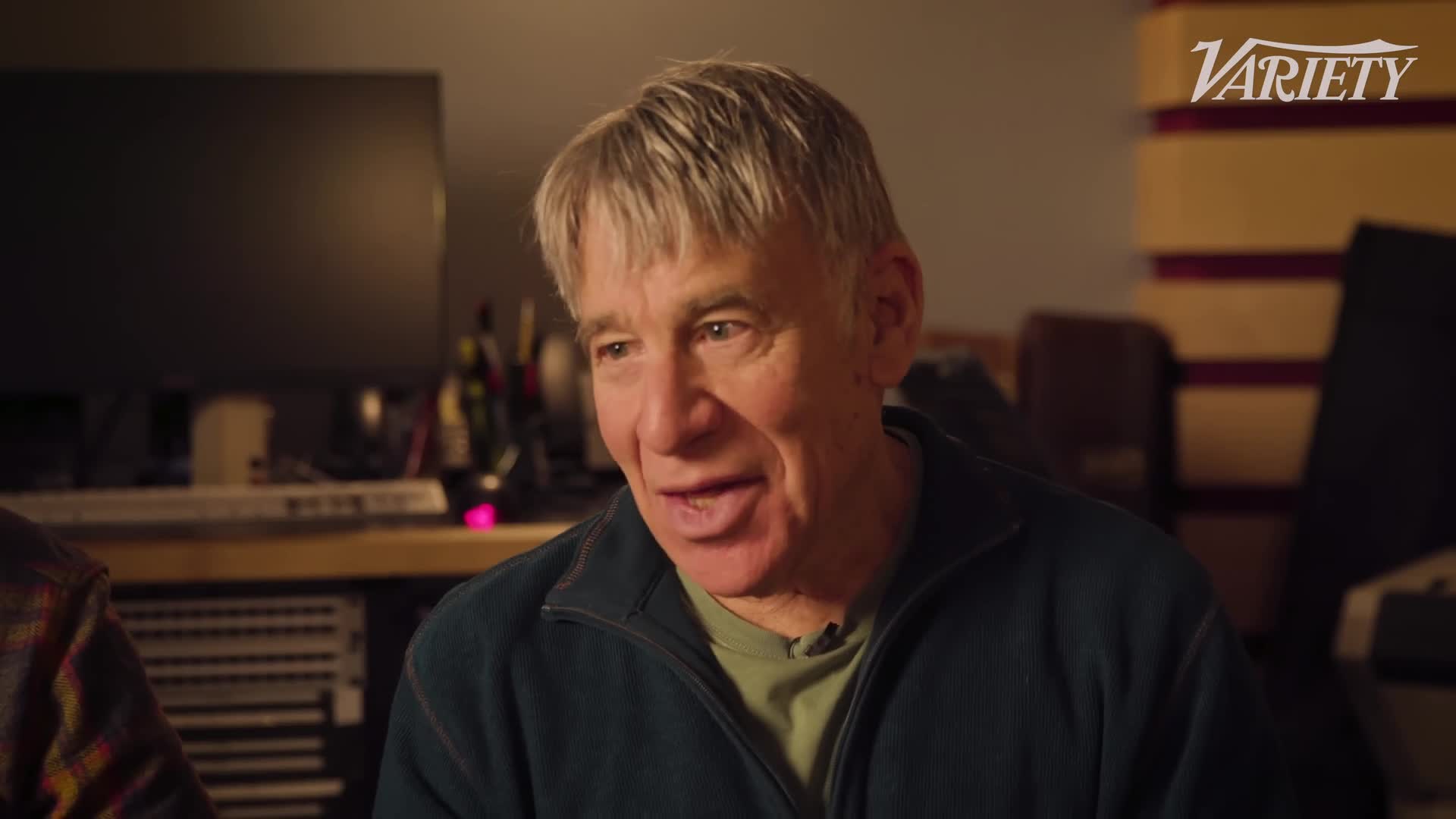
Hi, I'm Stephen Schwartz, and I am the composer and lyricist of Wicked for Good.
Hi, I'm Stephen Orimus.
I'm the executive music producer and conductor of Wicked for Good.
This is Neil Shaw, who's going to be playing things back for us on the computer.
The idea to do Girl in the Bubble didn't actually come from John.
It came as an impulse, once we knew that we were doing two movies and that the arc of Glinda's story was going to be bigger than it is in the show and events that happen offstage in the show were going to be on screen.
It seemed clear that the big turning point for the character, where she comes to the realization that she just can't go on floating above events and just being oblivious to what's going on below her.
Therefore, it needed to be sung about.
John Chu's big contribution came in this sort of brilliant way that he filmed it.
I still don't actually know how technically he did what he did and he won't tell me.
But that led to some decisions that Stephen and I and our music team made about the arrangement and the orchestration, but the actual writing of the song just preceded all of that.
The second half of Wicked on stage is much more orchestral driven.
It has a much more intense orchestral sound compared to the first half of the show.
Just the way the songs and the story and the characters evolved.
So I think that once we knew exactly where these songs were going to be, it was really about kind of finding the overall orchestral sound for how we wanted to drive the songs and how we wanted to tell the story.
No Place Like Home went through a whole journey.
Many paths.
Many paths in terms both of what content is actually going to wind up in the movie.
There was a whole intro that didn't get into the movie.
There was a whole tag that didn't get into the movie.
And that we discovered over time.
And orchestrally, what's the feel of this?
How pop is it?
We went through a bunch of different stages.
Girl in the Bubble was pretty defined from the beginning.
Really all that changed from the demo that I sent in was there was an intro that we did shoot and record and then ultimately found the song played better without it.
And there was a lyric change in one verse, but essentially the demo that I recorded is what we used.
She's the girl in the bubble.
The original idea was that this angry chant of the enraged Oz populace saying go and find the witch and hunt her down and kill her is happening outside the window.
And Glinda has witnessed this.
And of course, they're talking about her friend that she loves and she is trying to shut it out.
So I just want to say, like, this is my terrible out-of-tune voice memo that we always start with.
The raw material.
Very, very raw.
So everybody just has to forgive the bad singing.
And hunt her, and fight her, and kill her.
So this is the angry Oz populace outside, and now this is Glinda.
Don't listen, don't watch, close the door.
That was the original idea, but when we saw it on screen, first of all, it felt stagey.
It felt like the kind of thing that would work in a stage musical, but it felt contrived on screen.
Why don't we play the first verse, just so... Of you?
Yeah, I think, because then people will hear what has to be fixed by having an actual singer like Ariana Grande.
Look, there's that beautiful girl With a beautiful life.
Such a beautiful life Built of lies.
This is how I work.
I write the song in my little at my piano in my music room up in Connecticut and then I literally put my phone in front of me and play it and sing it usually a little bit flat like that because I don't have auto-tune.
No auto-tune.
And then we work from that.
When we saw the scene in the movie and saw sort of John's brilliant staging, there were moments that had more motion to them than maybe what we anticipated but certainly then were reflected in the accompaniment of the music.
So can you play that without the vocal?
It's the eighth notes on the harp we added so that there was motion.
I don't know if you can hear that that way.
Can we bring the harp up?
So that there was motion.
Originally, it was just kind of harp, not quite glisses, but sprays that supported it.
And then I'm not hearing it here, but I thought we added keyboard too.
You did, yeah.
Was that mine?
Did I add it or did you?
That was you.
Yeah.
And then I played, just to help boost the harp, eighth notes so you could feel when she's running up the stairs that there's some motion in it.
This voice memo demo.
I know because it says so on my phone.
I recorded on April 14th 2022.
Sent it in.
What I'm playing on the piano essentially gets transcribed so other people can play it.
Then I sit down with Ariana and figured the key out and figured out what felt comfortable for her.
And then we went into rehearsals for the film, for films, I should say, in September of 22.
So this was probably shot in early 23.
So it's Almost a year after the song gets written and sent in, Stevens rehearsed it with Ariana.
She prerecords it, even though We did like a rehearsal recording so that we, all you know, agreed on the shape and the overall flow of everything and make sure that it all.
Even though she sings, I guess all of it is live, right?
Because she can.
What they play on the stage on the scoring.
So what would you call the sound stage where she's shooting it?
She has an in-ear that she's singing to.
Since they're capturing vocally what she's doing live, can't have the orchestra playing on the set or even a keyboard player there.
Basically, it has to be silent except for her voice, but she's got it in her ear.
Once we saw a cut, then we were able to do our work as far as building the orchestration and building the arrangement.
Now, we had to then go back and refit the orchestration to the cut of the film.
That didn't happen until this past July, when we finally had an 85-piece orchestra in the studio.
Where we're recording this big, lush orchestration and realizing oh, now that we have actually 50 violins playing, we now are missing all of this motion and all of this extra stuff.
Ariana and Cynthia both are excellent actresses.
They're, of course, world-class singers, but they're also world-class actresses.
And so for both of them, it's the storytelling.
I think Ariana is always Glinda.
Ariana found a way to internalize that character.
Can we play that section in my demo and then play what Ariana did?
Because I think they're pretty damn close.
And blind as you try to be, eventually it's hard to unsee what you see.
Yeah.
I mean, to me, it just sounds like the character of Glinda singing what I wrote.
I don't hear sudden presence of Ariana Grande in this.
In fact there were not so much in this film, but when we recorded Popular for the first film, when we did Popular,
And we'd done a kind of slightly different rhythm track that we thought might just be interesting.
And Ariana heard it and she said, no, I don't want to do that.
I want to be much closer to the original because I don't want people to feel oh, this is Ariana Grande now playing Glinda.
I wanted to be Glinda.
So she was really conscious and very strict about- Very protective of the character.
Very protective of the character, trying very consciously not to inject her own persona into the character.
We feel you can't fight anymore.
Just tell yourself there's no place like home.
So now we're gonna pivot to talk about the other new song, No Place Like Home, which actually occurs much earlier in the movie than Girl in the Bubble, but was written later.
It was written for a sequence that does not occur in the Broadway show, which is that Elphaba discovers that the animals of Oz are escaping, just leaving Oz behind, and she tries to persuade them to stay and fight for their homeland.
It felt as if Again, that needed to be a song.
Obviously, once that storytelling idea is there, the title No Place Like Home becomes inevitable if you're writing about Oz.
I wrote a few earlier versions of it, but the version that is relatively close to what wound up in the movie was written.
It says on my phone June 20th 2022, when I sent it in
Again, me singing flat. you can't fight anymore.
That's when you tell yourself there's no place like home.
So that's the thing that I apologetically send in to everybody.
But already you can hear how it evolved.
So much more for the film as far as right, where we started playing, when Stephen started to sing.
That moment in the film for Cynthia is much more driving.
It has much more of an intensity.
So then again, it gets transcribed.
Stephen takes it.
It works with Cynthia on it and then, you know, i i think with this one it really interestingly, the discoveries came later and later for it, because we we had a version right where where the animals were singing a lot more as well.
Yeah, the animals were responding to her and singing.
She's trying to get them to sing with her.
Yeah, and that didn't make it to filming.
And don't forget, when they shot cynthia singing the song, All of those animals are computer generated.
So she was all by herself, just exuding this incredible passion and incredible drive.
It's actually extraordinary.
The brass come on the... We feel you can't fight anymore.
Just tell yourself there's no place like home.
So that's Jeff Atmagean came up with that.
I had said to him once we get into this, I feel like brass needs to come in something kind of noble and anthemic.
Originally, that was like much fuller and much louder.
But then, when we saw the picture, what's happening at that section is that there are two little bluebirds.
And we were like, well, it just can't be that big.
We thought we were going to see like a pride of, you know, tigers or something.
And then there were these two little birds.
But we still wanted the nobility of that sound.
All those orchestrational decisions get made based on what you're seeing on screen.
And of course, the cut is changing constantly.
And one element of that was at the very end where Cynthia did this cool thing where she sang all different sort of riffs on the title line.
At one point it cuts and you see the flying monkeys come in.
And so we wanted, within the orchestration, to have the the monkey theme, which is this um, kind of 16th note thing that goes this is what it was and was about to be in the movie and on the soundtrack album.
Just the strings, which is very cool and very Jeff Atmagian to use strings as a rhythm.
But now play just that with Cynthia's vocal, but not with the piano track.
We feel you can't fight anymore.
Just tell yourself there's no place like home.
It felt because Cynthia has such soul and power in this kind of low end part of her voice, it just felt well, it's a little unsupported.
It feels a little thin underneath her.
And so at the last minute when we were mixing, I remembered from my very, very original demo that kind of low end piano.
And I just ran into the studio and played a piano track along with it.
We feel you can't fight anymore.
Just tell yourself there's no place like home.
Cynthia, particularly because she's got this extraordinary vocal instrument that can do anything.
She would try different riffs in different places.
And if she'd done all of them, it would have been just ornamentation.
But then Stephen and I, with Cynthia, would select.
Okay, this one feels really organic and really feels like part of the storytelling.
Let's keep that one, but don't do this one over here.
And all those sorts of choices were made because we had such gifted artists to work with.
There's no place like home.
Also written.
We're all kind of in denial that it's over as far as finishing both films, because it was such a joyous and beautiful process for all of us.
I mean, there's like a whole wicked family that from all the people who have done the show over the years all over the world, and now it includes the people who worked on the film and it just expands and expands.
For Wicked, the musical on stage, and now Wicked, the musicals, with the two films, to become part of that ongoing legacy is an honor.