M .P .R. This is The Indicator from Planet Money.
I'm Darian Woods, and I'm here with Kate Dario, producer for the Public Radio Podcast, Outside In.
Hey, Kate. Hey, Darian.
It is great to have you.
You've been reporting on one wildlife program that has been quite controversial over the years.
COLLEEN O 'BRIEN Yes.
The U .S. Department of Agriculture oversees a budget of millions for what it calls wildlife damage management.
MALCOLM BRABANT Is that some kind of euphemism?
COLLEEN O 'BRIEN Well, some environmental groups would say so.
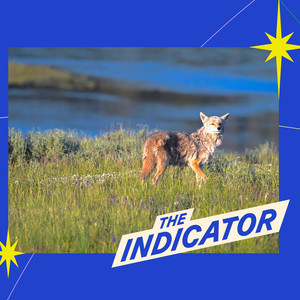
Part of this program includes the killing of coyotes every year.
They do this with rifles, cyanite, and even aerial gunning.
It's tough to say exactly how much is spent killing coyotes — the agency doesn't readily release those numbers.
But news outlets and nonprofits have estimated it that it costs anywhere from $200 to $1 ,600 per coyote.
Doing some back of the envelope math, being conservative, that means it costs taxpayers close to $17 million to kill coyotes every year.
Yeah, but here's the thing, that program may actually be increasing the number of coyotes overall.
So, today on The Indicator, why is the government spending millions of dollars on a program that is exacerbating a perceived problem and could that money be better spent.
This message comes from Charles Schwab.
When it comes to managing your wealth, Schwab gives you more choices, like full service wealth management and advice when you need it.
You can also invest on your own and trade on thinkorswim.
Visit Schwab .com to learn more.
This message comes from Greenlight.
Parents rank financial literacy as the number one most difficult life skill to teach.
With Greenlight the debit card and money app for families.
Kids learn to earn save and spend wisely.
Get started risk -free at greenlight .com slash npr.
This message comes from Charles Schwab when it comes to managing your wealth Schwab gives you more choices like full service wealth management and advice when you need it.
You can also invest on your own and trade on think or swim.
Visit Schwab .com to learn more.
This message comes from Amazon Business.
With smart business buying, get everything you need to grow in one familiar place, from office supplies to IT essentials and maintenance tools.
Ready to bring your visions to life?
Learn how at amazonbusiness .com.
So it is important to note that coyotes are indigenous to North America.
They emerged as a distinct species in the American Southwest and Great Plains about a million years ago.
And along the way, they have developed a batch of traits that have made them super scrappy.
You'll often hear people say something along the lines of, when the world ends, all that will be left is roaches, rats and coyotes.
Christine Wilkinson is a carnivore ecologist based in the Bay Area in California.
She says she feels empathy for these misunderstood creatures.
I can more easily relate not just to my study animals, who face all sorts of issues, but But also to the different communities and types of people that I work with.
Christine says, unlike wolves and other predators, coyotes have a big evolutionary advantage.
They're not picky. Coyotes are generalists.
They're very flexible in their diets.
They're omnivorous.
They're also behaviorally and socially flexible.
They can hunt either at night or during the day, which makes it easier for them to adapt to diverse environments.
And they have some unique reproductive tricks that make trying to kill them off likely to bite you in the butt, as Christine puts it.
First, there's evidence coyotes will demonstrate what is termed compensatory reproduction when under attack.
What that means is their litter sizes will increase to make up for the coyotes being killed off and you'll see younger coyotes breeding earlier.
We call this offsetting behavior in economics and that basically means when somebody changes their behavior in response to a policy meant to limit risk.
Like riding your bike more dangerously than you normally would when you're wearing a helmet.
it?" For coyotes, that means breeding more when they're being hunted.
And I'll throw in some Latin here too.
Coyotes know something ancient classical philosophers knew well.
Orduvacui? Excuse my pronunciation.
I would have no idea.
Well, it means roughly nature abhors a vacuum.
If a niche opens up where that breeding pair has been killed off, then another breeding pair can emerge really easily, or new coyotes can move into the area very easily.
So normally within just a few years you'll have the same number of coyotes in your backyard, or maybe even more.
Plus there's evidence that coyotes become more aggressive after an extermination event leading to more conflict which can be fueled by coyotes trying to feed their now larger litters.
All of this means the westward expansion in the 19th and 20th centuries actually helped coyotes expand their territory.
Farmers and ranchers brought livestock like cows, chickens, sheep, and pigs.
Easy snacks for predators.
And ranchers were soon concerned about their animals being attacked.
At first, wolves were seen as the primary culprits, but then coyotes.
This is when you see the origins of today's Wildlife Services Program.
Its predecessor was called the U .S.
Biological Survey. And its primary goal was science, cataloging the country's wildlife.
But historically, Congress was sometimes skeptical about funding pure scientific research, so the Little Agency pivoted.
So the biological survey, primarily to get regular funding, advocates that it's the solution to the so -called predator problem in America.
That's Dan Flores, an environmental historian and author of the book Coyote America.
He says the biological survey was really good at killing wolves.
Between about 1910 and 1925, the biological survey essentially wipes out wolves in North America.
And so the biological survey realizes, okay, we've got to have another animal that we can promote as a real threat to America.
America, and that's when they come up with the idea that the coyote is the arch -predator of the 20th century.
That pitch worked and nearly $10 million was allotted in the 1930s to eradicate coyotes and other species.
Poison ore traps are the more usual way of killing coyotes.
There's one now. But we now know because of compensatory reproduction and ourovacui, this didn't work.
And there's a third biological trade -up play here.
coyotes are considered a fission fusion species.
They can work together, i .e.
Fuze, when it benefits them all or separate, that's the fission part.
When environmental conditions make that more advantageous.
In other words, they can be solitary or social, depending on whichever behavior benefits them at a given time.
All of these factors explain how coyotes ended up just about everywhere in the lower 48.
Intriguingly enough, our attempts in the American west, which was the coyotes' original range, change, to try to control their populations, resulted in spreading them across the continent as they went into fishing mode.
So instead of exterminating coyotes, the federal government has helped triple their range over the past 150 years.
They can now be found in just about every corner of this country, from the plains of Montana, to the suburbs of Atlanta, to even downtown Manhattan.
Yeah, I've seen on social media posts of coyotes in Central Park.
I was pretty surprised.
They're very cosmopolitan.
They seem to be. And they've been reported grabbing small pets and even on the rare occasions nipping people.
Wildlife services plus other state and local agencies still see killing coyotes as a solution, primarily to protect livestock.
Reports of them grabbing small pets and nipping people, those are really, really low.
But people are nervous sometimes.
And this is a debate that runs very deep for many, especially in the American sheep industry, which has been in decline for decades.
USDA data reported more than 100 ,000 sheep and lambs killed in 2019 by coyotes.
Still, research has undermined the idea that lethal management makes sheep safer.
There are studies demonstrating that non -lethal management techniques, like fencing and guard dogs, are more effective at reducing predation than just killing a bunch of coyotes.
Plus a 2006 paper found that coyotes weren't the reason for the sheep industry's shrinking size.
This paper found increasing production costs and decreasing land prices played a bigger role.
Kristine Wilkinson's solution?
We learned to live with coyotes.
We need to just accept the fact that there are coyotes and they will continue to persist.
And there are numbers that indicate we may be on the road to doing this.
Non -lethal management practices have grown in popularity in recent years.
The number of operations using non -lethal methods to protect their flocks increased by more than 140 % from 2004 to 2019 and wildlife services started receiving congressional funding to research non -lethal methods in 2020.
That said, there are a lot of changes taking place at federal agencies under the Trump administration and answers are not easy to get.
We reached out to the USDA to ask about its current budget for this program and whether they think coyote culling is still a wise use of taxpayer dollars.
They did not respond to our emails, or a courier letter.
This episode was produced and fact checked by Julia Richie and Sierra Juarez, who is engineered by James Willettz.
KACHIN Canon edits the show, and The Indicator is a production of NPR.
This message comes from Warby Parker.
What makes a great pair of glasses?
At Warby Parker it's all the invisible extras, without the extra cost, like free adjustments for life.
fifth, find your pair at WarbyParker .com or visit one of their hundreds of stores around the country.
This message comes from Mint Mobile.
Mint Mobile took what's wrong with wireless and made it right.
They offer premium wireless plans for less, and all plans include high -speed data, unlimited talk and text, and nationwide coverage.
See for yourself at MintMobile .com slash Switch.
This message comes from Warby Parker.
If you wear glasses, you know how hard it is to find the perfect pair, but step into a Warby Parker store and you'll see it doesn't have to be!
Find a Warby Parker store near you at warbyparker .com slash retail.