This message comes from the Center for U .S.
Voters Abroad Foundation.
If you're a U .S. citizen living abroad, the Center for U .S.
Voters Abroad turnout projects online form will walk you through requesting your ballot in just five minutes.
Visit internationalvoter .com.
This is Planet Money from NPR.
Keith Romer. Sally Helm.
I recently noticed something that I have never noticed before, and it is that Planet Money has a tagline.
Yes, we have had that tagline for, I'm going to say, two years now.
I missed it. Well, it's like a little description of Planet Money that you can see in Spotify or Apple or whatever.
It says, want to see a trick?
Give us any topic and we can tie it back to the economy.
Exactly. And Keith, as you and I have been discussing, that what you just said is a big promise.
A very bold, very public promise to all of our listeners.
Any topic. We said any topic we can tie to the economy.
It is like a gauntlet we have thrown to ourselves.
And Keith, you know I can't resist a gauntlet.
It's almost a character flaw.
How much you love gauntlets?
I just, I love them.
So I decided, all right, let's do it.
Let's put out a call to our listeners, get them to send us their most obscure esoteric topics so that we can try to tie those topics back to the economy.
What could go wrong?
Hello, and welcome to Planet Money.
I'm Sally Helm. And I'm Keith Romer.
Today on the show, Sally Helm tries to find the big economic lessons in some subject matters that seem very far from the economy.
And you, help me. No, I do not, Sally.
I see my role in all of this more as kind of judge and jury, and I gotta tell you, Sally, I've got the list of topics right here.
There's some doozies.
All right, gonna be fun.
Support for this podcast and the following message come from WISE, the app that makes managing your money in different currencies easy.
With WISE, you can send and spend money internationally at the mid -market exchange rate.
No guesswork and no hidden fees.
Learn more about how WISE could work for you at wise .com.
This message comes from Indiana University.
Indiana University performs breakthrough research every year, making discoveries that improve human health, combat climate change, and move society forward.
More at iu .edu slash forward.
When voters talk during an election season, we listen.
We ask questions, we follow up, and we bring you along to hear what we learned.
Get closer to the issues, the people, and your vote at the NPR Elections Hub.
Visit npr .org slash elections.
Okay, Sally, we recently put out a call to our listeners, asked them to send us their most obscure, most challenging topics, and they sent us like a hundred ideas for things they wanted to see you tie back to the economy.
A hundred is a lot.
I'm not gonna make you do all a hundred.
Thank you, because honestly, there were some kind of gimmes on the list that I did not choose.
For example, number 22 on our list, water.
Water. I could have found so many economic lessons about water, like states fighting over the Colorado River.
There have been these massive floods in central Europe.
Have you heard of farming?
Water would have been an easy one.
Yes, so I also did not choose for your challenge number 29 on our list of topics, Stradivarius.
We literally have already done an episode about this.
Today on our show, the Stradivarius.
How much of a brand is real, and how much, how much is in our heads?
That story showed us that yes, probably a lot of a brand is in our heads.
Economic lesson from Stradivarius.
But some of the topics were more difficult.
I've chosen three of them for you to tackle today.
The first one comes from Lister Paula Pawpaw Gomez, polyamory.
Polyamory. Okay, I mean, I know about it.
It's a setup where, like, instead of being in a romantic relationship with one other person, someone's in a romantic relationship with two or three or four or however many people.
Yeah, I feel like it is kind of in the zeitgeist right now.
You read a lot about it.
My financial advisor, it turns out he is polyamorous.
Oh, well, economic connection, boom, done, next.
No, not move, not done, not next.
I should not have even brought it up.
Sally, this is where you go off and find a more convincing connection between polyamory in the economy than my financial advisor.
All right, I'm on it.
Okay, so while this time passing music is playing, I'm going to tell you, the listener, how this is going to work.
I want you to imagine Sally out there for hours and hours working the phones, the Google machines, searching for the very best economic lesson embedded in the idea of polyamory.
Then, when the music stops, she will, through the magic of audio, reappear with her answer.
And I will, you know, sit in judgment and tell her whether she succeeded or failed.
I'm back. You seem changed.
You know, I've seen things, I've experienced things, I've learned, I've grown.
Well, great. What have you learned?
What have you got about polyamory?
All right, Keith. First, let me tell you about Jennifer C.
Martin, Ty Simpson and Daniel Martin.
They live in Richmond, Virginia, and they are a polyamorous trio.
A throuple. Actually, no.
Oh, we prefer V as opposed to throuple.
Yep. People assume that we're a throuple all the time, but I date Ty and I date Daniel.
Daniel and Ty don't date each other.
It's a V as in like the letter V.
Like if I'm at the bottom of the V, then the two others go out, but they don't connect like a triangle as in a throuple.
Got it. V, not a throuple.
Yet, Jennifer and Daniel were married with two kids before Ty entered the picture, and now all five of them live together.
A decision that they made, Keith, not just for emotional reasons.
A lot of it was financial.
I think, you know, that the economy was definitely a pretty big factor in like the upsides to living together that I started to think about it in a new way.
Polyamory is not just about love, Keith.
Okay, say more. Cost of living was a big factor in Jennifer and Ty and Daniel taking this relationship to this different level.
And for them, this all goes way beyond like roommates splitting the rent.
We are all entangled financially now in ways that are almost too complicated to discuss.
Me and Ty have several credit cards together, and we do the utilities together.
And so I'm on the big account with Daniel, but not Ty.
Recently, they even all bought a house together.
And Jennifer has saved up for the down payment, but it was Ty and Daniel who ended up on the mortgage.
It is so tangled up that they don't even always know exactly who is doing what anymore.
Ty and I are on a carload together as well.
Oh, you are? Are you just finding that out now?
No, I'm sorry. He's wrong.
We started it going that way, but then we flipped it.
Okay, so I can see that yes, their relationship is more about money and finances than I would have thought at first.
But still, like what's the broader economic lesson?
Great question. I thought you might ask.
So I called up Mindy Marks, an economics professor at Northeastern University who has studied like adjacent topics here.
And she said, number one, you can just back up and think about relationships generally.
There is a lot of evidence that all of our dating and marriage and relationship decisions respond to economic conditions.
Like people are more likely to co -habitate and move in quicker in expensive cities than cheap cities because the benefits of economies of scale are larger.
Or because they're so in love.
Or because there's a lot more love in New York City, also possible.
And Mindy said, look, there's not great data yet.
But Polly Amory does seem to be modestly on the rise in the United States.
And she said she can see some ways that the economy could be driving that.
It feels like you're getting warmer.
So rising costs of living, rising housing costs, obviously.
But Mindy says there could be another more subtle economic advantage to Polly Amory.
She told me, think about this particular class of jobs.
Jobs where employers really want their employees to work long hours.
Claudia Golden has done a bunch of work on this.
And it's not true for every occupation, but it basically has to do with labor market specialization.
Right. Newly minted Nobel winner Claudia Golden.
Her big idea here was basically that there are different kinds of jobs.
We've talked about this on the show before.
In some jobs you can work your eight hour shift, then someone picks up where you left off, no problem.
But that if you are, on the other hand, maybe a corporate lawyer and you're writing a super complicated legal brief, you can't just hand that over to somebody else mid sentence and let them take over.
Right. And so in those jobs, employers are willing to pay a lot for you to keep working.
70 hours, 80 hours a week.
Like some jobs in this category value extra hours so much that they will pay more to have one person work 80 hours a week than they would have two people working 40 hours a week.
And if you think about the implications of that for a traditional family unit, like two parents, kids, it can get tricky.
The economic pressures are pushing towards having one person focus in on work and one person, you know, focus in on home.
So like a couple could go into their marriage with both of them planning and wanting to work.
But then one person, most often the women winds up dropping out.
And so bringing this all back to polyamory.
If you think about adding a third person to the relationship, the calculations change.
You could be like, well, if we had a third person, then I could still go to work 40 hours, have time with my kids and then have this other person in the relationship who's also picking up the sort of missing household production.
Jennifer and Daniel and Ty are V.
They do all work and they did confirm that having three of them makes childcare a lot easier.
I'm sure you've heard the joke that, you know, monogamy in this economy.
Do you guys kind of feel like you're like, how do monogamous people do it?
I mean, a little bit.
Yeah. So there you have it, Keith.
Polyamory, it's not just about the romance.
It is all tied up with economics.
Sally, not bad. I'm going to give you a passing grade on that one.
Well done. Thank you so much.
Are you ready? Are you ready for challenge number two?
All right. Bring it.
Okay. The next term I need you to tie to the economy comes from listener Patrick Kenny.
And it is dark matter.
Dark matter. All right.
Physics. Exactly. Yes.
I'm going to need you to tie that to the economy.
All right. I'll do my best.
Cue the music that tells us the time is passing and Sally is out in the world.
Okay. Sally is pounding the pavement.
She's at the science space observatory.
Maybe she's in a rocket ship.
I don't know. I'm back.
Did you in fact go to outer space?
I did. Oh, that's great.
I didn't actually. I didn't.
Come on, Sally. Anyway, what'd you find about dark matter?
All right, Keith. Well, the first thing we have to do here is understand what dark matter is.
And a definition of it recently made the rounds on the internet.
It was from a surprising source.
NBA player Victor Wambanyama.
Seven foot four plays for the San Antonio Spurs.
He was somewhat randomly asked about dark matter in an interview.
I like this kind of questions.
Those are different.
Dark matter is is something like a mass we can't see, but we know it's there because it's got influence on gravitational pulls and, you know, the speed of gravitational orbits.
And we can't see it.
We can't observe it, but we can observe its influence.
So this is dark matter.
Very sci -fi. I did reach out to Victor Wambanyama to see if you could tell me more about dark matter.
How'd that go? Did he get back to you?
His rep got back to me, and unfortunately he declined an interview.
So I went to prominent astrophysicist Sandra Faber of UC Santa Cruz.
And I checked Wambi's definition with her.
Oh, totally correct.
Congrats to him. You don't need me.
We do actually need Sandra Keith.
And look, okay. A key thing about dark matter is that we do not observe it directly, but we can tell that there is something out there in galaxies exerting this gravitational pull.
And here is maybe one way that I can tie this back to the economy.
First, you need to know, Sandra Faber told me that without dark matter, the theory is galaxies would like fly apart.
If we took the dark matter away, galaxies would be unstable.
So dark matter is necessary to hold together the present order.
Sandra also told me dark matter is truly everywhere.
There's dark matter in my office.
There's dark matter in your office right now.
These particles, they go through ordinary matter like a knife through butter.
They just, you know, zoom right through it without leaving any trace.
So like, okay, sure, Keith, when we think of the economy, we think of the visible matter, which includes container ships, iPhones, fed chair Jerome Powell himself.
But dark matter is also always there, flowing through those container ships and iPhones and fed chairs, and it is keeping the known universe functioning.
So like, can we not argue that on some level, the entire economy only exists because of dark matter?
I mean, yes, on some level we can, but like, that's maybe too big.
It's like, matter is everywhere.
So it's the economy.
Okay, fine, fine, fine, fine, fine.
Here's another try.
I went looking for times when economists have used the term dark matter somehow within economics.
And one that struck me as interesting was on page 93 of a 163 page PowerPoint presentation from 2008.
Sally, hello. The presentation was by economist John Campbell.
He teaches at Harvard.
And he told me economists kind of have their own version of dark matter.
Economists sometimes explain phenomena in financial markets or the macro economy by reference to mysterious fears, thoughts, beliefs that may be in people's heads.
And sometimes to make their models work, economists will point to one of these invisible forces, a force that isn't terribly well defined.
So John was using dark matter as a kind of cautionary metaphor.
I think it's become a shorthand for a situation where an economist seeking to explain some phenomenon invokes a force that is measurable only through that one phenomenon.
And we should be very wary of that.
Like in this case, in this lecture, John was talking about models that tie stock prices to our fears about rare disasters.
And he's saying if you're going to invoke an invisible force like that, fear, you got to try to button it up as much as you can.
Like at the very least, go looking for its effects in multiple places.
Like how does our fear of disasters affect not just stock prices, but also maybe how much people are saving for retirement or something?
Basically, John is saying, fellow economists, be more scientific.
I mean, it sounds like this is getting into this kind of ever present anxiety for economists, like how much economics is in fact a science, they can get kind of tortured about it.
It's true because they want to be super empirical, but they are also always dealing with like fuzzy human beings and their feelings.
Which are hard to count.
Exactly. And John was very quick to say, look, economics is not a hard science in the way that physics is.
The difficulty for economists is that our theories are simply not as good as the theories in physics.
They're not as predictive, they're not as precise, they're not as universal.
We must be appropriately humble about what we can say as economists.
Okay. So in astrophysics, dark matter represents this stuff that scientists can actually quantify.
But John is using dark matter to talk about the parts of the economy that economists can't quantify.
So it's like an inverse metaphor or something?
I admit I'm not making a perfect parallel here in what I have brought you, but all right.
Okay. What about this?
So both economists and astrophysicists are trying to use these two simple words, dark matter, to draw a line around a big invisible category of things that are hard to pin down, which I think is kind of beautiful.
It's getting very 3am dorm room in here Sally.
Stick with me. So one of the valuable things that scientists can do is describe what we do know about the world.
But dark matter in astrophysics is an example of how it can also be important for us to account for things that we don't fully understand and can't see directly.
And economists need to try to do that too.
So how'd I do? I mean, did you tie dark matter to the economy?
Galaxies would fly apart, Keith.
Sally, I am going to give you a grade of complete.
You will not have to repeat the course, but do not put this on your grad school applications.
All right. I'll take it.
But you're not done.
I have one last topic.
It is my favorite. For this one, I actually called up the listener who sent in the suggestion.
His name is Karl Ford.
He lives in Washington, DC.
My challenge was to connect economics to the symbolism of the works of Hieronymus Bosch.
And why did you choose that?
Because Hieronymus Bosch is really trippy.
Oh no. Yeah. Hieronymus Bosch, famous painter from the late 1400s and early 1500s.
I asked Karl to describe Bosch's works for you.
You know how in a dream, you know, like when you're dreaming overnight, you might dream about a squirrel that talks, and then, you know, Abraham Lincoln shows up and gives you relationship advice.
You know, his paintings are like a Renaissance version of that.
Yeah. Well, thank you, Karl, for this very difficult challenge.
Oh, you're welcome.
Thanks, Karl. Um, after the break, I guess symbolism in the paintings of Hieronymus Bosch and how that connects to the economy.
I believe in you, Sally.
It's a high -stakes election year, so it's not enough to just follow along.
You need to understand what's happening, so you are fully informed come November.
Every weekday on the NPR Politics Podcast, our political reporters break down important stories and backstories from the campaign trail, so you understand why it matters to you.
Listen to the NPR Politics Podcast wherever you get your podcasts.
This election season, you can expect to hear a lot of news, some of it meaningful, much of it not.
Give the Up First Podcast 15 minutes, sometimes a little less, and we'll help you sort it out.
What's going on around the world and at home.
Three stories, 15 minutes, Up First, every day.
Listen every morning, wherever you get your podcasts.
This message comes from 60 Minutes, A Second Look.
Journey through the vast 60 Minutes archives, unearthing never -before -heard audio to give fresh perspectives on the people and events that shaped the world.
Listen to 60 Minutes, A Second Look, wherever you get your podcasts.
Are you looking for something a little different in your 2024 election coverage?
Here at the It's Been a Minute Podcast, we look at politics from a culture perspective.
We look at why name calling seems to be in, how influencers are changing the game, and how the candidate's fashion choices are redefining power dressing.
We're giving you a different way to look at the 2024 election.
Listen to It's Been a Minute from NPR.
All right, Sally Helm, your last assignment for this episode was to take the topic, symbolism in the paintings of Hieronymus Bosch and tie that to the economy.
Correct. So, as you mentioned, Hieronymus Bosch is this enigmatic painter from the late 1400s and early 1500s.
He lived and worked in Europe in what is now the Netherlands.
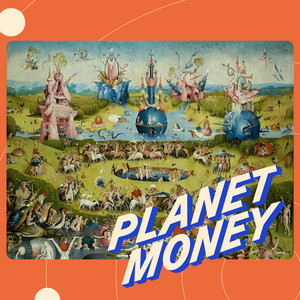
His most famous painting is called The Garden of Earthly Delights.
Yeah, I'm pulling it up right now.
Okay, so this is a triptych.
Triptych. Triptych.
Yep, triptych. Three panels.
Three panels on the left side is what I guess is the Garden of Eden.
There's a white giraffe, there's naked Adam and Eve.
Looks great. In the middle, there's a lot of, there's like a ca -billion naked people.
There's horses, there's a sort of thing with spikes sticking out of it.
And on the right side is hell, and there are naked people, but they're having a tough time.
There's an ear with a knife sticking out of it.
Good luck. Thank you so much.
So, at first glance, I would say the symbolism in this painting looks to be all about like sex and nature and religion.
There's fruit, there's cavorting, but there is some money in the painting, all in the third panel.
Hell. Oh yeah, I see.
So there's a man pooping coins into a hole.
Is that what you mean?
But that's it, as far as I can see.
Okay, well actually no.
Do you see the big tan -colored instrument kind of like in the middle of the hell panel?
Uh -huh, and there's like a nun inside of it playing a triangle.
Yeah. And do you see, if you zoom in, do you see how on top of that instrument there is a man holding a bowl with what kind of, it's like a golden bowl with what looks kind of like one coin on a string.
Oh yeah, and his eyes are blacked out, so I guess he's blind.
What's going on there?
So that instrument is called a hurdy gurdy.
It is sort of like a mechanical violin that you play by turning this crank, and I was curious about that man holding the golden bowl and the golden coin, because like it seemed like there was some money symbolism there that maybe I wasn't getting.
And luckily, I found a person who could tell me all about it.
His name is Alden Hackman, and for many years he ran a business with his wife Callie making and restoring hurdy gurdies.
We're really not doing it very much now.
We've moved on to something slightly less profitable, or more profitable.
I meant to say more profitable.
It's hard to find something that's less profitable than building hurdy gurdies, sadly, but there it is.
I mean, Sally, that sounds kind of like the opposite of an economic connection.
What are you talking about, Keith?
This is our first economic connection to Bosch, supply and demand, and the market for medieval instruments.
Demand is weak. Anyway, I was here to talk about symbolism in the paintings of the forgiveness Bosch, and because Alden is an expert in hurdy gurdies, he totally knows his painting, and he knows about that guy on top of the hurdy gurdie with the golden bowl.
Bosch placed all the musical instruments in hell, and along with them, he placed the guy who is turning the crank on the instrument, who's a beggar, and he's very thin, and he has a begging bowl.
Okay, so that's the golden bowl.
What's the deal with a golden coin hanging on the string?
Yes, so Alden said that is basically a license to beg.
These licenses were a thing in the middle ages across Europe.
Beggars were starting to exist more and more because of various forms of social upheaval, and they'd get this official license to beg for money in like a particular city or state.
So for example, communities might give them to veterans who had been injured in war.
It was essentially the medieval version of the Veterans' administration, where they said, all right, we took your leg, so now we're going to give you a living whereby you've been granted the right to beg by your lord or by the king.
And these beggars would play the hurdy gurdie as like a noisemaker to attract attention.
So we have here a story about medieval economics, where to solve this problem of war veterans and poverty, states created this regulated form of welfare, that license to beg.
All right, this is promising.
I loved that fact. But I did wonder if we could make like a bigger point here.
I mean, this is one beggar lying atop one hurdy gurdie in one Bosch painting.
So I called up an art historian, Marc Meadow at UC Santa Barbara, and he was like, oh yeah, there's money in some of Bosch's paintings, of course.
It maybe symbolizes greed.
We could talk about that.
And I was sort of racking my brain for how one gets to the economy with Bosch.
I sort of went in a different direction with this.
Marc said, okay, at the time Bosch was painting, the art market was mostly based on patronage.
Someone would commission a painting and an artist would paint it.
But then, after Bosch's death, that begins to change into something maybe more recognizable to us.
Like a market where artists are basically making paintings on spec and then hoping someone will buy them.
And one thing that they start doing in that world is making art in the style of Bosch.
That kind of immersive experience, it's almost like a kind of where's Waldo way of looking through images, is something that other artists realize was endlessly appealing to viewers.
There was a market for it, and so they began producing images like that.
And that's the chain reaction that has continued on.
Bosch was so influential that he inspired all these other artists to make Bosch -like work, starting way back, like mid -1500s -ish, and continuing to now.
A haranum economy. Keith, exactly right.
The cat up here, it's from Garden of Earthly Delights.
Keith, that is the voice of Roberto Benavidez.
He is a sculptor in Los Angeles who makes these amazing and beautiful pinatas, including many which are creatures based on the paintings of Hieronymus Bosch.
He showed me some of them on a video call.
So this is a figure from the painting as well.
He was holding up a berry to the bird, so I just switched the berry to star pinata, and it's actually piercing his hands.
So I gave it a little bit of a stigmata, so it's called stigmata pinata.
Roberto sells these pinatas for thousands of dollars.
He works full -time as an artist.
You know, I'm still using imagery from that time period and from those paintings to create an economy for myself.
So, to summarize, symbolism in the paintings of Hieronymus Bosch had an economic impact by creating a niche in the burgeoning art market of the 1500s and 1600s.
And it is in fact so powerful that it is still employing working artists in our economy today.
Sally, that was like nine connections between Hieronymus Bosch and the economy.
Thank you. Yeah, well done.
Full marks. You win.
You pass. Thank you, Keith.
And to celebrate, I give you Alden Hackman playing his hurdy gurdy.
And with that, now we are done.
Listeners, thank you for sending us these obscure topics.
Keep sending them in.
We might do this again some other time.
This episode was produced by James Snead.
It was edited by Molly Messick and fact -checked by Sierra Juarez.
Engineering by Kwesi Lee.
Alex Goldmark is Planet Money's executive producer.
Special thanks to Peter Arnotti.
I'm Sally Helm. And I'm Keith Romer.
This is NPR. Thanks for listening.
This message comes from Grammarly.
The work week can be fast -paced, and it's hard to focus on getting everything done.
93 % of professionals report that Grammarly helps them get more work done.
Download Grammarly for free at Grammarly .com slash podcast.
Once again, we find ourselves in an unprecedented election.
And with all that's happening in the lead up to the big day, a weekly podcast just won't cut it.
Get a better grasp of where we stand as a nation every weekday on the NPR Politics Podcast.
Here are seasoned reporters dig into the issues that are shaping voters' decisions and understand how the latest updates play into the bigger picture.
The NPR Politics Podcast.
Listen on Spotify.