NPR Imagine a toll booth on the US border.
There are three checkpoints.
One for people, one for goods, and one for money.
The line for people is long.
You've got visas and passports to check, fingerprints, questioning, investing.
The line for goods is a little shorter.
You've got freight containers with the odd biosecurity spot check.
Now some added tariff assholes.
But the tollbooth for money runs very swiftly.
Money comes in and out of the country with barely a glance.
We've become in a way the world's biggest tax haven.
Law professor Reuven Avionis says since the Reagan administration, the US has encouraged global money to flow freely.
But two sections tucked away in the big spending bill going through Congress could disrupt that.
A tax money immigrants send to their home countries and another measure that's been called a revenge tax.
It's a massive reversal of the position that we've taken for many many decades.
This is The Indicator for Planet Money.
I'm Adrian Ma. And I'm Darian Woods.
Today on the show, taxes on global money, sometimes called capital controls.
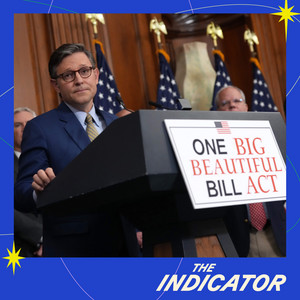
We explain the proposals and the One Big Beautiful Bill Act and we ask what this huge potential shift could mean for the U .S. economy.
It's kind of been a bipartisan position for the last 40 years.
Capital should be free to come and go in and out of the U .S. Yeah, no, definitely.
I mean, at least since the 1980s, since the Reagan administration, we've really encouraged foreign capital to to come into the United States.
Ruben Avallona is a tax law professor at the University of Michigan.
Before the One Big Beautiful Bill Act, we were really, really welcoming foreigners.
Look, we really have to say One Big Beautiful Bill Act, Adrian, whether we like it or not.
Yeah, but Ruben says that welcoming environment could change if the Senate and the president sign off on what's in the bill.
Let's start with the tax on immigrants sending money overseas, commonly known as remittances.
It would be a three and a half percent tax, or $3 .50 for every $100 that non -citizens send abroad.
Now, would that apply to people on visas or green cards?
That's unknown at this stage, but the rhetoric from the Republican -led House Committee on Ways and Means has been that it's about clawing back money from unauthorized immigrants.
This is a totally new form of tax that the United States has not tried before, and so there's a lot of details that are not clear.
So is a tax on remittances good for American citizens?
Rubin says that's hard to answer.
The increased revenue for the U .S. Government will be a plus, a small way to help stem the federal deficit.
But he thinks the whole intent is actually to discourage immigration in the first place.
And if that happened, that would reduce the amount of revenue that could be raised from remittances.
If immigration decreased, America would also lose out on that labor, the skills and the talent those people bring.
Rubin also worries about people trying to evade the taxes.
Immigrants might send cash through people physically traveling on planes instead.
Or they might use less regulated cryptocurrency platforms for example.
In my mind, the US will become similar to many other countries where crypto is a main way of avoiding government regulation and taxation for, you know, at the very least tax evasion, and that is a major reason why crypto is popular.
Crypto can be tracked, but it would be unrealistic to expect the US government to trace every small transaction.
But under this bill, the US government will enlist some help for plain old money transfers.
Collecting this tax would be up to the money transfer companies like Western Union and PayPal — though associations representing them and many other financial companies are lobbying Washington to try and get the Senate to remove the proposed levy.
A remittance tax would also harm receiving countries, like Mexico.
Last year people in the U .S. sent the equivalent of about $1 ,700 for every household in Mexico.
If immigrants in America send less money back home, that could financially harm many families in worse off places, including in some of the poorest areas on earth.
Now, turning to the second big policy in the big, beautiful spending bill is the so -called revenge tax, which applies to certain foreign countries.
Essentially it means the U .S. government would add new taxes on American dividends, and profits, rents and royalties, and some interest of these foreign investors.
Yeah, so let's explain this with an example.
Say I run a Canadian restaurant chain...
Poutine Delight? That's a good name!
So I have some Poutine Delight restaurants in the U .S. and this revenge tax would mean I have to pay an additional tax on the profits I get from selling to my U .S. customers.
It might start at 5%, and then that extra tax would go up to 10 % the next year, 15 % the year after that.
Sounds more like poutine despondent.
Yeah, not great for spreading the gospel of cheese curds and gravy on fries.
So we've talked about certain countries, right?
And here's where the revenge part comes in.
because which countries these actually are would be decided by the treasury secretary.
See, they would determine if other countries governments have been taxing US companies unfairly.
In international tax parlance, this is called discrimination.
Discrimination in the tax context means that you're treating corporations from one country worse than your own corporations or worse than corporations from different countries.
You're supposed to apply the tax law even handedly to everybody.
One example is the digital services taxes that countries like France and Canada are putting on platforms like Facebook and Google.
France and Canada tax large digital platforms 3 % of their ad and data revenue.
There are some exceptions, but the taxes do mostly affect American companies.
And so the Republican authors of this bill are thinking of a way to get back at the French and the Canadians and the other countries that have these and other kinds of taxes.
Ruben sees problems with the US fighting back, though.
That was just in Canada, the Canadians love their digital services tax.
They are very politically popular in these countries and therefore not very likely to be repealed.
Kim Clausing is a UCLA tax law professor and she was at the US Treasury under the Biden administration.
Yes, it's a very untested, unique proposal that I think risks damaging U .S. workers and U .S. businesses substantially.
The President has after all said companies from other countries should build in America.
So we're kind of pursuing isolationism with both hands, right?
We're discouraging international movements of goods, and we're also discouraging the investment that might replace that.
And as we know from looking at other countries, isolationism isn't a recipe for prosperity.
Kim says less foreign investment could mean higher interest rates.
That's because you would need those higher interest rates to convince Americans to invest more in, say, treasury bonds, not what the government wants when debt projections are going higher and higher.
There is a potential way that overseas companies could invest in the U .S. while avoiding the extra tax.
Reuven Avionis sees the so -called revenge tax as losing a lot of its bite when a company from say, Canada again, could simply start a new subsidiary in the US.
Putin delight, US. Precisely.
Different paperwork, American in name only, but they might avoid the tax.
There is one big exception though.
Banks. Which can't do that.
We called and emailed Jason Smith, the Republican chair of the House Ways and Means Committee, who helped draft the bill.
He didn't get back to us by our deadline, but at a recent panel, he described the measure as a way to deter other countries from taxing U .S. companies unfairly.
Put them in check, so that they understand that if they do that to U .S. businesses there will be consequences for their actions, hopefully it will never take effect.
Hopefully it will never take effect.
So it sounds like Jason Smith understands that if these measures are implemented they could be economically disruptive.
Yeah. Not to mention, vulnerable to legal challenge.
The U .S. already has tax treaties with these countries.
Reuven -Avionis says it's unclear whether this law could override those.
It's pretty toothless, but to the extent that it has teeth, it just invites retaliation.
And the retaliation may have stronger teeth.
So what have we achieved, exactly?
Going back to that toll booth metaphor, if the Senate and the President do pass these two policies, global money is going to start seeing a similar crackdown that people and have found recently.
But money has a funny way of being able to slip through the cracks.
This episode was produced by Cooper Cats for Kim with Engineering by Kwesi Lee.
It was fact checked by Cyril Juarez.
Kake and Kannon edits the show, and The Indicator is a production of NPR.