I'm Kevin Ruse and I'm Kacie Newton.
We're the hosts of Hard Fork, a show from the New York Times.
Kacie, you and I have covered the tech industry for like the last decade and it really feels like Silicon Valley is shifting now toward these new ideas like crypto and the metaverse and AI.
It feels like a real turning point.
We're going to talk about these stories.
We're going to bring in other journalists, newsmakers, whoever else is involved in building this future, to explain to us what's changing and why it all matters.
Listen to Hard Fork wherever you get your podcasts.
From New York Times, I'm Michael Bauboro.
This is The Daily. After engaging in a campaign of retribution against his enemies within the federal government, President Trump is now turning to those outside of it.
Today, my colleague, Mike Schmidt, on what that retribution has looked like for a single law firm and the impact that it's had on the entire legal profession.
It's Tuesday, March 18th.
Mike, welcome back to the studio.
Thank you for being here.
It's good to be back.
I want to give a little bit of context for this conversation.
Before Trump was elected, The Daily ran a series of episodes about what a second Trump term might look like, on a range of fronts.
And you guided us through how Trump might use the powers of the federal government to you turn his threats of retribution into action.
And your big finding was that we didn't have to look far to try to understand what retribution might look like in practice because Trump had already done it in his first term more than we had actually realized.
And you documented that.
And you said that it would only escalate if he were given a second term.
And I think it's fair to say so far that you were right.
Michael telling me I'm right.
You were right. Frame it.
Yeah, look, I was concentrated on how he was going to use the criminal powers of the Justice Department to go after his enemies.
But he has actually been more creative and audacious and faster, frankly, than I ever thought he'd be.
At retribution. Correct.
And what in your mind is the best example of this unexpected, inventive retribution?
The way that he has targeted in the past week or so a law firm called Perkins Cooley.
With the stroke of his pen, he was able to essentially cripple the firm's ability to represent its clients and create an existential threat for it that could put it out of business.
But in doing that, Trump has done something even bigger and greater.
He has fundamentally undermined the American legal system.
A very bold statement.
So let's tell the story of what happened to this law firm from the beginning.
Tell us about Perkins Coie and how it arrives at this existential crisis at the hands of the President.
them. In 2016, Hillary Clinton's campaign hired Perkins Cooley to be its chief outside law firm.
In many ways, this made sense, because Perkins Cooley had one of the biggest, most robust practices that focused on representing Democrats.
Right. And we should say in Washington, that's kind of how things work.
There are law firms known for doing work for Republicans.
There are law firms known for doing work for Democrats.
Correct. So what happens is during the campaign, the law firm took over paying for the work of a former British spy who was compiling a dossier on Trump's potential ties to Russia.
And by dossier, of course, you mean the dossier on Donald Trump that becomes a big factor in how we all think in that moment about Trump and Russia.
correct the salacious compilation of unverified intelligence reports that laid out potential ties between Trump his associates and Russia and the chief boogeyman in his eyes was a lawyer for Perkins Cooley who was the top lawyer on the Clinton campaign a guy named Mark Elias who had not only established himself as the top lawyer for Democrats, but had played a role in helping to fund the dossier and represent the campaign.
Controversial move by Buzzfeed last night, publishing a dossier sourced to a person who claims to be a former member of British intelligence.
So as Trump is coming into office, Buzzfeed, of course, published the entire contents of that dossier.
The dossier is everywhere.
— This is for that infamous dossier — — it's all over the news media.
— Correct. — It is widely thought to be pretty scurrilous.
— Some pretty salacious allegations.
— This is lurid stuff.
This is all unsubstantiated.
— And let's be clear for a second, just about the dossier.
Many of the allegations in it eventually are debunked.
But for Trump, Perkins Coie's involvement in the dossier was just unforgivable.
because as he comes into office, he quickly faces this sprawling Justice Department special counsel investigation into potential ties between his campaign and Russia.
All right. And the dossier had nothing to do with why that investigation was opened.
But Trump is able to conflate all of this and blames the dossier, and by extension, Mark Elias and Perkins Cooley for the investigation.
Got it. Dossier, do you hear about the dossier?
It was paid for by crooked Hillary Clinton.
He sees this or at least he makes it out to be...
I call it the Russian hoax.
...all part of a larger deep state conspiracy.
They lost the election and they didn't know what happened.
And they needed an excuse, so they said, Russia.
He says big law, Democrats, and the media have come together to unfairly tarnish him and delegitimize his election victory and, by extension, his presidency.
These are sick people, and there has to be accountability because it's all lies, and they know it's lies.
Eventually Trump does get the Justice Department to investigate whether there was this conspiracy and a range of different things are looked at, including Perkins Cooy's role.
And ultimately, that investigation results in a Perkins Cooy partner being indicted for misleading the FBI during the 2016 campaign about Trump's potential ties to Russia.
And that partner goes on trial, but is acquitted.
So the efforts to use the criminal powers of the Justice Department to go after Perkins Coie ultimately fall flat.
So Trump is able to put this firm under some pretty intense legal scrutiny, but it doesn't deliver for him the victory over Perkins Coie that he clearly cranes.
Correct. But his tangling and fighting with Perkins Coie is not over.
He loses the 2020 election and he's going around the country trying to overturn the results.
At many of the important junctures where Trump's lawyers go into court to try to have the results thrown out, those Those lawyers find themselves on the other side of Mark Elias.
Oh wow. And Mark Elias and his practice at Perkins Coie just kicked Trump's butt.
They win pretty much all of these court battles.
They are celebrated by Democrats as a bulwark against Trump.
Mr. Mark Elias joins us now live.
Mr. Elias, thank you very much for being here, I really appreciate you taking the time.
— And by this point, Elias is all over the place as one of Trump's loudest critics.
— The fact is, Republicans didn't find really any fraud, because there wasn't much of any fraud.
— He essentially becomes synonymous with the democratic resistance to Trump.
— The lawsuits that were filed, one after another after another, were just, you know, surreal.
They were not grounded, in fact, but they also weren't grounded in law.
And so for Trump, there's no bigger foe or offender in terms of lawyers or law firms than Mark Elias and Perkins Coie.
And yet what can you do about it?
Well, when he's out of office, Trump tries to sue Perkins Coie.
And his lawyers tried to make the argument again that Perkins Coie was somehow responsible for the investigation into the ties between his campaign and Russia.
Which, as you've said, it was not.
Correct. And the lawsuit falls apart and it's thrown out.
So once again, Trump cannot knock this firm down.
Not for one of trying.
He just keeps failing.
Correct. And look, for Perkins Coie, this certainly was not a fun endeavor to be the target of Trump's ire.
there, but they appear to breathe a sigh of relief and then it gets even sort of better for them.
Mark Elias actually leaves Perkins Coie.
So if you're Perkins Coie, you have survived the scrutiny and you've gotten rid of the lawyer who Trump hates the most. But then Trump wins reelection.
And it doesn't matter to Trump that Mark Elias is gone.
He still wants revenge, and just weeks into office, Trump goes after Perkins Cooley in a way that I did not think he was capable of.
We'll be right back.
I'm Jetson Jones, I'm a reporter and meteorologist at the New York Times.
For about two decades I've been covering extreme weather, which is getting worse because of climate change and it's becoming more important to get timely and accurate weather information.
That's why we send these customized newsletters letting you know up to three days in advance about extreme weather that could impact you or a place you care about.
At The Times, you can be confident that everything we publish is based off of the most accurate scientific and vetted information available to us, because we want you to be able to make real -time decisions about how to go about your life.
This is the kind of work that makes subscribing to The New York Times so valuable.
And it's how you can support fact -based, independent journalism.
So if you'd like to subscribe, go to nytimes .com slash subscribe.
So, Mike, once Trump returns to the White House, how does he go after Perkins Coie in a way that as you just said, seemed unfathomable to you until he did it.
I told you that Perkins Cooley did a lot of work for Democrats.
Mm -hmm. But a major portion of the firm's day -to -day work is representing companies and contractors that have business or problems with the federal government.
That's kind of their bread and butter way of making money.
Got it. And to do that, and I know this may sound a little basic, you have to interact with the federal government.
You have to talk to the federal government.
You have to go into the federal government to represent your client.
Will, could you come over?
Yes, sir. I'm going to send some Executive Orders.
Keeping that in mind, Trump less than two weeks ago in the Oval Office.
Sir, your administration has made it a priority both to end lawfare and the weaponization of government, and also to hold those who have engaged in lawfare accountable.
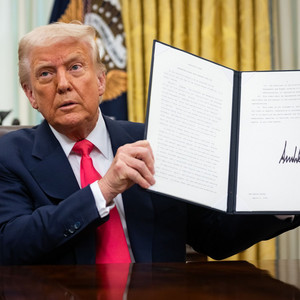
Signs an executive order.
One of the law firms that has been involved in that is called Perkins Coie.
That's also a law firm.
That essentially bars Perkins Coie, specifically the firm itself.
And it's lawyers from entering federal buildings and essentially interacting or dealing with the federal government.
This is an absolute honor to sign.
What they've done is, it's just terrible.
Making it impossible to do the most basic function of their job, which is represent their clients before the federal government.
Correct. And it should never be allowed to happen again.
And on top of that, the executive order basically says that if you're a contractor and you have business with the government and you are represented or tied to Perkins Coie, you could lose your work with the government as well.
Basically, Trump in this executive order is putting Perkins Coie on a blacklist. Correct.
And simply your tie to Perkins Cooley means that your work for the government is majorly in question.
So what happens is that almost immediately, the firm starts to hemorrhage clients, clients that they've had for decades.
They start losing clients every single day in the aftermath of Trump signing this.
And this is an existential threat for this law firm.
So Perkins Coie itself has to go out and find a law firm so it can now fight this in court Can you just explain that because I think most people listening will assume that a law firm full of lawyers can fight its own fight Sure Perkins Coie could have gone to court and fought this themselves But because it was existential They needed to walk in the door with the best representation they could get because if they fail to stop this Yes, the firm will be toast. But what happens is, in an example of how powerful this action from Trump was, not every law firm is jumping up to represent Perkins Coie.
Because if they take on Perkins Coie, they could be the target of the next Trump executive order crippling them.
But then, something sort of remarkable happens.
In Washington, is a law firm called Williams and Connelly.
They are known as the toughest, nastiest, fiercest litigators in Washington.
They almost take pride in fighting the government.
And amid all of these questions about whether anyone is going to step up and come to the and says, we'll do it.
We'll take the risk.
Correct. So as quickly as they can, Williams and Connolly file suit against the Trump administration, asking a federal judge to jump in and stop the executive order.
And there's a hearing before a judge in which Williams and Connolly faces off against the Justice Department.
A Williamson Connelly lawyer lays out how what Trump has done is unconstitutional, unfair, and will destroy Perkins Coie.
The Justice Department argues that the President of the United States has great leeway to do whatever he wants in this area and sees Perkins Coie as a potential national security threat.
How can it justify that claim?
That this firm, because of its role in the 2016 campaign and creating this unfair cloud around Trump's ties to Russia, is a threat to the country.
This law firm is dangerous.
Correct. And cannot be trusted to do business with the federal government.
And how does the judge roll?
She says it sends a chill down her spine, it is chilling to the legal profession, and And she issues a temporary restraining order, essentially barring major portions of the executive order from being enforced.
Basically, she hands Perkins Coie a victory against President Trump.
Correct, in the judicial sense.
But the damage has probably already been done to Perkins Coie.
If you're one of Perkins Coie's clients, you know that this firm has a target on its back.
Even if the Supreme Court someday says, no, Donald Trump, you did not have the power to do that to Perkins Coie.
Will it still have its clients?
Will the clients still have hung around for this?
Right, by the time the courts sort this all out, Perkins Coie may effectively be gone.
And that's kind of the point for Trump, and what is so ultimately powerful about what he has done here.
Yes, he's achieved an extraordinary level of retribution against this one firm, but by making an example out of Perkins Coie, he's done much more than that, because he has told the entire community of big law firms in the country that what happened to Perkins Cooey is exactly what awaits them if they cross him or if they upset him and what awaits them, if they take that risk, is destruction.
And that is an attack on the American justice system because in our country, the way that the legal system has taken hold over the past two and a half centuries is the idea that everyone is entitled to a vigorous defense, to a lawyer who is going to do everything and their power within the law and ethical guidelines to defend them.
So what happens when, if you're a lawyer, you're afraid to represent different parties that are potentially on the other side of the government, that the government is going after?
And what does that mean for those people who are potential targets of the government?
Whether they work at USAID and they've been fired, whether they are an inspector general who was just let go without Congress's approval, theoretically in violation of the constitution.
Whether you're a billion dollar grant being held up by this president even though it's been approved by Congress, all those people, all those entities in theory are out there looking for lawyers to sue the Trump administration.
Or if you're one of the people that we've talked about on the show who Trump would like to have criminally prosecuted, if you're Liz Cheney or James Comey or Adam Schiff.
What does that mean to them when the government comes for them and they need to find lawyers?
And beyond all of that, the reason I think this really matters is because of the current makeup of Washington.
You have a president who is using power in ways that we have never seen before.
You have Republicans on Capitol Hill who have no interest in standing up to him.
Democrats seem to have no ability to stop him.
A cabinet full of people who were appointed because they have no desire to stop him.
So that leaves the courts.
But for the courts to hold Trump accountable, to stop Trump, they need for people to bring lawsuits in matters before them.
And the people best equipped to do that are the big law firms in Washington.
But if those firms are afraid that if they enter that fight, they can lose all of their business.
Trump is then essentially taking one of his biggest adversaries off the playing field.
Right, essentially intimidating.
One of the last, maybe the last, check and balance against his power in this moment.
There are other lawyers who can bring these matters and that are skilled.
But the ones with the most horsepower are potentially being sidelined.
I've been reporting on this for the past week and a half, and I've learned that the leaders of these law firms have gone back and forth with each other about what to do.
Should they file a friend of the court brief, should they put out a joint statement?
And despite all of those discussions, they are yet to take any collective action.
So just to some real degree, that they are intimidated, that they are scared that what What he's doing is working.
Privately they will all tell me how horrific they think this is, but publicly they're saying very little.
Oh Mike, thank you very much. Thanks for having me.
Over the past few days, President Trump expanded his attack on the legal industry by issuing a new executive order that bars another major law firm, Paul Weis, from interacting with the federal government.
In the order, Trump singled out a former Paul Weis lawyer who had worked on a criminal case against him, calling the lawyer, quote, unethical.
Like Perkins Coie, Paul Weiss is expected to sue the administration to block the order.
We'll be right back.
Here's what else you need to know today.
Israeli forces have launched large -scale aerial attacks across the Gaza Strip — the first major strikes on the territory since Israel's ceasefire with Hamas began roughly two months ago.
Gaza's Health Ministry said that more than 400 people had been killed in the strikes, which raised the prospect of a return to all -out war.
And flight data reviewed by The New York Times suggests that the Trump administration ignored a ruling from a federal judge to turn around planes carrying 200 migrants to El Salvador and returned them to U .S. soil.
The flight data showed that none of the planes in question landed in El Salvador before the judges' order, and that one of them did not even leave American soil until after the judges' written order was posted online.
During a court hearing on Monday, a lawyer for the Trump administration denied that the White House had violated the judges' ruling.
Stonewalled when the judge asked for detailed information about the flights and their timing, and said that the administration was not bound by the judge's oral directive to turn the planes around.
In response, the judge called that claim, quote, a heck of a stretch. Today's episode was produced by Will Reed, Mary Wilson and Claire Tennisgeder.
It was edited by Rachel Koester contains original music by Dan Powell and Pat Mcgusker and was engineered by Chris Wood.
Our theme music is by Jim Brunberg and Ben Lamferg of Wonder Lake.
That's it for the Daily.
I'm Michael Boborro.
See you tomorrow.