NPR. This is The Indicator from Planet Money.
I'm Waylon Wong. And fresh from Portugal, I am joined by producer and reporter Ajwa Jimabrempong.
Hi, Waylon. Hello. And you are here to talk about something that's all over my feeds right now.
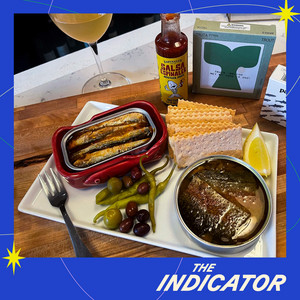
Sardines. Happy Sardine Girl Summer to all who celebrate.
Oh, I am celebrating.
I've been celebrating.
I'll never stop celebrating.
But why are there tinned fish prints on literally everything from, you know, dishware at Target to viral handbags?
I feel like there's probably a lot of reasons, like it's cheap protein in the age of macros and also recession indicators.
Plus, like there's good packaging design.
And I think just like after years of being told that they were stinky and gross, Americans are finally vibing again.
end. They're realizing how delicious sardines are over rice or on toast. I have a Trader Joe's tote bag that literally the print on it is a recipe for sardine toast. I love this for you.
And you know, I'm not the only one out there who is enjoying all of this tinned fish.
The canned fish market is on the rise.
Last year was more than a $30 billion industry globally.
But when I When I think of fancy tinfish, I really do think of European sardines.
Which is understandable, but we used to have a thriving domestic tinfish market, too.
And like a lot of U .S. manufacturing, honestly, that's been lost, bringing it back will be a bit of a lift. But there are some producers who are betting sardines are here to stay.
So today on the show, what it takes to resurrect a lost industry and the American canners giving it a try.
This message comes from Dell Technologies.
Supercharge your studies during Dell's Back to School event with AI PCs starting at $749 .99.
Like the Dell 14 Plus featuring an Intel Core Ultra processor.
Shop now at dell .com slash deals.
This message comes from Capital One.
Banking with Capital One helps you keep more money in your wallet with no fees or minimums on checking accounts.
accounts. What's in your wallet?
Terms apply. See CapitalOne .com slash bank for details.
CapitalOneNA member FDIC.
This message comes from NPR sponsor Holiday Inn by IHG.
It's a new day for a new stay at Holiday Inn for business travelers.
With modern spaces for meeting and working, plus delicious dining from breakfast to happy hour and dinner, you have everything you need to get work done.
Give your everyday business travel an upgrade.
Great. Book your next business trip at Holiday Inn by IHG.
Visit HolidayInn .com to book your stay.
The American fishing industry has some real regional titans.
You've got New England for its oysters, the Pacific Northwest for its salmon. Michigan probably doesn't spring to mind.
What I would say to someone, of course, is never underestimate the underdog.
That's Marissa Fellows.
She's the founder of Great Lakes Tinned Fish, headquartered in Grand Rapids, Michigan.
One day in 2017, she found herself in a relatable situation for me personally having an awkward moment at a bar in downtown boston i was actually on a date so she's looking at the menu i remember seeing an extensive wine list like you would expect you see all the different regions where the wine is from but having tinned fish appear in that same way it was just right in front of my face that oh my gosh there's all of these imports from portugal and spain and scandinavia it was just staring up at at me so vividly saying, why don't we have this in the Great Lakes?
She couldn't stop thinking about it.
I like to say the idea stuck, the date didn't.
But you know what? Plenty of fish in the sea, Marissa.
And in 2024, she launched Great Lakes tinned fish.
But she quickly ran into one big reason why the region didn't have a slate of fancy cans.
There is no fish cannery in Michigan.
again. Aside from the Pacific Northwest, most states in America don't have fish canneries anymore.
But that wasn't always the case.
Sardines used to be big in America.
They were immortalized in John Steinbeck's cannery row.
Monterey, California, was known as the sardine capital of the world.
At its peak in the 1940s, it produced more than 10 million cans a year.
But by the 1960s, demand started falling, helped along by big tuna.
Big tuna? Are you talking chicken of the sea?
Chicken of the sea.
Star -kissed. Star -kissed, taking down sardines.
Basically, sardine populations weren't as stable, so canneries needed something, some sort of fish to go in those tins.
And tuna, like, stepped in, and sardines got demonized as too stinky, too fishy.
Over the next few decades, canneries shuttered.
America's last sardine cannery, Stinson Seafood, closed its doors in 2010.
That was in Prospect Harbor, Maine.
So it's kind of fitting that the newest business to seize the means of canning production is also in New England.
I often joke that there hasn't been a new cannery in the Northeast for 85 years, and that's probably for good reason.
That's Christopher Sherman.
He's the president of Island Creek Oysters, which opened a cannery in New Bedford, Massachusetts, a couple of years ago.
Christopher says canning fish helps address a seasonal mismatch between supply and demand.
In the U .S. in particular, everyone wants to eat seafood in the summertime.
time. So demand goes way up when patios open at restaurants and starting in late May, early June every year, things really take off.
But cute rooftop season doesn't necessarily line up with the best time to actually harvest fish.
A lot of production happens in the fall here in New England because everything, whether it's farmed, whether it's a shellfish or a fin fish, it's either thinking about hibernating for the winter and building up fat stores to do that, or it's thinking about migrating and doing the same thing.
A fun fact, oysters hibernate.
How does like an oyster hibernating look different than an oyster not hibernating is what I want to know.
Apparently they like put on some fat and then they stop filtering water and Island Creek just keeps them, They have like a sub -basement that they put them in.
A sub -basement? I know I do oysters at such rich interior lives.
Truly. So all of the seafood here in New England is gathering in mass in the fall and is really at its peak abundance, peak quality, and right when kids go back to school in the fall is when we see demand kind of slump.
Christopher says this means canneries can capture fish at their peak for a good price and then consumers can enjoy it year -round.
But one of the biggest barriers for canneries to get up and running in the U .S. again is infrastructure.
In the U .S., you have essentially the tuna can, a soup can, or like what we call the cat food can, the smaller round, and that's kind of all the canning that happens here.
So we wanted to do the European formats.
So that's kind of like the classic sardine can shape.
Think like the mouse bed in Tom and Jerry.
And so in order to do that, we need to get all of the equipment for canning it, and the cans themselves from Europe.
Now, the fish canning process itself is not rocket science.
Christopher says it's basically 150 -year -old technology.
Essentially what happens is the product gets brought in, and if it's fish, it gets cut.
If it's shellfish, it gets shucked.
It then gets par -cooked in some way, so it can be smoked, it can be steamed, it can go on the grill, kind of any kind of quick cooking process to just firm up the texture and add some flavor and kind of get it into a state where it's more easily canned.
That's where the equipment starts to matter.
Facilities tend to be specialized for specific seafood in order to facilitate processing.
That requires a can seamer, specialized saws, microscopes to test the seal, a massive steam cooker called a retort.
And remember, this is all European equipment, so it also has to be adapted to U .S. measurements and voltage.
heritage we're trying to do the thing which is to manufacture this product here in the united states and very few other people are doing it but it's a challenge they're happy to take on and over in michigan marissa is doing her part to change hearts minds and palates i think there's still at least in the midwest a really big education gap when it comes to tinned fish you even get the occasional person kind of sticking up their nose like ew that's cat food In response, her pitch is simple.
Just try it. Try it.
You're going to love it.
You're going to taste right away that this is something that you would want to eat all on its own.
You do not need to put even a hint of mayonnaise in this to make it edible.
Along with Island Creek and a growing number of other American brands, she's trying to make sure Sardine Girl Summer doesn't end up as just a flash in the can.
Adjoa, thanks so much for bringing us this story You are very welcome, thank you for having me This episode was produced by Cooper Katz McKim and Corey Bridges It was engineered by Gilly Moon and fact -checked by Sierra Juarez.
Kicking Cannon is our editor and The Indicator is a production of NPR