N .P .R. To start a business, you need money, you need skills, you need to know suppliers and where to find customers.
And what can also be very helpful is a third space.
Yeah. A third space is a place that isn't the home and it's not the worksite.
It's somewhere where the main activity is conversation.
So that could be a bar, a park or a coffee shop.
There's been a lot of research showing how these spaces have brought communities together or even catalyzed revolutions.
New research is showing that coffee shops could be key to sparking new businesses too.
This is the indicator from Planet Money.
I'm Waylon Wong. And I'm Darian Woods.
Today on the show, fueling entrepreneurship one coffee at a time.
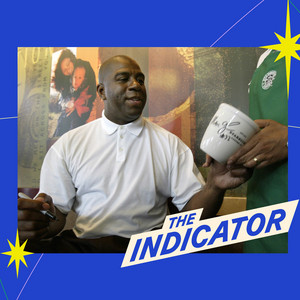
We're going to go back a few decades for the story of how Magic Johnson partnered to build Starbucks cafes in black and Latino neighborhoods and how new research has shed light on how Magic's plan changed entrepreneurship in those communities.
In 1991, basketball star Magic Johnson announced his retirement from the LA Lakers.
He had tested positive for HIV.
Months later, Los Angeles was engulfed in riots.
An amateur videographer had captured the brutal beating by police of African American man Rodney King.
It was one of the first videos of this kind to go viral.
And when police officers involved were acquitted in a much publicized trial, Los Angeles erupted.
We tore down our own community.
Latinos, African Americans, they tore down and burnt down our own businesses.
This is from an interview Magic Johnson gave to NPR in 2022.
In today's dollars, the riots cost these communities more than $2 billion.
So now we had a problem because now all these storefronts were gone, but also all these jobs were gone.
And so I said I got to do something about that.
And he did. Starting in the 1990s, Magic Johnson built a line of movie theaters around the country in black and Latino neighborhoods.
The idea was that not only would these movie theaters be vibrant places to visit, but that the construction and operations of the businesses would help bring jobs to the communities.
During this period, Magic was on the East Coast to New York and he noticed a long line of people going somewhere.
Starbucks had been on this tear expanding across the country and this was Magic's first introduction to the Seattle coffee shop company.
I said, man, I got to try this Starbucks.
Everybody waiting in line.
Magic got a security guard to grab him some peach tea.
Man, I tasted that tea.
I said, oh, that's it.
I said, this is the next thing I'm taking to the hood.
That must have been some tea.
It must have been. He didn't even try the coffee.
So Magic thought he needed to go to the Seattle headquarters.
He called Starbucks CEO Howard Schultz and met with him there.
Magic made his pitch just as he'd been doing with his movie theaters.
He could help open Starbucks and urban neighborhoods to use his parlance.
He said, look, Magic, we don't have franchisees.
I said, I'm not here to become one.
You put up half the money.
I put up half the money.
Let's build these Starbucks.
And I tell you, it's going to be a home run.
Howard Schultz wasn't fully convinced.
The company had mostly viewed minority neighborhoods as risky financial bets.
But Magic persisted.
He invited Howard to one of his movie theaters.
And sitting there, Howard started to realize that Magic Johnson really knew these majority Black and Latino communities well.
So Starbucks and Magic Johnson's company partnered 50 -50 on a new series of Starbucks.
And now the hard part comes, which is me proving to everybody that this thing could work in urban America.
In 1998, the first Magic Johnson Starbucks was open in Ledera Heights in L .A.
The line was down the block, man.
It was incredible. And sure enough, Howard looked at me and said, you called it.
You said it was going to be successful.
Harlem in New York was the second cafe.
Eventually, Magic Johnson would invest in 125 Starbucks across the country.
Okay, so he managed to get Starbucks to Ledera Heights in Harlem.
But would a few cafes really have a lasting effect on the local economies?
Could they help grow businesses or even entrepreneurship in the neighborhoods?
Jorge Guzman is a business professor at Columbia University.
He and two other academics wanted to answer this question.
For entrepreneurship to work, you need connections.
We realized there's a lot less understanding how to form those connections.
To answer this question, he investigated how many new businesses were formed after the introduction of a Starbucks to a neighborhood that previously didn't have any coffee shops.
Entrepreneurship goes up.
The average is about 6 % increase.
So here's one way to think about that 6 % increase.
A neighborhood might normally see 35 new companies a year.
The introduction of that new Starbucks, it added two extra new businesses each year.
Now, you might argue that Starbucks are just picking neighborhoods that seem to be on the rise anyway.
But Jorge gets around this.
He compares the neighborhoods that welcomed a new Starbucks with communities that blocked them.
From the Starbucks side, they must have been equally appealing if they were interested in entering both.
And that's one kind of much more precise comparison, if you see what I mean.
Another check, zooming in on just the Starbucks that Magic Johnson brought in.
Remember, those were neighborhoods that Starbucks initially didn't even want to enter.
These Magic Johnson cafes have a much larger effect.
We actually see a 29 % increase in total entrepreneurship.
Jorge says that almost 30 % is a lot of growth.
But given low numbers of businesses formed in these neighborhoods to begin with, it's not so huge that it's outside the realm of plausibility.
Now, a big elephant in the room is gentrification.
Starbucks, to some people, is the poster child of a gentrifying neighborhood when richer, often whiter residents come into a low -income neighborhood and it's changed forever.
Could Starbucks be signaling?
Gentrifiers, come here!
Jorge thinks about this issue in two ways.
First, if the neighborhood was becoming a hot new destination, he would expect growth to be especially hot in retail or real estate companies.
He doesn't see this when Starbucks enters.
We're talking anything from chiropractors to hair salons to plumbing businesses.
All kinds. And as for whether these new businesses are formed by existing residents or by newcomers who are attracted by the Starbucks, that's something Jorge doesn't know.
It's a limitation of our study because what we don't know, if the people that are starting the businesses, they were the ones that have been resting there before.
We think they are. There's a bunch of reasons to believe that that's the case, but that's kind of the type of work we are also hoping to do in the future.
Weilin, I wanted to find out whether I could see third place synergies happening in the Harlan Cafe, you know, the second ever Magic Johnson Starbucks.
And to my surprise, the seats have been taken away, the tables have been taken away.
Now it's just a place to pick up coffee and go.
I chatted with one of the baristas, Ron Dixon, as he was making coffee.
We had a redesign a couple of years ago, you know, kind of keep it a little more urban for the busy area that we're in, you know, a lot of times.
A redesign a couple of years ago, like a lot of Starbucks, corporate strategy in recent years has emphasized pickup only.
It's convenient, but if Jorge's research suggests anything, that could be at the expense of neighborhood entrepreneurship.
This summer, Starbucks CEO Lakshman Narasimhan was ousted following disappointing earnings.
The new CEO, Brian Nichol, wrote a letter to staff.
In it, he committed to reestablishing Starbucks as the community coffee house and to ensure the cafes will be inviting places to linger.
Oh, do you think he read Jorge's paper?
I hope so, especially if they want to fuel entrepreneurship for the neighborhoods.
Do you think he read it standing up while picking up his coffee at a to -go only Starbucks and was like, ah, we need a place to sit down.
You know what? Some people were chatting over the rubbish bins.
Wow, just the third place of our dreams, a trash can.
Yeah, the third place.
Look, I mean, it's convenient for when you finish your coffee, but it's not quite the same.
We all preserve our fed spaces in the face of adversity.
We all fight them in the trash cans.
We all fight them in the alleyways.
This episode was produced by Angel Correras with engineering by Valentino Rodríguez Sanchez.
It was fact -checked by Ciar Juarez.
Kate Kincannon edits the show and the indicators of production of NPR.
The story of our future is the story of our future.