Hi, Rebecca Shear here. Before we get to our story, exciting news.
Circle Round is going back on tour. with live recordings across the united states our first stop Sunday, October 5th in Parker, Colorado at the Pace Center.
And Circle Round Club members are invited to a special post-show meet and greet with me and composer Eric Shimalonis.
Get your tickets at wbur.org slash circle around and click on events.
We're announcing more tour stops soon, so stay tuned.
We look forward to circling around with you live.
Produced by the iLab at WBUR Boston. When you need advice.
What kind of advisor do you turn to? Someone who's honest, trustworthy, supportive?
In today's story, we'll meet an advisor who is none of those things.
And the person he's advising, a wealthy, powerful sultan, has no idea.
Woo-hoo! . . . I'm Rebecca Sheer, and welcome to Circle Round, where storytime happens all the time.
Today our story is called The Sultan's Figs.
Versions of this tale originally come from North Africa and the Middle East.
Some really great people came together to bring you our adaptation of this folktale, including Shahzad Latif and Anthony Rapp.
Two stars you grown-ups might recognize from Star Trek Discovery on CBS All Access.
So circle around, everyone, for The Sultan's Figs.
There once was a sultan with a fondness For figs.
That's right. Figs. Oh, is there anything quite like a ripe fig?
So plump and sweet and juicy. Mm-mm. But here's the thing about figs.
In the Sultan's part of the world, figs only ripened once a year in the summertime.
So all through the fall, winter, and spring, The great ruler counted the days, hours, minutes, and seconds until he could once again gobble up the luscious succulent fruit.
One afternoon in the cold of winter, the Sultan's guards were riding through the countryside when they came across a tiny ramshackle hut with a fenced-in yard.
Peeping out over the fence were the branches of a fig tree.
And to the guard's astonishment, those branches were bursting with plump branches. ripe figs.
The guards galloped back to the palace and told the sultan what they saw.
Is it true? You've found a fig tree that's actually bearing fruit.
In the middle of winter? Return to that hut and come back with the person who lives there. and tell whoever it is to bring me some figs.
The person who lived in the tiny ramshackle hut with the fenced-in yard was a poor basket weaver.
The basket weaver was a kind, generous man who was every bit as sweet as the figs that magically grew from his tree all year long.
When the guards brought the basket weaver to the palace, the modest man pulled a plump, ripe fig from his satchel. and presented it to the sultan on his throne.
I hope my humble fruit is to your liking, your highness.
The sultan took the fig and gazed at it with hungry eyes.
Then he popped the entire thing into his mouth.
Oh, my good fellow. This fig is delicious.
Delectable. The best I've ever tasted. Surely you have some more?
The basket weaver blushed. Actually, your majesty, I only brought one.
You see, I may be a poor peasant who doesn't have much, but...
I'm always meeting people who have even less than I do.
Hungry, weary beggars often wander the countryside and come knocking at my door asking for food.
All I can give them is one of my baskets loaded up with figs from my tree.
With all due respect, Your Excellency, I need to save my fruit for the people who truly need it.
The sultan was disappointed to receive just one fig.
But he was impressed by the basket weaver's selfless generosity.
I tell you what, my friend. In exchange for the beautiful fig you brought me today, I will send you home with a reward.
Ali! The Sultan snapped his fingers, and his highest-ranking advisor came scurrying over.
Yes, your majesty. Please go to the royal treasury and fetch this gentleman one bag of gold.
Then bring it back here to the throne room.
Ali could hardly believe his ears. The sultan wanted to give the basket weaver an entire bag of gold?
For just one silly little fake? Forgive me if I'm speaking out of turn, Your Highness.
As your chief advisor, I'm always happy to carry out your royal bidding.
But surely a great leader like yourself deserves more than just one fig.
This gentleman here has an entire tree full of figs.
Why be satisfied with just one? The sultan scratched his chin.
Then he gave the basket weaver a nod. Ali is right.
My friend, I wish to taste more of your figs. but I don't wish to be selfish.
So please, Come back to the palace tomorrow and bring me just one more fig.
In exchange, I'll send you home with one more bag of gold.
Come back the next day with just one more fig, and I'll send you home with one more bag of gold. will continue on that way every single day until summer comes. and the fig trees in my royal orchard start to bear their own fruit.
Ali, get this fellow his bag of gold. Ali gritted his teeth, then grumbled off to the tower that housed the royal treasury.
This is preposterous. The sultan plans on giving this shabby... peasant an entire bag of gold every single day until the summer?
You know who deserves a bag of gold every single day.
An upstanding, hardworking advisor like myself.
That's who, not some random country bumpkin.
But Ali did as the sultan requested. He fetched one bag of gold from the royal treasury, then handed it to the basket weaver.
Here you go. The next day, as promised, the basket weaver brought the sultan one more fig.
And, as promised, Ali handed him one more bag of gold.
Here you go. The next day, the basket weaver brought the salt and one more fig.
And again, Ali handed him one more bag of gold.
Here you are. As time went on, the basket weaver was no longer a poor peasant.
He was a rich gentleman. He was also very friendly with the Sultan.
Sometimes the sultan asked him to stay for tea and sit with him in his private dining room.
Ali burned with jealousy. Thanks to those ridiculous figs, the basket weaver is living the high life.
Not only that, but look how buddy-buddy he is with the Sultan.
How many times has the Sultan asked me to sip tea in his private dining room?
I'll tell you how many times. Zero. I must find a way to get rid of this basket weaver. to make him fall out of the Sultan's favor.
And when I do, oh! It'll be sweeter than any fig.
Much sweeter. What do you think Ali will do next?
We'll find out what happens after a quick break.
Support for Circle Round comes from Indeed.
You just realized that your business needed to hire someone yesterday.
How can you find amazing candidates fast, easy Just use Indeed.
There's no need to wait. You can speed up your hiring with Indeed. and Circle Round listeners will get a $75 sponsored job credit to get your jobs more visibility. at indeed.com slash circle round.
Just go to indeed.com slash circle round right now.
Support the show by saying you heard about Indeed on this podcast.
Indeed.com slash circle round. Terms and conditions apply.
Hiring? Indeed is all you need. mind. Welcome back to Circle Round.
I'm Rebecca Shear. Today our story is called The Sultan's Figs.
Before the break, we met a kind basket weaver who had a magic tree that produced ripe figs all year long.
The sultan was wild about figs, so he asked the basket weaver to bring him one fig in exchange for one. one bag of gold every single day until the summer, when the figs on the Sultan's own trees would be ready to eat.
The Sultan's chief advisor was an arrogant, selfish man named Eli.
And as Ellie watched the basket weaver grow richer and richer, Not to mention, friendlier and friendlier with the sultan, the advisor became greener and greener with age. envy.
So he cooked up a plan. One spring morning, as the basket weaver left the palace with yet another bag of gold, Ali came running after him.
My dear fellow, wait before you go. I must tell you how...
Thankful I am for those beautiful figs of yours.
Ever since that cold winter day when you brought the salt and one ripe fig from your tree.
His Majesty has been very pleased, very pleased indeed.
There's just one problem. Oh? The basket weaver cocked his head.
What? kind of problem. Well, His Highness couldn't bring himself to tell you in person, but...
It's your breath. My breath? The basket weaver brought his palm to his nose, breathed into it, then took a whiff.
My breath doesn't smell so bad to me. Well...
The Sultan says it's atrocious. Like a skunk.
Like old garbage. His Majesty wishes you would do something about it, but he doesn't wish to embarrass you.
The basket weaver felt his cheeks flush.
I'm afraid I'm already embarrassed. How about if I change my diet and I could start brushing my teeth more?
Oh, that definitely would help, but it wouldn't solve the problem.
I suggest that when you deliver another fig tomorrow, you tie a kerchief around your face.
Then, when you breathe out, you won't offend His Majesty's delicate nose.
So the next day, when the basket weaver returns to deliver his single fig to the sultan, He wore a linen kerchief over his nose and mouth.
Though the Sultan was perplexed, he chose not to ask any questions.
But the moment the basket weaver left the palace, the esteemed ruler pulled his chief advisor aside.
Ali, when the basket weaver came in just now, Why was he wearing a kerchief over his face?
I found it most peculiar. Ali felt his heart flutter.
His plan was working. Well, great minds must think alike, your majesty, because I was thinking the very same thing.
That kerchief was bizarre. How about if I catch up with the basket weaver and ask him what's what?
He couldn't have gotten far. So Elise scurried out of the palace as if he were about to chase after the basket weaver's carriage.
But do you think that's what he actually did?
No way! Instead, Allie dove behind a bush in the royal garden and waited.
After some time, he got up from his hiding place and returned to the Sultan's throne room. with a disturbed look on his face.
Alim! What's wrong? Did you find the basket weaver and ask him about the kerchief?
I did, your majesty. But I don't think you're going to like what he had to say.
Oh, come now. How bad could it be? Ali smiled to himself.
He couldn't believe how beautifully his plan was working out.
Well, Your Greatness, the basket weaver says he is forever honored by your generosity and your friendship.
There's just one problem. Oh? The Sultan tilted his head.
What sort of problem? Well, the poor fellow couldn't bring himself to tell you in person.
But... It's your breath. My breath? The sultan lifted his palm to his nose... exhaled through his mouth, and took a sniff.
My breath smells just fine. Like the mint tea I had after lunch.
Oh, I know that, sir. But the basket weaver insists your breath is terrible, like a farmyard, like a sewer.
He wears the kerchief over his nose and mouth so that he doesn't have to smell you.
He says without it, he would faint dead away every time you exhale.
This was the moment Ali had been waiting for.
Surely the Sultan would be so offended that he'd clench his royal fists, flare his royal nostrils, and banish the basket weaver from the palace. or from the entire empire.
But that's not what happened. Instead, The sultan was quiet for a moment.
Then, instead of flying into a rage... He smiled.
Oh, Ali. I am so glad we had this talk. Thanks to the basket weaver, now I know the truth.
Tomorrow, when that fellow returns, I will show him my gratitude with an extra special reward.
Ali was confused. "'But, your majesty, think about what the basket-weaver said about you!'
Do you really want to give him a reward?
The Sultan's eyes twinkled. Yes. I do. And trust me, Ali, it will be a reward that he will never forget.
The next morning, when the basket weaver returned with his single fig, and his white kerchief, the sultan gobbled up the fruit with more gusto than ever.
Incredible, my friend! It's your finest fig yet.
Ali was about to hand the basket weaver his usual bag of gold. when the Sultan held up his hand.
No gold today, Ali. Instead, we're going to give our friend here something extra special.
The sultan reached into his robe and pulled out a tightly rolled scroll.
It was closed with the Sultan's official seal.
He handed it to the basket weaver. After you leave my throne room, I want you to take this sealed letter to the royal treasury.
Make sure the royal treasurer opens it and reads it and then enjoy the reward. as the surprised basket weaver rushed off to the royal treasury.
Ali was more befuddled than ever. Was the Sultan actually rewarding the basket weaver with even more riches?
Well, not if he got to those riches first.
Ali dashed out of the throne room and caught up to the basket weaver.
Wait, my friend, wait. That letter the Sultan gave you, you must give it to me.
The basket weaver whirled around, scroll in hand.
Give it to you? Why? Well... Ali's mind raced.
Well... You see, given how close I am with the Sultan, I happen to know exactly what that letter says.
It's an... Order for the royal treasurer to reward you with many, many riches.
Far more riches than your usual bag of gold.
That's amazing! Yes, it is. And I'm sorry to spoil the surprise, but...
I'm just thinking about your safety. Do you really want to ride your carriage all the way home with so many precious riches on board?
What if someone tries to steal them? Listen, I will bring this letter to the royal treasury on your behalf. then I will personally deliver the Sultan's reward to your house.
The basket weaver agreed and rode his carriage back home.
Meanwhile, Ali brought the sealed scroll to the royal treasury and handed it over with trembling hands.
The royal treasurer unsealed the scroll and silently began to read.
Immediately, her eyes grew wide. She raised a finger, and two of the Sultan's burly guards came barreling over.
They grabbed Ali by the scruff of his neck and escorted him out of the building.
Hey, what's going on? What's happening?
Where's my reward? Next thing Ellie knew, the guards loaded him into the back of a carriage.
The guards steered the carriage away from the palace, across the countryside, and all the way to a desolate mountain range at the very edge of the empire.
Then they dumped Ellie onto the rocky ground and rode away.
The next morning, the basket weaver donned his linen kerchief and returned to the palace to deliver that day's fig.
When the Sultan saw the basket weaver enter the room, his royal jaw dropped.
What are you doing here, you scoundrel? I thought I wrote an order banishing you from the Empire.
Now it was the basket weaver's jaw that dropped.
"'What do you mean, your majesty?' That letter I gave you, it was an order to have you banished from the Empire.
Immediately! The royal treasurer was supposed to summon the guards and have them drive you far, far away.
And yet, here you are! The Sultan began looking around the throne room.
Where's my chief advisor? Where's Ali? Perhaps he knows what's going on.
Allie! Allie! The basket weaver shrugged.
The last time I saw Ali, Your Majesty, he was taking your letter to the royal treasury for me.
He was so worried about someone stealing all the riches I was getting that he... offered to pick them up himself, then personally deliver them to my house.
He hasn't delivered anything yet, but I know how busy he is being your chief advisor and all.
Right? The sultan didn't respond. He just stared at the basket weaver with ever widening eyes.
Anyway, I thought that was really kind of him, and...
Speaking of kind, it was also Ellie who did me the service of... finally saying something about my breath and how bad you think it is.
He even suggested I wear this kerchief, so as not to offend Your Majesty's delicate nose.'
The sultan sat frozen on his throne. Suddenly, he understood everything.
Everything. This man standing before him wasn't a scoundrel.
No, the true scoundrel was the Sultan's very own advisor, Ali.
The great ruler thought about how jealous Ali had been of the basket weaver. how much he had coveted everything the basket weaver had.
And now, the envious advisor had actually taken the basket weaver's place and been banished from the empire.
So, what else could the Sultan do but make the swap complete?
He invited the basket weaver to take Ali's place in the palace and become his new chief advisor.
And the generous, humble man provided the fig-loving sultan with years and years of very helpful advice. and very fruitful advice.
Now it's your turn. The sultan was grateful to receive the basket weaver's figs. even if it was just one fig at a time.
Then in the end... The sultan was grateful for the basket weaver himself.
What are some things or people in your life that you are grateful for?
Find a big piece of paper or poster board and start making your very own gratitude quilt.
First, get something to write with and divide the paper into as many squares as you'd like, just like on a real quilt.
Keep the paper somewhere handy in your home, then once a day Fill in a square with a picture of something or someone you are grateful for.
Once your gratitude quilt is complete, hang it in your home in a place where you'll always see it.
Anytime you're feeling blue, just sneak a glance at your gratitude quilt. and you'll remember all the things you have to be thankful for.
This week's story, The Sultan's Figs, was adapted by me, Rebecca Shear.
It was edited by Circle Round's executive producer, Catherine Brewer.
Our original music and sound design is by Eric Shimalonis.
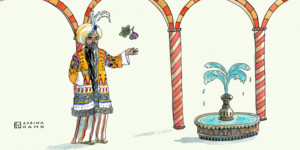
Circle Round's artist is Sabina Han. Want to color while you listen?
Sabina has made a black and white picture for every Circle Round story, and you can print them out and add your own colors.
Ask a grown-up to visit our website, wbur.org slash circleround, and click on Soundtrack and Compose. coloring pages.
Special thanks to this week's actors, Mike DelGaudio, Shahzad Latif, and Anthony Rapp.
Grownups, you can see Shahzad and Anthony on the CBS all-access show Star Trek Discovery.
You can also check out Shehzad Latif in three Netflix shows, Dark Crystal Age of Resistance, Penny Dreadful, and Toast of London.
And look for him in the upcoming indie film Falling for Figaro.
Anthony Rapp has been all over Broadway, starring in dozens of plays and musicals including Rent, You're a good man, Charlie Brown, six degrees of separation, and, if then, opposite Idina Menzel.
He's also the author of the book Without You, a memoir of love, loss, and the musical Rent.
Our featured instrument this week was the oud.
You can read about this pear-shaped, stringed instrument and see a photo on our website.
Again, that's wbur.org slash circlearound.
Never want to miss an episode of Circle Round?
Ask a grown-up to subscribe on Apple Podcasts or wherever they get their podcasts.
And please leave us some stars, write us a review or just tell your friends about the show.
Circle Round is a production of WBUR, Boston's NPR news station.
I'm Rebecca Shear. Thanks for circling around with us.
One of the best things about creating Circle Round is hearing from listeners like you.
Circle Round fans have been telling us about their favorite Circle Round stories. and we're excited to share some of their voices with you.
Hi, my name is Juliet. I'm from Carrollton, Texas.
My favorite Circle Round story is... The princess and the egg because he changes his mind so many times.
Hi, my name is Liam and I'm from Carrollton, Texas.
And my favorite story is A Taste of Honey because The master of the rubbers got stung by a bunch of bees and the other rubbers did too.
Did someone mention an episode you missed?
No problem. You can find every single Circle Round story on our website.
That's wbur.org slash circleround, or wherever you and your grown-ups get your podcasts.