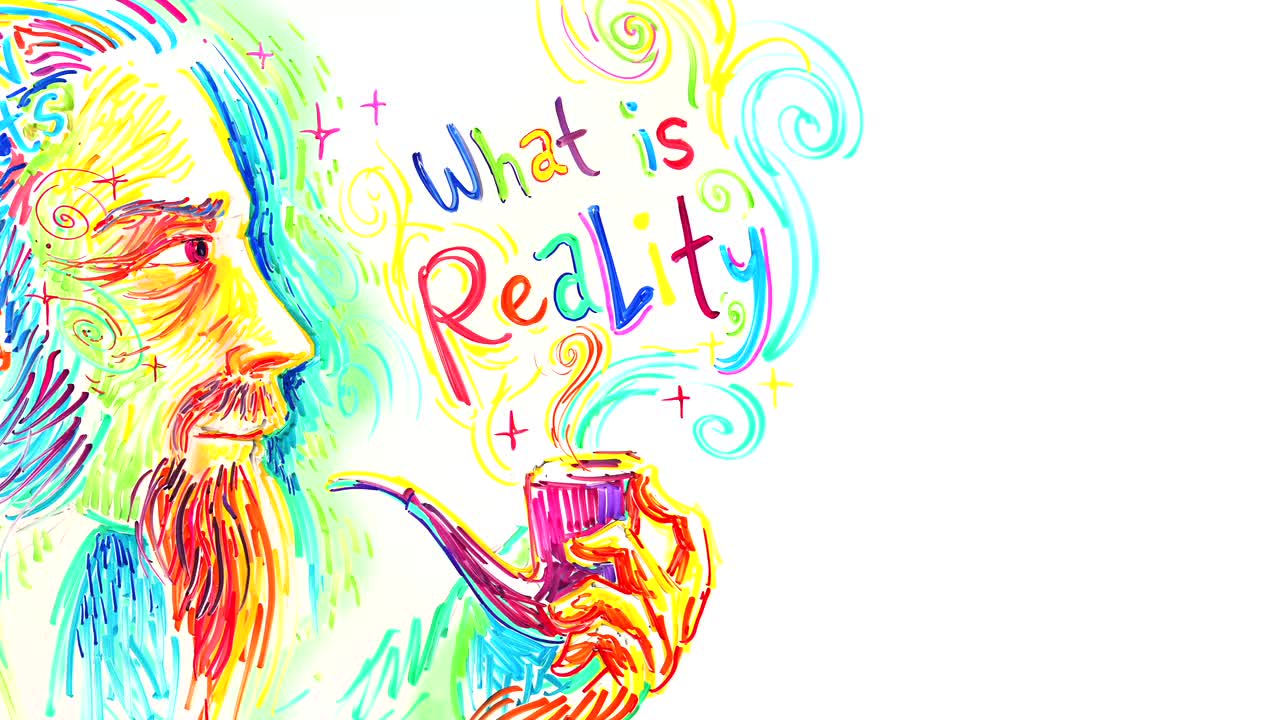
Now, the first thing though, that we have to do is to get our perspectives with some background about the basic ideas which influence our everyday common sense, our fundamental notions about what life is about.
Ideas of the world which are built into the very nature of the language we use and of our ideas of logic and of what makes sense altogether.
And these basic ideas I call myth, not using the word myth to mean simply something untrue, but to use the word myth in a more powerful sense.
A myth is an image. in terms of which we try to make sense of the world.
We have this hostility to the external world because of the superstition, the myth, the absolutely unfounded theory that you yourself exist only inside your skin.
Now, I want to propose another idea altogether.
If you think that you are only inside your skin, you define yourself as one very complicated little curlicue way out in space and way out in time.
Billions of years ago you were a big bang.
Now you're a complicated human being.
But so we define ourselves as being only that.
And then we cut ourselves off. and don't feel that we're still the Big Bang.
But you are.
Depends how you define yourself.
You are the Big Bang, the original force of the universe, coming on as whoever you are.
See, when I meet you, I see not just what you define yourself as, Mr. So-and-so, Ms.
So-and-so, Mrs. So-and-so, I see every one of you as the primordial energy of the universe coming on at me in this particular way.
I know I'm that too.
But we've learned to define ourselves as separate from it.
You and I are all as much continuous with the physical universe as a wave is continuous with the ocean.
The ocean waves and the universe peoples, And as the wave, I wave at you and say you, the world is waving at me, with you.
And saying, hi, I'm here.
But the way we feel and sense our existence being based on a myth that we are made, that we are parts, that we are things.
Our consciousness has been influenced so that each one of us does not feel that.
We feel we have been hypnotized, literally hypnotized by social convention, into feeling and sensing that we exist only inside our skins.
That we are not the original bang, but just something out on the end of it.
And therefore we are scared stiff.
My wave is going to disappear.
And I'm going to die.
And that would be awful.
You are a fluke.
You are a separate event and you run from the maternity ward to the crematorium and that's it, baby.
Now, why does anybody think that way?
There's no reason to because it isn't even scientific.
It's just a myth.
If there is any such thing at all as intelligence and love and beauty Well, you found it in other people.
In other words, it exists in us as human beings.
And as I said, if it is there in us, it is symptomatic of the scheme of things.
We are as symptomatic of the scheme of things as the apples are symptomatic of the apple tree or the rose of the rosebush.
When, as a scientist, You describe the behavior of a living organism.
You try to say what a person does.
It's the only way in which you can describe what a person is.
Describe what they do.
Then you find out that in making this description, you cannot confine yourself to what happens inside the skin.
So, if that is necessary if, in other words, in order to describe my behavior, I have to describe your behavior and the behavior of the environment, it means that we've really got one system of behavior.
That what I am involves what you are.
I don't know who I am unless I know who you are.
And you don't know who you are unless you know who I am.
In other words, we are not separate.
We and our environment and all of us and each other are interdependent systems.
We know who we are in terms of other people.
We all lock together.
And any good scientist knows that what you call the external world is as much you as your own body.
But the problem is, you see, we haven't been taught to feel that way.
The myths underlying our culture and underlying our common sense have not taught us to feel identical with the universe, but only parts of it, only in it, only confronting it aliens.
And we are, I think, quite urgently in need of coming to feel that we are the eternal universe, each one of us.
Otherwise we're going to go out of our heads.
You see, the problem is this.
We identify in our experience a differentiation between what we do and what happens to us.
We have a certain number of actions that we define as voluntary.
We feel in control of those.
And then over against that there is all those things that are involuntary.
But the dividing line between these two is very arbitrary.
Because, for example, when you move your hand, you feel that you decide whether to open it or to close it.
But then ask yourself, how do you decide?
When you decide to open your hand, do you first decide to decide?
You don't, do you?
You just decide and how do you do that?
And if you don't know how you do it, is it voluntary or involuntary?
Let's consider breathing.
You can feel that you breathe deliberately.
You can control your breath.
But when you don't think about it, it goes on.
Is it voluntary or involuntary?
And so we come to have a very arbitrary definition of self, that much of my activity which I feel I do,
And that then doesn't include breathing most of the time.
It doesn't include the heartbeats.
It doesn't include the activity of the glands.
It doesn't include digestion.
It doesn't include how you shape your bones, circulate your blood.
Do you or do you not do these things?
Now, if you get with yourself and you find out that you are all of yourself, a very strange thing happens.
You find that your body knows that you are one with the universe.
In other words, that the so-called involuntary circulation of your blood is one continuous process, with the stars shining.
If you find out that it's you who circulates your blood, you will, at the same moment, find out that you are shining the sun.
Because your physical organism is one continuous process with everything else that's going on.
Just as the waves are continuous with the ocean, your body is continuous with the total energy system of the cosmos.
And it's all you.
Only you're playing the game that you're only this bit of it.
But as I tried to explain, there are in physical reality no such things as separate events.
Doesn't it really astonish you that you are this fantastically complex thing?
And that you're doing all of this and you never had any education in how to do it?
You never learned, but you're this miracle.
Well, the point is that, from a strictly physical, scientific standpoint, this organism is a continuous energy, with everything else that's going on, and if i am my foot, i am the sun.
Only we've got this little partial view.
We've got the idea that no, i'm just something in this body, the ego.
That's a joke.
The ego is nothing other than the focus of conscious attention.
It's like a radar on a ship.
The radar on a ship is a troubleshooter.
Is there anything in the way?
And conscious attention is a designed function of the brain to scan the environment like a radar does.
And note for any trouble making changes.
But if you identify yourself with your troubleshooter, then naturally you define yourself as being in a perpetual state of anxiety.
And the moment we cease to identify with the ego and become aware that we are the whole organism, you realize that, as a first thing, how harmonious it all is, because your organism is a miracle of harmony, all this thing functioning together, even those corpuscles and creatures that are fighting each other in the bloodstream and eating each other up.
If they weren't doing that, you wouldn't be healthy.
So what is discord at one level of your being is harmony at a higher level, and you begin to realize that.
And you begin to be aware too that the discords of your life and the discords of people's life, which are a fight at one level, at a higher level of the universe, are healthy and harmonious.
And you suddenly realize that everything that you are and do is, at that level, as magnificent and as free of any blemish as the patterns in waves, the markings in marble, the way a cat moves, and that this world is really okay and can't be anything else, because otherwise it couldn't exist.
So then, if you awaken from this illusion, you can feel yourself not as a stranger in the world, not as something here on probation, not as something that has arrived here by fluke, but you can begin to feel your own existence as absolutely fundamental.
What you are basically deep, deep down far, far in, is simply the fabric and structure of existence itself.
So in this idea then, everybody is fundamentally the ultimate reality.
Not God in a politically kingly sense, but God in the sense of being the self.
The deep, down, basic, whatever there is.
And you're all that.
Only you're pretending you're not.
Thanks for watching this episode.
I truly believe we humans are put here on earth to create.
We all have a creative spark within our hearts that has the potential to light up the world.
One of the best ways to share your creations is by building a professional looking website.
This is why I'm so thankful for today's sponsor Squarespace, a beautifully simple tool to construct your dream website.
Squarespace has a range of product capabilities such as online stores, print-on-demand, blogs, email campaigns, appointment scheduling, gated member areas, and more.
I used Squarespace to build the Afterschool website and it was a seamless process to get my domain and integrate my entire business into one place.
Anytime I want to make a change to my site.
Squarespace makes it incredibly easy to customize any feature without having to go through expensive software engineers or learn any coding myself.
Go to squarespace.com slash afterschool or click the link in the description for a free trial.
And when you're ready to launch, use code afterschool to save 10 on your first purchase of a domain or website.
There's no better time to create the exact website you desire.
Visit squarespace.com slash afterschool to start creating now.