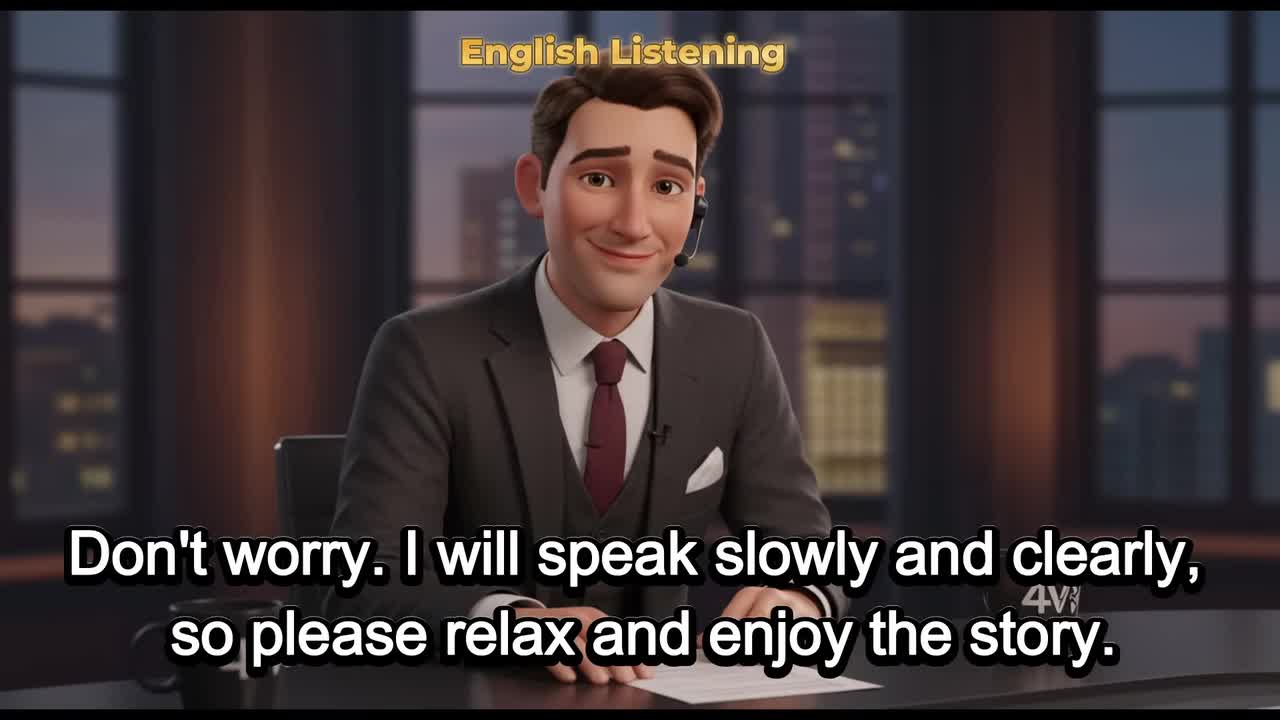
Welcome to English Listening Channel!
Hello everyone!
Today we're going to look at a conversation about taking a taxi in a foreign country.
In this video, you will follow a simple and practical story about two friends traveling together.
Don't worry, I will speak slowly and clearly, so please relax and enjoy the story.
But before we start, I have a small question for you.
Please listen carefully to find the answer.
This will help you understand English more deeply.
So here is today's question.
What does Mina say to check if the taxi driver is available?
The answer is mentioned in the conversation.
If you find the answer, please write it in the comments section.
By writing your answer in English, you can improve your English skills even more effectively.
All right, let's start the video.
Are you ready?
Okay, let's begin.
Hey, Mina.
We're finally at the airport.
We made it.
Wow, this airport is so big.
There are so many people everywhere.
Yeah, it's always busy here.
But don't worry, we'll find a way together.
Okay, so what do we do first?
I have no idea where to go.
First, we need to find a taxi.
Let's go look for one.
A taxi?
How do we find one?
I don't see any taxis here.
We need to go outside.
The taxis are usually waiting outside the airport.
Oh, I see.
Outside.
Okay, let's go outside then.
Look, do you see that sign?
It says taxi.
We should follow that sign.
Oh yes, I can see it.
It has a picture of a car.
That's helpful.
Exactly.
Most airports have signs like that.
Just look for the taxi sign.
Good.
That's easy to understand.
But wait.
What if there is no taxi waiting?
Then, you can wave your hand to stop a taxi on the street.
Just wave your hand like this.
Like this?
Just wave my hand?
Yes, exactly like that.
The taxi driver will see you and stop.
That sounds easy, but I'm a little nervous.
This is my first time taking a taxi in another country.
I understand, but don't worry.
It's easy.
I'll be right here with you.
Thank you, Sam.
That makes me feel better.
Okay, let's do this.
That's the spirit.
Oh, look.
There are some taxis over there.
Let's go.
Great.
I can see them.
There is a line of taxis.
Should we just walk up to one?
Yes.
Just walk up to the first taxi in the line.
That's how it works.
Okay.
I'll try.
Here I go.
You can do it.
I'll be right behind you.
Hello, excuse me.
Hello there.
How are you doing today?
I'm good, thank you.
Are you available?
Yes, I am.
Where would you like to go?
Please take us to this hotel.
We have the address here.
Sure.
Can you show me the address?
Yes, here it is.
It's on my phone.
Can you see it?
Let me take a look.
Oh, yes, I can see it.
The Grand City Hotel, right?
Yes, that's right.
The Grand City Hotel.
Do you know where it is?
Of course.
I know that hotel very well.
It's in the city center.
It's about 30 minutes from here.
30 minutes.
Okay, that's not too bad.
Thank you.
No problem.
Please get in.
You can sit in the back seat.
Thank you.
Oh, should I put my bag in the back of the car?
You can if you want.
Or you can keep it with you.
You can choose.
I'll keep it with me.
It's not very big.
Come on, Sam, let's get in.
All right, here we go.
Please put on your seat belts.
Oh, yes, of course.
Thank you for reminding us.
You're welcome.
Safety first.
We should arrive in about 30 minutes.
That sounds great.
Oh, one more question.
Is there a lot of traffic today?
It's not too bad right now.
It's still early, so the roads are not so busy.
That's good to hear.
Thank you very much.
Hey, Mina.
How do you feel?
Are you comfortable?
Yes, the taxi is nice.
But Sam, I'm a little worried about something.
What are you worried about?
Tell me.
Well, how much is the taxi ride?
I'm worried about the price.
Is it expensive?
That's a good question.
You can always ask the driver.
Just say, how much is it?
How much is it?
That's simple.
But should I ask before we go or after we arrive?
You can ask any time, but it's good to ask before you go.
That way you know the price.
Okay, I understand.
What about the meter?
Do all taxis use a meter?
Good question.
Some taxis use a meter and some don't.
You should always ask the driver.
Say, do you use the meter?
Do you use the meter?
Okay, I'll remember that.
And what is a meter exactly?
A meter is a small machine in the taxi.
It counts the distance and time, and it shows the price.
Oh, so the price goes up as we drive, like a clock?
Yes, exactly.
The longer the ride, the higher the price.
That's why the meter is important.
I see.
And if there is no meter, what should I do?
If there is no meter, you should ask the price before you get in.
Say how much to the hotel.
How much to the hotel.
That's a very useful phrase.
Thank you, sam.
You're welcome, and if the price sounds too high, you can always say no and find another taxi.
Really, i can do that.
I didn't know that.
Of course, it's your choice.
You don't have to take the first taxi you find.
That's good to know.
I feel less worried now.
Good.
You're learning fast.
You'll be fine.
Sam, can I ask you something?
I feel a little strange.
Sure.
What's wrong?
Well, I looked at my phone and the map shows a different road.
This way looks longer.
Hmm, let me see.
You're right.
This road looks a little different from the map.
Do you think we are going the wrong way?
Are we going the right way?
Well, sometimes taxi drivers know shorter roads that are not on the map, but sometimes they take a longer road.
A longer road?
Why would they do that?
Well, sometimes the short road has a lot of traffic, so the driver takes a longer road to save time.
Oh, I see.
I understand.
But what if the driver is just trying to make the price higher?
That can happen sometimes, but usually drivers are honest.
Don't worry too much.
But what should I do?
Should I say something to the driver?
Yes, I think you should.
It's okay to ask the driver.
You can be polite and ask nicely.
But I'm nervous.
I don't want to be rude.
What should I say?
You can say, excuse me, is this the fastest way?
That's very polite.
Excuse me, is this the fastest way?
Okay, that does sound polite.
I can say that.
And you can also say can you follow the gps?
That's a good one too.
Can you follow the GPS?
That's smart.
My phone has the map, so the driver can follow it.
Exactly.
Most drivers are happy to follow your GPS.
It's very common.
Okay, I feel better now.
I think I can do it.
I'll talk to the driver.
Good.
Remember, just be polite and smile.
You'll be fine.
Excuse me.
Can I ask you something?
Of course.
What's on your mind?
Well, I was looking at my phone and the map shows a different road.
Is this the fastest way to the hotel?
Oh, I see.
The main road is very busy right now.
There is a lot of traffic, so I'm taking a side road.
It's a little longer, but it should be faster.
There are fewer cars on this road.
Oh, I understand.
Thank you for explaining.
No problem at all.
I always try to find the fastest way for my passengers.
That's very kind of you.
I have one more question.
Can you follow the GPS on my phone?
I want to see the road on the map.
Sure, I can do that.
Can you hold your phone up so I can see the screen?
Like this?
Can you see it?
Yes, I can see it clearly.
I'll follow this road on your GPS.
We should be at the hotel in about 15 minutes.
15 minutes?
That's great.
I'm really excited to see the hotel.
It's a nice hotel.
I think you will like it.
Are you here on vacation?
Yes.
This is my first trip here.
Everything is so new and exciting.
Do you have any tips for me?
Well, the food near the hotel is very good.
There are many restaurants on the main street.
You should try them.
That sounds wonderful.
I love trying new food.
Thank you for the tip.
You're welcome.
I hope you enjoy your stay.
Thank you so much.
You are very friendly.
Thank you.
That's nice of you to say.
Okay, here we are.
This is the Grand City Hotel.
Oh, it looks beautiful.
This is fine.
You can stop here.
Alright, let me stop right here.
Is this a good spot?
Yes, this is perfect.
Thank you.
How much is the fare?
Let me check the meter.
The total is $23.50.
2350.
Okay.
Can I pay by card?
I don't have much cash.
Yes, of course.
We accept all major cards.
You can tap or insert your card here.
Great.
Let me use my card.
Here you go.
Thank you.
Just one moment.
Okay, the payment went through.
Would you like a receipt?
Yes, please.
I'd like a receipt.
I want to keep it.
Here you go.
Here is your receipt.
Thank you.
Oh, I also want to give you a tip.
Keep the change.
Is $3 okay for a tip?
That's very generous.
Thank you very much.
You don't have to, but that's very kind of you.
You're welcome.
You were very helpful and very kind.
Thank you for a nice ride.
Thank you.
Enjoy your time at the hotel and enjoy your trip.
I will.
Thank you.
Goodbye.
Goodbye.
Have a great day.
Hey, Mina.
You made it.
How was the taxi ride?
It was really good.
The driver was very nice.
That's great to hear.
And you talked to the driver all by yourself.
I'm proud of you.
Thank you.
I was so nervous at first.
My hands were shaking a little.
But you did it anyway.
That's what matters.
You did great, Mina.
Thank you, Sam.
I asked about the meter, and I even asked about the road.
I tried my best.
You really did.
And the driver understood you, right?
Yes, he understood everything I said.
I was so happy.
I feel more confident now.
That's wonderful.
You learned so many useful phrases today.
Yes, I did.
Like, are you available?
And can I pay by card?
Those are really useful.
And is this the fastest way?
That was a good one.
You asked that perfectly.
I was a little scared to ask that, but the driver was so nice about it.
See?
Most people are friendly.
You just need to try.
That's the most important thing.
You're right.
I was so worried before, but now I know I can do it.
Next time will be even easier.
Definitely.
And you learned so many phrases today.
Do you remember them all?
I think so.
Let me try.
Are you available?
How much is it?
Can I pay by card?
And keep the change.
Perfect.
You remembered all of them.
These phrases are useful in many countries.
Really?
I can use them in other countries too?
Yes, taxi systems are similar in many places.
Many of these phrases work the same way.
That's really good to know.
I feel so much better now.
And next time, maybe you can try taking a bus, too.
A bus?
Oh no, that sounds scary too.
Don't worry, i'll teach you, just like today.
Okay, i'll try, but first let me enjoy today.
Today was a big day for me.
It really was.
You should be proud of yourself, mina.
You did a great job.
Thank you, sam.
I'm glad you were with me today.
You helped me so much.
That's what friends are for.
Now let's go inside and check into the hotel.
Yes, let's go.
I can't wait to see the room.
And tomorrow, I want to explore the city.
Sounds like a plan.
Let's go.
Let's go.
I'm ready for anything now.
How was it?
I hope this video helped you improve your English.
Now, let me ask the question from the beginning one more time.
What does Mina say to check if the taxi driver is available?
The answer was mentioned in the video.
Did you find it?
If you did, please write your answer in the comments section.
By practicing English output like this, you can improve your English skills more efficiently.
On this channel I share stories in slow and easy English with useful expressions you can use in real life.
I will keep uploading videos like this, so if you enjoyed it, please subscribe to the channel.
And please don't forget to like the video and leave a comment.
I also offer channel memberships.
If you enjoyed this video, please consider joining as a member.
Alright, that's all for today.
I hope to see you in the next video.
See you next time!
Bye!