Hi, Rebecca Shear here. Before we get to our story, exciting news.
Circle Round is going back on tour. with live recordings across the united states our first stop Sunday, October 5th in Parker, Colorado at the Pace Center.
And Circle Round Club members are invited to a special post-show meet and greet with me and composer Eric Shimalonis.
Get your tickets at wbur.org slash circle around and click on events.
We're announcing more tour stops soon, so stay tuned.
We look forward to circling around with you live.
Produced by the iLab at WBUR, Boston. Ever heard the phrase, too good to be true?
If something is too good to be true, that means it sounds so amazing you can hardly believe it.
In today's story, we'll meet a clever, sneaky rabbit. who makes an offer that definitely sounds too good to be true because, well...
It is. I'm Rebecca Sheer, and welcome to Circle Round, where storytime happens all the time.
Today our story is called Sweet Corn and Clever Rabbit.
Versions of this tale come from Mexico, Costa Rica, and the First Nations people of Canada.
Some really great people came together to bring you our telling of this folktale, including Eris Baker.
Grownups, you may recognize Eris from This Is Us on NBC.
So circle around, everyone, for Sweet Corn and Clever Rabbit.
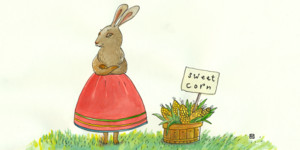
Rabbit was one of the fastest animals around.
She also was one of the cleverest. Her mind was every bit as quick as her feet.
And, being a bit of a rascal, Rabbit was especially fond of using her smarts to hatch schemes, and play tricks.
This story is about one of those tricks.
It all began one morning, when Rabbit was hopping around a part of the countryside she'd never seen before.
After scurrying up a hill and around a bend, she saw something that stopped her right in her tracks.
Whoa! Before her was a massive field of corn.
Row after row of bright green stalks stretched up toward the sky. and each stalk was bursting with plump, sweet cobs.
Mmm. All this hopping around sure has me hungry.
I think I'll have just one nibble. Rabbit snatched a cob and shucked off the bright green husk.
She took a bite. Wow, this is the freshest, sweetest corn I've ever tasted.
As she chewed on the corn with her sharp teeth, her sharp mind began chewing on a plan.
You know, I can think of a bunch of animals who'd love a taste of corn this sweet.
I bet I could sell a thousand bushels of this stuff.
I'd be rich. Then it occurred to her, this field must belong to a farmer.
And farmers do not appreciate finding rabbits in their fields, especially rabbits who are snatching all their corn.
But remember, Rabbit was speedy. She figured she could pick at least one bushel without getting caught.
There was just one problem. How can I get rich selling just one bushel of corn?
Aha! I know just what to do. In the blink of an eye, Rabbit darted down a row of stalks and grabbed a few dozen corn cobs.
Exactly one bushel's worth. She tossed the cobs in an old burlap sack she found and dragged them back. to her burrow.
Once there, she brushed her fur, smoothed her whiskers and put on her most winning smile.
Then she grabbed three cobs of corn and hippity-hopped to the old rotting log. where cockroach lived.
Good morning, Cogroach. Good morning, Rabbit.
What brings you here today? Well, Let's just say I have a business proposition for you.
Tell me, cockroach, do you like corn? The insect's tiny eyes lit up.
Like corn? I love it! I thought so. Listen.
I'm selling one bushel of the freshest, sweetest corn you've ever tasted.
And I wanted you to be the first to know about it.
Me? Really? Yes, you! Here, have a bite.
Rabbit handed a cob to Cockroach. This is the freshest, sweetest corn I've ever tasted.
What are you asking for this one bushel of fresh, sweet corn?
For you. Rabbit grinned. Five silver pieces. cockroach nearly jumped out of her shell.
"'Five silver pieces! That's it!' What a bargain!
What can I say? I aim to please. So, what do you say, Cockroach, you in?
Cockroach thought for a moment. This seemed like an offer she couldn't refuse.
Yeah... I'm in! Fantastic! Meet me outside my burrow in exactly one hour.
No sooner, no later. And don't forget your five silver pieces will do.
See you in exactly one hour. As Rabbit leapt away, she smiled to herself.
My plan is working. I'm going to make a fortune.
Rabbit's next stop was a mushy, marshy spot beside the river. where Duck lived.
Good morning, Duck. Greetings, Rabbit. What brings you here today?
Well, let's just say I have a business proposition for you.
Tell me, Duck, do you like corn? Duck's tail feathers quivered.
Ooh, I love corn. Almost as much as I love creepy crawlies.
You know. worms, slugs, cockroaches. I knew it!
Listen, I'm selling one bushel of the freshest, sweetest corn you've ever tasted.
And I wanted you to be the first to know about it.
Me? You don't say. I do say. Here, have a bite.
Rabbit handed a cob to Duck. This is the freshest, sweetest corn I've ever tasted.
What are you asking for this one bushel of fresh sweet corn? for you.
Rabbit beamed. Five silver pieces. Duck let out a surprised quack.
Just five silver pieces. That's unheard of!
What can I say? I aim to please. So, what do you say, Doug?
You in? Duck thought for a moment. This seemed like an offer she couldn't refuse.
Yes, indeed. I'm in. Outstanding! meet me outside my burrow in exactly one hour and one minute.
No sooner, no later, and don't forget your five silver pieces.
Absolutely. See you in exactly one hour and one minute.
As Rabbit bounced away, she had an extra spring in her step.
This is easier than I thought. Just one more stop to go.
Rabbit made her way to a thick cluster of bushes in the middle of the forest, where Fox lived.
Before we go on, one thing you should know about Fox Like Rabbit, he also was one of the cleverest animals around.
And like Rabbit, he also was a very cunning trickster.
All right, back to the story. Good morning, Fox.
Hey there, Rabbit. What the... brings you here today?
Well, let's just say I have a business proposition for you.
Tell me, Fox, do you like corn? Fox's red ears perked up.
I love corn. Almost as much as I love little critters.
You know, frogs, mice, ducks. I figured.
Listen, I'm selling one bushel of the freshest, Sweetest corn you've ever tasted.
And I wanted you to be the first to know about it.
Mmm, I like the sound of that. As you should.
Here, have a bite. Rabbit handed a cob to Fox.
Mmm. This is the freshest, sweetest corn I've ever tasted.
So, uh, what are you asking for this bushel of fresh, sweet corn?
For you? Rabbit smiled. Five silver pieces.
Fox cocked his head. Wait, really? Just five silver pieces?
That's a steal! What can I say? I aim to please.
So, what do you say, Fox? You in? Fox thought for a moment.
This sure seemed like an offer he couldn't refuse. but it sounded way too good to be true.
Was Rabbit up to one of her sneaky tricks again?
There was only one way to find out. Sure, Rabbit.
I'm in. Splendid. Meet me outside my burrow in exactly one hour and two minutes.
No sooner, no later. And don't forget your five silver pieces.
You betcha. See you in exactly one hour and two minutes.
As Rabbit dashed back to her burrow, Fox sat puzzling and pondering in his den.
Hmm. That rascal rabbit is up to something.
But what? I know. I'll sneak over to her burrow right now.
I'll hide out of sight and see what kind of game she's playing.
Something tells me Rabbit's sweet corn offer doesn't have a kernel of truth.
We'll find out what happens next, after a quick break.
Support for Circle Round comes from Indeed.
You just realized that your business needed to hire someone yesterday.
How can you find amazing candidates fast, easy, Just use Indeed.
There's no need to wait. You can speed up your hiring with Indeed. and Circle Round listeners will get a $75 sponsored job credit to get your jobs more visibility. at indeed.com slash circle round.
Just go to indeed.com slash circle round right now.
Support the show by saying you heard about Indeed on this podcast.
Indeed.com slash circle round. Terms and conditions apply.
Hiring indeed is all you need. I'm Rebecca Shear.
Welcome back to Circle Round. Today our story is called Sweet Corn and Clever Rabbit.
Amen. When we left off, Rascal Rabbit was doing one of her favorite things. hatching a scheme to trick her fellow animals.
One by one, she approached Cockroach, Duck and Fox with what she called a business proposition. she offered each of them one bushel of fresh sweet corn for just five silver pieces.
Little did they know, she only had one bushel to sell, not three.
She instructed Cockroach to come over in one hour, Duck to come over in one hour and one minute, and Fox to come over in one hour and two minutes.
The cockroach was delighted about the deal, as was Duck.
But Wiley Fox knew something wasn't right.
A few moments after rabbits sprung away from his den, he scurried to her burrow. and hid behind a bush.
Before long, he spotted cockroach scuttling over.
Hi there, Rabbit. Well, hello, Cockroach.
Has it been one hour already? You're right on time.
Did you bring your five silver pieces? I sure did.
Here you go. Thank you. Rabbit shoved Cockroach's five silver pieces into her left pocket.
Okay, so where's that sweet corn? It's right here in this sack.
Oh no! Cockroach froze. What? What's the matter?
I hate to say it, but here comes Duck. You know how she loves to eat cockroaches.
You'd better go hide. I'll let you know when it's safe to come back.
Oh, okay. Thanks, Rabbit. See you soon. As Cockroach scuttled behind a rock...
Duck waddled up to Rabbit's burrow. Good day, Rabbit.
Well, hello, Doc. Has it been one hour and one minute already?
You're right on time. Did you bring your five silver pieces?
Indeed I did. Here they are. Thank you.
Rabbit's left pocket was full of cockroaches' silver pieces.
So she dropped Duck's five silver pieces into her right pocket.
All right, so... Where can I find that sweet corn?
It's right here in this sack. Duck froze.
What? What's wrong? I hate to say it, but here comes Fox.
You know how he loves to eat ducks. You better go hide.
I'll let you know when it's safe to come back.
Oh, dear. Thank you, Rabbit. I'll see you shortly.
As Duck shuffled behind a tree, Rabbit looked around and frowned.
I told Box to come over in one hour and two minutes, and now he's late.
I wonder where he could be. Now, we know that Fox had been watching all this time, right?
But Rabbit didn't know that. So you can imagine how startled she was when, all of a sudden...
Fox jumped out from behind the bush where he'd been hiding.
I'm right here, Rabbit. Fox? How'd you get behind that bush?
What have you been doing? Fox smiled, his pointy white teeth glinting in the sun.
What have I been doing? Oh... Just listening to you sell the same bushel of corn twice. and give nothing in return?
Rabbit's mind raced. Oh, that. I can explain everything.
You see, Fox? My plan was to sell all the corn to you.
You and you alone. Really? Truly! Before Rabbit knew what was happening, Fox bounded over to the rock and pulled Cockroach out of her hiding place.
He did the same with Duck behind the tree.
Rabbit watched as the three animals, cockroach, duck, and fox, went into a huddle.
After whispering amongst themselves, they turned to Rabbit and began to speak. using some very familiar words.
So, uh, listen, Rabbit. We have a business proposition for you.
The three of us are going to split a bushel of the freshest, sweetest corn you've ever tasted.
And it'll only cost you... Ten silver pieces!
The five you stole from me. And the five you stole from me.
So. What do you say, Rabbit? You in? Rabbit hung her head.
She knew they were making an offer. she couldn't refuse.
Yup, I'm in. So, the three new friends Cockroach, duck, and fox split the corn three ways. and enjoyed every fresh, sweet bite.
But even sweeter was the lesson they learned that day.
Don't trust everything you hear. If something sounds too good to be true, most likely it is.
In fact, it's probably just another hare-brained scheme.
Hmm. Now it's your turn. If you had a bushel of something, anything, what would it be?
And who would you give it to? Maybe you'd give a bushel of food to a homeless shelter, or a bushel of books to your bookworm of a best friend.
Perhaps you'd give a bushel of flowers to a family member who loves to garden Or, why not, a bushel of hugs to someone who's having a rough day.
Think about what you'd like to give and who you'd give it to.
Then find some paper, something to draw with, and make a picture that shows you giving a bushel of something super special to someone super special.
This week's story, Sweet Corn and Clever Rabbit, was adapted by me, Rebecca Shearer. and edited by Circle Round's founder, Jessica Alpert.
Our original music and sound design is by Eric Shimalonis.
Our artist is Sabina Han. Sabina's drawn a black and white picture for every Circle Round story, and you can colour them in.
Visit our website, wbur.org slash circle round, and click on Coloring Pages.
Special thanks to this week's actors. Evan Casey.
Tracy Lynn Oliveira, Maisie Scarpa, and Eris Baker.
Grown-ups, check out Eris on This Is Us on NBC.
This week's featured instrument was the banjo.
You can learn more about this plucked stringed instrument on our website.
Again, that's wbur.org slash circleround.
And hey, have you subscribed to Circle Round yet?
If not, find us on Apple Podcasts or wherever you get your podcasts.
And please write us a review. We'd love to hear what you think of the show.
Circle Round is a production of WBUR, Boston's NPR news station.
I'm Rebecca Shear. Thanks for circling around with us.