Hi, I'm Dave Isay, founder of StoryCorps.
Support for this podcast and the following message come from Dignity Memorial.
Did you know that a prepaid funeral plan is one of the greatest gifts you can give your
family, plan your life celebration in advance to protect your loved ones?
For additional information, visit DignityMemorial.com.
It's 2005, at a public radio conference, everyone in the industries there.
Our founder Dave Isay is the keynote speaker and he has a big announcement to make.
Dave gets on stage and tells the audience that StoryCorps is going national.
We're partnering with public radio stations around the country to send mobile recording
boots out to do interviews.
Then Dave adds another announcement for good measure.
He says, moving forward, StoryCorps will be on the radio every Friday on NPR's morning
edition.
One in the audience began applauding enthusiastically, except for one person, the person who was running
that show.
There were no words.
I was just like, what?
That's Ellen McDonald, who was the head of morning edition for many years.
Dave had been pushing for a spot on the show for a while and Ellen's feedback was always
the same.
Morning edition is a national news program.
StoryCorps is just too New York.
Yeah, so she told him, let me know when StoryCorps starts recording nationally and then
we'll discuss it.
I went up to him later and said, Dave, could we have talked about this?
He said, no, no, no, we did.
We definitely talked about it.
We definitely, he may have had conversations on his head with me, but we never had the
conversation where I said, yes, we will do this weekly.
That's a big, big commitment to say you're going to give a very coveted weekly slot
on morning edition.
I certainly could have pulled it back.
I could have said, forget it, I don't care.
We're not doing it.
You know, 20 years later, I'm thrilled we didn't.
Fridays are special because of StoryCorps.
With the terrible news surrounding us every day, we need that human connection.
And in many ways, it's the rainbow we all need.
It's a special moment.
The launch of the mobile tour is a very special moment in StoryCorps 20 year history.
This one StoryCorps began to grow exponentially, reaching into every corner of America.
To date, our mobile booths have recorded in more than 270 different cities and towns, collecting
more than 27,000 interviews.
But in this episode, we're focusing on that very first year of the tour.
You'll hear some of those stories.
And about life on the road, from the StoryCorps staff who went along for the ride.
So Dave, I say, came out to visit us when we were in St. Louis, so it was about a month
then, and I remember he took us out to dinner and like, right away, turned to us and said,
so you're out on the road and you're recording all these stories.
You're doing this thing that no one's ever done before.
So I just want to know, what have you learned about humanity?
No pressure or anything.
I'm Michael Garafalo.
And I'm Jasmine Morris.
From MPR, this is StoryCorps then and now celebrating 20 years of StoryCorps.
Now when StoryCorps hit the road, we did it in style.
That's right.
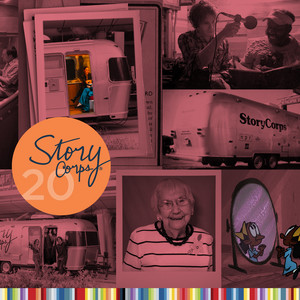
We took two air stream trailers, these iconic gleaming aluminum campers, gutted them,
and built recording studios inside.
We launched the tour in front of the Library of Congress in May 2005.
After that, one booth went west, the other east.
One of their early stops was Sarasota, Florida, where cousins Sherry Johnson and James
Ransom stepped into the trailer for a conversation.
They shared memories of growing up in Braydenton, Florida, and specifically of their larger
than life Sunday school teacher.
Let's talk about Mississippi.
Lizzie Devane.
She was the only person I knew that had more power than my grandmother.
She wasn't a mean person.
She was stern.
Yes, she was stern.
When she said something, she meant exactly what she said.
The only thing that would keep you from going to Sunday school, you had to have one
foot on banana peel and other engraved.
Absolutely.
There's no excuse.
You had to go.
One of the things that you prayed for when you were in the Divine's class was Lord,
please let me get all enough to get out this class.
She did the Catholicism.
Who weighed you?
God.
Where is God everywhere?
And you said, Lord, I'm mercy, please.
This Miss DeVane would come in on Sunday mornings to take us to Sunday school.
And when I saw her come, Sherry, I thought the leaves would be blowing out the trees and
the sky would go black and the clouds would come in and she'd come in the house one morning
and say, good morning children and everybody, my mother on down said, good morning Miss
DeVane.
And she says, it's time to go to Sunday school this morning children.
I said, Miss DeVane, I can't go to Sunday school today.
She said, no, I said, no ma'am.
She says, why not?
I said, my mother didn't bring enough clothes for me to go to Sunday school this morning.
She said, oh, no, what kind of clothes do you have?
I said, all I have, Mr. Vine, I'm my pajamas and my tennis shoes.
She said, when that's okay, honey, put your tennis shoes on.
We go to Sunday school.
I looked at my mother and she looked away, Sherry.
Mr. Vine made me walk two blocks in my pajamas and my tennis shoes.
I had to sit in church with my friends.
I would tell you, Sherry, I'll never lie to get a...
The Vine was always there to take care of us.
Right.
But when Miss DeVane breathed your hair, your eyes went up like this.
You had to sleep on soft pillows because, boy, she had a tight.
And Miss DeVane had mango trees all over her yard.
Miss DeVane never brought you a mango until it was rotten.
It would smell like liquor.
That's when she brought you a mango.
You know what, that's the kind of stuff that we got growing up and I'll never forget that.
That's James Ransom and Sherry Johnson and Sarasota Florida.
Sherry died in 2017.
And James is now a story core board member.
He recently gave the toast at our 20th anniversary gala.
In preparing for this episode, we realized one of the stories that doesn't really get
told is what it's like to be out on the road collecting these interviews.
Yeah, you've heard us refer to story core facilitators.
But unless you've done a story core interview yourself, you might not understand what that
job is.
These are the people who welcome participants into the booth, engineer all the recordings,
make sure everything sounds good, and also listen.
They're there to jump in and ask questions, basically be the ear of future generations
who may listen back to this.
I always call it the best job in the world, especially the mobile tour facilitators.
They go out in pairs for months at a time to record stories in the air streams, spending
weeks in each community they visit, just absorbing the wisdom of all the people they meet.
People often assume that we slept in the recording booth because it's an air stream trailer
that people do use as campers.
That's Nick Yulman, one of the very first mobile facilitators.
And no, they don't sleep in the booth.
It's really one of the best ways to travel that I can imagine that you not only go to a
place and obviously get to see what's there and learn about a history, but to actually
directly hear about people's lives there.
And it's kind of the thing that I often would like to be able to do, to go up to a stranger
and just like ask somebody like any kind of any question you want.
Nick spent four months on tour that first year and we recently asked him what that was
like.
It was a beautiful routine.
You wake up and you'd go to the booth and you'd get the air stream ready to greet people
into record and then there would be six interview's a day.
So every hour a new group of people would come.
Nick's first stop was Chicago where the booth was parked outside the field museum.
I think we worked six days and then had day off and then five days and then two days off.
It was pretty all-consuming.
So certainly it was tired, but part of what was so exciting about doing this work was
not just like, you know, we're making these recordings and we'll produce radio from it
and people will hear it now, but also what the impact will be a hundred years from now
if somebody can find this recording and hear those voices.
On the way out of town to their next stop, Nick and two other facilitators, Kev Ambarame
and in Ronnie Shankar, did something that's only happened once they took the booth to someone's
house and not just anyone.
Someone with a special connection to story core.
As we were leaving Chicago, we made a special stop at Studs Turcles House for how large
he loomed in our imaginations.
It was not a large man physically and, you know, he was walking with a cane and you know,
it kind of helped him get up into the booth and kind of situated.
No, no.
I can't tell.
It's so inspiring.
Hearing aids on the blink, eyesight is blurry.
Aside from that, pretty good.
You look good.
So here we are.
You go ahead.
He'd recently just had heart surgery, but as soon as we started recording, he just became
incredibly animated, just this kind of light in his eyes and technically you could say
we interviewed him, but I think we only got in maybe two or three questions.
What has happened to the human voice, Vox Humana, Hullaring, Shaunting, Quiet, Talking,
Buzz?
I was leaving the airport, it's an Atlanta.
You know, you leave the gate, you take a train that took you to a concourse of your choice
and I get into this train, dead silence, a few people seated all standing up above
me here a voice that once was a human voice, but no longer now it talks like a machine.
Concourse one, Fort Worth, Dallas, Lubbock, that kind of voice.
Just in the doors are about to close, nomadic doors, only young couple Russian and push
open the doors and get in.
Without missing a beat, that voice above says, because of late entry, we delayed 30 seconds.
People looked at that couple, I thought a couple just committed mass murder, you know.
And the couple of shrinks, I'm like this, you know.
I'm known for my talking, I'm Gabby.
And so I say, George Orwell, your timers come and gone.
I expect the laugh, dead silence.
And now they look at me and I'm with the couple, three of us at the Hill of Calvary on Good Friday.
And then I say, my God, where's the human voice?
And just a little baby, maybe the baby's about a year old and I say, sir, I'm out of
the baby.
What is your opinion of the human species?
Well, what does a baby do?
Baby starts giggling.
I thank God.
The sound of a human voice.
Because to record a nonprofit, we also ask people if they'd be interested in, you know,
making a donation to help support the project.
I remember at the end of the interview, he says something like, so can I give you some
money?
Is this where I can give you a donation?
And I think we sort of, I don't know if it's okay.
It's such an honor to get to meet you and to record you.
But then what he wound up doing was giving us a $5 bill, which he also autographed as his
donation for StoryCorp.
You know, I did get a sense, he felt, you know, somewhat honored that like this was a
whole project that in some ways was building on what he had done.
And to be able to go to his house and record him was an incredible honor.
After that interview, Nick and his co-facilitator Ronnie and the booth headed south.
We'll go with them after the break.
This message comes from NPR sponsor Subaru.
Join Subaru in celebrating their fifth annual National Make a Dogs Day on October 22nd.
A day to do something special for all dogs.
This day combined with the Subaru Love Pets Initiative has helped many shelter animals
find loving homes, including hard to adopt underdogs.
Learn more at Subaru.com slash Make a Dogs Day.
Welcome back.
A big part of the facilitator's job is to bear witness.
And sometimes that means they find themselves sitting a few feet from people who lived through
history.
It's one of the incredible things about the archive we've built.
All the first hand accounts of things you usually only read about in books.
Here's Nick.
One of the stops I was in was Memphis, Tennessee.
And we were parked just a few blocks away from the other end motel where Martin Luther King
was killed.
And one of the interviews that got to facilitate was with Bessie and Taylor Rogers, who came
in to talk about their recollection of Martin Luther King's final speech.
I mean, it would wall and wall with people.
And it was storming and raining.
He preached.
And he said that all.
I've been to the mountain top.
Oh, yeah.
Because I've been to the mountain.
I looked over and I've seen the Promised Land.
And I've looked over.
And I've seen the Promised Land.
I might not get there with you.
I may not get there with you.
We will get there.
But I want you to know the night that we as a people will get to the Promised Land.
And he was crying.
Tears were rolling and dying.
He's she.
Preaches with crying.
People with crying.
And everybody was crying.
And he really talked that night.
I mean, he really, really talked.
You could tell about his special on his face in the feeling and the sound of his voice
that he knew something was going to happen.
He said, Coach, I'm not a fear of any man.
And I'm not fear of any man.
My eyes have seen the glory of the coming of the Lord.
Next day, he was killed.
You know, it's kind of like you lost a part of your family.
You just really can't describe it.
He stopped everything.
But everything aside to come to Memphis to see about the people on the bottom of the
ladder, the sanitation workers.
After his death, we marched.
You couldn't hear a sound.
You couldn't hear nothing but love against people.
It was just some terrible days back then, but with God's help, we came through.
And it means something to know that you were a part of this.
It is humbling to sit with somebody who has been, you know, a witness to history like
that.
And also, like, bestie and tailor, Rogers are not famous civil rights leaders in the
sense that you're going to read about them in every history book about that struggle.
But like, this is such a central and key moment in their lives.
And to be able to the chance to record that, it was very important.
And it wasn't just stories from 40 or 50 years ago.
They were documenting key moments that were happening in real time.
Yeah, this was 2005.
And of course, that's the year that Hurricane Katrina devastated New Orleans and the Gulf
coast.
Not long after the storm, StoryCore took the booth down to Gulf Port Mississippi.
And that last stop was actually something was not planned initially, but we wound up finding
a way to kind of add it on because Hurricane Katrina happened like shortly after I started
on the mobile tour.
And it was sort of our first opportunity to bring the booth to a community that had been
affected by it.
And this was just a few months after the hurricane.
So there was still so much destruction.
And people were coming in and just talking about really harrowing experiences.
And we were staying at like a casino hotel that was right on the water there.
You know, and then the casinos there are these offshore barges.
The strip that we were on, some of the barges had blown inland and crushed buildings.
So it was just kind of apocalyptic setting.
And to get there, we had to go through like a national guard checkpoint and then get
up in the morning and go to the booth and record stories.
My name is Douglas Paul DeSilvie.
I'm a native of the Gulf Coast.
The story I want to tell today is about my family.
The three women in my family have steered my life for the past 59 years to the man that
I am today.
And I hope and think that I am pretty good fellow.
When Douglas DeSilvie came in, you know, he came alone.
So in that case, the facilitator would serve as an interviewer.
And so, you know, I knew I was going to interview him and he was very soft spoken.
And it became clear why he was coming in alone.
And that's because I don't know that he had somebody who he could sit down and talk to
about this or who could he could do this interview with.
Every time we had a hurricane, we would all go over to Nadine's home.
We considered it just another storm since 77.
When she built this house, we've been through every storm.
Not knowing what we were in for.
We were sitting on the bed and I could hear glass breaking.
And I walked to the back of her bedroom, which was facing the bay just to measure the
water to see how high up it was.
And in the back of the water just came up so fast it was unbelievable.
As I turned and told them to hold hands, it was going to have to get into the water.
The roof came down on all of us.
And my lungs started filling up with water and I just kept asking Jesus not to let me go
like this.
I had to give him a family out.
I got out and they didn't.
I'm a big 268 pounds exercise and stay healthy.
And I just, I could not do a thing.
It was just, it was just their time to go.
The only way I can understand this.
Losing a family is, I don't think there's any words for it.
It kind of makes you wonder what life's all about.
Many, many questions I have not received answers for yet.
I just don't know what I feel these days.
I wake up and go to my office and do my job.
And I come home.
I've got the house full of their belongings and that I don't know what to do about.
You know, as a father and a dad and a husband and everything, you always plan for the future
of everybody and it's just the opposite now.
I have nobody to plan for or work on retirement for or to save for buying a house or just me.
You know, being able to sit down and ask questions and hold space and know that it's going
to be an incredibly emotional interview.
I think there are moments during that recording when we both were crying and just had to pause
a moment and just kind of take a deep breath and improve and continue on.
Definitely those interviews in Gulfport have stuck with me and I think about a lot of
those people still.
There's two facilitators who would work together on the mobile tour at a time.
It was incredible to be out on the road with just one other person and you're having this
experience and so to have somebody to go through that with you.
Process the things we'd heard and some nights we would tell each other, we had this incredible
moment in the booth where these two people were holding hands and crying.
But also there were some nights where I think you'd just be so emotionally drained that talking
was hard.
You felt like you had already spent all of the kind of resources you had to communicate
or to actively listen to somebody because it was just an intense day.
We've talked before about how story court connects people.
Well this is another way that happens between facilitators who have shared the experience
of being on tour together.
At the end of a facilitator's time on the road, they often do their own interview together.
Here's a little bit of Nick's conversation with this co-facilitator, Ronnie.
I really want to thank you, Ronnie.
I was just so blessed to have you as a partner on the tour, just like the level of curiosity
that you bring to everything and just like the empathy that you've exude for just anybody
you're interacting with.
I learned a lot from being on the road with you and just knowing you too and it's been
really wonderful.
Thank you, Nick.
I feel the same way.
I think I've told you on the road how much I've learned from you just by watching you
in action.
I'm really going to miss working with you and I feel so blessed to have become part
of your everyday interaction.
I said more time with you than with anyone else.
I was thinking we had every meal together for like 10 weeks.
I've never had that experience with any other person ever.
Thank you so much.
I believe you now with some closing thoughts from Nick about life on tour and what it meant
to him.
By the end of four months, I was very tired.
I mean, we worked hard and it's unforgettable.
I mean, there's still things that I think about from that time and the people I met and
the places that we went to.
I just think of it as one of the best times of my life.
I think I just kind of reset my mind in a lot of ways too.
It's the different way of seeing the world, a different way of interacting with people.
I think one of the key takeaways for me is you never know what somebody is going to
talk about.
So when you're walking down the street and it's easy for us to get into the mode of making
quick assessments of people, but nothing dissolves that feeling faster than having this
experience day in and day out of having somebody walk into the booth and just having your
mind blown about what their life was or what they're talking about or the relationship
they have with the person sitting across from them.
One of the clearest and I think most genuine ways you can show love to somebody is to just
be curious about who they are, what they care about, what they've done and being able
to kind of sit and witness so many people doing this for family members and what it meant
for them.
It's an incredible example in my own life and my own personal relationships.
That's something that I try to bring to being a parent too.
Letting your kids know that you genuinely want to know what they're doing, how they feel
about it and make sure that you're having these deeper conversations.
Next week, how will listeners comment, let one man home again?
Is that Wes?
No.
Take the next right, then arrive at your destination on the right.
Oh my gracious.
This is Wes's task.
This is extremely different.
Look, there's black students walking.
Come to school.
Amazing.
This episode was produced by Judd Este Kendall with Max Young Rice.
Our technical director is Jared Floyd.
Liz McCarty created the art for this episode, special thanks to Elem McDonald, Nick Yolman,
all the facilitators who have been on the road over the years, producer Katie Simon and
facilitator Nelson Simon.
Find out how to record your own conversation at storycore.org.
You can go to one of our story booths, visit one of our mobile booths when they're in
your area.
Use our app or record remotely.
I'm Jasmine Morris.
And I'm Michael Garoflo.
We'll be back next week.
Thanks for listening.
Thank you.