Hey everyone, I'm Alex.
Thanks for clicking and welcome to this lesson on 25 essential business English phrases.
So in this lesson, we are going to learn 25 phrases that you can use in emails, in everyday communications, whether you are talking to your boss, a client, a customer, your colleagues you will hear this in offices all around the world.
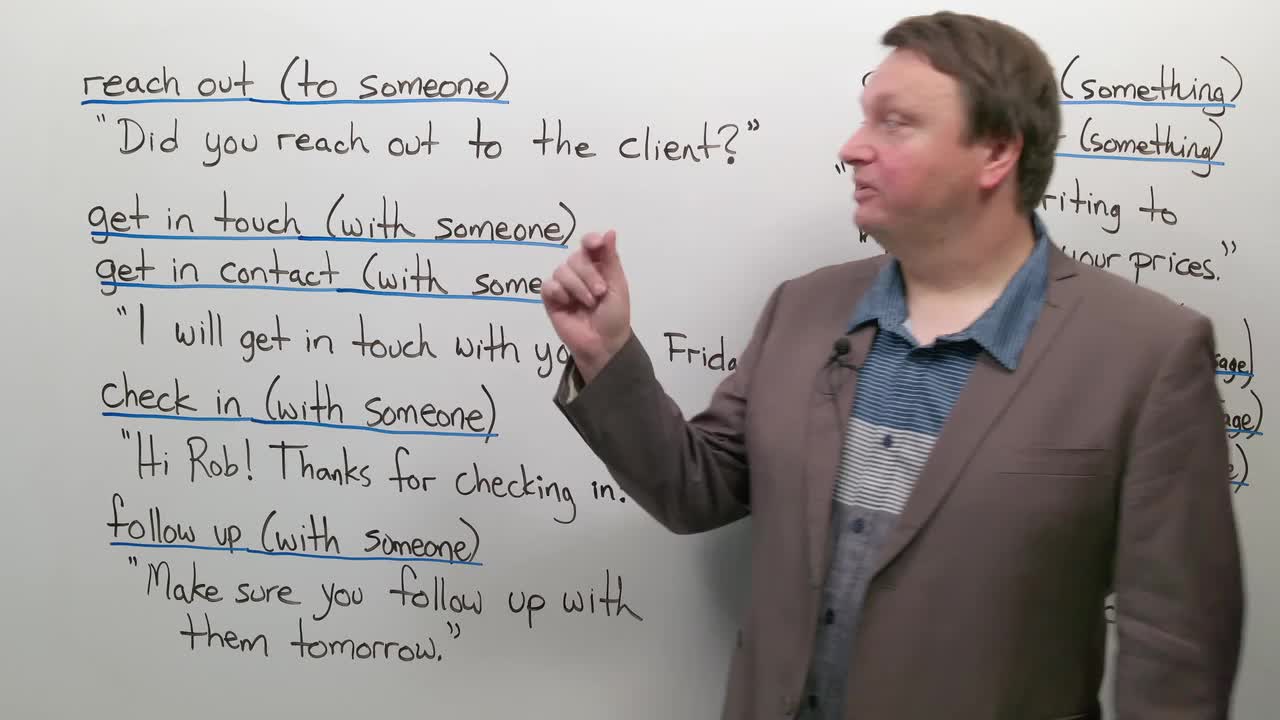
So let's begin with reach out.
So if you reach out to someone, you send them a communication, you send them an email or a message in an attempt to contact them, to make contact with them.
So for example, your boss might ask you, Did you reach out to the client?
Did you make an attempt to contact the client?
Did you send them an email?
Now, this is slightly different from the next two, which are get in touch with someone or get in contact with someone.
If you get in touch, you get in contact, this means you actually contact the person.
Reach out has more of a meaning of you attempted, you reach.
That's why i'm reaching my arm.
You reach out, you attempt to contact them and say hi, i need to talk to you about something.
So to get in touch, to get in contact means to contact someone, so i will get in touch with you by friday.
So maybe you send someone, you leave a message on their machine or you send them a message over a chat program, a messenger service or an email and say i will get in touch with you by friday, or i will get in contact with you by friday, so you can reach out to clients, reach out to customers you can get in touch, or you can get in contact with them as well.
Next, to check in with someone.
Now, when you check in with someone, it means that you contact them for an update on something, because you just want to see the status of the project, the status of the relationship that you are trying to develop with a particular client or customer.
So when you check in with someone, you are just tapping them on the shoulder and saying hey, how is it going okay?
So, for example uh, maybe you have checked in with rob and rob contacts you in return.
He returns your email.
And or sorry, you are rob and someone contacts you and they contact you in return and they say hi rob, thanks for checking in.
Right like, thanks for sending me a message, thanks for tapping me on the shoulder okay uh, it's possible, if you work in an office, that you check in with your boss once a week, maybe.
Or you check in with your team on a daily basis.
This means every day or maybe once a week.
So, if you do, if you do work right now, how often do you check in with your department?
How often do you check in with your boss?
To just get the newest information, to get the latest updates?
Next, to follow up with someone.
So this is similar to check-in, but the difference is, when you follow up with someone, it doesn't mean that they have caught that.
The communication has been two ways necessarily.
So, for example, if you are someone who is selling your services to clients or potential clients, potential customers, and you contact them and you get no response, You get zero response.
Probably they saw your email.
Maybe they deleted it.
Maybe they haven't opened it.
Maybe they opened it and said, I'm not interested.
Or, oh, maybe later.
Your boss might ask you to hey follow up with them.
This means contact them again.
So when you follow up with someone, you send a subsequent communication, another message, another email, because Did you receive my email?
Did you receive my message?
Do you have any questions?
These are the types of questions you ask when you follow up with someone to get more information.
Ask if they got your information in the first place.
So for example, make sure you follow up with them tomorrow.
Now, I mentioned that with follow up.
Sometimes the other person hasn't even contacted you about anything.
It's possible that you already have been communicating with this person for a while as well, and maybe you're working on something and the person hasn't responded to you in five days about something.
And your boss says five days, that's a long time.
You should follow up with them.
Make sure you follow up with them.
In that case, they could also say make sure you check in with them.
Ask them for an update.
What's the newest information?
All right, next now.
These are some everyday common words, but i want to show you which prepositions they often work with and which of them don't need a preposition.
So some people don't use these correctly And that's why I want to make sure you have the basics, so that you master them and you use them effectively and correctly in your English communications.
So ask about and inquire about, so you can ask about something.
You can ask someone about something.
Inquire is a more formal way to say ask.
You can inquire with someone about something or just inquire about something.
So, for example hello, i'm writing to inquire about your prices.
Or Hello, I'm writing to ask about your prices.
So both of these are possible.
Inquire is a nice formal word that you can use if you want to sound more professional.
Let's go next.
We have reply respond answer, get back to.
All of these are in the same family of words.
You can use all of them in an email or when talking with a customer, client or colleague.
So you reply to someone okay, you reply to a message so um, don't say thank you for replying me.
Say thank you for replying to me, don't say thank you for replying my message.
Thank you for replying to my message.
So, you always reply to someone.
You respond to someone.
Answer is different.
You answer someone or you answer a message.
If you use answer to, this means like you are in a subordinate position to someone.
So if someone asks you, whom do you answer to?
This means like who is your boss.
Who is your superior?
Oh, I answer to David.
David is my boss.
I answer to him.
But you can answer a question, answer a message, answer a person, so to get back to someone.
This is a more informal way to say reply, to respond, to answer someone.
So, for example, very common sentence i'll get back to you as soon as i can, or as soon as possible, or a s a p, so i will respond to you.
I will reply to you.
I will answer you as soon as i can.
Did you respond to her?
Did you reply to her?
Did you answer her?
Did you get back to her?
So all of these?
As you can see, they talk about returning a message to someone.
Okay, how is it going so far?
Are you listening to this and saying yeah, this is great stuff.
Okay, i got more great stuff, so let's keep going, okay.
Next we are talking about updates, or receiving the latest, the newest information about something, so you can provide an update on something to someone.
You can give an update.
Provide is a more formal word, give is a more neutral word.
Give an update on something.
And again to someone uh, you can get an update.
This means to receive, receive an update on something from someone, and you can update someone.
You can use update as a verb as well, so you can update someone on something.
So let's look at the example sentences.
Feel free to use these in your emails.
Could you please send me an update on your availability?
So your availability means when you are free, when you are available in your calendar.
What's your schedule like?
Maybe I'm scheduling a meeting with you.
I'll update you tomorrow.
You can also say, I will send you an update tomorrow.
I will provide you with an update tomorrow.
And next, did you get an update on the status of the payment?
So maybe your accounting department is asking you this, or you are asking your department, your accounting department, this.
Did you get an update from the customer on the status of the payments?
Have they paid us yet?
So again, you can provide or give an update, you can get an update to receive one and you can just update someone.
Give them the latest information.
Next, another common word, send.
So you can send something to someone or you can just send something.
I put parentheses, which means it's optional.
This is absolutely necessary.
So you send something.
You can't just send, you have to send something, send something, or send something to someone, or you can send someone something.
So you can send me the details, send me your availability.
Here we go.
Thanks for sending me the file.
I'll send the attachment this afternoon.
And here you could say, like, I'll send you the attachment this afternoon.
I'll send the attachment to you this afternoon is also possible, and finally, to forward something to someone or to forward someone something.
So when you forward something, it can be a synonym for the word send.
But typically if you have an email, you know there is a forward button, which means someone sent you an email and you want to send that email to someone else, so you just want to forward that email to a different person.
But you can also just forward someone, meaning send someone something.
So, for example um, could you forward me the details, like send the details to me.
I know you have them.
Send them forward to me okay, so we have send forward.
Update a lot of useful language and it's funny how we have like, the word update, but you can give an update, you can get an update, you can provide an update, you can just update someone.
So, as you can see, they're simple words but they have so many different uses and i hope by watching this video you are getting that sense and you're feeling more informed and more empowered with your language.
So we're almost done.
We have a few more phrases.
These are great.
They're very essential.
Let's take a look at them.
So next we have according to.
So this means based on the information we have, or as stated in, or as stated by someone or in some documents.
So, according to our records, the delivery date is September 7th.
So based on our records, our records say this, as stated in our records, according to our records.
According to your previous email, you are not available to do this until september 7th, for example.
Uh, why are you saying that you can do it earlier now, like we weren't ready for you until september 7th?
So next, in regard to this is like with attention to when you are trying to focus the topic of conversation.
Um so, with attention to something.
So i am writing regard to your late payments.
I am writing to you about your late payments with attention to, with focus on this conversation piece, this topic that we are discussing.
So I'm writing in regard to your late payments.
Some people write with in regards to
The correct form is in regard to, but in regards to is being used so much that it's probably just going to become an accepted part of English speech.
My old boss used to write in regards to all the time uh.
But they say that some bosses don't have actually really good grammar because they don't need to.
They're the boss bosses.
Okay uh, apologize for, and my apologies for.
So if you'd like to be a little more formal, you can send your apologies for something.
So here apologies is being used as a noun, here it's a verb i apologize.
Now i'm in canada, so we spell it with a z and the us also spells it with a z.
If you are in england and, depending on actually z or zed, however you want to say it uh, in england, you will hear, you will see this with an s, apologize.
So we apologize for the delay, my apologies for the delay, our apologies for the inconvenience, for example.
So this one sounds a little more formal, a little more polite.
If your company made an error, if you made a mistake and you upset your clients, you can say my apologies for the confusion, my apologies for the delay, my apologies for previous email.
Maybe you send incorrect information or something.
Okay next, let me.
This is a cheat.
Let me is not technically a phrase, it is a sentence like let me, let me do something.
So let me know if you have any questions.
Let me know if you require more details.
Let me know the best time to call, let me know whatever it is right.
So let me see what i can do, let me see if i can help.
Let me check my records.
So this is like saying allow me, give me a chance to do this And finally look forward to, which means to anticipate something in the future, to be excited about something that is to come.
So I, I'm looking forward to hearing from you.
Very common ending for an email or simply looking forward to your response in writing.
This is totally fine in english.
Technically, you need a subject.
We don't have like implied subjects in most constructions.
However, in certain phrases, certain writing constructions, you can just leave out the subject and just say looking forward to your response.
And I'm looking forward to your comments, to your likes, to your shares.
I'm looking forward to hearing from you and to see if you enjoyed this video.
If you did, let me know in the comments.
What could I have done better?
Could I have done something better?
What am I missing?
What are some other useful phrases?
Tell me.
Or if you just want to review everything we have learned here, go to engvid.com.
Check out the link in the description of the video.
Maybe here, maybe here, here, here.
Who knows how.
YouTube or tube it could be a different name when you see this uh is going to make videos in the future, so uh yeah, check out the quiz on engvidcom to test your understanding of this material.
I hope you found it useful until next time.
Thanks for clicking and good luck with your work, with school, with everything.
Use this stuff because it's good and i hope you're good.
So this is too long, take care.
Bye, looking forward to your comments bye.