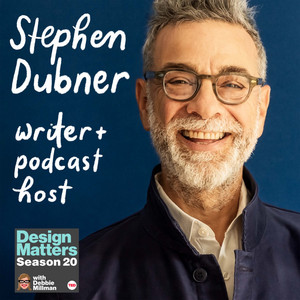
Hey there, it's Stephen Dubner.
If you divided the world into two groups of people, one that likes to ask questions and one that would rather answer them, I would definitely be in the first group, the question askers.
It's what I do for a living, but it's also one of my very favorite things to do.
But once in a while, I do find myself on the answering end of things, and that can be fun too.
It certainly was When I recently sat down with Debbie Millman, a designer, educator and writer who is host of the podcast Design Matters.
And that's the episode we are about to play for you.
As you'll hear, we are coming up on a couple of big anniversaries around here.
20 years since Steve Levitt and I published Freakonomics and 15 years since I launched Freakonomics Radio.
You'll also hear a bit about a new project.
I'm starting a TV talk show with the working title Better in Person.
You'll hear more about that in the months to come.
In the meantime, if you want to catch me in person, I will be in Washington, D.C. on Sunday, November 2nd, to celebrate 20 years of Freakonomics in conversation with Jeff Bennett at Sixth and I. and I will be in New York City on Thursday, November 13th in conversation with Bud Mishkin at the 92nd Street Y. For tickets for the New York and DC events, go to freeconomics.com slash liveshows.
Okay, here is today's episode with me answering Debbie Millman's questions on Design Matters.
I had never spoken with Debbie before this interview, but I liked her a great deal.
If you feel the same way, you should check out her show on Apple podcasts or wherever you get your podcasts.
As always, thanks for listening.
From the TED Audio Collective, this is Design Matters with Debbie Millman.
On Design Matters, Debbie talks with some of the most creative people in the world about what they do, how they got to be who they are and what they're thinking about and working on.
On this episode, Stephen Dubner talks about 20 years of Freakonomics and about our extraordinary capacities to adapt and change.
Stephen Jay Dubner is an award-winning journalist, best-selling author and the co-creator of Freakonomics, the book that became a cultural phenomena and has changed the way millions of people think about how the world really works.
20 years after its publication, Freakonomics has grown into a global franchise, spawning sequels, films and some of the most popular podcasts in the world, including Freakonomics Radio, which Stephen Dubner hosts with wit, rigor and curiosity.
Along the way he has built an empire of smart, surprising storytelling, showing us the hidden side of everything and inviting us to question what we think we know.
Stephen Dubner, welcome to Design Matters.
Hi, Debbie.
I'm blushing hard, but that's very nice.
Thank you.
Thank you, Stephen.
Now I understand.
You published your first, your very first piece of writing when you were 11 years old.
Can you tell us a little bit more about what you wrote?
That is true.
It's not a long story, but it takes a minute.
So do you mind?
Absolutely.
I want to hear the whole thing.
So I was sitting there in sixth grade and And I had a teacher that year that I did not like.
I'm not going to name her name.
She knows who she is.
And I was having a year.
It was the year my dad had died.
I was a kid.
I was the youngest in a big family in upstate New York.
And my dad, our dad had died.
And, you know, that sucks.
And someone knocks on the door and it's Mrs. Peterson, my fourth grade teacher.
And she comes in.
She says to the sixth grade teacher, I have something to say, I guess she said about Steve Dubner.
And I said, oh, shit.
What did I do in fourth grade?
That was so bad that the statute of limitations hasn't run out and I'm being called out on it.
And she held up a copy of Highlights magazine, which all of us knew, because it was like in the dentist's office.
Of course.
I loved Highlights.
I loved it, too.
I really read it quite avidly.
And it turns out that this poem I'd written in fourth grade for Mrs Peterson's class.
She was so, I guess, taken with that.
She submitted it, unbeknownst to me, to Highlights Magazine for their submission section of whatever a young writer's section where they would publish a few things.
It was a poem called The Possum.
I'm not going to say it was a great poem, but it wasn't a terrible poem.
And so anyway, she wanted to announce to me and the class that they had a published author among their ranks.
And I was just so... you know, I tear up now thinking about it.
I was just so moved because I'm not saying I wouldn't have become a writer had Mrs Peterson not done that, but oh my goodness, what a vote of confidence that was.
And so, yeah, so the first time I saw my name in print as a byline was in Highlights Magazine.
It said Steve Dubner, Delance in New York, age nine, but I was actually 11 by the time it was published.
I guess I have a big slush pile there, but it was extremely exciting.
And I have that original copy of Highlights on the coffee table in my office to this day.
I don't open it very much, but I'm glad to know it's there.
I feel the pride for you.
Does Mrs. Peterson, do you keep in touch with her at all?
Does she know what you've become?
I haven't been in touch with her lately, but when I first started writing books which is gosh 25 years ago now yeah, I think when I gave a reading or two back up home near the Albany area and we connected then.
And you know what I really think about that story.
What it really shows is just the power of a good teacher.
Yeah.
Mm-hmm.
Mm-hmm.
Mm-hmm.
And I was studying writing, but I also got a teaching assignment, a teaching fellowship.
This was up at Columbia, and I was teaching freshman English.
It was a wonderful course called Logic and Rhetoric.
And I loved teaching it.
The students were really brilliant.
Most of them were much smarter than I was.
I didn't have anywhere near the kind of education they had by that point.
I was a kind of young graduate student.
And I realized after teaching there a year that I did not want to be a professor, because I think to be a really great teacher you have to be quite selfless.
And I'm just not.
I mean, I'm selfless in some ways, but as a writer, I just wanted to write.
I wanted to do my writing, my reporting, my ideas, my books, whatever.
And so I realized that I wasn't going to be a great college professor, because I would have been like working on my novel and then like, oh crap, I have to go teach that class now.
And that's not who you want as a teacher.
Who you want as a teacher is Mrs. Peterson.
So I was really lucky to have her.
You were born in Duanesburg, a small town in upstate New York.
You were the youngest of eight children, as you just mentioned.
As you were growing up, I read that when it was your birthday, you had to eat your entire piece of cake without saying a word.
And if you broke your silence, it resulted in this penalty.
Molasses would be poured over your bare feet.
Then chicken feed was sprinkled on top.
And then you had to walk through the chicken coop and let the hens peck at you.
So my question is this.
Really?
Okay.
So we definitely sound absurd at the very least.
Second of all, it is true that was a custom the birthday cake eating custom.
No speech allowed from the birthday person and you would be goaded into speaking by family and friends.
Now, as far as I know, the chicken feed on the feet with molasses thing was real as a threat.
I don't know if it actually ever happened.
It's quite possible that it did happen to some of my older siblings, but When you're the youngest in a family, you inherit all this family history, some of which is wonderful, some of which is just absurd.
So I'd have to check with all the siblings if it ever happened.
I wouldn't be surprised if it did, but I wouldn't be shocked if it didn't either.
But yeah, I was pretty scared.
And also by the time I was that old whatever six seven, eight The chicken coop was one of my turfs, my territory for chores.
And I did not like it.
Like, I was scared of even the hens.
The rooster was a menace.
Just mean, ornery, all those things.
And I was really scared of him.
But I had to go in every morning and collect the eggs.
And even that, you know, I was born in the country.
I was raised on a farm.
But I'm really a city boy genetically.
And so it took me a while.
But once I got to New York City in my 20s, then I started to breathe easy.
I read this account of your birthday cake silence in an article that you wrote in the New York Times in 1996, titled Choosing My Religion.
And in the essay you write about how both of your parents were born into Jewish families in Brooklyn as was I, by the way but independently converted to Roman Catholicism before they met each other.
And I know you've spoken about this at length.
You wrote an entire book about it.
But for my listeners that might not be aware, what initially motivated their conversion?
That's a good question.
And the answer can get long fast, which is why, as you noted, my first book was A book that was meant to be about just my parents.
That was my curiosity.
It actually began even before that, when I was in grad school.
That I mentioned when I ended up teaching for a little bit.
This was up at the School of the Arts in Columbia, and I got a degree in writing.
And I thought what I would do is write novels and teach college.
And so what I was writing in that two-year writing program?
I started a couple novels.
And the one that I liked most was a fairly autobiographical-ish novel about a guy like me who'd grown up in a family like that two Jews who became Catholics.
And I was just starting to get curious about Judaism because I'd moved to New York a few years earlier.
And all of a sudden I had a lot of teachers friends, all kinds of people who grew up Jewish and stayed Jewish.
And I'm like, well, my parents grew up Jewish.
And then people would say, well, what happened to them?
And I was like, well, you know, they converted to Catholicism, as though a lot of people did that.
I didn't even know.
I knew so little.
And they're like, what do you mean they converted to Catholicism?
So I thought, oh well, I don't really know the details because by the time I was a kid in this family, that was ancient history.
So...
What started as a novel.
I ran into a brick wall because I wanted to tell the fictional version of their conversions and I didn't know it.
So I went to my mom, who by now was living in Florida.
You know a vestigial Jewish trait there the migration to South Florida.
And And I began to just really sit down and interview her.
You know, I've been a writer really my whole life.
I've always enjoyed interviewing people because I was very shy.
But if you're a writer, it gives you permission to ask questions that you want to know, but it gives you a kind of framework or a reason to do it.
So I sat down with my mom and a tape recorder.
I said, you know, mom, I'd really just love to do an oral history with you.
The other motivation for this was that I had no money, and every year I'd like to give some nice Christmas present to all my siblings.
And this year I thought well, what if I record a nice oral history with my mom about her childhood and about converting to Catholicism?
Then I'll write it up and I'll distribute it to the siblings.
I thought that would be really nice.
But then...
Once we got going in it, it was just really interesting, and one question led to a hundred more.
I didn't know my father's family at all.
His family was Orthodox, so when he left Judaism, they, for the most part, really cut him off.
My mother's family was more assimilated.
There was less cutting off, but there was still a lot of friction and tension and so on.
So anyway, what started with my mom led to then many many, many other people interviews, travel around, whatever.
And that became, it started as a New York Times article that you cited.
That was in 1996, maybe.
And then I published my first book in 1998 called Turbulent Souls A Catholic Son's Return to His Jewish Family.
And that was my first book.
I ghosted a book before that, but it was my first book.
And it was an incredibly moving, difficult, satisfying experience to write a book like that.
I wished my first book wasn't about me.
Because I ended up coming into it?
Because as I began on this exploration of what it meant for my parents to leave Judaism, I started hanging out with all these Jewish people.
Like I said, friends, mentors, teachers, scholars.
I started studying some Judaism.
I did a lot of reading and so on.
And then I ended up kind of returning to Judaism myself.
So I can't remember the question you asked me, Debbie.
I hope I'm answering parts of it, but that's what happened to me.
Yeah, no, you've absolutely answered it.
I thought it was really fascinating on so many levels.
From a personal point of view, my father's family also were Orthodox Jews from Borough Park Brooklyn.
Hmm.
My father, I wouldn't say that he... abandoned his roots.
But going to a public high school in Brooklyn, he ultimately became less orthodox.
He became really more reform.
But my mom was also Jewish.
They got divorced.
My dad remarried to a woman who wasn't Jewish, had two more children.
And you know what that means.
And he was basically at that point excommunicated from the family.
He's a non-Jewish person.
It wasn't until much, much later, towards the end of his life, that he and his sister reconciled.
So it's really interesting.
Now, I understand that Your parents, like, never, none of them went to your parents' wedding.
Your father's father, I think, never spoke to him again.
Is that right?
That's true.
Yeah, that's true.
Your mother saw your return to Judaism as a betrayal.
But ultimately, I believe your path to reconciliation with her was through Cardinal O'Connor, who counseled you towards an informed conscience.
I believe your mother wrote him a thank you note because of that.
I'm sure she did.
My mother had good manners.
What happened is before I wrote the book.
I wrote the Times Magazine article, as you noted, and it was on the cover.
And it was a big deal for me.
It was a big deal for my mom, too, maybe.
In a slightly different direction.
It was published on, I believe, the week of – there was an overlap of Good Friday, Easter and Passover.
So it was a very fortuitous collision of the calendar there.
I was at the Times office.
I worked at the New York Times Magazine.
And two colleagues of mine, I think it was Jerry Maserati and Camille Sweeney good friends – came back from.
Patrick's Cathedral.
And they said, hey, you know, just so you know, Cardinal O'Connor just read from your article.
Jerry had edited the piece I wrote.
So I just read from your article during the Mass there.
And he said well, he read the part about your mom becoming a Catholic, not the part about you becoming a Jew, which makes perfect sense.
And I would have done the same thing if I were a cardinal.
So anyway, this happened at a time when, as that article came out, my mom, as you said, had some conflicted feelings.
I think the big thing was really a maternal feeling.
She truly believed –
That when she died, that she would go to a Catholic heaven if she did everything the way she saw fit.
And she did see fit.
My mom was a really wonderful, wonderful woman and a very I don't want to say obedient or observant Catholic, but a really a true believing Catholic.
And so she thought she would go to a heaven where, over time, she would be reunited with her husband first certainly and her siblings, but that I, by excluding myself from the Catholic belief and tradition, that I would never get there and see her.
And so as a mother not as a theological endeavor, but as a mother she saw this as a sort of family tragedy.
As I began to understand the import of that, I wanted to try to fix it.
I guess and, And so I wrote a letter to the Cardinal and I introduced myself and said you know, I understand.
I wonder if I could kind of pick your brain.
I probably didn't use that language that I wonder if I could sit down for some counsel.
And you know, because he'd read the article, I knew, I knew, he knew where I was coming from and where she was coming from.
And so we had a meeting at which he described to me what you just mentioned.
Debbie, you know that the Vatican, during the Second Vatican Council, which I think was in the early 60s that you know, the church changed the ways in which it talked about, thought about and preached about Judaism.
It was a real evolution.
But in addition to that, the Vatican embraced I believe this was part of the Second Vatican Council.
I may be wrong, but the Vatican embraced what they call the primacy of an informed conscience.
And the cardinal told me that if you believe you have duly informed your conscience in the ways of the church, Catholic church and in the ways of another faith, and if you truly believe God wants you to be a member of that other faith, then you should father your conscience.
Now, I don't know about the God part because I don't – that's a complicated issue.
So it's hard for me to say even then that I think that God wants me to be a member of the Jewish family rather than the Catholic family.
But yeah, I went with that.
I thought that was enough.
And so –
I had, you know, I'm a reporter, I'm a writer, I record my interviews.
And so I recorded the interview with the Cardinal, with his consent, of course, and knowledge.
And afterwards, I took it and typed it up and sent this transcript to my mom.
And that was really the beginning of a new kind of relationship between the two of us.
And I remain very, very grateful to Cardinal O'Connor for having done that.
He really helped heal a family rift that I think otherwise would have been very difficult to heal.
You've said that the experience of inhabiting two traditions gave you a lifelong fascination with questions about identity and belonging and belief.
How has that fascination shaped your worldview, your career and the way that you're living your life?
I love that question.
Look, I believe curiosity is natural for everyone.
And I think we adults tend to think about children as innately curious And then like what the heck happens.
And I think what happens is often school and parenting.
Because you know it's exhausting when somebody is just asking question after question after question, especially when you don't know the answer.
And so I think a lot of our education system and even a lot of our parenting is kind of geared toward parenting, behaving well, to quote, paying attention.
Even that phrase, paying attention, I hate, because what paying attention means is I want you to listen to what I think is important.
Oh, why?
What makes you?
I mean, I'm not saying you shouldn't ever pay attention, but I think that all of us are really curiosity engines.
And if you can manage to get into your adulthood with that drive intact, then I think it makes life a lot more interesting.
And I like to hang out with people who are not just smart, but really curious.
And the curiouser you are, I think the smarter you are.
So for me, it's really important.
I shouldn't even say it's important.
It's almost natural.
To look at any, whatever it is occupation institution place, person and just kind of want to figure it out.
I had an interview the other day.
We're making a radio series right now on the economics of the horse market, mostly racehorses and showhorses.
And this grew out of just a kind of recurring notion of mine of how interesting it is that when technologies get superseded by new technologies, the old ones don't go away.
They get repurposed, usually.
We did an episode recently on candles.
Why are candles a $10 billion global industry 100 years after electric light was introduced, right?
So with horses, similarly, we used to be extraordinarily reliant on the horse.
Most of civilization, for transportation manufacturing, all these things, and then they got replaced for that.
But there are still a lot of horses and there's a really interesting universe around the horses and a really interesting market around the horses.
And so the other day, i mean the last couple weeks, i've had a few interviews with people in the horse world and i know very little about the horse world, maybe Slightly more than the average person about racing.
I've been to racetracks and whatnot, but I know very little and I'm a little bit scared of horses.
But for the series, I got on a horse, spent a lot of time with horse people and so on.
And two of these interviews in the last few weeks one with a guy in Kentucky who's a breeder buyer, trader agent, all these things, who's a lovely, lovely man.
And another interview with a retired jockey, one of the best jockeys in American history, Richard Migliore, who's now a commentator for Fox Sports I guess on their horse racing events.
Both of those conversations were among the most interesting conversations I've ever had in my life.
And it's just because these were interesting, knowledgeable people who were willing to be expansive with a person who is genuinely curious.
I brought no special skills.
I didn't have anything to offer them other than, you know, I make a show.
And if you'd like your voice to be on the show, here's an invitation.
But you know they're taking an hour and a half or two to go to a studio and sit down and tell some stranger how things work in their field.
And I think that is wonderful.
And I wish, you know, I love what I do.
I wish I don't want to say I wish more people did the kind of stuff that you do and that I do, but I do wish it because I think so much of what people consume that they think is media or information or news is really just gossip.
So-and-so did such and such, and now so-and-so is upset or happy and it costs blank.
That's not really news.
That's not an idea.
And so I do feel that almost any person on earth is pretty interesting if you sit down and talk with them.
With Freakonomics Radio, we've had a pretty broad remit over the years.
We cover a lot of topics, but it's mostly trying to figure out how things work.
I'm actually starting a new project now that I'm super excited about and super scared about.
It's actually, I mean, it's a TV show.
I'm starting a TV show.
It's a talk show.
And I want to have conversations that are similar to what I've been doing with Freakonomics Radio, but a little bit more like this maybe that are less interviews about a topic and more conversations with a person.
So, you know, Freakonomics Radio is about how things work.
This would be a little bit about how people work.
What's the difference between reputation and character?
I'm much more interested in character.
I don't give a darn about reputation.
I've known many people who had reputations that were wonderful and you spend time with them.
You're like really.
They have good PR and vice versa too.
And I think when you're speaking with people Someone, if they see that your curiosity is genuine, you're not cynical, you're not exploitive, you just want to know for the sake of knowing.
I think most people really appreciate that and they do their best to meet you halfway and I love that.
When will we be able to start seeing the television show.
Well, the plan is to start shooting some episodes in November of this year.
So I'm guessing probably sometime in the first one to three months of 2026 people will be able to watch this.
This is something I'd like to do in concert with, in addition to Freakonomics Radio.
I want to do this for another 10 years, 20, whatever I have.
You know, I love this stuff.
Coming up after the break more of my conversation with Debbie Millman on her podcast Design Matters.
I'm Stephen Dubner.
This is a special feed drop episode of Freakonomics Radio, and we will be right back.
I want to talk to you a little bit more about this notion of reputation and character, and And you also mentioned before that your dad passed away when you were 10 years old.
And I think this is when you first became entranced by Franco Harris, the famous running back for the Pittsburgh Steelers.
And you were really, really infatuated.
You've written about how you dreamed of him every night.
You signed your school papers, Franco Dubner, which I love.
Years later, you journeyed to meet Franco Harris, and you wrote a beautiful book about this.
You were certain that he would embrace you.
What happened?
What happened?
Yeah, he wasn't very interested.
He was a very good man, I think.
He died suddenly, tragically, a couple years ago.
Yeah, you know, I pitched him on this story, basically.
I said, you know, he was, as you just said, a childhood hero.
I had this recurring dream every night for a couple of years, not long after my dad died.
It was plainly a sort of Messiah rescue dream.
And I was a huge Pittsburgh Steelers fan.
So he was really an important kind of character in my life, as ridiculous as that sounds.
Although I will say now that...
One reason podcasting is so popular now, I realize, is because of what psychologists call the parasocial element.
People feel they know you, Debbie, because they hear you.
And they don't know you, but they have a relationship with you.
And That's a very powerful thing.
So I had this very powerful parasocial relationship with Franco Harris.
Then years later, so I was in my late 20s maybe, early 30s, I was at the New York Times.
I'd maybe just published, or getting ready to publish, my first book, which was this – memoir about my family.
I was walking by a newsstand in Times Square and I saw Franco's face along with Lydell Mitchell, his Penn State backfield mate, who played pro for the Baltimore Colts.
They were in this magazine called Black Enterprise Magazine and they were in business together in like an industrial food business.
And I thought, oh my gosh, I hadn't thought about Franco in 10, 15, 20 years.
I wonder... what he's doing.
I wonder how he came out.
And so when I read this article, I thought, well, he came out well.
He's doing well.
But, you know, another fascination of mine was the afterlife of the professional athlete.
When you're a sports fan and you watch these people, you're seeing their life just through a tiny tiny, tiny piece of a keyhole.
And you don't know what their life is.
You don't really know who they are.
You don't know what they were really before and after.
So I thought it would be a really...
Interesting story to write would be to follow up with my childhood hero and write about the afterlife of the professional athlete and see what that life was like.
So I wrote him this letter.
He called me.
We talked it through.
He sounded, you know, Franco is just a little bit of a he was just his own guy.
He wasn't he was very nice, but always a little bit.
There was always just a little bit of distance there somehow.
Yeah.
Very good man.
He did a lot of good things for a lot of good causes and so on.
But he wasn't the kind of guy who's going to say hey, come on down, and you know you stay at my house.
We'll talk for hours.
It was a little bit trickier than that.
But he did say, come to Pittsburgh.
I'll pick you up at the airport.
So I do that.
He picks me up at the airport.
We walk by in the Pittsburgh airport, these two kind of statues that they have there.
One is young George Washington, who I believe did some of his surveying work in Pittsburgh.
And the other was Franco Harris, making the Immaculate Reception the most famous play in Pittsburgh Steelers history.
And it's kind of cool to walk by the Franco Harris statue with Franco Harris when he picks you up.
So we spent, you know, the better part of a day and a half or something like that together.
I just described this idea.
I'd like to hang around.
I'm a reporter.
I'm a writer.
You hang around.
And I said, what do you think of that?
And he said, well, can you sell?
And I'm like, what do you mean?
He's like, well, you know, I'm running this business.
Like most of my work is like I'm going places.
I'm going to schools, prisons, whatever.
I'm trying to sell them my line of nutritional baked goods.
So he was kind of serious about that.
And I'm like, no, I can't.
I can't sell.
But I'll follow you around and write down everything that happens and I'll write a book about it.
And he wasn't really that into that.
So we went back and forth.
There was another time I was supposed to visit him in Pittsburgh, packed up my car, drove down.
I had all my files, got a motel for like 10 days.
And he left town without telling me.
So there was that.
There was a lot of back and forth like that.
Anyway, I did publish the book.
He invited me.
That year, the year the book came out, he invited me to the – every year at the Super Bowl he would throw a party, kind of a business opportunity for him, because he had all these clients.
And he invited me to that, but he always kept me a little bit at arm's length.
And then, a couple years ago, they were celebrating the 50th anniversary of the Immaculate Reception in Pittsburgh.
And it was a game late in the season.
I think it was December.
I want to say maybe it was against the Raiders, probably because that's who the play happened against originally.
My son, Solomon, by now has been a Pittsburgh Steelers fan since he was a kid because of me.
So we were going down.
And then I got invited to Franco's family and friends were having a party on the side to celebrate this.
And I got invited to that.
And I thought, oh, that's nice.
You know, maybe there's been some passage of time there.
Since the book and maybe they're feeling – he's feeling a little bit more sanguine about it.
And then a couple days after that, the invitation was revoked.
I'm not quite sure by who.
I don't think Franco was involved at all in any of this.
I think it was people who defended him who felt that I had – given him a little bit short shrift somehow in the book.
And I'm not sure they're wrong.
I'd have to go back and read it.
I try never to be ungenerous as a writer, but I always try to be pretty honest.
And you know, when your hero says he's going to let you into his world and he kind of doesn't show up repeatedly and you write it down, I guess it makes him look bad, whatever.
But then after I'd been invited and uninvited, then he died.
Like in those days between the uninvitation and the actual event.
And so my son and I were already.
You know, we were already planning to go to the game and we went down.
It was just very, very sad.
On the other hand, when family and friends got up to toast him at the game itself, like during halftime, it was just a reminder.
He was really, he was awesome.
I loved him.
I loved him deeply.
I wish he'd loved me back a little bit more, but if I were him, I think he played it just right.
Okay.
In your book about the experience Confessions of a Hero Worshipper, you write I came looking for a savior, but what I found was a man.
And maybe that's the truer gift.
Do you still feel that way?
I do.
I do.
I like that line.
I didn't know.
You know I don't go back and read much of what I write, but when I'm writing something I care a great deal.
And I probably wrote that 150 times, those couple sentences.
So, yeah, I like hearing that back.
I do feel that way.
I do feel that way.
And I think not just a man, but a mensch.
I think he was a really menschy fellow.
So, yeah, I miss him.
I mean when I say I miss him.
It's not like we had much of a relationship, but I miss being in a world where Franco Harris is still around.
You went to college at Appalachian State University.
You were studying, majoring in communication.
But you also started a rock band named The Right Profile, which you seriously pursued for five years.
Before we talk about that experience, was the name of the band an homage to the Clash song?
It was, yeah.
Oh, good.
Yeah, London Calling was my... probably one of my 10 favorite records ever.
And it was relatively new then.
And yeah, I thought the clash was just great.
And I didn't, it wasn't like I had some big affinity with Montgomery cliff.
That song was about Montgomery cliff, how he'd smashed up the left side of his face in a car crash.
He had to shoot his right profile, but you know, that's what we named the band.
You described the band's music as a sort of mashup of blues and Rolling Stones-style rock and punk.
And you said you were terrible for a long time, but then you got better and better.
So you were the guitarist?
So as a kid I played mostly piano and then band instruments like French horn trombone, stuff like that.
But it was a musical family, so everybody played a little bit of everything.
But then in the band, I started on piano.
And I was a decent piano player.
I grew up playing kind of like my piano hero when I was a kid.
I don't know how this happened.
Somebody gave me a record by Otis Spann, who was a...
A Chicago blues piano player.
So I was, weirdly enough you know, a white kid from upstate New York who really really loved hard blues piano.
And, you know, I was okay.
I was good.
I could have been really good if I'd really, really kept at it.
And then, once I got in the band with these guys Jeffrey Foster and Tim Fleming were the two other guys who'd already gotten the band started, really when I joined.
I was there as a piano player.
Jeffrey was a writer, really good songwriter.
But then over time, I started writing songs as well.
And then I also started playing a lot more guitar.
And again, not a great guitar player by any stretch, but we did start to become a pretty good band.
And our writing got better.
Jeffrey and I probably each wrote many dozens of songs over the next four or five years.
And then you progress.
It's like going up through the minor league system.
You play crappy little clubs.
You play crappy big clubs.
You play slightly better big clubs.
You start opening for bigger bands now and again.
Then we got signed on.
We got a manager that represented a couple bands I really liked.
The Del Fuegos was a band from Boston that I loved.
They also represented the Replacements, which were a bigger band that I liked not as much as the Fuegos.
And then we came to New York, did some shows.
We played CBGBs.
Clive Davis from Arista came to see us at CBGBs.
Arista signed us.
And then we started...
Making our record over the period of, you know one, one and a half, two years.
Maybe we're in writing songs pre-production, whatever.
And then, as we were getting really close to making our first record for a major label, I just it wasn't sudden.
It was, it was cumulative.
It was gradual for a lot of different reasons, not just it's all the travel and whatnot.
But you know, I'm not sure I want to lead a life where my main professional activity is drawing attention to myself.
So yeah, I decided to quit the band.
That was a little bit dramatic and traumatic.
It was really my entire community and whatnot.
By then, I'd been spending a little bit of time in New York City.
I had a girlfriend here.
I moved here, then ended up going back to school, graduate school up at Columbia.
And then I've been doing pretty much some version of the same thing ever since, some version of writing ever since then.
You stated at the time that you wanted a somewhat more stable and more anonymous life, but I don't think that anonymous thing really worked out very well.
I guess that is true, although I will say this.
Being a writer of books and then being a radio person are pretty anonymous.
People may know what you do.
They may know your voice.
But if they don't know your face, that counts for a lot in my book.
Now, the paradox here is, as I told you, I'm getting ready to start a TV show.
Yeah, I was just about to say that face is going to be everywhere.
Well, OK, so that's problematic.
Yeah.
But the thing is, is now I think I can handle everything.
The right level of not caring about it.
I had this incident even with someone Freakonomics came out.
It was 2005.
A few years later, there was a film made, a documentary film based on the book, by a bunch of different directors.
I love that film, by the way.
Thanks.
Thank you.
I can't claim credit because we didn't make it, but I'm glad I'm really glad you liked it.
And when the film came out, Steve Levitt, my Freakonomics co-author, and I were in it a lot.
Our faces, you know, we sat for interviews and blah, blah, blah.
They follow you around and shoot B-roll and all that stuff.
It was just a documentary film.
But still, people see this stuff.
And I was starting to get recognized in airports.
And I don't know what to say.
I just don't like it.
And I get that many people do like it.
I get that many people who are recognizable love being recognized.
I like being thought of as someone who does good work.
Don't get me wrong.
It's not like I have no ego.
But the idea of someone coming up and saying, hey, you're so-and-so.
And then they want to tell you what they think of you.
And it's usually positive, but it's just not a conversation that I'm crazy about having.
And so when that happened, I cut my hair short and grew a long beard.
And that worked pretty well for a while.
And at the time I was also doing a fair amount of TV as a regular guest because of Freakonomics stuff.
And I kind of stopped then.
I also felt that...
The way most TV is made is just really stupid.
Someone once said about TV, they call it a medium because it is neither rare nor well done.
I mean, I realize that's snotty of me to say, but you know, I just think a lot of it is not made...
With the best intentions, with the best forethought, with the best talent, and so on.
Obviously, there's been some great television, especially in the last 20, 30 years.
Mostly, I'm talking about scripted fiction stuff.
But I want people to put as much effort and thought into the TV show as they do into writing a book or creating a great painting or building a great building.
And I don't always see that in TV.
Sometimes, for sure.
I don't mean to disparage at all.
So anyway...
I stopped doing TV as a guest and we had a Freakonomics TV show at one point, all lined up ready to go, and I realized it just wasn't going to be good.
It wasn't going to be fun, and it wasn't going to be good.
And the only reason to do it would be for me to get more attention, which I didn't want, or to make more money, which I kind of had enough of.
Freakonomics was a great thing financially for me and my family.
I got to send my kids to college.
I got to stay in New York City.
It was a huge boon.
So I didn't want to get greedy and just do something for money.
But now I'm at the point where I really feel like I want the visual conversation.
I want the visual medium.
The tagline I have for our TV show is, because people need to be seen and not just heard.
And so, yeah, so I'm willing to take that gamble.
I also figure, you know, I'm 62 now.
It's like, who gives a shit?
I don't.
Other people probably don't.
But I do feel that, sitting knee to knee with someone that you either know well or don't know at all, maybe you agree with them about things, maybe you don't.
And having a real good conversation, I think is a valuable model to put out in the world.
I'm so distressed as I'm sure you are, as I'm sure most of your listeners are about how we just talk past each other and shout at each other.
Now, I hate that.
I hate that.
It goes against everything I've ever treasured about humanity.
And so, you know, I don't have great aspirations that this show of mine is going to change anything.
But, you know, if it changes five people's minds, that's something.
Yeah.
Yeah, I mean, I think a lot of social media is about having a one-way conversation, which is really problematic for lots and lots of reasons.
I really listened to your episode about, is social media terrible for us?
I thought it was really interesting to hear that it's also the conditions of our culture that are contributing to so much of the unease in our time right now.
Yeah.
I wanna talk to you a little bit about writing.
I listened to your episode with my dear friend, Tim Ferriss, and you said something that really stopped me in my tracks.
You stated that it was harder for you to learn writing from great writing than it was to learn from writing, because when things are really good, There's a natural inclination to want to copy it or mimic it.
So if you read a novel that you thought was a great novel, you initially thought this is what you should pattern yourself on.
And you go on to state that there's all kinds of reasons that can't or won't work, including the fact that it's going to take you away from being your best natural version of yourself.
And so I want to know, how were you able to locate that best natural version of yourself?
I think it took a lot of time and a lot of work and a lot of honesty, really.
And also, I think a lot of it is a word that people don't talk about.
Well, maybe people do, and maybe I just didn't hear it.
I think you have to just have confidence in yourself.
I think that we live in a very status-obsessed civilization.
Some people more, some people less.
But what status obsession does is?
It leads or forces you to always and constantly compare yourself to something.
It might be your former or future self, but more likely it's other people.
I wrote this short story.
Is it as good as Raymond Carver?
Is it as good as Mark Twain?
Is it as good as Virginia Woolf?
Probably not.
But then you realize, what am I doing here?
Sure, there are imitative elements of creativity, but I really do believe that every one of us is this wild little science experiment of genes and bones and muscles and synapses and whatnot.
And be that.
Be you.
I was fairly good at enough things when I was young to know what it feels like to be confident in myself in certain circumstances, right.
So I was pretty good at baseball.
And so when I would get up down two runs, two runners on bottom of the ninth, I mean I got nervous but I felt like I belonged there right.
Yeah.
But then in other domains that sometimes wouldn't transfer, like dealing with important people I would get very intimidated by, and so on.
I still feel often, you know, when I'm in a room, I often still feel like I'm just like a nosy kid and I want to ask this person stuff like why would they want to talk to me or why would they answer that question, or so on.
I do feel that a creative life is really an exercise in Taste making, like it's really important to have good taste, but it's got to be good taste that originates from who you are and what you really love.
And so I feel like I'm now at the stage in my writing radio whatever, whatever career that I feel like I know what I like to do.
I like to have fun.
I like to learn.
I like to be kind.
I like to be around other people who are all those things.
If there's something worth learning from someone who's unkind or not fun, I might still do it if I really want to learn from them badly enough.
But you kind of sort out what kind of person you are.
I play golf.
I took golf up late in life, but I really, really, really love it.
And a lot of amateur golfers, especially people who take it up later in life.
They find themselves trying to learn a swing That belongs to someone else.
It might belong to Ben Hogan, Jack Nicklaus, Tiger Woods, whatever.
Well, all their swings are really different from each other.
You really think it's going to work for you to copy their swing.
So there are elements of a swing, just as there are elements of writing or music making or cooking or science or whatever that are certainly transferable.
But there's also a great deal of. of individuality in all of those things.
Who is it that says, swing your swing?
Arnold Palmer maybe was a golfer who said, swing your swing.
And I think that's the case for write your writing, sing your song.
I think it's really important to get to that point, to feel confident in your ability to do what you want to do.
But then there's another step, which is, well, what if the world doesn't like it?
You know what?
It's unfortunate.
It really is.
If you make something that you loved making, that you're really proud of, and you put it out there and the world either doesn't care or actively dislikes it.
That just sucks.
It hurts.
It just does.
But it's, you know it goes to like is it better to have loved and lost than never to have loved at all?
Is it better to have created and been slammed than to have not created at all?
I would say yes.
Not everybody feels that way.
But I think you have to develop your own personal creative philosophy.
And that's mine.
We will finish up this conversation of mine with Debbie Millman on the Design Matters podcast after the break.
I want to talk a little bit about Freakonomics.
You have your 20th anniversary of the book.
Congratulations.
You have your 20th anniversary edition coming out.
Is it true that you almost titled the book Eccentric Economics?
Oh, probably.
We had this book, which was really, really fun to make.
So Steve Levitt and I were not friends.
I'm a writer.
I was sent to write a piece about him for the New York Times Magazine, which I did.
And I loved, I just loved his brain.
And I wrote this piece that I really enjoyed.
I remember calling my wife from Chicago, where Levitt is, the first night of my reporting there.
And I said I don't know if anybody at all is going to care about this article that I'm writing about this guy.
Kind of offbeat economists at Chicago, but I'm loving it.
I'm having a great time.
Then I wrote this piece and people did care and then people wanted a book.
What do I do?
And I said, well, if you want to write a book.
You need an agent.
She said, do you know an agent?
I said, well, my agent is awesome.
Suzanne Gluck, William Morris.
And people were saying to me, oh, I love that piece.
You should write a book about Leavitt.
And I'm like, I don't want to write a book about an economist when I just wrote a profile about him.
And I was also in the middle of another book.
And then Suzanne said, what if you guys co-wrote it?
Which neither of us would have in a million years of thought, as obvious as that idea may have seemed.
And it was a blast.
We just really enjoyed working with each other.
We fed off each other.
We kind of filled in each other's blanks in a way.
And then we had this manuscript that was full of, like all these, different stories, empirical stories based on data, mostly based on research that Levitt had done in a very intense analytical setting, or empirical setting at least.
There were stories about, like sumo wrestlers and real estate agents and Klansmen and high school teachers.
Like there was no unifying theme whatsoever.
And ours was sort of the opposite.
It was all these stories that illustrated no concept at all.
So we were looking for titles.
We had a bunch of horrible titles.
Steve Levitt's sister got to work.
She had worked in publishing and in advertising.
She came up with a list of about 200 titles maybe.
And one of them was Freakonomics.
And when Levitt and I saw it, we both like burst out laughing with joy.
And like, this is so, just so outrageous and outlandish.
It's so bad that it's great.
And we just loved it.
So we brought it to the publisher and they're like, absolutely not.
Like they'd say like, do you know what a freak is?
I'm like well, I just think of as freak as someone who does something a little different.
You know Coney Island freak show, whatever.
And like, no, no, no.
A freak is someone who engages in transgressive sex.
Like, well, OK, I guess that's one definition, but that feels kind of narrow.
But anyway, we couldn't budge them for a long time.
So we were feeding them a bunch of other titles.
And I'm not going to lie.
Some of the ones we fed them were intentionally pretty bad.
And whatever you said, eccentric economics, that sounds like it was one of them.
The worst one that I remember was E-Ray Vision, right? with the E standing for economics.
Like if you use these special lenses, you can look through things.
And so finally the book was publishing like pretty soon and there was no title.
And finally the publisher relented and I'm glad they did because I think it was good title.
Thanks to Linda.
Absolutely.
I want to give you some data here.
You know this, I'm sure, but it's all in one place.
Freakonomics A Rogue Economist Explores the Hidden Side of Everything was published in April of 2005.
For my listeners that might not have read this wonderful book.
Why do drug dealers still live with their mothers?
What do real estate agents' incentives reveal about human behavior?
It offered answers through the lens of economics and incentives.
The book debuted on the New York Times bestseller list at number two, quickly rose to number one.
It then spent over 96 weeks on the list. has been translated into 40 languages at last count.
I could be wrong about that one.
And the paperback edition released the next year extended that run even further in total.
The book logged over 140 consecutive weeks on the list.
If that isn't enough, the Freakonomics universe expanded with the subsequent publication of Super Freakonomics in 2009.
Think Like a Freak in 2014 and When to Rob a Bank in 2015.
All New York Times bestsellers.
So here's a funny question.
Can I just say, I would hate the person who wrote those books.
I would be so jealous.
I can't believe it's me.
I'm serious.
It sounds absurd.
So for those of you who hate me, I get it.
It's just too much luck for two people.
It's just too much luck.
I just wanted to say that.
I'm going to apply a little bit of Freakonomics economics to this question.
If you were to apply a Freakonomics lens to the publishing world, what hidden incentives do you think drive the bestseller lists?
Hmm.
That's a really good question.
Well, I guess it depends.
When you say drive it, I guess it depends on who are we talking about driving for the publishers, or maybe the buyers, or maybe the writers?
One of the things that I think is true about publishing and not just publishing, but movies, food trends and so on is that someone will do something different and it succeeds.
And then the companies who are responsible for making stuff change. just start to copy.
That's just the way it works.
And I get it.
It makes sense.
When Henry Ford showed that the assembly line could work for an automobile, it made sense that other people are going to do it.
But I think when it comes to ideas or creative endeavors, it's a bit of a.
The thing you should really care about are things that are new and different.
It's a shame that our discovery mechanism for new and different things is so inefficient.
I think there are many wonderful wonderful, wonderful things about humans and society and civilization, and there are many terrible things too.
There are many things that are abundant, which are often good.
Some things are abundant that are bad.
But then there's one thing that I think is rare, is too rare, that's a good thing.
And that thing is courage.
I just think people need to give themselves permission to be courageous about everything.
About who they are, about what they make, about what they think.
You know, this goes back, I was saying...
How a lot of what passes as news is essentially gossip.
People are capable of thinking hard and well, having ideas, thinking ideas through sharing those ideas with other people, adding to them.
I mean, that's what New York City is.
New York City is a place where a lot of people move because they want to do something or have ideas that they can then bounce off of other people.
See why it was terrible.
Build it, change it, whatever.
But all of that takes courage.
I said confidence earlier, but I think courage is the precursor to confidence.
Oh, I think that courage is the birthplace of confidence.
Yeah.
Absolutely.
How do you get more?
Like, how do you get more?
When you're not feeling courageous, what do you do to back into it?
Well, I tell my students that...
I believe that the definition of confidence is basically the successful repetition of any endeavor.
We don't start doing anything with confidence.
Maybe, unless we're you know, when we start to walk as babies.
Somehow you know we continue to want to do that, even though we keep falling.
But still, we keep trying.
And I think for me, confidence is so fleeting, as is the feeling of any sense of accomplishment.
It just goes away instantly.
For me, it's really just a good talk with my therapist.
I don't have any tricks.
Honestly.
I wish I did.
I wish I could say, Stephen, this is what I do.
And this is what everyone should do to ignite their confidence.
Doesn't work for me.
You know, it's interesting.
I mentioned golf before.
Like, I do love golf, but it's hard.
And the tricky thing is, you can hit a great shot one minute and then you, the same person can the next minute hit a terrible shot.
And there are very few other things that I've ever done that are like that.
Bowling.
Bowling.
Bowling.
Bowling.
All right, bowling and golf.
But usually if you're competent at something, your variance, your range is not that wide.
But with golf, it's different.
But really, if you think about it, it's very rarely a physical failure.
It's almost always a mental failure with golf.
You're thinking too much about the wrong thing.
You're out of your rhythm.
You're out of your routine or something.
And so for me, playing golf, confidence is a huge part of it.
But saying that, oh, I'm going to be confident now, that gets you nowhere.
You need to learn.
Here's another thing that I only learned relatively late in life.
And this was a lot through a friend of mine, Angela Duckworth, who wrote the book Grit.
And she and I did a podcast together for a couple of years called No Stupid Questions.
And I learned a great deal from her.
And the very basic thing that I came away with is that, I mean, I knew that the mind or the brain, the brain, let's say.
I know the brain is a muscle.
I know that.
But I never treat it like a muscle.
I treat it more like a trampoline that things will bounce off it and send you into some other direction, right?
Someone will say something or do something.
You will have an involuntary emotional response.
And all of a sudden you say or do something that is far from the thing that you really wish you had said or done.
But in fact, your mind or brain is a muscle and you can control it.
And I can say, you know what?
I recognize what's happening right now.
I just hit a bad shot.
I just gave a bad talk.
I just embarrassed myself.
I was just unkind to someone.
And you can say, okay, that's done.
What am I going to do now?
I'm going to process that for a minute.
See why I did it, try to figure out how not to do that very thing again.
And then I'm going to direct my mind, my brain back to what I want to be working on.
What do I want to be working on?
I want to think hard on this idea right now for the next 15 minutes.
Or I want to go for a walk, or I want to do a favor for somebody.
And I think that being a little bit more intentional with your brain as a muscle is a huge easy win for just about all of us, whether it's a cognitive thing we're doing, physical thing, whatever.
But the fact that it took me 50-some years to learn that tells me at least for me it's pretty hard.
So I'm guessing it's hard for other people as well.
Oh my goodness, it's one of the great struggles of my life.
I would love to get to a place where I can allow myself to suffer or feel humiliated or ashamed for a minute and then try to train myself to move out of that state, because truly agonizing for much longer isn't particularly good for anyone.
I mean, if you can learn from something and move on, how were you able to train your brain to give yourself that space, to regret it and then move on quickly?
I think it was honestly just experience and a lot of trial and error.
And I would say to myself, why am I locked into this mood or mode that I don't want to be in?
There's no one forcing me into it.
No one.
It's all me.
You know, if I interview someone and I didn't perform well or I didn't ask questions I liked or I couldn't get them rolling, I wouldn't say torture myself over it.
But yeah, I'd stay up at night.
I'd think about it and I'd say, wait a minute.
This is literally a massive waste of resources.
The resources being time is precious.
Mental bandwidth is relatively limited.
What am I doing?
This is just stupid.
And so I need to find a better way to manage it.
And, like I said, working with Angela every week, having these conversations, learning from her on the fly a lot of applied psychology, was really helpful.
We did make this show, No Stupid Questions, which is still around as a podcast.
We're actually republishing the archive from the beginning now.
And yeah, it was a great, I learned a great deal from Angie.
And for me it was a fairly.
I think I got quite a bit better quite fast because I had a great teacher.
But again, I was in my 50s before I started to even really think about it.
Stephen, you're now on the precipice of launching the 20th anniversary edition of Freakonomics.
The new book comes out on November 11th.
It will feature new material, a new look.
If you look back...
And think about this first version.
Is there any chapter that makes you think, hmm, maybe I'd write that one differently today?
So let me just say first, there's only a little new material.
I don't want anybody to be misled.
It's basically the original book.
I wrote a new foreword.
I put my heart and soul into the foreword.
It's only about two pages, and it took me about six months.
But I tried really hard on that.
My biggest regret about the original book was something that –
We already corrected, like not many months after we wrote a chapter, part of a chapter, about this guy named Stetson Kennedy, who was basically a civil rights pioneer, white guy who went after the Klan.
This was in the, I guess, probably started maybe late 30s.
He was an old guy by the time we got to know him.
Anyway, to make a long story short, we wrote about him in Freakonomics in a chapter about information asymmetry, because what he had done was he had used the clan's own kind of secret language and information in a way that would ridicule them and use that information in a clever way.
We compared that to the way that real estate agents might use language in a way that's not entirely truthful.
You know when a property is charming and whatnot.
You know there's a lot of language in there is meant to cover up the fact that the property is actually small or broken and so on.
So we were playing with this notion of what economists call information asymmetry.
And what was nice about the Stetson Kennedy story is that he took groups information and, by making it public, ridiculed them in a way that hurt them, and it was an amazing story.
He'd written some books.
Levitt and I and a third co-author, Roland Fryer, who's at Harvey, went down and spent some time with Stetson Kennedy before writing the book and then, when the book was published, we heard from someone who had been a former collaborator of his who alerted us to an archive that I hadn't known about that offered evidence that Stetson Kennedy had pretty significantly exaggerated his own role in these exploits of exposing the Klan.
And that while he had done a lot of good and indeed courageous work, that going undercover into these Klan meetings and so on, which he had written about and then we wrote about it because it was in the books that he had published and then it was in the books that other people had published subsequently about him, that that was probably quite a large exaggeration.
And so So that was very painful, most of all, because I had to go to Stetson.
Then I called him and I said, I need to talk to you.
And I flew back down to Florida to sit with him to say you know, I've gone through these archives and a lot of the work that you claim to have done I don't think you did.
And I need you to explain this to me.
And that was horrible.
And he didn't acknowledge that I was right.
He kind of denied, said, I don't know what you're talking about.
That was a long time ago.
But the The proof was, to my mind, pretty strong.
So what we did is we then rewrote that little chunk of the book.
We published that in the later editions.
We wrote a column in the New York Times Magazine telling this whole story that I've just told you about how we discovered that we'd gotten this part wrong.
And so, you know, that was terrible.
That was terrible.
It was terrible because not that we had, you know, done this thing that turned out to be in error.
It's because...
We lionized him to a large degree based on the work of someone else that he took credit for.
And by then exposing the truth, we were now kind of de-lionizing him, which I also didn't like because he was a heroic guy.
And so that was a very, you know, that's a painful chapter.
So I guess that's the one that I wish somehow I had magically found that other archive that I hadn't even known about before.
I guess that also just goes to show you, when you're doing nonfiction work or any kind of work, whether creative work, and you're trying to look for inspiration or how your idea might fit into an older tradition, you know there is no such thing as too much research.
I agree.
Absolutely agree.
Absolutely.
Stephen, over the last 20 years, Freakonomics has come to mean different things to different people.
But I think that the common denominator is that it is an exercise in curiosity without cynicism.
And I want to thank you for that.
And I have one last question for you.
20 years after Freakonomics was first published, it's become more than a series of books or a movie, or a podcast or a television show.
It's really a way of thinking.
And when you look back, what do you hope the lasting legacy of Freakonomics will be on economics, on journalism, etc.
?
And on how people make sense of the world.
So, on journalism, what I hope it will continue to influence or play a small role in is the notion that storytelling is great.
Storytelling is the best, but storytelling with data is better.
I love the New York Times still.
I worked there for four or five years.
I really revere the traditions of journalism.
But what is it that the cynics used to say?
The plural of anecdote is not data.
So like, you know, one person did this thing.
Two people did it.
Oh, it's a trend story.
Three people did it.
Oh, it's a fact that needs to be reported.
It's not the way the world works.
And you really have to work to get better data to represent more of the totality of you know any issue, whether it's political social, whatever.
And I feel like we all get in our silos.
Journalists are just as guilty as anybody.
And also you start to preach to the choir of the people who read you.
I remember one editorial meeting at the Times when I was there where I brought up an idea.
It was a pitch meeting.
I brought up an idea that had something to do with West Point, which I maintain is an amazing institution, not just a military and engineering institution.
It's an amazing academic institution.
And everyone around the table groaned because the kind of standard view of the American military was overwhelmingly negative.
And I thought, I get that.
You know, I get that.
The New York Times was heavily involved in the publication.
The Pentagon – I get that.
But are you really willing to write off – I don't know what share of the population is military and their families.
It's a huge share of the American population.
And if you're just going to cross that off your list of things that you should be interested in – then that's going to give you a lot of blind spots in the world.
And so I believe that to be an important thing for journalists to understand.
And I think in some ways it is getting better, in some ways maybe not getting better.
In terms of economics, since I'm not an economist, but I've now hung out with a lot of economists for a long time.
I've watched this field and I do love the field for a variety of reasons.
I feel that the research papers within economics are more robust on average by a long shot than the research papers within the other social sciences.
And I think that's important.
I think there are a lot of smart, dedicated people doing great research within economics.
The thing that I'm heartened to see, but it took a long time, was that a lot of economists, including the ones that I really revere and I think are brilliant, didn't really care that much about people.
They're really good at creating a kind of algorithmic way of thinking through a problem.
They're amazing at working with really big and complicated data sets.
But they didn't really pay that much attention to what people really want and need and how people respond to incentives.
And so with Levitt.
One of the reasons that Steve Levitt is such an unusual thinker and has been such a great collaborator is one of his mentors was an economist at Chicago named Gary Becker, who won a Nobel Prize in econ.
But before he won the Nobel Prize he was often marginalized and maybe even ridiculed because in the 60s and 70s he was doing a lot of economic research about people.
He did work on the economics of the family.
How do families decide How many children to have?
How do they invest in their children?
He did research on empirical, analytical research on discrimination.
How do you measure it?
What different types of discrimination are there and so on?
And so it wasn't like Gary Becker had... wasn't standing on the shoulders of somebody else.
I mean, you can go back to Adam Smith, what we think of as the founder of economics.
Adam Smith was first and foremost a moral philosopher.
And when he wrote about you know this pin factory, which is really like a nail factory, near Kirkcaldy, Scotland.
What he's really talking about is there's this massive change in society right now.
People have invented these machines that are able to do a kind of work that humans have done a thousand times faster, right?
What the heck is that going to turn us into?
It's exactly the same question we've got right now.
What I loved about Adam Smith and what I love about some of the economists today including, like a guy named David Autor at MIT is they're not thinking about it just in terms of how many inputs and how many outputs.
How much does it cost?
They're thinking about how do we as the humans adapt, adjust?
How do we exploit that? new technologies for the better without getting gobbled up by them.
We're seeing this conversation every day now around AI.
And so I would like for economists to keep remembering, keep reading outside of their areas, but keep remembering that the Xs and Ys in their formulas are actually people.
And that if you don't consider how those people are processing inputs and the outputs and the prices, then you're really going to be undershooting your abilities as an economist to describe and explain the world.
I do think that economists are in a good position to describe and explain the world.
Not the only way, but it can be a real help to politicians, policymakers, teachers, and so on.
But it needs to have the human element.
And that's what I hope.
The that for economics may have changed a tiny bit is reminding people that economics and people do go together, but you have to be conscious about that.
It doesn't happen by accident.
Stephen Dubner, thank you so much for making so much work that matters.
And thank you for joining me today on Design Matters.
Debbie, I had a blast.
I loved your questions.
I'm a little bit frightened of how much you know about me at this point.
But I really appreciate the care you put into this.
It's really, really lovely of you.
So I appreciate it.
Thank you.
Thank you.
To read or listen more to much of Stephen Dubner's work, you can go to Freakonomicscom or listen to Freakonomics Radio, wherever you love your podcasts.
The new edition of Freakonomics, Celebrating 20 Years Out in the World, will be published on November 11th.
And remember, we can talk about making a difference, we can make a difference, or we can do both.
I'd like to add one more special sign-off today as an homage to Stephen Dubner.
Take care of yourself and, if you can, someone else.
I'm Debbie Millman, and I look forward to talking with you again soon.
Thanks again to Debbie Millman for having me on Design Matters.
Design Matters is produced for the TED Audio Collective by Curtis Fox Productions.
The editor-in-chief of Design Matters Media is Emily Weiland.
If you want to check out more of the Design Matters archive, you can go to designmattersmedia.com.
Meanwhile coming up next time here on Freakonomics Radio.
What is a good doctor worth and what happens when there aren't enough of them?
In the middle of COVID, in some of our darkest days.
I am in my office as the director of the CDC and I'm hearing hospital beds are closed because they don't have staff and personnel.
But is no doctor better than a bad one?
We hear about one reform from over 100 years ago that left its mark on today.
Low-quality doctors were actually harming people.
The hidden side of the doctor shortage.
That's next time on the show.
Until then, well, yeah, take care of yourself.
And if you can, someone else too.
Yeah, Michael Jordan, I think, only got the ball in the basket about 35% of the time.
He sucks.
He was terrible.
The Freakonomics Radio Network The hidden side of everything