This podcast is supported by Cartier.
In celebration of the Trinity Collections 100th anniversary,
Cartier shares testaments of love in all its forms from around the world.
Please keep listening for today's love story later in this episode.
Love now and...
Did you fall in love?
That's not how I love love.
That's stronger than anything.
You should love for love.
And I love you more than anything.
You should love it.
Love.
From The New York Times, I'm Anna Martin.
This is Modern Love.
Recently on the show, we've been celebrating 20 years of the Modern Love column,
asking some of our favorite people to read essays that they connect to personally.
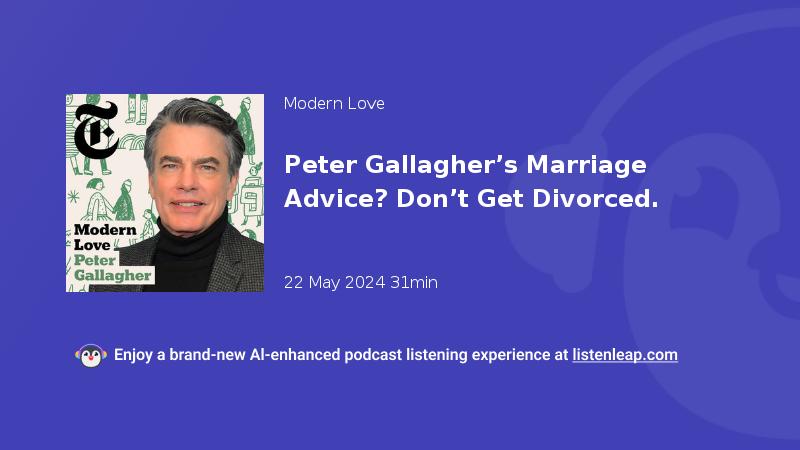
Today, we're closing out our season with actor Peter Gallagher.
Peter got famous mostly playing a particular kind of role.
Skizy, cheating, lying men.
That was back in the late 80s, early 90s, in movies like Sex, Lies, and Videotape, and American Beauty.
But if you miss that chapter of Peter's career,
you might associate him with a totally different kind of character.
To many younger fans, he's Sandy Cohen,
the loving, devoted dad and husband on the TV show The OC.
And now, having met Peter myself,
I am very happy to report that Peter is way more like Sandy than his other roles.
It's just so clear he really loves his family.
He showed me his phone background when he came into the studio.
It's a photo of his wife, Paula Harwood, from when they first met.
And if you look him up, his Instagram is a total dad Instagram,
full of long captions bragging about his kids and cute selfies with Paula.
And it just so happened that the very day Peter and I spoke
was his and Paula's 41st wedding anniversary.
So today, Peter reads the essay,
Failing In Marriage Does Not Mean Failing At Marriage by Joe Blair.
And as I talked to Peter about his own relationship,
I started to understand what's kept it going for so long.
Peter Gallagher, welcome to Modern Love, or should I say,
welcome back to Modern Love.
Well, thank you very much.
It is a total pleasure to have you here.
You read an essay for us back in 2017.
Now you're here again.
And Peter, I heard that today,
this very day we're talking,
is your 41st wedding anniversary?
God, it sounds so embarrassing when you're in show business.
But yes, it's true.
Okay, I've read an interview where you say that it's embarrassing to be together
for 41 years, but tell me what you mean by that.
Just that it's not something you hear every day.
And it's not something I ever really am interested in promoting.
I always feel like the people say,
oh, you know how long we've been married,
and then they do it in the press,
and then six months later, they're on the rocks.
But you don't want to jinx it, is what you're saying?
Well, I'd not jinx it.
It's just a, I do think it's dangerous to like promote it
or talk about it.
It's not immutable.
It's a living, really saying something that needs to be,
it's like, it's a garden.
I love that.
Well, congratulations again.
Thank you.
Tell me what it, 41 years, what comes to mind
when you think of 41 years?
Holy shit.
It's just a standing, really, because I don't think either
it's feel substantially different or changed.
Of course, we probably are.
I don't feel very lucky about it.
Feel very lucky about it.
Do you have any advice for people who are hoping to make it that long
in their marriage?
Don't get divorced.
There you go.
Straight forward, yeah.
Anything else?
Good luck.
Well, the fact is, it's, you know, I find there's very little
certainty about anything in life, so much of life,
including love and work.
And the choice that you make is built more on suspicion
than certainty.
And it's being able to listen to those subterranean streams
that are talking to you.
And you kind of hope you're going in the right direction,
but there's very little certainty, I think.
Picking up on the signs, the signs that this is something
worth holding on to.
Yes.
And being willing to cope and accept the uncertainty of it anyway.
Yeah, I like what you're saying,
listening to the subterranean streams, as you call them,
trusting your gut.
It's making me think of a story I heard about how you met
your wife, Paula.
You met her your first week of college at Tefs University
on a stairwell.
Well, research.
Well, there you go.
You got to do it for the time.
Oh, my God.
This is a New York Times building.
Of course you have been.
Can you tell me a bit about that story?
I love that image, meeting on the stairwell.
Tell me how you first saw her.
It was our first week of freshman year in college.
How old were you?
18?
Yeah.
Wow.
Yeah.
Oh, wow.
That means we've, whoa.
It's known each other for a very long time.
I think it was September 13th.
Wow.
We think that it was September 13th.
Okay.
It was at Bush Hall at Tufts University.
And I was going up to stairs to see a girl.
And she was coming down the stairs to see a boy.
And no words were exchanged.
And I don't remember anything about anything.
But I remember almost every moment of that.
And we've just sort of, you know, go ahead and buy each other.
She was in this spectacular hair and this tight, turtle neck thing and a disco belt and
tight cordray bell bottoms and platform shoes.
Okay.
Gorgeous.
And I looked like, you know, I had just left eighth grade gym class or something like
that.
Yeah.
She was way, way, way, way cooler than I.
Still.
And it was just powerful.
And I spent the next seven years trying to figure out how I could go out with her.
I was going to say, so you were both going to see other dates, let's say you clearly
remember what she was wearing.
You remember, tell me a little bit more about that feeling that you remember.
Was it like a, I've known you before, even though I don't, what was that feeling for
you?
I was just kind of surprised at the feeling.
Hmm.
I had never really felt anything like that.
I found her in this freshman year book and I would look at her picture and I think,
wow.
As being someone unattainable, you know, as, as, wow.
And yeah, it was weird.
What was the first time you talked to her?
Do you remember that?
Probably a few years later.
No.
I was pretty doyby.
Oh.
No, what I did was I would, well, regardless of my class schedule, I would manage to be
in the cafeteria for lunch when she was.
Oh.
So I would, I would make a laugh.
And frankly, that's still like a huge component of our relationship.
Was there a, I don't know, like how far into the relationship?
Did you think to yourself, like, I want to marry this person?
Was there a moment?
We were driving up the Boston to see a friend of hers who's the first person I ever knew
who was getting married that was our age.
And it was a torrential rainstorm.
It was torrential.
It was, it was sheets of water were coming out of the windshield and so on and so forth
and we were talking about going up to this wedding.
And then, and this is not a moment I'm proud of, but it was true.
I started to see, so, um, wow, like, mar- oh.
Well, yeah, just, Ron is getting married.
Wow, whoa.
Hey, you know, that's something that a lot of people do.
Maybe, could you ever imagine that kind of thing doing something like that, you know,
with, you know, somebody like me or something like that.
Meanwhile, we're driving in this torrential rain.
Right.
And as I'm saying this, she's, what are you, what are you asking me?
Well, I'm, you know, I'm asking, are you asking me to marry you?
Well, well, well, it sort of seems that way.
You see, you can, you can ask my parents, oh, well, yeah, I did.
And I did.
And then I wrote her dad a long letter about how I would take care of her.
He didn't have to worry.
And we got married.
And here you are now, Peter, 41 years later.
Okay.
So the modern love essay you chose to read today is about a marriage that lasts, but not
without some serious hurdles along the way.
It's written by Joe Blair and it's called failing in marriage does not mean failing at
marriage.
Peter, what did you see in this essay that drew you to it?
I felt like they loved each other.
And regardless of the ways in which Joe may have felt he failed in his marriage, I think
we all do to some extent.
It might be more dramatic, a less dramatic, but there's always that sense of what you're
not getting or what you're not giving or what you should be getting or what you should
be giving.
And ultimately, I think it has very little to do with love or marriage.
I think you hope to get to a place where you sort of embrace the whole person, not what
they've done for me lately or what they haven't, but start to appreciate what some gratitude,
the fact that they occupy such an important part of your life and you there and somebody
you can trust.
What a beautiful way to lead us into this essay.
Why don't you take it away for us whenever you're ready?
Learning and marriage does not mean failing at marriage by Joe Blair.
Alone one evening in early spring, seated on a green park bench beside the Charles River
and Cambridge mass, I waited for Deb.
The sun was setting and the temperature was falling and I was wearing my softball jersey
and knickers and wishing I had remembered to bring my thick flannel shirt.
Now, decades later in my home in Iowa, I searched for that bench on Google Maps.
Here it is, River Bend Park.
Here's the bridge, the John W. Weeks Bridge.
Here's our bench, the bridge arches, the still water.
It makes my body ache to see it again.
The place where we were young.
We'd agreed to meet there in that rady little park.
I waited for her and waited.
I imagined her getting off work at legal seafoods at the Kapli Plaza, cashing out, boarding
the bus, walking along the path, approaching.
I imagined someone watching us as she arrived.
Would they think we were madly in love?
I guess for Harvard students, people with illustrious futures?
The moon was brightening.
The sun, a slur of color in the west, I was cold.
My thick flannel shirt at home in my closet.
I had returned to college at 26 after serving my apprenticeship in the refrigeration trade.
I first noticed her in my selected authors' class.
On the first day, the professor asked if anyone could give him an Emerson quote, and she,
blushing, raised her hand.
Three months later, I asked her to marry me.
She said yes.
We shared my tiny overheated Cambridge apartment and fell into a nightly bar crawl routine.
From the plow and stars to the cellar to drummers, the cantabbe, after the first three rounds,
I would accuse her of being in love with her cigarettes.
And she would accuse me of not being truly in love with her.
And I would swear on the Bible how I loved her with the intensity of ten sons while holding
up my hand to order another round.
We knew we needed to end this childish routine.
We imagined a new town unsullied by the likes of us, some place clean and innocent.
After less than a year of squirreling away cash in a mason jar atop the refrigerator, we
allowed the lease to expire, moved our furniture, a futon and a lamp to the curb.
We had our parking tickets, climbed on my motorcycle and with no ultimate destination in mind,
left town.
We had enough cash left by the time we rolled into Iowa to run a small brick house adjacent
to a hog farrowing pen on the rolling Iowa cornfields.
Soon we found work and started a family.
By the time Deb kicked me out for the first time, she had already given birth to our first
two children.
I moved into a duplex on East Washington in Iowa City.
The inside of the place reminded me of a rustic hunting lodge.
The ship-lap walls and ceilings were stained dark brown.
I remember sliding into my coal and sleeping bag that first night, settling myself on my
camping mat and thinking, ah, yes, this is how I'm meant to be.
Alone.
We reunited after a month or two, then we had the twins.
Saturday nights we would walk down to Georgia's where three beers in Deb would once again
accuse me of not loving her enough, and I would do my best to drum up the old enthusiasm.
But I wasn't fooling either of us.
Over the 32 years of our marriage, she's kicked me out five times.
One time I subled a basement apartment across the street from a small park with a basketball
court, which was a big plus.
The basement was crawling with little white worms, which when they died, curled up like pill
bugs.
Another time I moved into Lyshatel, a low rent apartment complex.
There was an outdoor pool on the property, but it wasn't open when I lived there.
I don't think it had been open for a long time, hence the black mud and leaves at the bottom.
There was a laundry room, which was my favorite room in the place.
A single coin operated washing machine and a single dryer.
It was always warm and brightly lit, and there was a metal folding chair, and the air
always smelled clean.
The last time, the sixth, Deb didn't kick me out.
I left.
I was very worried about our accusation and outrage routine.
I rented another duplex in a quiet neighborhood on the south side of Iowa City.
I shared the place with little red ants.
They really liked the sponge I used to clean my dishes.
I would boil water and soak my sponge in it to kill them, then dump the floaters down
the drain.
I didn't do anything in the apartment.
Didn't cook, read, or listen to music.
If I got home from work early, I would go to bed.
If I got home late, I would go to bed.
I would lie down under my blue and white duck blanket, turn on my side and think, yes.
This is how I'm meant to be.
According to the landlord, the young woman who lived there before me had once dated the
young man who lived across the street with his parents.
After she broke it off, the young man
continued texting her.
He even knocked on her door at odd hours.
When the young woman moved out, I moved in.
Sometimes when it was dark, I would look through my front window at that house and think
about the young man.
I would wonder how one is supposed to find love.
Where to look?
How to begin?
On weekend mornings, I took walks around the neighborhood.
It was still cool enough to need a hat and a jacket.
One of my neighbors had erected a book exchange.
I chose a collection of Kafka short stories and then later that day sat on my front-sinter
block steps and began reading it.
But I kept thinking of Deb.
I kept thinking how she would like this quiet working-class neighborhood with the book
exchange and the red ants and the sickle-morm movie theater close enough to walk.
And no traffic sound and big deciduous trees and rickety front steps and cool air and warm
sun.
I called her and asked her if she wanted to stop over for coffee.
We sat at my little kitchen table and drank our coffee.
She said she liked my little house.
She liked my rickety front steps.
I have always thought of Deb wherever I am.
Whomever I am with.
Whenever I experience something good, I want her to experience the same thing.
I can't stand to watch a good movie without her.
I'll walk out after half an hour if I can't turn during the dark and whisper, isn't
this great?
I can't ride my motorcycle up into the Rocky Mountains.
I can't enter a small diner with a worn pine floorboards and an antique curved glass
pipe case with slices of banana cream inside.
I can't take a flight without wishing she were occupying the seat beside me.
I think we have the wrong idea about marriage.
It's not like running a business.
Where there are recordable credits and debits or buying a house where you pay your mortgage
or lose it.
Or owning a pet where in return for companionship, you are obligated to feed them and take
them for walks and clean up after them.
It's more like learning after a thousand hangovers to stop drinking so much or learning
after often being false to be true just once in the hope that you can continue to be true
for learning after habitually hating yourself to love yourself just once in the hope that
you can continue to love yourself and then learning through loving yourself to love
someone else.
I will always love Deb even when she hates me, even when I hate her.
Not because she's especially forgiving or pretty or pleasant to be with or well read
or spiritual, not because she may or may not be any of those things.
Loving her isn't transactional.
I love her because I can't help it.
There's something in her that makes me weak, something vulnerable and uncomfortable, something
fleeting and unmoving.
After a few months in the house with the rickety steps, I move back in with Deb.
Soon enough now, I'll be alone on the edge of sleep just as I am alone on the edge of
all things.
It's how I am.
It may be how we all are.
Still alone, waiting and still in love.
Peter, thank you.
What came up for you is you read this.
I think it's true.
There's a power and a truth to this and a humanist to this.
I feel like I was with Joe where he was and the place he described so well.
But it was sympathetic with where I was inside about how I feel about Paula, my wife.
Peter from Peter Gallagher after the break.
This podcast is supported by Cartier.
As far back as I can remember, my mom and I have always had this double hand squeeze.
Twice in a row means I love you.
She told me that it signifies like your heartbeat because it goes twice.
So every time she squeezes, it just means that she loves me with all her heart.
I remember one time when I was seven, I had this really bad nightmare.
So I clambered out of bed and I ran to my mom and dad's room.
Then I remember that my mom, I don't know if she was fully awake or not, but she must
have realized that I'd come in because she tapped me twice on my arm.
It makes me feel happy.
Like really loved.
Like no matter what I'm thinking at the time, no matter what is happening around us,
I know that my mom loves me and she will always love me.
With love from Cartier.
Hi, my name is Sandra E. Garcia and I'm a reporter at The New York Times.
I write for the style desk where we try to understand our complicated world by keeping
up with culture.
We want to take you to the forefront of cultural shifts and let you know why things
are trending.
Our subscribers make this kind of coverage possible so the New York Times can continue
to highlight the stories that go beyond breaking news.
Plus keep a pulse on culture by subscribing at nyx.com slash subscribe.
I can't help it.
Have you experienced that with your wife Paula or have you seen that in other areas of
your life?
I experienced it all the time.
I remember when I was growing up, I was really trying to encourage my father, my mother,
to split up because it would just be so much quieter and so much more peaceful than
I'd expect that.
I spent some time with you.
Spend some time with mom would be fine.
Ten years later, probably twenty years later, I've ever seen my mother and father holding
hands, walking, holding hands and really meaning it.
I thought, you know, kids don't know everything.
And always again, you know, encourage me to believe that there was more to life, to love,
to them, to us than met the eye.
And you know, in those healthy on moments, when you can abandon the scorekeeping and
abandon the transactions and begin to see just how lucky you are to be with this whole
complete complicated person.
Good things seem to happen then.
I mean, I love that story, seeing them holding hands and realizing what you didn't know
when you were a kid, but you didn't understand.
But perhaps also another lesson is sticking it out.
Is that, does that feel like it?
Yeah, that's, I guess, what I, yes, thank you.
That's what I felt when I saw them was that there was the potential for some grace.
I love that.
By virtue of just sticking it out, sticking together.
You know, to return to Joe Blair's essay, I think what jumps out to me is how, and we've
talked about this a bit, but how he redefines what a marriage is.
He says it's not like a business to maintain.
It's not like caring for a pet, which we hope not.
It's actually about learning to love yourself so you can more fully love the other person.
Can I ask you, why do you think that is?
What is it about living ourselves that allows us to love other people?
Well, I think it begins with forgiveness.
I think you have to begin to forgive yourself, because it can be like being a drunk, you
know, that is dire for some kind of self-abnegation or constant expression of disdain against oneself.
And it takes courage to see things differently and to try to see things differently and believe
it.
But I think that exercising that muscle of forgiving yourself for whatever imagined
sins and crimes you've committed against humanity or yourself, or it sheds enough light
for you to be able to be generous and to see what's there, what's not there.
Can you think of an example in your own life where loving yourself was key to being able
to love your wife?
I just had it funny.
I don't know if it's related, but I just flashed on this where I broke up with Paula once.
I told my mom.
When you were dating her?
Yeah, we were dating.
And she had, I didn't bring many people to my house when I was growing up.
But I brought Paula and I told my mother, I said, I'm not my, yeah, I just, I'm not
breaking up with her.
You go back to her and apologize.
She is a wonderful young woman.
And any problem you're going to be having with her, you will be having with anyone because
they're your problems.
Wow.
So you'll be damn sure that you figured out what's going on with you before you start changing
partners like socks.
I don't think she said socks, but she said that was the gist of it.
Before you throw this relationship away, you investigate what it is.
That's really bugging you and I bet you'll find it.
It's your issue and an issue that you will have regardless of who you're with.
Okay.
She says the most wise thing as a son.
You're like, okay, mom.
But did you follow her advice?
Did you look in words and repair things?
But it took me 30, 35 years.
I didn't want to give my mother the satisfaction while she was alive of doing it.
Cool.
I guess.
You know, it's interesting.
We're talking about the kind of ups and downs of a marriage and even the time leading
up to marriage.
And certainly Joe writes about all of the ups and downs he's been through in his relationship.
And despite that, the word divorce never comes up in the SSA, which is very interesting.
I guess I wonder, it comes down to Joe throughout the SSA is sort of working out whether or
not his relationship is working, whether or not to keep going, to stay committed or whether
or not to call it.
And I guess I wonder, I mean, I'm asking you for a lot of advice.
I'm not even married, but I guess I am turning to you as someone who's been married
now for 41 years.
How do you make that call?
How do you know if something is working?
How do you know whether to keep fighting for something?
That's what I mean about suspicion.
There's very little certainty.
It's like faith.
It's like willing to accept how little you might know and trying to pay attention to
your partner in a more inclusive view.
Can I ask, what does a successful marriage look like for you and Paula?
Well, we woke up on this beautiful day in this wonderful city.
And we found just about everything funny.
And she laughed.
She had a lightness.
I just felt very lucky.
Peter, thank you so much for today.
Oh, thank you, Hannah.
It was a lot of fun.
And I cannot believe that we scheduled it on your wedding anniversary.
That is really...
I was kidding about today being our wedding anniversary.
Are you serious?
No, I'm just kidding.
Oh, my God.
Don't scare me.
We'll get the research team on this.
We'll get our fact checker.
It's real.
It's real.
It's real.
That's it for this season of Modern Love.
Thank you so much for listening.
We'll be back this fall with more love stories.
Modern Love is produced by Christina Joseph, Riva Goldberg, Davis Land, and Emily Lang.
It's edited by executive producer Jen Poehont, Riva Goldberg, and Davis Land.
The Modern Love theme music is by Dan Powell, original music by Dan Powell, Pat McCusker,
and Rowan Nemistow.
This episode was mixed by Daniel Ramirez.
Our show is recorded by Maddie Masiello and Nick Pitman, digital production by Mahimachablani
and Nell Galogli.
The Modern Love column is edited by Daniel Jones.
Meal Lee is the editor of Modern Love Projects.
I'm Anna Martin.
Thanks for listening.