NPR. It has been a fraught tourism season in Barcelona this year.
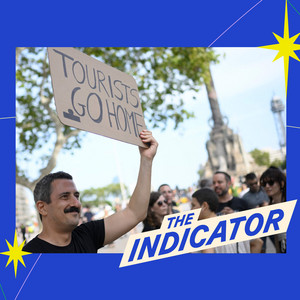
Public opposition against crowds of visitors, including from local protesters, reached a fever pitch.
And there is particular grumbling about cruise ships, these massive vessels like floating cities that carry thousands of passengers at a time.
Yeah, Barcelona is the largest cruise port in Europe.
Nearly 4 million passengers cruised through the city last year.
And Juaní Pérez, who is a hospitality worker in Barcelona, she says it has just gotten out of hand.
The port of Barcelona receives more cruises than it should.
This is what's always being discussed among neighborhood associations, some anti -cruise platforms, some political parties as well.
And Juaní says you don't even have to work in hospitality to see how crowded it's gotten in Barcelona.
This cannot continue at these levels because it's affecting all of us.
This is the Indicator for Planet Money.
I'm your cruise director, Adrian Ma.
And I'm your evening entertainment, Weilin Wang.
Today on the show, we look at how cruise ships are generating both mega -revenues and mega -headaches for Barcelona.
And we consider what cities options are for making the flow of visitors more sustainable.
This message is brought to you by Warby Parker.
Their glasses start at $95, including anti -reflective, scratch -resistant prescription lenses that block 100 percent of UV rays.
Try five pairs of frames at home for free.
Go to warbyparker .com slash covered.
Support for NPR comes from NPR member stations Ann, Eric and Wendy Schmidt through the Schmidt Family Foundation.
Working together to create a just world where all people have access to renewable energy, clean air and water, and healthy food.
The Schmidt Family Foundation is part of the philanthropic organizations and initiatives created and funded by Eric and Wendy Schmidt to work toward a healthy, resilient, secure world for all on the web at the Schmidt dot org.
Let's say you're on a cruise ship that docks at the port of Barcelona and you're thinking, what am I going to do with all my tourism time?
Well, for a few euros, you could take a short ride on a shuttle bus to the city center and you can visit one of Barcelona's most famous sites, La Sagrada Familia.
It's a church designed by architect Antoni Gaudí that's been under construction for over a century.
Sounds like a great way to spend the day, right?
There's just one catch.
On a typical summer day, there could be four cruise ships in port, each one carrying up to 5 ,000 passengers.
Javier Romani is an economist at the University of Barcelona.
Let's imagine that 80 percent of them go visit Barcelona.
This makes 15 or 16 ,000 people who want to see the same things at the same time in a very few hours.
There are so many people around Sagrada Familia that you cannot cross the street.
Gosh, I'm imagining it's just got to be like back to back, butts to butts.
Yeah, I was there in 2013 and even then I can confirm butts to butts.
Yeah, but these crowds, they also bring in money.
Back in 2016, Javier and several other researchers published a study measuring the economic impact of cruise tourism, both on Barcelona and on the Catalonia region.
And focusing on the year 2014, they looked at both direct and indirect economic impact.
Direct is spending by cruise ship passengers, crew members and the companies themselves.
So it's everything from a museum ticket to a restaurant meal to fuel for the ships.
And then indirect spending includes things like ingredients that the restaurant buys or electricity and insurance for a souvenir shop.
Javier and his colleagues found each cruise ship that stopped in Barcelona in 2014 was responsible for, on average, 1 million euros in revenue and nine full time jobs.
And since then, the number of cruise passengers in the city has gone up 50 percent.
Javier says Barcelona started becoming a popular destination for cruise ships in the 2000s.
You have a port with all the facilities, a port that can accommodate maybe even five large cruise ships a day, a port that is well connected to an international airport.
And apart from that, it's an attractive tourism destination.
Barcelona's port is also close to the city center.
And that's a contrast to ports of call in, say, Asia, where cruise ships often dock further away from popular tourist attractions.
At those locations, passengers tend to book their outings through the cruise lines, meaning the cruise companies capture more of that direct spending than the local businesses do.
In Barcelona, the city's museums, restaurants and bars benefit from having cruise passengers exploring more freely and spending.
And with the return to travel in the last couple of years, the number of cruisers is now higher than before the pandemic.
There is, however, an economic downside to all these visitors.
And Javier says the issue is that this negative effect is tricky to calculate.
You say, well, I cannot walk next to my house because the street is crowded or I cannot get into the bus because the bus is full of tourists.
This clearly has an economic effect.
And I know it. But how can you quantify this?
It's quite difficult.
The hard numbers may be difficult to come by, but Javier says he feels like Barcelona has reached or is close to reaching what the industry calls the tourism load capacity.
It's also called the tourism carrying capacity.
It's basically the number of people that can visit a place without messing things up, whether that's angering locals or damaging the physical environment.
You know, Wayland, the tourism carrying capacity at my place is very low.
Really? Is it like one?
Yes, that's I can't come over.
Anybody more than me is starting to push things to clean up after myself.
But in Barcelona, the locals there are definitely pushing back a water fight on the streets of Barcelona.
Some locals spraying tourists with water guns as they ate at popular restaurants, sending visitors fleeing from their tables.
I mean, that sounds kind of fun if you are you know, not the one being sprayed.
Yeah, that's how water fights work.
It's never fun to be the one getting sprayed.
I guess that maybe that's kind of obvious.
But this all goes to show that residents and politicians have a number of grievances.
One is that tourists use city infrastructure, but they don't pay the same kinds of taxes as locals.
So, for example, you know, the tourists use the roads.
They're not paying for them like the locals are.
Juana Perez, the hospitality worker we heard from at the beginning of the episode, says she doesn't feel like she's enjoying the benefits of the tourism dollars flowing into Barcelona.
This is despite what she hears about how visitors are a boost to the economy.
Employers have to decide what kind of tourism.
What kind of businesses do they want in the future because this is not sustainable.
When it comes to cruise ship tourism, city and port officials have already put in some measures in place to manage the crowds.
Last year, Barcelona closed one port terminal that's near the city center.
That area will be converted to public space and cruise ships now have to dock further away.
Barcelona's mayor has also proposed hiking attacks on cruise passengers that stay for less than 12 hours.
These are the visitors who are just in the city for the day versus doing an overnight stay in Barcelona before or after their cruise.
Now, the city already taxes the short term cruise passengers similar to the tourist tax it adds to hotel bills.
And the current tax for cruisers is seven euros per day.
Though the mayor hasn't said how much he would want to raise that tax.
Higher tax revenue could help pay for city infrastructure.
The tax hike might not deter cruise ship tourists.
That's according to Jamie Chen.
She's a professor at Midwestern State University in Texas who has studied the cruise industry.
Raising up tax is not a solution to solve the problem because the problem is very comprehensive.
Jamie points out that tourist hotel taxes haven't seemed to reduce crowds in hot spots like Amsterdam.
And when it comes to cruises the tax would be folded into the overall price of the cruise.
So a passenger who is already paying hundreds or maybe thousands of euros for a vacation probably is not going to notice that increase.
Jamie says she thinks the cruise lines and city officials could negotiate better schedules of when ships are in port.
Javier for His Part says there's been some talk of developing venues that are alternatives to the most popular attractions.
In other words, increasing the supply of tourist destinations.
That is a hard thing to do though, right?
Because really are most tourists going to visit Barcelona and not visit one of the biggest attractions like La Sagrada Familia.
That would be like going to Paris and skipping the Louvre.
Yeah. And I mean I went to La Sagrada Familia back in 2013 and I thought it was well worth the hype.
Sorry, I think we should all go.
I'm gonna be honest with you, Waylon.
I visited Barcelona last year and I did not go to La Sagrada Familia.
Oh my gosh, Adrian, you were part of the solution and you didn't even know it.
You really didn't go?
I really didn't go.
I spent the whole time just stuffing my face with tapas and they say tapas are not a morning food and I say I can prove you wrong.
A -plus -fication. I love Spanish food.
This episode was produced by Julia Ritchie with Engineering by Valentina Rodriguez Sanchez.
Thank you to Miguel Macias for additional reporting, including the interview with Juaní Perez.
Sierra Juarez fact -checked this episode.
Kicking Cannon is her show's editor and the indicators of production of NPR.
On the TED Radio Hour, online chopper Aparna Meta used to get a lot of packages delivered to her door.
Oh, per week, 12 -15.
Whoa, sorry. But I didn't think I was doing anything wrong.
Look, the store is making it possible for me to order as many as I want and return back what I don't want.
Shopping and the state of fashion.
That's on the TED Radio Hour podcast from NPR.
Hey, it's Mike and Ian.
We're the hosts of How to Do Everything from the team at Wait, Wait, Don't Tell Me.
Every week we take your questions and find someone much smarter than us to answer them.
Questions like, how do I safely jump out of a moving vehicle?
How do I dangerously jump out of a moving vehicle?
We can't help you, but we will find someone who can.
Listen to the How to Do Everything podcast from NPR.