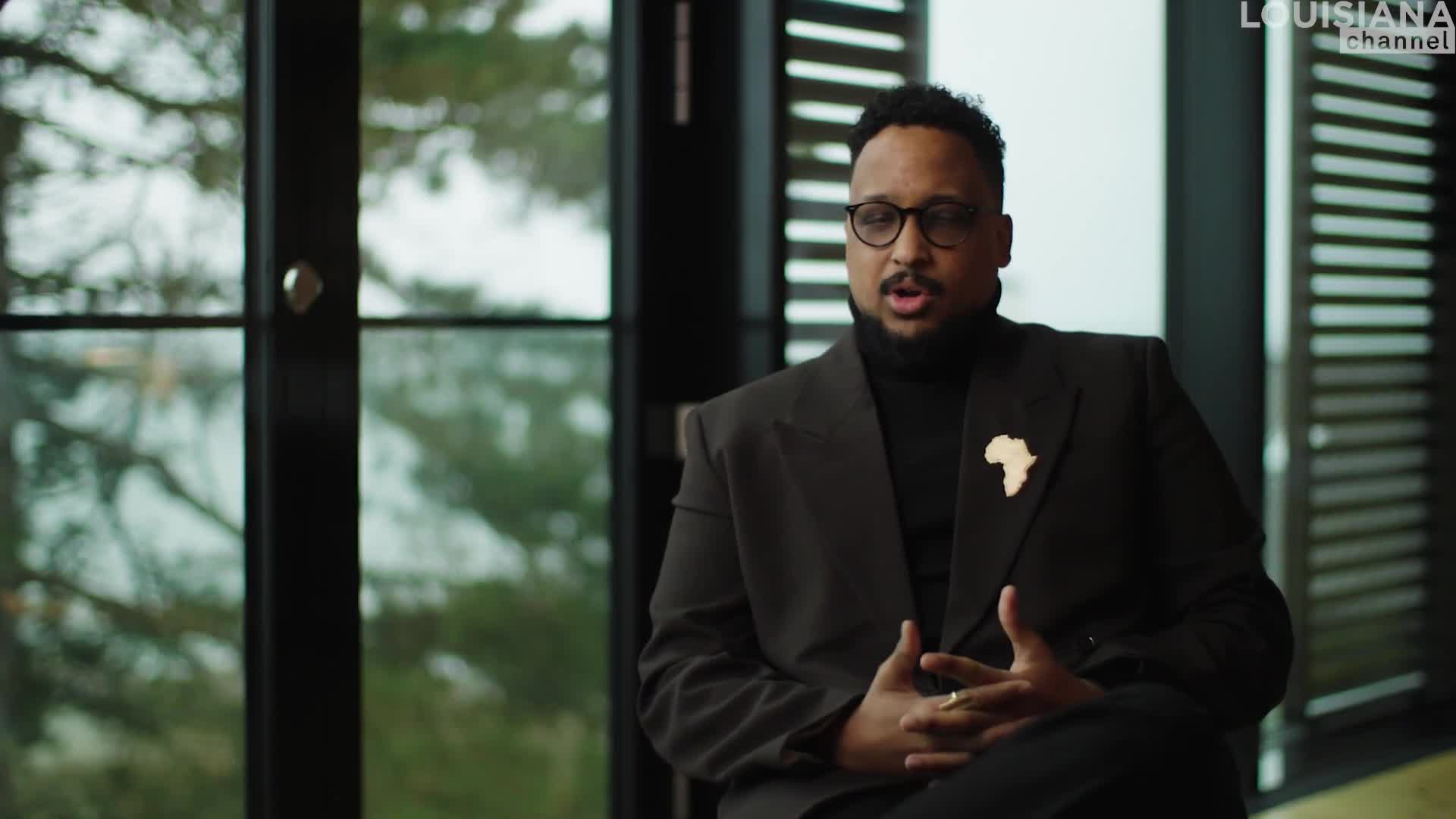
In 2026, Africa as a continent will host the first Pan-African Architecture Biennale.
And the Pan-African Biennale was born with the intention of not being a recipient anymore of what architecture is, but actually reclaiming a space that has always been African but that now is become imperative for the continent to get in that space.
For too long, I believe, we have been the periphery of the discourse, the recipient of what is good, what is bad, what is that is happening within the continent?
But the Pan-African Biennale aim to actually share to the world that African create, African shared knowledge, and African, after all, was the center of life.
And if Africa was the center of life, architecture was the first language of existence, and that was African.
Africa has been always portrayed and defined through the lens of colonialism exploitation, political instability, migration.
And all of this narration has been done by defining and describing a very small part of the history of the whole continent, which has started with the scramble of Africa.
If we want to,
However, that is one chapter of thousands of years of history of populations, community movement of people.
And I think what is fundamental through the Pan-African Biennale is actually sharing these other stories through the lens of Africans, through the lens of the people that work and live in those environments.
But, more importantly, to also highlight that History is different when told by the people that are actually part of that story.
So with this Biennale we aim into shifting that discourse and ultimately to shift the center of what is the global discourse of Africa.
2050.
By 2050, one out of four people in the world will be Africans, which simply means that the continent cannot be excluded by any conversation that involves humankind.
The Pan-African Biennale challenged the pure conception of African architecture.
I do not believe that African architecture exists.
Actually, I do not think that no one should refer to what is happening about architecture within the continent of Africa as African architecture, because Congo is not Morocco, Morocco is not Cape Verde and Cape Verde is not Ethiopia.
Each one of these places has different communities, different architectural practices.
The continent has more than 3,000 languages, an infinite group of people that are diverse.
There are eight climate zones.
You know materials that variated from stone, coral stone to the coastline of the Indian Ocean, all the way to the earth.
Architecture of Mali.
So, with this presence of 54 partitioners, each one from one of these 54 countries will represent the entirety of the continent.
But why Pan-African?
I think is very important because Africa contributed to the history of the world for the good in the bad part of the history, from you know, contributing to writings and history, like you know Des Moines, all the way to the history of trade with the Indian Ocean.
And you know, from Oman and India all the way to slave trade, but also the adventurer, the explorer.
And I think that the Pan-Africanism as a movement as intended, as a movement wanting to create unity in that sense,
And as every movement move and change and shift with years.
And this portion of the movement that architecture, the Pan-African Biennale, aim to do is exactly to reconnect the people.
And I like the fact that African contributions has been enormous, from the diaspora to the writers, to you know, of course, architecture as well.
And that Africa is still the epicenter of production, of resilience, of communities.
And, you know, hopefully also the world will understand that is also the nest of solutions for the crisis that the world is facing today.
Well, it always triggered me a bit when we talked about sustainability, because I do think that the concept of sustainability per se has been very Eurocentric in that sense.
Who defines what is sustainable?
Because I do not believe that sustainability is based on lead practices or a passive house or living in a glazed tower where you can't even open the windows.
But then why is that considered sustainable?
But the earth construction in a rural village In Ghana, where people build from the soil, live in symbiosis with nature and animals and don't almost create any sort of negative emissions, why is that not considered sustainable?
Also think about the fact that Africa contributes to only 3 to 4 of global emissions, but yet is one of the most affected continents by climate change.
It is, again, the recipient of the bad decision that the Global North took under their belt.
So what this Biennale want to do as well is to share new ways of seeing what sustainable architecture is, but also trying to give an answer to how to solve some of the problems megacities, movement of people, the migration from rural areas to cities, water issues, sea level rising.
So I think all of this they do have African solutions and architects that will exhibit, architect that will open this first Biennale will actually showcase that the continent is much more than what the history told by the Global North actually showcase it is.
Well, so I think history, when we talked about Africa, is not simply history.
I think that when we talked about Africa, compared to the other parts of the world, the history told about the continent is just the portion that the colonizers decided to share, which again it shifts a bit.
What is the reality of the narration?
I think there are a few examples that are very interesting.
If you look up on the internet the richest man ever lived, it comes out the Emperor Mansa Musa from Mali.
Mali is not even in the list of countries with gold reserves, which then makes you understand that something is not correct in terms of what the history has been told.
Because how can the richest man in the world, coming from a country that is not in the list yet?
France is the number four.
So I think all of these are indicators of lack of sharing knowledge, right?
I think everyone is aware, for example, of the family de' Medici in Florence, but very few talk about Alessandro de' Medici, which is portrait with carlier and black skin.
In fact, the mother was actually African descendant.
So all of this part of the story would have to share the fact that the continent was rich, that the history were great.
Reading at travelers like Ibn Battuta, which traveled extensively in the Muslim world for 30 years.
He defined some of the cities that he saw in Africa, like Mogadishu, as an incredible town with rich people and traders.
But yet that conversation will be shifted because obviously the story has been retooled.
And in cultures where predominantly histories share orally, they become a very strong point of weakness if all the publications are written by non-Africans.
So I think the Biennale really wants to put a stop, at least for what is concerning the world of architecture.
To define that okay, I may accept the fact that you're not aware of what is happening in the continent in terms of architecture and I give you the benefit of doubt.
However, after this biennale and the fact that you will have access to understand the partitioners, the architecture of the continent, then if you neglect the participation and the engagement of these partitioners and their histories, then it's deliberate.
It's not anymore about lack of knowledge.
So when I'm talking about bridging, this is the possibility to create those exchange and connections.
Well, I think colonization took away a lot from many people around the world, not only the people of the continent of Africa.
But I think what is important to also remember is the fact that history as a thing, it happened and that's how it is.
What I believe that is important is acknowledge those histories and then moving forward in a common ground that is at the same level for everyone.
So I do believe that it's fundamental to, kind of like, do a step forward, to first having an equal table, not that someone has a stronger voice than someone else.
When using always architecture as a point of reference.
We can't talk about the colonization studies and having all this discussion when majority of the architecture Biennale around the world that do not involve African partitioners.
And when they do, is under very little conditions of participation, almost having a quote of presence, but it's not due to the real interest in what is happening in there.
So if that is the way of recovering and cleaning the quotients, in that sense is like well, that is not what I'm aiming to.
I'm aiming to having real conversations, real partnerships and real discussion to move forward in a historical moment where it is necessary to have dialogues rather than divisions.
Architecture is a political act.
You can just decide to accept that or pretend that it's not like that.
So, whatever action we do, it is the strongest of the political act by forcing people to either live in certain spaces or passively engage with them.
Right,
And if you think about that, I believe around 83 to 85 of our lives is actually spent within buildings.
That alone is an indicator of the extreme power that the built environment has psychologically physically, on us.
But for me, in considering the very challenging political times that we live in in, moments where, rather than build bridges and you know, understanding the value of diversity and exchange practices and communication, we cut those bridges more and more,
The Biennale wants to help to rebuild some of these bridges, but also by telling the true story of each one of the region of the continent, to showcase that there is much more of what media has been portrayed politicians, you know, defined as the negative aspect of Africa again.
But I believe also that beside the intent of talking about architecture, right?
Architecture is.
It's, at the end of the day, is materiality, but it is the intellectual package that comes with the built environment.
Why you build, for who you build, what is the intention, what is the impact that you want to have in the future?
So I'm hoping to have all those discussion that can finally, in 2020 Five, where we are all connected and interconnected, where the butterfly effect is a real thing.
Whatever happened to someone in South America effect who lives in Europe and Africa and vice versa.
We don't have the luxury anymore to live independently.
So we do need to collaborate and create bridges if we want to survive to the global challenges of climate change and growth, population and lack of resources.