I'm Ayesha Roscoe and this is the Sunday Story from Up First, where we go beyond the news of the day to bring you one big story.
As we approach the new year, we often think about resolutions.
You know like wanting to exercise more.
Maybe do some Pilates, some cardio, eating better, drinking more water, saving money, all of those things.
But Today we're actually going to focus on life-altering changes like the choice to go back to school to pursue a new calling or pick up an old passion, and specifically making those changes late in life.
Now, you've probably heard of a three-act structure in movies or plays.
It's sort of like the beginning, middle and end of a story, where the beginning is the setup, the middle is the big challenges and conflicts and the end is the resolution.
In life.
We've assumed that the first act is youth and adolescence, the second is middle age and the third act is usually retirement.
But what if you choose not to rest and retire, but to launch into a whole new era?
That's what today's episode is about.
People who are rejecting the idea that a productive life ends at a certain age and who see life in older age not as an ending but a powerful and purposeful new beginning.
Anthony Brooks is a former NPR reporter and longtime correspondent at member station WBUR in Boston.
He's spent the last few years interviewing people about their decision to reimagine and reinvent themselves late in life.
His series is called Third Act, and he joins us now to talk about what he's learned.
Hi, Anthony.
Hey, Aisha.
Nice to talk to you.
Yeah.
Welcome to the podcast.
Thank you.
So I'm intrigued by the origin story of this project.
Did you decide to do this because you were feeling stuck or you wanted a change in your life?
I think there's always a bit of that going on with me.
But I think where this really started for me was about 16 years ago.
I had a bit of a health scare, which thankfully I recovered from.
I was also mourning the loss of my dad.
And I guess you could say that I was coming to terms with this idea that there's a lot more of my life behind me, then ahead of me, and I'm thinking for the first time what do I really want to do with the time that remains?
And I became intrigued with stories of people who found ways to reinvent themselves late in life in interesting and inspirational ways.
And just when I was dialing into this idea, Catherine Seeley of the New York Times reported a great story about a man who began this third act journey in a really fascinating way.
And that story really helped launch this project.
Okay, so tell me about the man in that story that drew your attention.
Yeah, so his name is Tom Andrew and he worked a full career as a doctor, including 20 years as the chief medical examiner for New Hampshire, which is where I live.
Tom saw it all up close, Aisha.
You know, the grim toll of car accidents, of gunshot wounds, poisonings, assaults, and suicides.
You name it, he saw it.
He said it was a job that gave him a particular appreciation for the fragility of life, And he remained committed to his work until the opioid crisis hit New Hampshire hard.
And he told me that he watched too many kids, too many young people die and that he didn't feel that the state was taking the epidemic seriously enough.
And I tried to raise the alarms about this that at this rate we will see more drug deaths in a given year in New Hampshire than traffic deaths.
Well, sure enough, it came to pass.
What was the actual number if it started out at like 50 a year?
There were 500 drug deaths a year.
There was this frustration with some folks who were perfectly content not to do anything.
We live free or die here.
I could not reconcile that with what I was seeing and what I was feeling.
And eventually, Tom just had enough.
And in 2017, at the age of 61, he quit.
He'd done the job for 20 years, so he retired.
But I'm guessing, since we're talking about him, he didn't just stop and retire in a traditional sense.
No, not at all.
You know, he could have followed that route.
He could have retired, put his feet up, cruised into old age.
But instead, he goes back to school.
He's a man of faith.
So he goes to seminary school to become a Methodist deacon, because what he wants to do is work with his local Boy Scout troop.
So here's a bit of what he told me about that.
I spent 20 years on the assessment end, counting the cost.
When I wanted to make my change.
I wanted to work with young people and let them see that there's a better way than that pill or that powder or that joint that's offered to them by their erstwhile friend.
So he wanted to do good and he wanted to do it at a point when it would matter.
Yeah, he really...
And this animates a lot of the stories that I found.
He wanted to give back is really a good way to put it.
And it's worth pointing out that becoming a full-fledged deacon is a long process.
It involves not only seminary school, but studying and sitting for interviews with church elders.
And Tom was still at it just a couple of years ago at the age of 66 when I was talking to him.
Well, how is it going for Tom now?
Like, is he happy with the life that he chose and the radical change that he made?
You know, he really is, as far as I can tell.
His kids are grown.
He's still happily married.
And perhaps most importantly, his life has new purpose, Aisha.
And he seems to be really thriving in this third act.
So, Anthony, this is a really heartwarming story.
And, as you say, what Tom did, I guess, is no longer as out there or outlandish as it might have seemed.
What has changed?
Is it that people are just living longer?
Yeah, I mean, that's a big part of it.
I mean, there's a lot of things going on here, but that's one of the main things worth considering.
If you go back just over 100 years to 1900, the average life expectancy was around 47.
Today, it hovers near 80.
So that means we're living three decades longer than we used to.
You know, I spoke to a bunch of experts on this subject and one of them put it this way that if you're 54, you could be only halfway through adulthood.
And by the way, I came across this fact, which sort of blew my mind, Aisha.
According to the U.S.
Census Bureau, the number of Americans living into their 90s by 2050 could be as much as 10 times higher than it was in 1980.
So that means if you're one of those people and you're 45, you're only halfway through your life.
So you've got half your life ahead of you.
So when you hit that traditional retirement age, there's still a lot of life left to live.
That's the main point here.
Okay.
I'm not 45 yet, but I certainly hope when I'm 45 that I got half of my life ahead of me.
I hope I got a long, long time.
You got a good chance, Aisha.
You got a good chance.
But that is wild to think about, like how much longer people are living these days and what that means.
Yeah, it is crazy.
And consider that some 80 million people in the United States are over the age of 60, and there are more and more of them every day.
In fact, as many as 10,000 people a day are turning 65.
So we're living longer and there are a whole lot more of us thinking about sort of what do we do with this extra two or three decades of life?
And those who study this period have given it a name.
It's called middle-essence.
Think of it as a later-in-life adolescence.
It's a time of change, of tumult, but it can also be a time of opportunity and growth, like adolescence.
And, by the way Aisha, old age, or older age, offers an opportunity to be even happier than you might have been.
And there's research on this, the so-called U-shaped theory of happiness.
That suggests that happiness declines for many people from the teens or early 20s into the 40s and 50s, but then rises again when people hit their 60s 70s, even their 80s.
So this can be a really great time to reimagine your life.
Stay with us.
We'll be right back.
This message comes from Intuit TurboTax.
With TurboTax Expert Full Service match with a dedicated expert who will do your taxes for you from start to finish, getting you every dollar you deserve.
It's that easy.
Visit TurboTax.com to match with an expert today.
Donate today to defend human rights and your gift will be matched at AmnestyUSA.org slash podcast.
This message comes from Babbel.
Babbel's conversation based language technique teaches you useful words and phrases to get you speaking quickly about the things you actually talk about in the real world.
With lessons handcrafted by over 200 language experts and voiced by real native speakers.
Start speaking with Babbel today.
Get up to 55% off your Babbel subscription right now at Babbel.com slash NPR.
Spelled B-A-B-B-E-L dot com slash NPR.
Rules and restrictions may apply.
We're back with reporter Anthony Brooks and his stories of people who reinvented themselves late in life.
But it's still scary, isn't it, to make a big life change so far along when you're really set in your ways.
And it's scary to me right now to make life changes.
And even like taking the finances aside, it often will require letting go of a planned life, right?
Yeah.
Absolutely.
I mean, there's no doubt that making these changes takes work and sometimes a lot of courage.
So let me tell you about another woman I interviewed for this series.
Her name is Juliana Richardson.
She grew up in Newark, Ohio, and she was the only black girl in her elementary school class.
And she told me that when she was in the third grade she already knew she was getting the sense there was something missing in her life.
There was no history. not Black history.
There was not even a sense of where my place was in American society.
But Juliana was smart.
She was ambitious.
She ends up going to Brandeis University outside of Boston.
And that's when she made a discovery that would eventually really change her life.
So she was studying the Harlem Renaissance when she came across this well-known song.
You're just wild about Harry.
And he's just wild about.
Can I do without?
Harry's wild about me.
So Aisha, you've heard this, right?
I have not heard this.
All right.
So well, it's a well-known song from a while ago and I forgive you for not hearing it because it is old, but it was a famous old song called Wild About Harry, famous Broadway tune.
That was a song about President Harry Truman.
Oh, okay.
But when Richardson learned that it was written by a pair of black songwriters, Noble Sissel and Yubi Blake, it absolutely blew her mind.
It thrilled her.
I mean, here's a woman who grew up without any sense of black history, of her history, beginning to discover it.
So that discovery inspires Richardson to record a series of interviews with a number of prominent black Americans for college for this project.
But it would take a while for her to figure out what to do with all this.
And that's because her dad wanted her to be a lawyer.
There was a lot of pressure on her to go that route.
So after Brandeis, she went on to Harvard Law School.
She got a law degree and ends up landing a job at a corporate law firm in Chicago.
I mean, it sounds like she was extremely successful.
She was successful.
She was well on her way.
But here's the thing.
She never felt completely at home in the world of corporate law.
She always was more interested in acting and the arts, as she told me.
And she said that she was the first Black attorney at the firm in Chicago and only the second woman to work there.
And so that had a lot to do with why she didn't want to keep being a lawyer, why she never really felt comfortable in that environment.
So she decides to quit.
Then she became an entrepreneur.
She worked in the cable TV industry for the city of Chicago.
She eventually started a home shopping channel.
But the cable TV industry was in flux and in decline, so that didn't end up working out.
So as Juliana told me, she was in midlife, out of a job, and lost with no idea what to do next.
Classic midlife crisis.
I couldn't go back to practice law at this point.
Too many years had passed.
My home shopping channel had gone belly up.
And what was I going to do?
But I say often that sometimes, at your darkest moment, the thing that's intended for you is right there.
Right there.
And the right there for Juliana was to return to that passion project.
She started at Brandeis to set up a company that would record and archive oral histories of Black Americans.
So how old was she at this point?
So she's in her late 40s when she makes this big decision.
Okay.
So tell me more about this project.
So the idea was to set up something that she called History Makers.
It's an archive of video histories of Black Americans.
But the plan had a huge flaw.
Juliana had no money to do it.
Her friends, they all thought she was crazy.
Even her parents wondered why a Harvard-trained lawyer would want to pursue this pipe dream.
But she was determined and literally started History Makers with a laptop on her kitchen table.
Fast forward to today.
History Makers has recorded thousands of interviews of lots of prominent Black artists, athletes and public figures.
So here's a brief excerpt that I want to play from my story about History Makers.
Yeah, let's hear it.
The nonprofit has collected masses of documents and recorded thousands of video interviews with the famous and not-so-famous from black athletes like Ernie Banks.
No bats, no balls, no gloves, no nothing.
We played with old rag balls.
So what did you use for a bat?
A broomstick or something?
A broomstick.
That's exactly what you use, a broomstick.
To Black artists like poet Maya Angelou.
Although I met Langston Hughes, he invited me to his house in Harlem.
I don't remember anything he said, but I remember he was very kind.
To Black politicians, including a young state senator from Illinois, recorded in 2001.
I'm Barack Obama.
That's spelled B-A-R-A-C-K.
O-B-A-M-A.
And my birthday is August 4th.
You know, that was done right in that room over there.
And it's really extraordinary, you know, like the path that he took.
So Ayesha, seven years after that was recorded, Obama was elected president.
And over the past 24 years, Juliana Richardson has raised close to 40 million and recorded something like 4000 interviews, all of which are now available through the Library of Congress and through many colleges and universities across the country.
And so, as she told me, it took a while, but Historymakers became her third act.
You know, you get at a point where you start asking, what is going to be your leave behind?
You know, what did you do in your life that was, you know, significant?
If we do this right, it will be something that hopefully makes society a richer place.
Well...
It really seems like she has achieved that and that this project really is making the world a little bit richer.
I think so.
I think a lot richer.
And another thing I like about Juliana's story is how she pushed through that classic midlife crisis.
You know, some of the people who study this concept of middle essence say we shouldn't think about these periods as crises.
It can be difficult tumultuous, but it can be a gateway to self-discovery and really find herself and contribute in a big way to the world as well.
We'll be right back.
Upfront payment of $45 for 3-month 5GB plan required.
Equivalent to $15 a month.
New customer offer for first 3 months only.
Then full price plan options available.
Taxes and fees extra.
See Mint Mobile for details.
This message comes from GiveWell.
When you give to a nonprofit, how do you measure success?
What is the real impact on people's lives?
GiveWell researches the highest impact opportunities around the world.
Over 150000 donors have confidently used GiveWell's research, collectively saving an estimated 300000 lives.
Make a tax-deductible donation at GiveWell.org.
First-time donors can have their donation matched up to 100 as long as matching funds.
Last select podcast and NPR at checkout.
We're back with Anthony Brooks of WBUR in Boston.
His series Third Act looks at how Americans are reinventing themselves in their older years.
So Anthony, I love this idea that, like as our life expectancy increases, people are seeing the end of middle age as a kind of beginning.
But it does feel like that may be easier done if you have the financial means.
If you are living paycheck to paycheck, is it really realistic to say let me reinvent myself and do some good in the world?
No, it's a totally fair point, Ayesha.
And clearly having the ability to reinvent yourself might be a bit of a luxury that a lot of people can't afford.
But also consider this that there are lots of people, no matter their social economic status, that are really creative and resourceful.
For example, one academic who's written about reinvention later in life told me about a woman who cleaned hotel rooms for a living, but her passion was helping animals.
So she changed careers late in life and went to work in an animal shelter not to earn tons of money, but it brought her way more happiness in a sense that she was doing some good in the world.
And Aisha, there's another woman who I met who also found a new path despite limited resources.
Can I tell you about her?
Yes, please.
Okay.
So her name is Natalie Jones.
She grew up in Boston in the 1960s in a working class family, granddaughter of Italian immigrants.
And she told me that from a very early age, there was zero expectation that she would go to college.
It just wasn't part of the family conversation.
And, in fact, when she was 12, the school she was going to asked her to choose whether she was business bound or college bound.
And Natalie told me it was a choice that just left her completely dumbfounded.
I didn't even know what that meant.
I think it was based on your family's economics, really.
My mother just said, check off business.
So the classes I took in the seventh and eighth grade were not college preparatory.
But I never thought that I was smart enough to go to college.
But Natalie was also a bit of a rebel and a risk taker.
And after high school, she takes off on a trip to Europe.
She traveled to Spain.
She met an Irishman with whom she fell in love.
And eventually they returned to the Boston area, got married, had a couple of kids.
But it turned into sort of a hard life for them.
Money was tight.
They both worked at low paying jobs, living paycheck to paycheck.
And after about 12 years, the marriage was in crisis.
And then her husband dropped a bombshell.
And he just came home one night and said, I want a divorce.
And it was like a kick in the stomach.
So at 41, she's got two sons aged five and nine and no college degree.
Oh, yeah.
Being in that situation and now she got to take care of two kids and no college degree.
That is a very difficult situation to be in.
It is.
But Natalie is resourceful.
You know, she juggled multiple part-time jobs, including waitressing and office work.
Then she joined a support group for families dealing with divorce.
And eventually, she became a volunteer facilitator and discovered that she was pretty good at it.
And despite the fact that she spent her whole life convinced that she wasn't smart enough to go to college, in her mid-40s she makes the decision to go to college and pursue a degree in human services.
I'm walking across the parking lot with tears rolling down my eyes saying, oh my God, I'm in college.
And I was just so thrilled to be there.
So with loans and scholarships, Natalie continues her studies.
And just shy of her 60th birthday.
She got a master's degree and then became a licensed clinical therapist.
And today she's well into her 70s and says she plans to keep working into her 80s.
I'm constantly saying to people, you can write your own script.
No, that is a great story.
I mean, really, all of these stories are incredibly inspiring.
And you know, even just in my personal life, I'm looking at this, I'm thinking OK, if they can do it well, maybe I need to keep trying to.
We can all do it.
Yeah.
But tell us why these stories matter to you and why maybe they'll matter to, you know, all of us.
Yeah, I mean, I guess I'd make two points.
First, for those who haven't already reached their older years, these stories are a chance to learn something about the road ahead from people who have already traveled it.
You could put it another way.
Wisdom matters.
It's inspiring to hear these stories.
And I think it makes us all kind of reflect on our own lives and what we can do with our later years.
And the other idea is this.
These stories show the transformative power of human passion and the search for lifelong avocation.
And that is literally a matter of life and death for all of us.
And by that, I mean, we know that people who feel that they have a purpose in life live longer.
And that's according to a growing body of research.
One study out of Canada found that people with a sense of purpose had a 15 lower risk of death compared with those who said they were aimless.
So they matter for that reason.
So before I let you go, I guess I'm wondering if this third act, this time of reinvention, does it go beyond work?
You know, I guess a lot of people might go.
I don't really want to spend much more time making money.
I want to spend more time on art or writing or other creative pursuits.
Yeah, it's a great question.
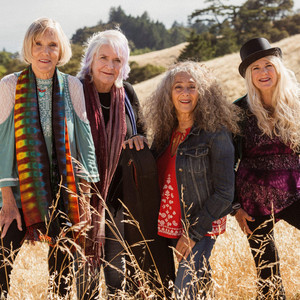
And it brings us to what was probably my favorite third act story about an all-woman rock and roll band.
An all-woman rock and roll band.
Tell me more.
All right.
This band is called the Ace of Cups.
Do you know, baby, I ain't hard to beat you at all.
So Aisha, this is a song from the Ace of Cups 2018 debut album, and the band members are all women.
But this record almost didn't happen.
The band was born in San Francisco in the 1960s and they played with a lot of really well-known bands, including Jefferson Airplane and the Grateful Dead.
But they never recorded an album.
They never managed to do that.
And as you can imagine, sexism had a lot to do with that.
Denise Kaufman plays guitar for the Ace of Cups, and she said that even landing gigs could be a challenge.
And she told me a story about trying to book a club in the 1960s in San Francisco.
Our manager called there and talked to the booking guy and he goes, yeah, all girl band.
Absolutely.
We'll book them, but they have to play topless.
Oh, my God.
And I said, you call them back and tell them we won't play topless, but we'll play naked.
So, well, they didn't play naked.
But by 1972, the band was pretty much done.
You know, some of the members started having kids.
They found other work and eventually they went their separate ways.
And their music was almost lost forever.
Now you say almost lost.
So what happened?
Well, decades after they first performed, a record producer heard them and was so impressed that he offered them a recording contract.
So in 2018, more than 50 years after they first played together, the Ace of Cups finally released their first album.
I don't think.
And when that album came out, they like to say on stage, we're in our 60s from the 60s.
Today, they're all in their 70s and have actually released two albums.
Well, Anthony, thank you so much for these stories.
And I guess it's basically like keep hope alive.
You can do it.
I love that.
Keep hope alive.
Aisha, thanks.
It's been a real pleasure talking to you.
Anthony Brooks is a reporter with WBUR in Boston.
You can find Anthony's third act series and more of his stories at WBUR.org.
This episode of The Sunday Story was produced by Andrew Mambo and edited by Jenny Schmidt.
The engineer was Jimmy Keeley.
Liana Simstrom is our supervising producer and Irene Noguchi is our executive producer.
Up first, we'll be back tomorrow with all the news you need to start your week.
Until then, have a great rest of your weekend.
Luckily, homes.com has got you covered.
Each listing features a comprehensive neighborhood guide from local experts.
Everything you'd ever want to know about a neighborhood, including the number of homes for sale, local amenities and even things like median lot size and a noise score homescom.
We've done your homework.
This message comes from Mint Mobile.
At Mint Mobile, their favorite word is no.
No contracts, no monthly bills, no hidden fees.
Plans start at $15 a month.
Make the switch at mintmobile.com.
That's mintmobile.com.
Upfront payment of $45 for 3-month 5GB plan required.
Equivalent to $15 a month.
New customer offer for first 3 months only.
Then full price plan options available.
Taxes and fees extra.
See Mint Mobile for details.