
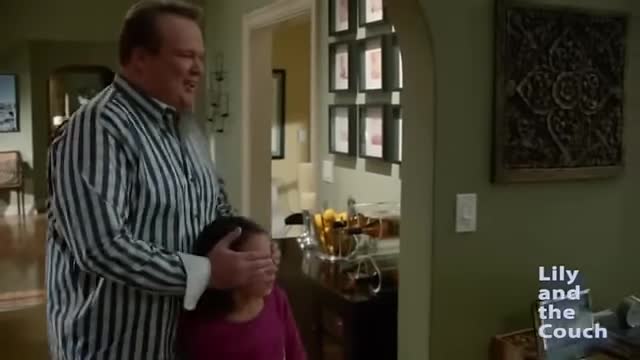
[The Awkward Quest for Truth: Navigating Parenthood and Innocence]-[Modern Family - Lily with the couch and babies]
📋 Summary
The Awkward Quest for Truth: Navigating Parenthood and Innocence
In this segment, the household becomes a stage for one of the most classic and dreaded milestones of parenting: the "where do babies come from?" conversation. The transcript captures a humorous, chaotic, and deeply relatable struggle as the adults attempt to manage Lily’s curiosity while grappling with their own insecurities and varying levels of maturity.
The Innocence of Inquiry vs. The Burden of Knowledge
Lily’s introduction to the topic is blunt and persistent. She catches the adults off guard, forcing them to confront their inability to provide a coherent explanation. When she asks, "Do you know where babies come from?" the immediate reaction is a mix of deflection and discomfort. The adults, particularly those in the household, are clearly out of their depth. One character attempts a whimsical, albeit outdated, deflection by claiming "the stork brings them," a classic fairy tale response that Lily quickly dismisses. It becomes evident that Lily is not merely seeking information; she is testing the adults, noting, "You're old. You should know."
Generational Clashes and Maturation
As the scene progresses, the dialogue highlights the generational gap and the differing perspectives on maturity. Luke, who attempts to explain the process using a "pen and a bagel" as props, embodies a crude, adolescent approach to the subject, describing a frat party scenario where people "pound their beers." His approach is immediately shut down by the older generation, who view his explanation as "immature."
This tension highlights a deeper theme in the transcript: the definition of maturity. While Luke views himself as knowledgeable, the others see him as a "buttface" whose understanding of relationships is fundamentally flawed. When the adults try to interject with a more romanticized version—suggesting a "romantic French bistro"—they fail to satisfy Lily’s need for biological truth, resulting in an embarrassing realization that, as one character admits, "No, I guess not" when asked if they truly know how the process works.
The Absurdist Reality of Childlike Logic
Perhaps the most humorous moment occurs when Lily finally decides to educate the adults herself. Her explanation is a masterclass in childlike logic, involving "eggs and tadpoles in a glass" followed by a kiss and jumping on a bed. Her assertion that "after a year, she pees and a baby comes out" serves as a stark reminder of how children attempt to make sense of the world using the limited data points available to them. This bizarre theory leaves the adults speechless, highlighting the absurdity of trying to maintain a facade of expertise when facing the unfiltered imagination of a child.
Domestic Tensions and Gender Roles
Beyond the primary topic of reproduction, the transcript explores the underlying friction in domestic life. The final moments shift to a conversation about childcare and frustration. One character snaps, "I am not some 1950s housewife," highlighting a deeper resentment regarding the division of labor and emotional expectations within the home. This outburst, triggered by the exhaustion of dealing with a crying doll and the daily grind of parenting, underscores that the search for answers about "where babies come from" is secondary to the real-world challenge of raising them.
Conclusion
Ultimately, the transcript illustrates that parenting is rarely about having all the right answers. It is a messy, evolving process defined by awkward conversations, failed attempts at instruction, and the constant realization that children are often observing their guardians' own limitations. Whether it is through the lens of a child’s creative biology or the frustration of an overwhelmed parent, the dialogue emphasizes that the "truth" of growing up is something that both children and adults are still working to figure out.
Deep Learning with ListenLeap


