Ted Audio Collective.
You're listening to Ted Talks Daily, where we bring you new ideas to spark your curiosity every day.
I'm your host, Elise Hugh.
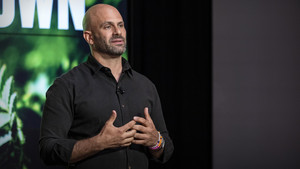
Sam Kass was a chef at the White House for President Obama, and for today's talk he describes a very special meal.
A meal of wine, crab, fruit, and bread that may not exist in a few decades, because its ingredients are so devastated by climate change.
But, as he'll point out, nature -based solutions have the capacity to turn things around during this make -or -break period.
This eye -opening 2024 talk, which he gave at an actual dinner party, is coming up after the break.
And now our Ted Talk of the Day.
Hello, everybody. I am here to welcome you to The Last Supper.
This menu has been put together with ingredients that experts and models predict will not be around for our kids and our grandkids.
And you'll see that it's many of the foods that we hold dear.
Now, I started off my career as a chef and then into policy, and now working on technology and innovation, trying to build some of the solutions for the future.
I first came up with this menu idea in 2015 around COP21 in Paris.
And the point of this menu is not to depress you, it's not to make you feel bad.
It's to really talk about what's at stake when we say the words climate change.
What do the words climate change actually mean?
What does two degrees warming actually mean?
I'm from Chicago. Like two degrees warming, that sounds good.
Like, let's warm it up a little bit and maybe what about five?
And I think we've really failed to connect what's truly at stake when we talk about the issues that we've been discussing today.
So let's get into it.
Let's start with those odors, those appetizers.
Let's turn to fruit.
It turns out that trees are really having a tough time.
And this includes nuts and stone fruit like pistachios and almonds or peaches.
Last year, we lost 95 % of the Georgia peach crop.
95%. And when you start to look at the models and how our environment is changing, in our lifetimes, I don't believe we'll be growing peaches in Georgia at all.
Let's talk about the wheat in your bread, or the rice in your salad or the chickpeas in one of the dishes.
Some of the core commodities, the core staples that feed the world.
In the United States, the models show that for every one degree of warming, we'll lose about 7 .5 % yield.
We'll decline about 7 .5 % year over year.
That's only part of the story.
The other challenge is right now on a global basis, 15 % of the world's wheat is produced in persistent drought conditions.
But if and when we hit that two degrees, 60 % of the world's wheat will be produced in persistent drought conditions.
So not only are we going to see precipitous decline of yields over time, we're going to see much more frequent disruptions and complete collapses of harvest in certain regions.
It is impossible to comprehend the economic upheaval as we start to see these core commodities decline, the food insecurity and malnutrition that will result of this, and the political instability of forced migration and conflict over resource as these core foods that feed most of the world start to
decline because of climate.
So let's go to your main course.
Let's go to salmon.
Salmon are also having a really tough time.
We all know their epic journeys up rivers to spawn.
And those rivers are not only warming, but we're starting to see reduced flows into them because of reduced snowpack.
And by about 2050, the models show that we will lose about half of that flow into those rivers because of reduced snowpack.
Making that journey for those fry back to the ocean nearly impossible.
But there's also massive heatwaves that are flowing through our oceans now.
Those heatwaves lower the oxygen levels and make the environment really unsuitable for many of these life forms.
This past year, just a few weeks ago, California announced it had closed the entire commercial fishing for the whole state, the whole coast, because essentially there weren't any fish to fish.
This is not some far out future challenge.
Now, I wish I could tell you, you know, you're still going to have your dessert and everything is fine, but I'm sorry I have to come for your chocolate too.
And in some ways, chocolate is faring the worst.
So there's probably, you've never probably had a bite of chocolate that wasn't grown within about 10 degrees of the equator by small holder farmers.
And there is not a single model that shows that, if and when we hit two degrees, that any of that region will be suitable for chocolate production.
It will be too dry and too hot.
That means those trees are going to have to walk and move.
They're not very good at that.
And the communities that that will affect are ones that do not have the resources to weather storms of that nature.
The economic and social upheaval that will come from those kind of changes is profound.
And again, this year, not in 2040 or 2050, chocolate prices are up by 50 percent because those production ecosystems have been hammered by drought and extreme weather.
50 percent this year.
I'm going to give you one more.
And this is where like, I just don't even know what to do.
I'm ready to do anything to solve the problem.
So, yeah, coffee too.
The IDB predicts that, just similar to wine, if and when we hit two degrees, about half of the regions that are currently growing coffee will no longer be suitable for coffee production.
But 75 of the 124 wild varieties of coffee are on the verge of extinction right now.
And that's really a problem because much of the genetic material that we will need to try to produce hybrid varieties that could thrive in much more volatile climate are going to be lost.
And now back to the episode.
But the point here is not to depress you or to scare you.
It's not. It's not.
No, it's not. It's to try to make an emotional connection in a way that only food can to understand really what's at stake when we're having these conversations.
And I believe what's at stake is fundamentally our way of life on planet Earth.
It's our identities both as individuals and as communities and cultures.
It's the vibrancy of our country and of the world.
And fundamentally as a father of two young boys aged six and five, Si and Rafa, it is fundamentally our ability to pass to the next generation a better life than we were given.
A life that is as rich and delicious as the one we've been lucky enough to have.
That is truly at stake now.
The good news is On Our Plates really does hold some of the biggest, both problems but also potentials to solve these challenges of anywhere that we have.
And that's the part that gives me a ton of hope.
We know food is a giant driver of environmental and climate change damage.
It's the number one driver of biodiversity loss by a lot.
Number one driver of deforestation and land use change.
Number one use of the world's dwindling fresh water.
70 % of our water goes into how we feed ourselves.
And it's the number two driver of greenhouse gas emissions globally.
Now unlike energy and mobility and transportation, where we can see a future where that curve is going to bend, food and agriculture is going straight up with absolutely no end in sight.
So we must figure out how to reduce the negative impacts the system is having on our planet.
Full stop. The second big part of the work that we collectively have to do is around adaptation and resilience.
A part that we are simply entirely unprepared to deal with right now.
We're now about to enter an age of extreme volatility with dwindling resources of water and soil, higher energy prices, and we essentially are unprepared.
So we need much more investment and focus on preparing a food system to deal with the reality that we are entering in today.
But this third part is the part that gets me excited and gets me a lot of hope.
Because I firmly believe, I know to be true, that food and agriculture and nature -based solutions more broadly, namely you throw in their oceans and forestry, are the only systems on planet earth that has the capacity to sequester enough carbon in the time horizon, this is the important part.
110 billion metric tons of carbon that are in our atmosphere used to be in our soils.
That's 80 years of our current footprint.
And we are starting to see tools and technologies and rediscovering of old techniques that can take a lot of that carbon and put it back into the soil.
And technologies that allow our food system to become much more efficient and vibrant.
I'll give you a couple that are super exciting to me.
One is a company called Lone Bio that has discovered fungi microbes that are pulling down, that coat seeds that pull down between one and three tons of carbon per acre per year and store that carbon in more permanent forms in the soil.
When you do the math on how many acres are under cultivation, this is a tool that can be transformational.
More company like Inari Agriculture that is using modern breeding techniques that can dramatically increase yield while reducing the amount of fertilizer that's needed.
Pesticides and herbicides that are needed to protect that plant.
I could go on and on about these tools.
They're out there. We have the solutions at hand.
The problem is we're just out of time.
So, for all of us who are working on these issues or leading in whatever we are, doing whatever we're doing, if we have our plan and we feel comfortable, like, yeah, this feels about right, like I'm doing my thing, then we're simply not doing enough.
We have to get fundamentally out of our comfort zone and take on a lot more risk in terms of our actions.
So, I hope that as we sit here tonight together and eat some of the challenges that we face, we understand what's truly at stake.
We understand that we absolutely have the capacity to solve this challenge, but that if we don't act now, we're going to lose time.
But I know that we can look back and collectively say to ourselves, we stood up and met the moment, and we ensured that our kids and that our grandkids will be able to enjoy a delicious meal like the one we're having here tonight.
So, thank you for your work, and I look forward to seeing what we can do together.
That was Chef Sam Kass recorded for Ted's Countdown Dilemma Series on the future of food in 2024.
If you're curious about Ted's curation, find out more at ted .com slash curation guidelines.
And that's it for today.
Ted Talks Daily is part of the Ted Audio Collective.
This episode was produced and edited by our team.
Martha Estefanos, Oliver Friedman, Brian Green, Autumn Thompson, and Alejandra Salazar.
It was mixed by Christopher Faizi -Bogan.
Additional support from Emma Tobner and Daniella Vallerezo.
I'm Elise Hugh. I'll be back tomorrow with a fresh idea for your feed.
Thanks for listening.
Looking for a fun challenge to share with your friends and family?
Ted now has games designed to keep your mind sharp while having fun.
Visit ted .com slash games to explore the joy and wonder of Ted games.