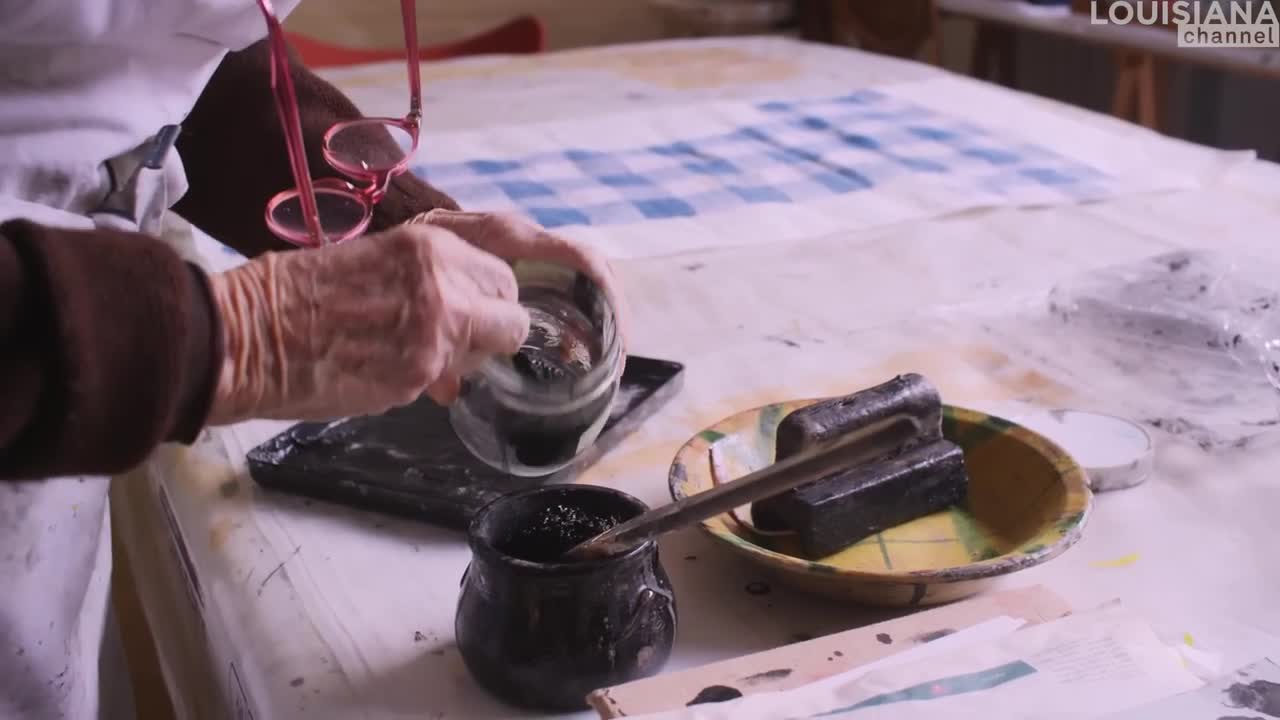
When you go into your studio and you start painting, what happens inside of you?
Happiness, happiness, happiness.
This is what I feel.
I have never been so happy since i didn't know that i was an artist.
I thought that it was normal for me, but i felt the need of the third element.
And the paper has not the third element.
Textile has it.
It is a lost time.
I don't want to lose time.
Time is so precious for me.
So I want to amuse myself every moment.
And these things, it is easier to join this kind of thoughts at my age because I'm much more free.
I have never been so free in my life.
It is an adventure.
I didn't know what was going to happen.
It is a surprise.
And when somebody say, but this is good.
I'm very glad to say this.
Sometimes they are very simple.
The round pieces.
So the beauty comes, but I didn't call it because I didn't know her name.
I have a son who is an artist and I have under my eyes what it is to be an artist, because when he was 4 5 6 7 11 20 30, all the time he knew what he wanted to do.
I did not.
I was a girl, I wanted to go out to dance and after to marry, to have children, to cook, to have everyday housewife.
I have been a housewife.
Now I am fully artist because the only thing I do is to stay or here or in my room and work.
My name is Isabella Ducrot.
In a way it is a fake name, because my real name, when I was baptized many, many years ago, my name was Antonia, because my mother made a kind of pray to Sant'Antonio because she wanted me to be born quickly and I was born in the day of Sant'Antonio, so she was obliged to keep her promise.
The day after she began to call me Isabella and my story begins that i am confused.
I don't know when i am antonia and when i am isabella.
So it is a little complicated and it is typical of my life, because i have always done something not so sure of what i was doing.
I amuse myself madly.
I adore what I do and I am less and less afraid of what I was doing.
Evidently I exist, but I exist also for the others, because what I do has a kind of dialogue with others.
I am not an optimist.
Reasonably speaking, I cannot be optimistic.
What I'm trying to do in my things is to make a kind of equilibrio, a kind of hope or a desire that things could go better, that the hope has more space.
I live the present.
I have no future.
It is a very strange time because it is enlarged, enlarged.
Every hour, every morning, every afternoon, there is a space in the world, a meraviglia near to happiness, very near to happiness.
I couldn't find another name.
Surprise, amusement, vanity.
And I think we had the last conversation, it was, I think, almost a year ago.
And I'm not the same person anymore, because I feel that I'm changing and changing in a strange disaccord.
Being so old, I should be the same, no?
Exactly, almost exactly the same what I was last time.
But in fact, things are not like this.
These last months I have jumped in new ideas and this has been very near to happiness.
In a way I understand the similarity between the textile structure and the language structure are really very, very tied together.
For instance, paper that I adore.
And paper is the material I work on very much.
I used it in Japanese paper.
But paper has not that mysterious space where, which is nothing. weaving, echo weaving.
While you do this, you build something, a structure.
But not only.
Inside the structure is a nowhere.
There is an empty place.
And the same things happens with the language.
You speak, but there is a subject.
There is an object, but also there is something inside this relationship which has no name.
And this without studying, without being particularly religious. without being a philosopher.
But I felt the need of the third element.
And the paper has not the third element.
Textile has it.
They say there is no two without three.
If there are two, It is necessary that there is also what is between the two.
And this is the Spirito Santo, we call it in Italian, the Holy Spirit.
So the difficulty has been to accept that that space, the empty space of the language and textile.
I was part of this space, little myself it was.
I have no name no, no a real presence, but I was there.
This I have to accept.
I don't consider myself something, but I have to accept that we are, you and me, and this gentleman are speaking about myself.
I have to touch it.
Thank you.
Thank you.
Because in a way, I think that your question is how do you realize all this while working?
Yes, while working.
I am afraid to do useless things a little bit, but in a way Like something who is blind but knows how to go.
I am a feminist, strongly feminist.
I think that our future of women is dependent on the language.
We should change language because, since we have never been, the story of the world has been written by male mind.
And I'm sure that there is a difference between a body of a woman and the body of a man.
So I think that also the writing is something different and we should begin to speak our language.
But we don't have a language.
We have to develop.
So the attention is not to imitate what man has done and do it better if you are good enough.
No, this is to change our way of telling things.
We can only imitate until now.
We cannot.
I used languages of philosophy, but perhaps one could develop a more realist for our body, because our body is less slave of the vista.
How do you call it the possibility to look?
Aristotle says that the vista was the quality of the science.
You cannot be a scientist if you don't look at the things.
In a way, I think that we women believe in what we touch. more babies, so it is not the view.
This is my way of walking.
I don't understand, but nobody can tell me, I know, I don't see myself when I do that.
A man sees, and this makes for him the view.
More important, we cannot use the view to know our body.
Menstruation, births, babies, and all this, it is secret for us.
We only know what the others tell us about our body, no?
No.
This is the first time that I see this thing.
I want to tell you that this is the first time today.
I would like to pass on the possibility to amuse ourselves.
To do things loving them, it is a chance and it is important to the amusement.
I would like that with a friend.
If we amuse ourselves, it is the best thing can happen with somebody else.
So I give a great importance to amusement.
Naturally, if you are tired, if you are poor, if you are ill, But I was ill.
I was quite poor during the war.
It was very difficult.
I have not been poor.
I was poor as a bourgeois, naturally.
But in any way, I had difficult moments, many difficult.
Also now, it is difficult.
But at the same time, I amused myself this morning.
I was able to tell you something that I think is important and this is an amusement.
So, with my sons and so on, I hope to be a little freer, a little lighter, to forget what somebody has not done for us.
I can consider the others always guilty or something, no?
The temptation is this.
It is a lost time.
I don't want to lose time.
Time is so precious for me.
So I want to amuse myself all the time. every moment.
Emily Dickinson said that the only happiness we can enjoy we human people is the.
I don't understand in English.
When you feel I was afraid, and now you are not more afraid because you understand that the cat is not a tiger, for instance.
The moment to pass from a moment of horror, fear, and they say, I'm not afraid.
She says, the only possibility for us to be happy is a moment when you pass from the fear to a moment of peace.
Thank you, beautiful.
Thank you, Isabella. okay thank you so much