
[The Prophecy and the Blade: The Prologue to the Legend of King Arthur]-[The Story of King Arthur and His Knights - Part 02]
📋 Summary
The Prologue to the Legend of King Arthur: A Kingdom in Chaos
The Fall of Uther Pendragon and the Rise of Uncertainty
The narrative begins with the reign of King Uther Pendragon, a ruler who relied heavily on the counsel of his court—specifically the wizard Merlin the Wise and the noble knight Sir Ulfius. Despite the prosperity of his reign, the foundation of the kingdom is shaken when Merlin, possessing the ability to "see the future," predicts the imminent death of the King due to a fever. Merlin warns Uther that his "kingdom falling into great confusion" is inevitable and that his newborn son’s life is in "great danger from enemies that would try to take what is rightfully his." Trusting Merlin’s foresight, the King allows his son to be hidden away to ensure his survival, setting the stage for a power vacuum.
Eighteen Years of Anarchy
Following Uther Pendragon’s death, the kingdom descends into exactly the state of turmoil Merlin had prophesied. The absence of a clear heir leads to a period where "a thousand lesser kings wanted to rule," and the land "positively groaned with the trouble that lay upon it." The social order collapses, with knights and barons turning to banditry, attacking and robbing "helpless travelers" along the highways. For eighteen long years, Britain suffers under this lack of leadership, desperately awaiting a return to the stability experienced during the days of Uther Pendragon.
The Prophecy of a New King
Driven by the desperation of the people, the Archbishop of Canterbury seeks out Merlin, imploring him to use his gifts to restore order. Merlin’s response is one of calculated optimism. He promises that the country will soon have a ruler who will be "even wiser and greater" than Uther, one who will "bring order and peace where there is now confusion and war." Crucially, Merlin confirms that this successor will be "Uther Pendragon's own flesh and blood," effectively bridging the gap between the fallen regime and the future of the kingdom.
The Trial of the Sword
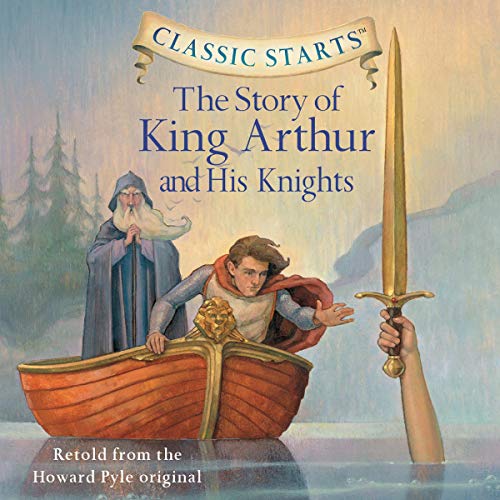
To settle the question of succession, Merlin orchestrates a "grand adventure" designed to reveal the rightful heir. He manifests a "huge marble stone" topped with an "anvil of solid steel," into which he drives a "large blue sword." The blade is inscribed with a divine decree: "Whoever shall pull this sword out from the anvil shall be the rightful king of Britain." This act transforms the search for a leader into a public spectacle, as the Archbishop announces a contest to be held at Christmas.
The Gathering at London
As Christmas arrives, the kingdom is gripped by "excitement." The narrative highlights the hubris of the established nobility, as many speculate that powerful figures like King Lot, King Urian of Gore, or King Leodogrance would be the ones to claim the throne. London becomes a melting pot of "kings and lords, knights and ladies, esquires, pages, and men at arms," all gathered to witness history. While the Archbishop remains confident that a worthy leader will emerge from this assembly of "well-known kings and noble lords," Merlin maintains a mysterious smile. He offers a final, cryptic warning to the Archbishop: "The one truly worthy person may very well be still unknown," signaling that the true hero of the legend is yet to be revealed to the world.
Deep Learning with ListenLeap


