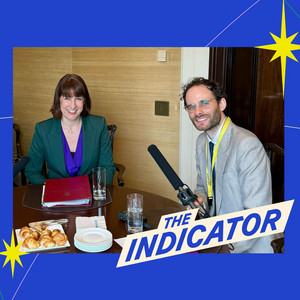
NPR. Globalization as we know, it is dead.
Or at least it is, according to the UK's new chancellor of the Exchequer Rachel Regs.
We did become overly reliant on countries that don't always share our values for some of our basic needs.
And we should never again put ourselves in that position.
Rachel runs the UK Treasury and signs off on pretty much everything that requires new money.
Rachel sees something wrong with the paradigm of a hands -off government setting sale into the free market, buffeted by whatever trade winds may blow.
She is facing an economic backdrop that is familiar to many countries, hollowed out industrial towns, climate change, global wars, and conflicts.
And the way to address these Rachel things is to keep the government's hands firmly on the captain's wheel.
This is The Indicator from Planet Money.
I'm Wailton Wong. And I'm Darian Woods.
Today on the show, our conversation with Rachel Reeves on her visit this week to the U .S.
What Rachel thinks went wrong with globalization, and the new economic map she's coursing.
This message comes from Wise, the app for doing things and other currencies, sending or spending money abroad.
Hidden fees may be taking a cut.
With Wise, you can convert between up to 40 currencies at the mid -market exchange rate.
Visit Wise .com. TNCs apply.
What's its story Theme trying, there's also another story about the people living those headlines.
On weekdays, Up First brings you the day's biggest news.
On Sundays, we bring you closer with a single story, about the people Wise, saw from the side, you can't afford it.
I'm Rachael Martin.
And Michelle Butau is on the Wild Card podcast, the show where cards control the conversation.
On the Embedded Podcast from NPR, what is it like to livearya...
So, Rachel Reeves, you are the UK's Chancellor, the Exchequer kind of the equivalent in the US of the Treasury Secretary.
At Oxford, you studied economics among other things.
Your friends gave you a framed picture of the former chancellor to hang up in your room.
Correct me if I'm incorrect on any of these things.
This is all correct so far, if a little embarrassing.
You wrote a book on under -appreciated women economists, in short, you're a massive economics nerd, which is why we're very happy to speak to you on The Indicator.
Well, it's great to be here.
And it's great that my nerdiness as an audience.
Yes, indeed. So, I want to kick off with globalization.
globalisation. You have said that globalisation, as we once knew it, is dead.
In brief, what do you mean by that?
That was a speech that I gave last year at the Peterson Institute in Washington when I was the Shadow Chancellor.
I was so introduced to the world where the cheapest, the fastest is always best...
Those days are well behind us.
For good reason. Globalisation has done a huge amount of good and lifting people up.
You know, globalization has done a huge amount of good in lifting people out of poverty improving our trade and productivity and growth rates.
But in this new world in which we live where war rivalries between different countries they don't necessarily share each other's values the cheapest and fastest is not always the best and think of, for example, protective equipment.
That we got protected equipment that we got predominantly in the UK, at least, from China.
Think energy and gas and oil in particular from Russia where Europe particularly was exposed.
Prices went through the roof and security was a threat and both of those incidents, the pandemic and Russia's invasion of Ukraine has taught us an important lesson I believe that we need to build up our resilience and our security as nations who share each other's value.
And so after Rex said, what is your government trying to do to build alliances with other countries?
What else can the UK do to reinvigorate its international connections?
Well, first of all, we need to reset and rebuild our relations with our neighbors and our allies in the European Union.
We voted just about eight years ago now to leave the European Union.
That's not how I voted, I voted Remain but that was the will of the people and that issue is now settled.
We won't be returning with this new government or the single market or bringing back free movement of labor.
but we do want stronger relations, whether that's on trade or indeed on security with the European Union, and we're going about trying to to do just that.
But we also look beyond Europe and how we could be building a stronger trade links with the United States, with with Canada, with some of the countries in the Middle East, some of the the Gulf countries, because trade is so important for productivity and growth and innovation?
With this new Labor government, Britain is very much open to business.
We want investment from all around the world in the United Kingdom.
That's the message I'm bringing here to New York this week.
You've said that you are inspired by the Inflation Reduction Act and the bipartisan Infrastructure Act in the US.
What about these do you want to apply to the UK and what would you do differently?
Well there's a parallel between the desire in the United States and the United Kingdom to reinvigorate former industrial heartlands.
You have that challenge in the United States, the areas where good jobs paying decent wages used to be plentiful, but those jobs have disappeared, often to countries like China for example, and the opportunities in jobs in clean energy and greener energy are really exciting and whether those are jobs
in things like carbon capture and storage, the production of green hydrogen offshore wind, giga - factories for electric vehicles.
These are good jobs paying decent wages.
So taking inspiration from some of the things that President Biden and Treasury Secretary Yellen had been doing in the United States, looking at how we can leverage it in private sector investment in some of these big growth areas, growth industries.
Now are common counter -argument to industrial policy and subsidies is that it could become a global zero sum game.
As in, each country gain becomes another's loss, with no added value overall.
What do you have to say to those arguments?
First of all, helping to reinvigorate industry is not all about money.
A lot of it is around reform of the planning system and unlocking private sector investments, so that's why as Chancellor, I have announced far -reaching reform of the planning system to make it easier to build infrastructure.
Whether that's data centers to help in the tech and AI parts of our economy, the energy infrastructure with grid connections as well as the permits and planning permission for things like onshore wind, which was effectively banned by the previous Conservative government in the UK, but now we're welcoming
that investment in the cheapest form of electricity.
It's not all about money.
We have created a national wealth fund to invest alongside private business in energy infrastructure.
But the idea is to leverage in at least three times as much private investment as public investment because that is the way to grow the economy and create more good jobs so this is not about picking winners, it's not about the industrial policy that perhaps you might associate with the 1970s in the United
Kingdom. This is about working with private sets and not replacing the private sector.
So going back to your quote, globalization as we know it is dead, from the conversation we're having now, it sounds like Britain is still open for global business, very much so is what you're saying.
However, you're thinking about a more multilateral approach country by country, where there is like minded interests that help the UK's growth, would there be a fair summary?
I think it's really important that a small island trading nation does not put up unnecessary barriers to trade.
If we tried to do everything ourselves in Britain, we would fail.
We are a small country and we need to work closely with our friends, our neighbours and our allies to build a more secure and resilient economy.
And we did become overly reliant on countries that don't share our values for some of our my basic needs, and we should never again put ourselves in that position.
One final question, who's your favourite underrated economist?
Well, as you mentioned I have written a book about women economists, and one woman who I write about in the book is Joan Robinson.
She is the first economist really to make the economic case for a minimum wage, which was one of the proudest achievements of the last Labour government.
Well Chancellor Rachel Reaves it's been a real pleasure to speak to you thanks so much.
Thank you. This episode was produced by Angel Correras and engineered by Valentino rodriguez Sanchez.
It was fact checked by Cyril Juarez.
Heard He added the show and the indicator is a production of NPR.
Support for NPR and the following message come from IXL online.
Is your child asking questions on their homework you don't feel equipped to answer?
IXL Learning uses advanced algorithms to give the right help to each kid no matter the age or personality.
One subscription gets you everything, one site for all the kids in your home, pre -K to 12th grade.
Make an impact on your child's learning.
Get IXL now. And NPR listeners can get an exclusive 20 % off IXL membership when they sign signs.
Since the beginning of women's sports, there's been a struggle to define who qualifies for the women's category.
Tested, from NPR's embedded podcast, and CBS's ["Drill, Baby, Drill"] Schools.
Take the department education closer.
Healthcare. Better and less expensive.
Follow coverage of a changing country.
Promises made. Promises kept.
We're gonna keep our promises.
On Consider This, the afternoon news podcast from NPR.