Hello, and welcome to a real conversation between two native English speakers.
I'm Adam Navis, and I'm here with Liz Wade.
Hello, Liz.
Hi, Adam.
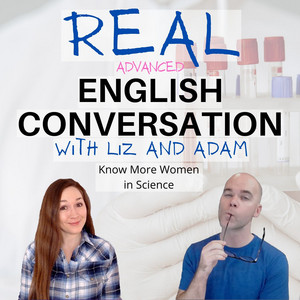
Today, we're talking about the spotlight program, No More Women in Science.
And I have to pause on the title.
Yes, if you weren't going to, I was going to.
Because I believe there's a homophone in the word, in the title, the word no.
Right, that's why it's a clever title.
Yes.
Really, not like a clear title, it's more of a clever title.
Yes.
So it's kind of a joke in the title.
It's intentionally unclear to make you think a little bit.
Because you could say, no more women in science.
Like there should be no more women in science.
There should be no more women in science.
And ironically, a lot of people have made the case that in the past or maybe even currently, I don't know that women are not as good in science and math, which is not true.
Let's be very clear.
No, it's not.
And much of history has hidden women who are in science, right?
Ah, we will get to that.
But the real, if you would read this word, it is K-N-O-W, know more women in science.
Like knowledge.
How do you get to learn about women in science?
Understand what women have done in the scientific fields.
So that's the program.
So if you heard that and be like, we didn't want you to be confused, though we did want to grab your attention why is spotlight saying there shouldn't be women in science, right?
No, that's not what we're saying.
We're seeing the opposite.
We want to be clever.
No more.
Yes, we want you to know more.
If you want to know more, make sure you like and subscribe to this video if you're watching it on youtube, and click that little join button to join our youtube membership channel to get a lot of free emojis and pdf scripts and a lot of fun things extra content that we're providing.
It's a great way to take your english learning to the next level.
You can also get PDFs of the script sent to you via email from our website.
There's a little, uh, scripts by email button.
Press that for a basically a dollar a script, a dollar a week.
Um, you're never going to miss anything and they're yours to keep.
Um, I like to call it the cheapest English class that you can, that you can take on the internet.
Yeah, exactly.
Yeah.
Um, Yeah.
So I'm forgetting one little piece.
Well, where people can find the program, I think.
Ah, yes.
People can find the program.
Because you definitely need to listen to this program.
It's a really good one.
Yes.
You can find it on YouTube.
You can find it wherever you get your podcasts.
I think there's an advanced version of this program, correct?
Yes.
I don't know.
Oh, well, a classic.
We have various versions of every program, most programs.
We have a classic version.
We have a advanced version.
And then we also have started offering a no music version.
I know there's some of you out there watching who prefer that, to have no music in the program.
So let's dive into what this program is about, because it's a program I wrote, and when i heard about what i'll call her the main character of the story was doing, i was really inspired.
Uh, there's a you want to say something?
I did want to say something.
I want to say that i um, i mean, i also love this program.
But one of the cool things about this program to me is that uh, this person and i have a very similar last name and there are not very many Wades, and so I always just feel like wow, that's kinda cool.
That's it, and it was just not important, but her name is Jess Wade and yeah, I think her work is really cool.
Yeah, so she has her work.
She's a research.
This is a woman who is a research scientist, And I mention that she's a woman because it is relevant to the topic.
It's not necessarily relevant to her research that she's doing, but it's relevant to what she does out of that research.
So this program is about her efforts to recognize women who've made contributions to the field of science.
She realized or did some, I don't even know how she would figure this out but a very small percent of Wikipedia.
Do we need to explain Wikipedia?
Yeah, I feel like you need to start with Wikipedia, right?
Because, I mean, lots of people know what Wikipedia is.
I feel like Wikipedia is all over the world.
Right.
But it's basically an encyclopedia or...
Dictionary?
Encyclopedia is more like, So you can search anything on Wikipedia.
But people who are experts or people who just know about stuff can also write on Wikipedia.
And then other people edit their content and things like that.
We're talking over each other.
I was going to say if you do a Google search, often Wikipedia is one of the top three results.
If you're searching for information,
So it's kind of...
It's part of the Internet.
Right.
I mean, a huge part of the Internet for research purposes.
So, like, if you are going to Google something, probably you're going to see Wikipedia.
Right.
But it's not about everything in the world, right?
Right.
It doesn't include everything.
While there are editors and regulations, you and I can go in and we could make an entry.
We could make an all about Spotlight listeners and how they're wonderful.
And we could write a description of them.
We could talk about the history of them.
And then someone else could come in and maybe say, I'm a Spotlight listener.
And they could contribute to that post.
Right.
So what was... So this...
Jess Wade was looking at Wikipedia, or came across Wikipedia, and she realized there were not Well, of all the entries on scientists, only 17 of them were women scientists.
Right. which is representative of how women scientists have been treated throughout history.
So that that, um it's it's more complex than like there's only 17 of women scientists, or there's it does.
The percentage is somewhat secondary.
Um, It doesn't necessarily have to be one-to-one for how many scientists there are.
But she recognized there was an under-representation of women.
So she said, oh well, I can start telling people about the women scientists who have influenced me, who I look up to, who are my coworkers, who are working in exciting fields.
So she started to write Wikipedia entries.
And it was... Was it once a week?
I think it was once a week that she did this.
She was... She started with a climate scientist who works on coral reefs.
This woman did... This scientist did not even have a Wikipedia page.
It wasn't like she had a page and it was, you know, just a few little things.
So she picked one and then she started with another.
And...
And she said, there's a quote here.
This was from a couple of years ago, but she said, I have done about 270 pages in the past year.
So it's about one a day.
She was trying, she said she sometimes got excited and did more than one a day.
But yeah.
Yeah, I could see that.
But yeah, and it's something that I never thought about what are the things that I was so passionate about that I wanted to tell the world about through Wikipedia?
So that was an interesting kind of like okay, when I ever encounter someone that passionate, what are the things that I feel that passionately about?
And I still haven't come up with what I think that would.
Yeah, I don't know if I would have something that I was that passionate about.
I mean, of course and there there are also in her case.
There are so many scientists who wouldn't be represented, so there's a huge Like sort of archive or group to draw from and and talk about.
Yeah, so Yeah, and I don't know if I would have that sort of group of things to draw on either.
Yeah, and I think.
I think other people have also kind of caught up on that and have started to.
Well, and that's what she wanted as well.
She wanted other people to continue doing this, right?
Right.
Because she didn't want just... Her goal wasn't just to recognize the people of the past.
It was also to inspire people in the future, right?
Yes.
And this is the.
This is what I wanted to talk about, because there's this, there's this saying in English if she can see it, she can be it.
I like that.
And so I mean I think that it does use, you know she, but I think it really is applied to anyone like if you can see someone like you, whether you are from a different culture or from a different background or a different religion or a different gender.
However you define you.
Yeah, exactly.
If you can see someone like you who has succeeded and, you know, maybe achieved their dream or or done something important, that can inspire you to also follow that path and achieve your dream.
And so I think this is like one of her things.
Is that she, when you write, when you make sure that women or you know any, any other minority group?
Right.
Who's not anyone who's not not easily represented.
Yeah, exactly.
Because women are not actually a minority.
But anyway, this is that's getting complicated.
But but when you see someone represented in a positive light, you can work toward being like them.
And this is a way to represent women scientists, especially um, so that young girls can see that women do achieve in science.
It's not just that 83% of, of scientists are men.
There are actually women scientists out there in the world making a huge difference, doing important work and, um Yeah, I think it's an inspiration to young girls.
I mean, I hope so.
As the father to two young girls, I'm aware of trying to show them the different possibilities, because they don't always see those.
They don't always get shown those possibilities.
Yeah.
Go ahead.
I was going to add.
The other thing that I love is that it is If she has success and then she is trying to pass it on to those who may need help or may need representation, who maybe don't have that voice for themselves.
Right.
And so I wanted to read this quote that is near the end, which I think is just so great, if you don't mind.
Yeah, go.
OK, she says we could all do a better job of celebrating the women and underrepresented groups who are in science and in engineering and technology and in any job where you are in the minority.
I think that at every chance we can, we should try and support someone else.
And if you have been given a chance, that is so great.
But then you have to help someone else at the same time.
And I think.
That is just so beautiful.
Right.
You know someone, you've gotten to this place, and then you reach down your hand and you help someone else.
And then that person can reach down their hand and help someone else.
And I'm getting all teary eyed because it's so beautiful to me.
But I love that about this program.
I think that's a wonderful note.
And I would encourage anyone who's watching this.
If you are working in a field where you feel kind of underrepresented, let us know in the comments.
It could just be science.
It could be a specific science or engineering or I don't even know it.
Just let us know.
Technology.
Let us know. if you've had the opportunity to help somebody, or do you wish you had?
I mean it's our hope for you that you do, that you're able to give back from what you've learned and what you know to the world.
And we really I mean, I really like spotlight in that we got to kind of hold Jess Wade before you in the work that she was doing, hopefully in the same way that she's holding other people in front of you and making you think about women in science.
So let us know.
And you can either put it in the comments.
Let us know on Facebook, Twitter, Instagram, whatever social media platforms you prefer.
Visit spotlightenglish.com to listen to this program again.
And you'll find lots of other programs there.
Anything I'm missing?
I don't think so.
Check us out all over social media.
Until next time, we hope you listen, watch, practice, and learn.
Spotlight out.