You're listening to Brains On, where we're serious about being curious.
Brains On is supported in part by a grant from the National Science Foundation.
Is this thing on? Greetings Brains On, this is Eric as I, a frog.
I noticed this episode of Brains On is all about body temperature.
Specifically how the human body is always around 98 degrees.
To that I say, seriously, the same, all the time, I'm boring.
It's like only dancing to Charleston all your life.
Hachachichachichachichachachachachachachachachachachachachachachachachachachachachachachachachachachachachachachachachachachachachachachachachachachachachachachachachachachachachachachachachachachachachachachachachachachachachachachachachachachachachachachachachachachachachachachachachachachachachachachachachachachachachachachachachachachachachachachachachachachachachachachachachachachachachachachachachachachachachachachachachachachachachachachachachachachachachachachachachachachachachachachachachachachachachachachachachachachachachachachachachachachachachachachachachachachachachachachachachachachachachachachachachachachachachachachachachachachachachachachach I've been using these I've been using these things for a long time, I've been using these things for a long time, I've been using these things for a long time, I've been using these things for a long time, I've been using these things for a long time, I've been using these things for a long time, I've been using these things for a long time, I've been using these things for a long time, I've been using these things for a long time, I've been using these things for a long time, I've been using these things for a long time, I've been using these things for a long time, I've been using these things for a long time, I've been using these things for a long time, I've been using these things for a long time, I've been using these things for a long time, I've been using these things for a long time, I've been using these things for a long time, I've been using these things for a long time, I've been using these things for a long time, I have been using these things for a long time, I have been using these things for a long time, I have been using these things for a long time, I have been using these things for a long time, I have been using these things for a long time, I have been using these things for a long time, I have been using these things for a long time, I have been using these things for a long time, I have been using these things for a long time, I have been using these things for a long time, I have been using these things for a long time, I have been using these things for a long time, I have been using these things for a long time, I have been using these things for a long time, I have been using these things for a long time, I have been using these things for a long time, I have been using these things for a long time, I have been using these things for a long time, I have been using these things for a long time, I have been using these things for a long time, I have been using these things for a long time, I have been using these things for a long time, I have been using these things for a long time, I have been using these things for a long time, I have been using these things for a long time, I have been using these things for a long time, I have been using these things for a long time, I have been using these things for a long time, I have been using these things for a long time, I have been using these things for a long time, I have been using these things for a long time, I have been using these things for a long time, I have been using these things for a long time, I have been using these things for a long time, I have been using these things for a long time, I have been using these things for a long time, I have been using these things for a long time, I have been using these things for a long time, I have been using these things for a long time, I have been using these things for a long time, I have been using these things for a long time, I have been using these things for a long time, I have been using these things for a long time, I have been using these things for a long time, I have been using these things for a long time, I have been using these things for a long time, I have been using these things for a long time, I have been using these things for a long time, I have been using these things for a long time, I have been using these things for a long time, I have been using these things for a long time, I have been using these things for a long time, I have been using these things for a long time, I have been using these things for a long time, I have been using these things for a long time, I have been using these things for a long time, I have been using these things for a long time, I have been using these things for a long time, I have been using these things for a long time, I have been using these things for a long time, I have been using So, if you could choose between feeling very hot, like being somewhere where it's super hot outside or being somewhere where it's super cold, what would you choose?
I feel like I'm pretty adapted to both extremes because where my school is where the base of my diabolos so in the morning it's always freezing, but then I still live in California, so in those summers it's always hot, but I think if I really had to choose, I'd go with always being hot.
Why is that, do you think?
I don't know, I feel like I have a lot more experience being hot than being cold.
And what are your favorite ways to cope when it's hot out?
For the most part, I do indulge in ice cream and popsicles sometimes, but what I really like to do is just carry around a massive water bottle filled with ice water and refill it constantly.
And I know that you're still really interested in science.
What kind of science are you most excited about?
Well, before I was really interested in biology and zoology, but because six whole years have passed, my scientific interests have changed a lot, and right now I'm more interested in physics and math.
What got you interested in physics and math?
I don't know, I think it was something about math being the building block of all of science and physics being the closest thing to math.
Well, before we get to the heart of your original question, let's figure out why our bodies are so hot in the first place.
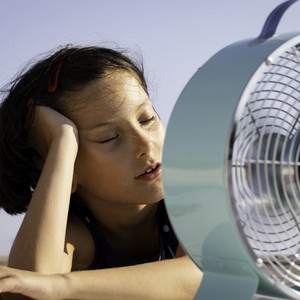
98.6 degrees is hot. If it were that hot outside, it'd be sweaty and want to go jump in a nice cold pool.
But the insides of our bodies are that hot all the time.
And that's because there's a lot going on in there that creates heat.
Your heart is pumping blood through your body.
Your lungs are moving air in and out.
Your stomach is digesting food.
Cells, your body's tiny building blocks are turning that food into energy, and that helps them do what they need to do, like grow hair.
Heal cuts. Power your brain.
And there's so much more going on in your organs and your blood street.
Your body is a hopping and very hot place.
That's because all of these activities create heat.
A lot of heat. So much heat that your body has to spend a lot of time getting rid of it in order to stay around 98 degrees.
When your body is nice and balanced and running as it should, that's called homeostasis.
It's a fancy word that just means everything in the body is working as it should.
All's good, homeostasis.
There's a part of your brain that helps with homeostasis by keeping track of your body temperature.
It also makes sure your body is doing what it needs to do to stay cool.
It's called the hypothalamus, and it's always working hard to help you do things like pump blood and sweat.
I actually have a workout video for us to try hosted by the hypothalamus herself.
Let's sweat it out. Hi, I'm hypothalamisty, the hypothalamus, and welcome to the homeostasis studio.
I hope that body of yours is ready to move because we are ready to beat the heat.
Oh, do you feel that? It's getting hot in here, so we better bust out our moves.
Just follow my simple step-by-step instructions and you'll be sweating it out in no time.
Let's start by getting that blood pumping to the skin and pump and pump and pump and pump and pump.
And as the blood flows from the surface of your skin, it's able to dump some of that heat from inside the body.
Pump and dump, pump and dump.
Who cares if your face is a little red?
That just means you're a master of the pump and dump.
Ooh, I can feel the heat radiating off your skin from here.
Now it's time to get wet with sweat.
Squeeze that sweat out.
Secrete, secrete, secrete.
And as that sweat dries and evaporates, it takes the heat with it.
Bub-y-heat, secrete, bu-y-heat, secrete.
Ooh, very good. You're getting that heat out of your body like a pro.
It's time for our last move.
It's called the booty shake.
You bend your knees just a little bit and shake that romp from side to side.
Uh-huh. Uh-huh. Uh-huh.
Get down with the music.
Uh-uh. Yeah. You're probably wondering, how does this get rid of heat from my body?
The answer? It doesn't.
But it's a great way to elevate your levels of funkiness.
And that's all for today.
You've done an amazing workout.
You've pumped and dumped.
I saw you secrete to beat the heat.
And now your body is just the right temperature.
I'm the hypothalamus and you're welcome in my homeostasis-sized studio anytime.
Bye-bye and don't forget to hydrate.
Phew. I am sweaty. Me too.
That was a workout. So our body is able to dump some of the heat it makes by pumping more blood near the surface of our skin.
That blood carries heat with it and the air around our skin soaks up that extra heat, cooling us off.
We also lose heat by sweating.
When the little droplets of sweat evaporate from our skin, the water and some of the heat float off into the air.
That cools us too. Our bodies are able to do this best when the air is 70 degrees cooler than the insides of our bodies.
Ah, so as it gets hotter than 70 degrees outside, it becomes harder for our bodies to get rid of extra heat these ways.
Yes, especially when it's humid.
When air is humid, it means there's already a lot of water floating around in it.
So it's harder for the water and our sweat to evaporate because the air already has plenty of water and it doesn't need more.
So the usual techniques of cooling us off don't work as well when it's humid and hot, so we feel uncomfortably hot.
Hi, I'm the hypothalamus and welcome to the homeostasisis studio.
It's hot in here. Like really hot.
Okay, let's try our tried-and-through methods.
Get that blood to the skin.
We'll pump and dump and pump and dump.
I'm pumping, but the dumping isn't working so well.
I'm so hot. Okay, let's try sweating.
Sick creed. Bye-bye heat.
Sick creed. Bye-bye heat.
Oh, the sweat isn't evaporating.
I'm so hot. Oh, you know what?
Forget it. I'm going to the pool.
So when it's hot and humid outside, it's harder for our bodies to keep that homeostasis and we feel hotter.
The answer to my question.
Finally, bodies are 98.6 degrees because they produce a lot of heat, but we need to constantly dump heat to feel cool.
Yes, and if it's 98 degrees outside, we can't dump heat very well.
We're going to hear what happens in our bodies when our temperature goes above the normal, but first, something else for you to puzzle over.
It's time for the... Shhh.
Mystery sound. Sautvik, are you ready for the mystery sound?
I am. Wonderful. Here it is.
Hmm, what do you think? Well, I mean, it definitely sounds like something grinding, so I'd say a table sliding against a concrete floor.
Ooh, very good guess. Should we hear it again?
Sure. Okay, here it is. Any new thoughts?
I mean, it does seem to be going back and forth, so maybe two really rough rocks rubbing against each other?
Ooh, very nice guess. I have no idea what this is either.
Why do you think someone might be rubbing rocks against each other?
I have no idea maybe to grind them to a powder, like a mortar and pestle.
Ooh, well, we're going to hear it, get another chance to guess, and hear the answer after the credits, so stick around.
Listeners, we love getting mail from you.
Head to brainson.org slash contact to send us your mystery sounds, drawings, and questions.
Like this one. Why does ice help with swelling?
You can find answers to questions like these on the moment of unpodcast, a short dose of facts and fun every weekday.
Again, that's brainson.org.
Brainson Universe is a family of podcasts for kids and their adults.
And since you're a fan of brainson, we know you'll love the other shows in our universe.
Come on, let's explore.
And the rain brainson universe.
So many podcasts. Brainson.
Smash Boom Best. Forever ago.
Ficking up signal. Smash Boom Best.
A debate show. What are they arguing about this time?
Tomatoes versus potatoes.
I was just remembering in 1949 the Mr.
Potato Head went into production.
A pivotal toy and a lot of people shouted and I was googling right now Mr.
Tomato Head. And the first thing that comes up is, did you mean Mr.
Potato Head? Oh! Laugh.
Lurp. Signal down. Need Smash Boom Best.
No! Search for Smash Boom Best wherever you get your podcasts.
Ba-ba-ba-ba-ba-ba-ba-ba-ba-ba-ba-ba-ba-brainson.
You're listening to brainson.
I'm Sothvik. And I'm Molly.
So far, we've found that it's hot inside our bodies because they're really busy and make lots of heat naturally.
And we actually have to be dumping heat through our skin to stay at homeostasis that nice 98.6 degrees.
But even though we talk about 98.6 as a normal temperature, it's really just an average.
Sothvik, how would you describe what an average is?
Well, to get the average, when you have a set of data points, you add up all of the values and divide by the number of points you have.
Oh, very good. That math knowledge is coming in very handy today.
So that 98.6 number was first put out there by a German scientist named Karl Reinhold August Wunderlich.
He published it in 1868, and in his report, he said 37 degrees Celsius.
Which is the same as 98.6 degrees Fahrenheit.
Was the average temperature.
He said he took multiple temperature readings from 25,000 patients.
That is a lot of data. Yes.
Some were a little hotter, the 98.6, and some were a little cooler.
But 98.6 was the average.
But several groups of scientists have been studying this more recently, and they found that our average temperature is now closer to 97.9 degrees.
And we need to point out that our body temperatures do change over the course of a day.
Our bodies are coolest in the early morning, and warmest in the late afternoon.
There are also differences between male and female bodies, differences based on age, and body size.
There are a bunch of reasons that our average body temperature is different now than in 1868.
One reason for this is that we have fewer infections now, thanks to a more sanitized world, and our bodies are warmer when they're fighting infections.
Many of us move our bodies less overall than people used to, and we also have better medicines and better nutrition.
So, even though we're a teeny bit cooler, we're still warm enough to keep our bodies running smoothly.
We are! But sometimes our bodies really want to warm up, climbing to 100, 101, or even higher.
That's what we call a fever, and it turns out they're super important to help us fight off germs.
I am Joe Alcock. I'm a professor of emergency medicine at the University of New Mexico, and I work in the ER there in a big urban hospital in Albuquerque.
And I also do research, if a normal body temperature is thought to be about 98.6 degrees Fahrenheit, a fever would be over 100 degrees Fahrenheit.
The question is, why does that happen?
And why did that evolve?
The fever has evolved on the planet, and a bunch of different kinds of creatures, not just us, if your dog or cat gets sick, they will also have a higher body temperature than what is typical for them.
And what's really amazing is that even cold-blooded animals, they don't have a way of actually increasing their body temperature internally, but they can actually increase their body temperature by seeking out warmth.
So, lizards that get sick with a bacteria, they'll actually go and sit in the sun and they'll warm their body temperature higher than what non-sick lizards do.
But even some animals without backpones do this too.
So, there's a Senegalese grasshopper that when it gets sick, it seeks out warmer places, and the body temperature of the grasshopper goes up.
So, there's a lot of babies when they get sick and they're colony, what they do is they will actually shiver their wings.
They don't fly, they just engage their little wing muscles, and they basically shiver, and that increases the temperature of the entire hive.
There's something similar that happens in worms.
There's something similar that happens in snails.
So, the last common ancestor of birds and lizards and people and worms is about 4 million years ago.
So, that means that fevers have been around probably on this planet for about 4 million years, maybe even longer than that.
So, for fever to be so widespread in the animal kingdom, then that really is evidence that fevers might be doing something useful for the animals that show a higher body temperature.
People are still doing some experiments to figure out exactly why this happens, but it turns out that when you are infected with something, and this could be a virus, or when a bacteria is causing an infection, to be a successful infection, the invader has to reproduce.
So, one bacteria has to become two, has to become four, but it turns out that when you increase the temperature, it makes it harder for bacteria to replicate.
So, it makes it harder for one to become two.
From your point of view, when you have a bacterial infection, it can be good to have the temperature be a little hotter, because that makes life a little bit tougher for the bacteria.
It also makes life a little bit tougher for you, but that's a price that you are willing to pay to get over an infection.
So, next time you have a fever and you feel achy and lousy, just know that your body is doing something pretty amazing and pretty ancient to keep you healthy.
Our bodies are always making heat, but there's a part of our brain called the hypothalamus that keeps our body temperature right where it needs to be, around 97 or 98 degrees.
Our body can get rid of heat by pumping our blood closer to the surface of our skin and by sweating.
Our bodies like to be so warm because the heat keeps germs in check.
And when we get sick, we get warmer to fight off the germs.
This is a fever. And it turns out lots of animals have evolved to get fevers too.
That's it for this episode of Brains On.
This episode was written by Molly Bloom.
And produced by Rosie DuPont.
Our editors are Sandin Totten and Shayla Farson.
Back checking by Katie Ruther.
We had engineering help from Michael Peterson and Derek Ramirez with sound design by Rachel Brief.
Original theme music by Mark Sanchez.
We had production help from the rest of the Brains On universe team.
Anna Goldfield, Nico Gonzalez-Whisler, Ruby Guthrie, Lauren Humbert.
Joshua Ray, Mark Sanchez, Charlotte Traver, Anna Weigel, and Haran Waldo-Salassi.
Beth Bromant is our executive producer and the executives in charge of APM Studios are Chandra Cavati and Joanne Griffith.
Special thanks to Shruthi Katturo.
Brains On is a non-profit public radio program.
There are lots of ways to support the show.
Subscribe to Brains On Universe on YouTube where you can watch animated versions of some of your favorite episodes.
Or head to BrainsOn.org.
While you're there, you can send us mystery sounds, drawings, and questions.
Okay, soft pick. Are you ready to listen to that mystery sound again?
Ready as a lever, B-Molly.
Okay, here it is. What are your new thoughts?
I think I am going to stick with my mortar and pestle answer, but I'm also pretty unsure because it does sound a lot heavier than a mortar and pestle.
Maybe it's a giant mortar and pestle used by Bigfoot?
Maybe. Maybe. That's probably not right.
I think you're probably closer than I am.
Should we hear the answer?
Sure. Okay, here it is. Hi, my name is Miles and I live in Atlantic, kind of New Jersey.
And I was the sound of me waxing my surfboard.
Oh, my goodness. I'm a waxing surfboard.
Have you ever waxed a surfboard before?
I have not, and never in a million years would I have thought of that.
That is so tricky. Okay, so when you wax a surfboard, you have this hard piece of wax that you rub on the bottom of.
So it's like hard, almost like a rock.
And the surfboard itself is kind of bumpy and hard.
And so that's making that noise.
Pretty cool, huh? Yeah.
You're in California. Would you ever like to try surfing?
I mean, maybe just so I can wax a surfboard.
Exactly. Now it's time for the brains honor a role.
These are the incredible kids who keep the show going with their questions ideas.
Mystery sounds, drawings, and high fives.
Lydia from Bluff City, Tennessee, Patrick from Worthing, UK, Kaylee from Columbia, South Carolina, Johnna from Louisville, Kentucky, Joanna from Gordon, Georgia, Kai Avery and Devon from Flora St.
Missouri, Maggie from Brithood, Colorado, Sawyer and Rory from Cincinnati, Lila from Puket, Thailand, Anissa and Hazel from Ann Arbor, Michigan, Luca Ellis and Vivienne from Medford, New Jersey, Esme from Nashville, Celia from St.
Louis, Emma from Fremont, California, May from New Orleans, Carolina from Washington, DC, McKay and Lincoln from Clearfield, Utah, Elias from Portland, Oregon, Jack from Helena, Montana, Stella and Iris from Pennsylvania, Zoe from Fort Mill, South Carolina, Jacob from Massachusetts, Nolan from the Netherlands, Maxwell, Oliver and Aiden from Leonard Town, Maryland, Mary from Baltimore, Claire from Edmonton, Alberta, Ellis from Chelmstrand, Massachusetts, Margot from Chicago, Iris from San Francisco, Ellie from Sunnyvale, California, Si and Crockett from Tacoma, Washington, Lauren Kate Joseph and Nicholas from Batesville, Indiana, Serena and Sofia from Hillsboro, Oregon, Nora, Brendan and Charlie from Raleigh, Massachusetts, Tom from Canmore, Alberta, Harper from Colorado Springs, Henry from Portland, Oregon, Carson from Houston, Texas, Gabriela from Lincoln, Rhode Island, Miles from Melbourne, Pennsylvania, Hanan from Vancouver, Sylvia and Penelope from Seattle, Nora, Alia, Liliana and Elias from Jacksonville, Florida, Jenna from West Jordan, Utah, Remington from St.
Augustine, Florida, and Daniel from Seattle, Samuel from Chapacol, New York, Jacob from Atlanta, Leo from Seattle, Nathan Naomi and Nemaya from Taipei, Taiwan, Mateo and Leo from Philadelphia, Ruth from Atlanta, Archie from Cambridge, New Zealand, Ben and Emmy from Western Virginia, and Rhea from Maryland.
Next week we'll be back with an episode about how Trees Help Cities.
Thanks for listening.