What's up indicator listeners?
We're taking this week to highlight some of our favorite episodes from the past year.
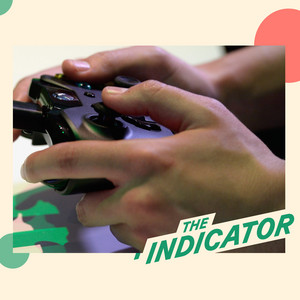
Today's episode is about how advocates have been pushing the video game industry to be more accessible to folks with disabilities.
Hope you enjoy. It was around the age of 12 when Steve Spahn discovered video games.
He was at home, which is where he was most of the time because he has spinal muscular atrophy.
It's a condition that gradually takes away a person's ability to use their muscles.
One time, one of the nurses helping him asked, have you ever tried playing video games?
I told her that I was too disabled.
There's no way that I could.
She challenged me that there was no reason.
I couldn't just hold the controller.
I was using a powered wheelchair, so why couldn't I hold the controller?
She brought over a Nintendo and it was like love at first sight.
I literally kidnapped it and would never take it back.
It was really great.
I ended up falling in love and beating Mario.
As Steve's condition progressed over the years and moving became more difficult, he's had to find more creative ways to keep playing, like using a dentist pick to push keys on a keyboard, or wearing a special hat with sensors that allows him to control a game by tilting his head.
He's had to do all this because for a long time, the video game industry just was not thinking about gamers like Steve, or gamers with disabilities generally.
But that is starting to change.
This is the Indicator for Planet Money.
I'm Adrian Ma. And I'm Weyland Wong.
Today on the show, how advocates and game developers are shifting the status quo on accessibility.
This message comes from Capital One.
Say hello to stress -free subscription management.
Easily track, block, or cancel recurring charges right from the Capital One mobile app.
Simple as that. Learn more at CapitalOne .com slash subscriptions.
Terms and conditions apply.
This message comes from NPR sponsor E -Trade from Morgan Stanley.
Take control of your financial future with E -Trade.
No matter what kind of investor you are, their tools and resources can help you be ready for what's next.
Now when you open an account, you can get up to $1 ,000 with a qualifying deposit.
Terms apply. Learn more at E -Trade .com slash NPR.
Investing involves risks.
Morgan Stanley, Smith -Barnie, LLC.
Member Sippic. E -Trade is a business of Morgan Stanley.
This message comes from Capella University.
With Capella's FlexPath learning format, you can set your own deadlines and learn on your schedule.
A different future is closer than you think with Capella University.
Learn more at capella .edu.
This message is sponsored by Greenlight, the debit card and money app made for families where kids learn how to save, invest, and spend wisely with parental controls built in.
Sign up this holiday season at greenlight .com slash NPR.
So for most of video game history, accessibility was sort of an afterthought, if it was thought of at all.
But then back in 2020, a company called Naughty Dog released a game called The Last of Us Part II.
Now The Last of Us Part II is this action adventure game where you run, jump in, shoot your way through this sprawling post -apocalyptic world which is filled with zombies.
Give me your hand. We're gonna have to run.
There's too many of them.
Now normally this sort of game just would not be accessible to players with hearing, vision, or physical disabilities, but The Last of Us Part II was pretty different in this respect.
Emilia Schatz is a lead designer at Naughty Dog and she says years before she started working on the game, she hadn't necessarily been thinking about how to make it more accessible to people with disabilities.
She was really thinking about how to make one of her games accessible to her mom.
I mostly was just like, okay, I want my mom to play this game.
That was my goal. And the reason was Emilia's mom would often be like, I don't really understand what it is you do.
And Emilia thought, well, if you could just play the game, you would get it.
But a big obstacle for her mom was learning the controller.
You know, with its buttons and multiple joysticks, could be pretty overwhelming for a non -gamer.
At the time, Emilia was working on a game called Uncharted 4.
And she thought, what if we added an option that players could turn on that would basically simplify the controls, make gameplay easier?
Then my mom could enjoy all the cool games I'm making.
Has she played the games that you've made?
Yes, but I don't know how much she enjoyed it.
That's a thing. Oh, such a tough audience, those moms.
Who cannot relate? Right?
So these new features didn't make a gamer out of Emilia's mom, but they did get a lot of positive feedback from other people who played the game.
And so Emilia and her colleagues thought, what other options could they add to a game to make it accessible to even more people, including those with disabilities?
And so they started having meetings with disability advocates and gamers with disabilities.
And at one of these meetings, a gamer who was blind asked them, could they make an option that would allow him to play one of their games?
Like somebody who could not see a screen at all.
And to be honest, I mean, the first thought of my head was like, probably not.
Like, no, I don't think so.
But it was so interesting of a question and it got me thinking about, I could let it go.
So as Emilia and her colleagues started working on their next game, The Last of Us Part II, that question kind of snowballed.
They thought, why just focus on one dimension of accessibility?
And after a lot of experimenting and consulting with gamers with disabilities, the developers eventually added more than 60 different accessibility options to the game.
For example, players had the option to reassign what each switch and button does, which could be really helpful for players with certain physical disabilities.
Players with hearing impairments could turn on multiple visual cues.
And then there were options aimed at people with vision -related disabilities, people like Ross Miner.
Growing up, so many blind people, including myself, have developed crazy, convoluted ways to play video games.
Ross works as an accessibility consultant and actually specializes in video games, which he says he's been playing since he was a little kid.
He remembers back then, this Pokemon video game was really hot.
And even though he couldn't see the screen, he adapted.
I literally went home and got my Game Boy and memorized every single sound in the game just to play alongside my friends.
Over time, Ross figured out how to play other kinds of games, even if they weren't designed with him in mind.
But there were certain games that Ross thought he would never be able to play, what some call triple A games, big budget, epic titles with epic storylines that often require players to navigate vast 3D worlds.
I had these thoughts when I was a kid, like, oh, if they added this feature, like, I'd be able to play the game.
But it always just seemed like a pipe dream.
That is until he played The Last of Us Part II, because it had all these accessibility options for vision impaired players.
There was a screen reader that helped him navigate menus, a voiceover that described what was going on in scenes, and oh, the sound cues.
Sound cues for when you need to vault over something, when you need to crouch.
When you're aiming at an enemy, like, there's so many different sound cues.
It's truly a work of art.
But maybe his favorite feature was an option that allowed a player to send out a sort of sonar pulse in the game.
And then like in stereo, you know, it'll play like a sound to the left or a sound far off to the right.
Then you can track that object and it'll guide you to it.
So yeah, you're literally able to go through the entire game.
You're able to collect items and weapons and all of that, completely by yourself.
I'm not an emotional person, but like it literally brought tears to my eyes because something like this was never done before.
This game, The Last of Us Part II kind of set a high watermark for game accessibility.
And in fact, the game awards, which are sort of the Oscars of video games, gave it its first ever Innovation and Accessibility Award.
And since then, Ross says he's been seeing more and more game companies follow that example.
I have hope that, you know, this trend will continue.
I'm 100 % positive it will because at the end of the day, it also just makes great financial sense.
Right, because a lot of people with disabilities play games.
According to the Census Bureau, about 13 % of the overall population has some sort of disability.
And according to some estimates, the percentage is even higher in the gaming community.
Ross says it's a big market.
But on the other hand, Steve Spahn, who's the gamer we met at the top, who has spinal muscular atrophy, he's less confident that companies will always be willing to address the needs of disabled gamers.
I mean, don't get him wrong.
He says there's definitely been progress.
Now, it's a matter of keeping people caring.
It's not something that can be taken for granted.
For years, Steve has helped run a nonprofit called Able Gamers.
On top of providing information and resources to gamers with disabilities, they also lobby game companies to add accessibility features to their games.
But he says making games accessible isn't just about the games themselves.
A person who is quadriplegic, for instance, may not be able to even hold a controller.
That's why his organization also focuses a lot on providing individual consultations to people who want to play video games but aren't sure how or don't have the assistive technology to do so.
One of the things that runs through everything that I stand for and that we do is you really want to meet people where they are.
They have certain abilities, they have certain things that they can do, and you gotta bring the technology and the gaming to them rather than making them come to you.
And Steve says that's something game companies should think about too.
This episode is produced by Corey Bridges with Engineering by Robert Rodriguez.
It was fact -checked by C .R.
Juarez. Kagan Cannon edits the show and the indicators of production of NPR.
This message comes from NPR sponsor Merill.
Whatever your financial goals are, you want a straightforward path there.
But the real world doesn't usually work that way.
Merill understands that.
That's why with a dedicated Merill advisor, you get a personalized plan and a clear path forward.
Go to ml .com slash bullish to learn more.
Merill, a Bank of America company.
What would you like the power to do?
Investing involves risk.
Merill Lynch, Pierce Fenner, and Smith Incorporated, registered broker dealer, registered investment advisor, member SIPC.
This message comes from ShipBob.
The holidays start earlier every year, so get your online store in shipshape now with ShipBob.
They'll handle fulfillment, provide two -day shipping, and more.
Get a free quote at S -H -I -P -B -O -B dot com.
ShipBob. This message comes from ShipBob.
The holidays start earlier every year, so get your online store in Shipshape now with ShipBob.
They'll handle fulfillment, provide two -day shipping, and more.
Get a free quote at S -H -I -P -B -O -B dot com.
ShipBob.