There's free cake in the staff room.
Thanks for letting me know.
See you there.
Yeah, free cake, all right, Hey everyone.
I'm Alex.
Thanks for clicking and welcome to this lesson on writing a business or professional email in English.
Now this is useful for those of you who are just starting a corporate job, or if you are looking to work in an English environment where emails are constant.
So, I use my email every day.
I can tell you 100 that I have used all of these at one point or another in my emailing career.
We'll say
So I've sent thousands of emails and I've used all of these.
So these are phrases that you can use in internal emails between yourself and your colleagues or between yourself and someone who works with your company.
So maybe you know someone who is selling you know technology to your company, like printers or computers.
Maybe there's someone who supplies paper for your company, and you have to interact with them.
So you can use these phrases and expressions with them.
All right?
So first, we'll start with the greeting.
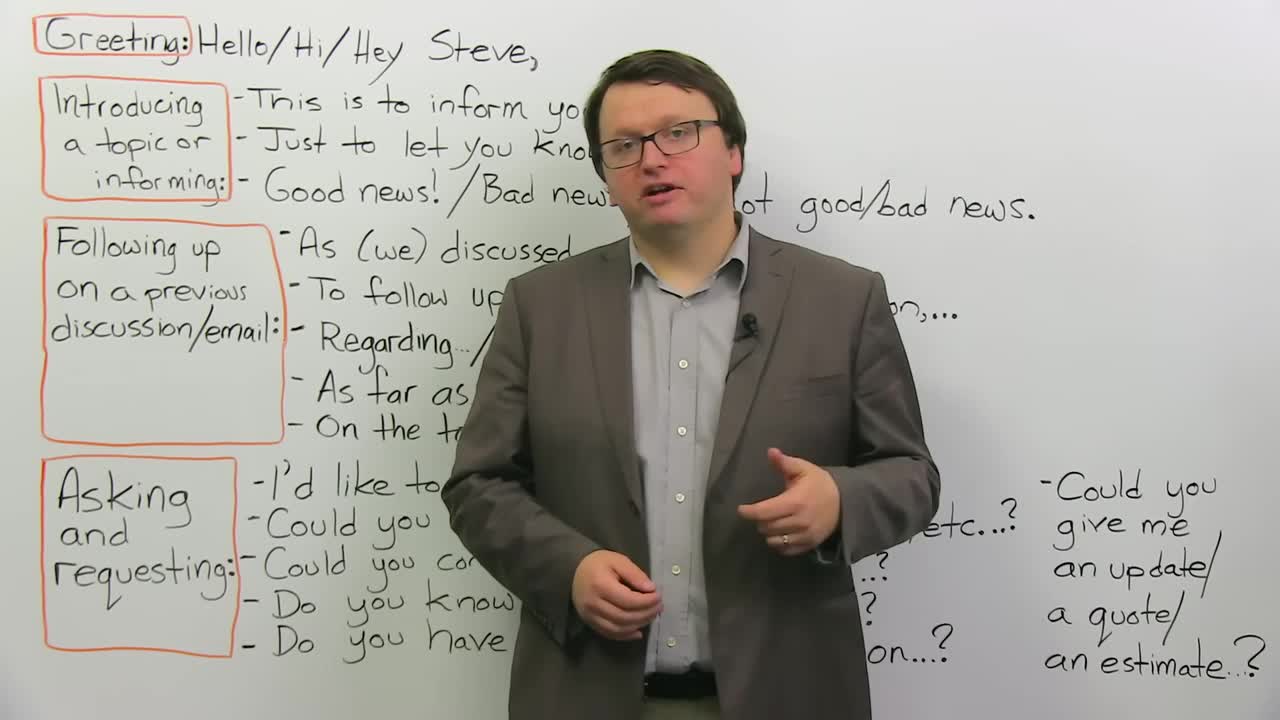
We have hello, hi, hey, Steve.
Steve, these are all for Steve.
So, you notice if you're wondering why didn't you put dear?
Why didn't you put to whom it may concern?
You could still use those.
I guess it depends on your own personal comfort with formality.
Having worked, like you know, in Canada and exchanging emails with people in the United States, most people are comfortable with a hello or a hi.
Only use a hey for someone you know.
So, these are in level of formality.
Of these three, hello would be the most formal.
Hi would be very neutral and hey is very familiar, very informal, so only use this with people you know well or that you have a good professional relationship with.
Next.
All right.
So one thing you might do in an email is to introduce a new topic or to inform someone of something.
Maybe not just one person, maybe a group of people, maybe a whole department.
So, for example, this is to inform you that... very general.
So maybe someone has received a promotion in your company and this is something you might see from your boss or, if you are a boss or a manager, you might send this to your team.
This is to inform you that You know, let's say Rosa, you have an employee named Rosa.
This is to inform you that Rosa has been promoted to the position of... Okay?
So you're giving information to your team.
This one...
Just to let you know.
Now, this is very informal, so only send this to people you know well, people within your company, maybe a friend in the company.
So just to let you know is a much more informal, casual way that you can use in an email instead of This is to inform you that
Okay?
So, for example, hey, just to let you know, I'm not here on Friday.
Please see me if you need anything from me before Friday.
Okay?
Also, you're introducing a topic or informing your company or someone of something.
So, hey, Steve.
Good news.
Hey, Steve.
Bad news.
Hey, Steve.
I've got good news.
I've got bad news.
Now, you notice here I used an exclamation after good news.
You know, it's a good idea to make it seem exciting.
So, good news.
You know, I just got promoted.
Okay?
Or, good news, I'm getting a raise.
Okay?
Something like this.
Bad news, we're not getting pizza for free today.
Bad news, I can't make lunch.
Sorry.
Okay?
I can't make lunch.
It doesn't mean you're creating lunch, you're making lunch.
It means I can't go to lunch with you.
Okay?
So you have... This is to inform you that, just to let you know good news, bad news.
I've got good news.
I've got bad news.
Okay?
Next, if you are following up on a previous discussion, a previous email.
Now following up means you had a conversation about a topic before, maybe in person, maybe in email, maybe by carrier pigeon, I don't know.
And you want to follow up on that email.
A carrier pigeon is a bird who brings a letter.
So, you can say...
Hey, Steve, as we discussed, or as discussed.
You can obviously add to this as discussed yesterday, as discussed at the meeting, as discussed this morning.
Please remove your shoes when you enter... I don't know. my office.
It's a strange thing, maybe.
I don't know.
It depends where you are in the world, perhaps.
So, next.
Instead of saying as discussed, you can also say to follow up on our meeting, to follow up on our discussion.
This is the same thing.
So, you know, as we discussed or to follow up, to give an update on the information we discussed.
You can say, you know, please come to work on time.
Okay?
Or, don't leave your lunch in the fridge for five days.
Other people use the fridge, Steve.
So, next, regarding. or in regards to.
Now, you can use either one of these.
Okay?
So, it just depends how you feel in the moment.
So, you know, let's see.
What else has Steve done lately?
Regarding...
Sure.
Regarding the quality of your deodorant, please change it soon.
Everyone can notice.
Okay?
Everyone notices.
Okay?
So, in regards to maybe, Steve wears strong cologne or strong deodorant and it smells very strong, so you know you're just having fun with Steve in an email.
Okay, as far as hmm goes.
So this is similar to saying regarding and regards to, but you put the topic here.
So if you are sending an email about your company budget, as far as the budget goes, please be careful with your spending.
Okay?
As far as, you know, this weekend's tour goes, it's going to begin at 11 o'clock.
Okay?
Same here.
On the topic of, hmm, and you follow up.
Okay, if you want to ask for something, if you want to request something many many many, many options.
All right?
So, I'd like to know if, when, how, Who?
Okay?
Any question you can think of.
I'd like to know when the meeting ends.
I'd like to know if I should bring anything.
Okay?
Next, instead of saying I'd like to know, you can also just say hey, could you let me know if when how, etc.
Maybe you're collecting money because it's Rosa's birthday, you know in the department and you can say hey, Could you let me know how much money I should contribute, you know, for Rosa's present or for Rosa's gift card or whatever.
All right?
Next, a little more serious.
Could you confirm?
Right?
Could you, like, 100% let me know, confirm if, when, how, etc.
So this is probably a more serious topic, although you could use it to be funny because it's a more formal expression.
You know, could you confirm how much money I should give or how much money I should contribute?
Could you confirm if we're getting paid today?
You know, just I want to make sure we're getting paid.
Next.
Do you know if, when, how, etc.?
So, do you know?
Okay?
So, do you know when the money will be in my account?
Okay?
Do you know if the printer needs more ink?
Okay?
Do you have any details, any update on a topic?
Okay?
So if you're ordering promotional material for your company from another company and you've been waiting for a long time maybe one week, two weeks which is a long time in most businesses
So, hey, do you have any update on the promotional material?
Do you have any details or any new details on the promotional material and another way to say this right hey, could you give me an update?
Could you give me a quote or an estimate?
So um, a quote is if you are in charge of, you know, dealing with some of the upper-end parts in your company, where you're dealing with other companies and you want to know hey, how much money does it cost for you to print this promotional material for us?
Or how much money does it cost for five new computers?
Could you give me a quote?
Basically usually a PDF or, you know, maybe some companies send a physical paper with the breakdown of everything.
Could you let me know how much it costs?
Could you give me an estimate?
Okay?
This means an idea of how much money things are going to cost.
All right.
So so far we've said hey Steve, we've introduced a topic, maybe we have followed up on a previous discussion.
We've asked some things, requested some things, and well, let's see what's next.
Stay tuned.
Come on.
Okay, so next we have saying thanks.
So, you can write, hey, thanks for getting back to me.
So you sent an email, they sent an email back and they answered a question for you and you want to send another email.
This is like the third email in the chain.
So, you would say, hey, thanks for getting back to me.
This means thanks for writing back, thanks for answering my question.
Okay?
And then you can use one of the other phrases regarding this question, right?
Okay, thanks for the info.
Thanks for the information, if you want to be more formal.
Again, if you are in a company where you know the people well.
Thanks for the info is pretty casual, pretty informal.
Only really use it with people you know well.
The information, if it's like the owner of your company, probably the information is better.
Thanks for the heads up.
So, this is a little more informal as well.
So, thanks for the heads up is usually thanks for the warning, thanks for the update.
So, for example, if someone sends you an email and they say hey, There's going to be a new position opening next week.
Why don't you, you know, update your resume and get ready, because I think you would be good for this job.
So you can say, oh, there's going to be a new position opening next week in the company.
Thanks for the heads up", right?
Thanks for the warning, so I know before other people.
So, think of heads up, oh, you can see the information that's in the future.
Okay?
All right.
Thanks for the update.
Thanks for the email.
Very general.
Hey, thanks for following up on, or thanks for following up with.
Thanks for basically, you know, keeping up to date or getting new information from this person or on this topic.
So, hey, thanks for following up with the accounting department.
Thanks for following up on our contract.
Okay?
Our contract discussion, something like that.
Thanks for your help.
Thanks for your help with something.
Hey, thanks for looking into this, into that.
If you look into something, it means you, you know, you research it, you take a deeper look.
So if a colleague asks you to look into something, they're asking you to get the details of a situation or get the details of something.
If they look into something and they send you the information say hey, I got the information.
The cost of this is 224.
It's like, oh, $224.
Oh, thanks for looking into this.
This cost changes everything.
Okay?
So, many ways to say thanks, many things to be thankful for.
And finally, closing your email, the ending you can say alright, I'll get back to you as soon as I can.
So, this is if someone has asked you for something, has made a request.
And you know you send them some information, you respond and you can just end with okay, I'll get back to you.
Or, if you want to, you know, be extra polite and say hey, I'm going to do this.
I'll get back to you as soon as I can.
This is very similar to, I'll let you know as soon as I can.
Okay?
So, this one, very, very common.
Okay?
I will let you know when I know.
Okay?
I will let you know.
I'll keep you posted.
This means if I have new information, I will send the information to you.
Okay?
I will give you an update when I know something.
Okay?
And then next, here you're asking for.
You know you've asked a question and you want a response, so you end it with please let me know.
Or just let me know, add a please.
If you want to be extra polite, Please keep me posted.
I'll keep you posted.
Keep me posted.
Keep me updated.
If there's any new information, tell me.
Okay?
Send me an email if there's new information on the topic we have discussed.
And, you know, there's a lot of talk about how should you end your email?
What's too formal?
What's not formal enough?
Do people still use sincerely?
I really only use sincerely on, like, government documents, things that are official from the bank.
If you, you know, have a complaint letter to a landlord where you're renting, you know your apartment sincerely works for those official situations.
In most internal company emails, I usually end mine with thanks.
Um, you could say regards, you could say all the best.
So, thanks works for internal, thanks works for somebody you're working with outside the company.
I would just keep it to more official official, official situations where you're dealing with government or banks or bigger companies.
Okay?
All right.
Whew.
That's it, guys.
So to test your understanding of this material, as always, you can check out the quiz on wwwengvidcom.
And what I want to see from you guys is, in the comments, write me an email.
Use like as many of these phrases as you can and just send a sample email to me.
In the comments that I can read and you know I can see how you guys are doing.
All this stuff that I gave you today, except for the ending, it doesn't have to go in this order.
Okay?
Like, you might just start an email saying, hey, Steve, hey, Rosa, thanks for getting back to me.
This could be the first thing.
It doesn't have to be the introductory part that I did in the previous board.
It depends what the email is about, of course, and what you want to stress.
All right?
So, write me in the comments. and do the quiz, which I already said.
And then, after you do the quiz, after you, you know, check the comments and all that stuff, go to YouTube, tell your friends.
Say, hey, I like this video by Alex.
Subscribe to his channel.
Hey, who's this person?
Huh?
Adam?
Yeah?
Ronnie?
Okay.
Yeah, Emma?
Yeah, I like these people.
I like these people.
Yeah, they have lots of good information over here.
So subscribe to them.
Check us all out on engVid and check me out on Facebook.
Check me out on Twitter.
I'm talking way too much and promoting too much, so one more thing.
If you want to support what we do, check out the support link on engVid and you can donate and help us do this for a long long long, long time.
All right?
So, thank you very much.
Until next time, thanks for clicking, and I'm going to go have that cake.
Cake, cake, cake, cake, cake, cake.