Ted Audio Collective You're listening to Ted Talks Daily where we bring you new ideas to spark your curiosity every day.
I'm your host, Elise Hugh.
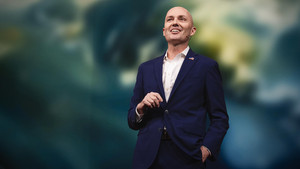
Spencer J. Cox is the Republican governor of the state of Utah in the United States, and he says that even in these deeply polarized times, it's possible to disagree without hate or contempt.
He shows how this idea sparked a campaign ad he made with his Democratic candidate counterpart back in 2020 and shares four practical things every one of us can do every day to heal the divides in our nations and neighborhoods after the break.
Like Ted Talks, you should check out the Ted Radio Hour with NPR.
Stay tuned after this talk to Hear Sneak Peak of this week's episode.
And now our Ted Talk of the Day.
In 1967, Ronald Reagan became the governor of the state of California.
In his inaugural address, he talked about the peaceful transfer of power, something he described as the simple magic of the commonplace routine, which makes it a near miracle to many of the world's inhabitants.
He then went on to utter an iconic phrase that would be repeated by politicians for decades to come.
Freedom is a fragile thing, he said.
And it's never more than one generation away from extinction.
Now, like countless others, I have used that quote many times.
But I have a confession to make.
I never really believed it.
Surely, after 250 years of this stuff, we no longer have to worry about losing it.
I'm not pleased to report that I actually believe it now.
The first crack in my confidence came during one of those commonplace routines of transferring power.
As Lieutenant Governor of the state of Utah, it was my duty to certify the votes of the electors for the presidential election.
Well, the meeting to do so was open to the public.
It was so commonplace to the routine that no one ever showed up.
As I walked into the room, I was stunned to see dozens of angry protesters screaming that the election had been stolen and demanding that we violate state law and change the votes of the electors.
Now, I know what you're all thinking.
And you're probably wrong.
This was not 2020. This was 2016, and the protesters were Hillary Clinton supporters.
Now, it got far worse somehow four years later.
With the election less than two months away, a friend and I were talking and lamenting about the state of our country following a summer of destructive protests by the extreme left.
And an extreme right that was already undermining the validity of an election that hadn't even happened to him.
Isn't there something you can do, she asks?
Well, that question haunted me all weekend.
So I picked up the phone and called my opponent.
By the way, I was running for governor at the same time that the Trump and Biden were battling for the presidency.
I called my opponent a Democrat named Chris Peterson, whom I respected.
And I said, hey, Chris, this is Spencer Cox.
I have a crazy idea. What if we filmed a campaign ad together?
I could almost hear the confused look forming on his face.
To his credit, he agreed.
And one week later, we were in a studio together.
I'm Chris Peterson, and I'm Spencer Cox.
We are currently in the final days of campaigning against each other to be your next governor.
And while I think you should vote for me.
Yeah, but really you should vote for me.
There are some things we both agree on.
We can debate issues without degrading each other's character.
We can disagree without hating each other.
And when or lose in Utah, we work together.
So let's show the country that there's a better way.
My name's Chris Peterson.
And I'm Spencer Cox. And we approve this message.
Well, the response was instantaneous and overwhelm.
The ad went viral. Neither of us sought coming.
There were media requests from all over the world.
Millions of views and shares.
Perhaps there really is an exhausted majority.
I remember thinking to myself, and maybe this is the message they want to hear.
I could actually feel my faith in the American idea, start to rekindle.
The popularity of the ad validated my hope that most people really do want their political leaders to uphold the values that we teach our kids.
That we can disagree without hate and contempt.
Even that we can find ways to treat each other with respect, even when we disagree.
And seeing like there was a hunger for architects instead of arsonists.
My hunch was confirmed one year later when a professor submitted a version of our ad to the Stanford polarization and social change lab as part of a huge depolarization experiment.
It was chosen as one of 25 interventions to be tested on over 30,000 people.
The result? Our ad actually had a measurable depolarization effect, including a reduction in urges towards violence.
It turns out there really are things that we can do to alter the trajectory of the United States.
Now look, I get it. It's easy to feel a little hopeless as Americans once again barrel towards an election with unsatisfying candidates and campaigns.
But there is good news. Over the past six months, 20 governors from all across the country have filmed similar ads, most of them with a public servant from the opposing party.
And the data continues to show that people really are hungry for something different.
Things to polling from more in common, 70% of Americans hate the divisiveness in politics.
And it also turns out that Americans aren't as far apart as we think we are.
The problem isn't how far apart the average Republican and the average Democrat is on the actual issues.
In fact, we're not much different than other Western democracies.
The problem is how far apart we think we are.
Do in large part to conflict entrepreneurs in both the media and politics, both sides overestimate the extremism on the other side by about 30%.
Now interestingly, this perception gap is actually strongest amongst progressive activists on the left and amongst extreme conservatives on the right.
So the people most engaged in the political process also have the most inaccurate views of the other side.
And now back to the episode.
But perhaps the best news of all is that there are very practical things that every one of us can do every day to help heal the divides in our nations and our neighborhoods.
First, we can start by turning off and tuning out some of those conflict entrepreneurs.
My wife and I, we stopped watching cable news 11 years ago and immediately saw an improvement in our marriage, our family, and our mental health.
Now, that always elicits a laugh, but we're not alone.
Studies have found that more time spent on the latest headlines, whether through social media or traditional media outlets, is really bad for our mental health.
Psychologists refer to this phenomenon in different ways, like media saturation overload or doom scrolling or headline anxiety.
You see, more news on all the time isn't making us smarter.
It's just stressing us out.
Second, we can spend more time, preferably offline, with real people who are different than us.
In the words of Brian Stevenson, proximity will empower you.
You see, it's just harder to hate up close.
To tell me more about why you feel that way is a magical request.
Twenty years ago, we rarely identified each other by our political identities first.
As for me, I'm a father, I'm an NBA fan, I'm a terrible aspiring bassist in a band.
I'm a Utahan. I'm an American.
How about you? You see, if we look beyond our political tribes, we can actually find shared identities and friendships that unite instead of divide.
Now, third, we can serve others.
Service and volunteering help build up communities and improve our outlook on life and the people around us.
Some forms of regular volunteering have even been associated with lower blood pressure.
There is nothing better for the soul or society than giving back.
Aristotle really was on to something when he described the, and summed up, the essence of life as serve others and do good.
Fourth and finally, we can work to develop the classical political virtues of humility, patience and moderation.
Without which, as John Adams explained, we all become ravenous beasts of prey.
Now, I know it's almost laughable to talk about words like humility and political discourse, but I truly believe that it is the only way for us to remember how to disagree without hate and contempt.
And the words of Judge Learned Hand, who so eloquently stated, the true spirit of liberty is the spirit which is not too sure it is right.
The spirit of liberty is the spirit which seeks to understand the minds of other men and women.
And I started with a quote from Ronald Reagan.
He went on to say that freedom is not ours by wave inheritance.
It must be fought for and defended constantly by each generation, for it comes only once to a people.
And those in history who have known freedom and then lost it have never known it again.
Ladies and gentlemen, it is our solemn duty in our generation to once again, to cure the freedoms endowed to all of us from on high.
We cannot wait for politicians or the media to do it.
It will take real work, hard work by each of us, but we must remember how to disagree without hate.
We must rise up and meet that radical call to love our enemies.
And especially our political opponents, it's not an easy answer, but it is a simple one.
If we really want to change the world, we have to start by changing our own hearts.
Thank you. That was Spencer J.
Cox at TED 2024. If you're curious about TED's curation, find out more at TED.com slash curation guidelines.
And that's it for today.
TED Talks Daily is part of the TED Audio Collective.
This episode was produced and edited by our team, Martha Estefanos, Oliver Friedman, Brian Green, Autumn Thompson, and Alejandra Salazar.
It was mixed by Christopher Faisy-Bogan, additional support from Emma Taubner, Daniela Balorezo, and Will Hennessey.
I'm Elise Hugh. I'll be back tomorrow with a fresh idea for your feed.
Thanks for listening. In 1983, NASA sent its first female astronaut into space with a bit of extra cargo.
When comedian Marsha Belsky heard the story, she just had to write a song.
One into space for only six days and they gave her 100 tampons.
Humorous. That's next time on the TED Radio Hour from NPR.
Please subscribe or listen to the TED Radio Hour wherever you get your podcasts.