

[The Evolution of the Taboo: A Historical Perspective on Female Body Hair]-[How did female body hair become taboo?]
📋 Summary
The Social Construction of Female Body Hair Taboos
Biological Reality vs. Cultural Perception
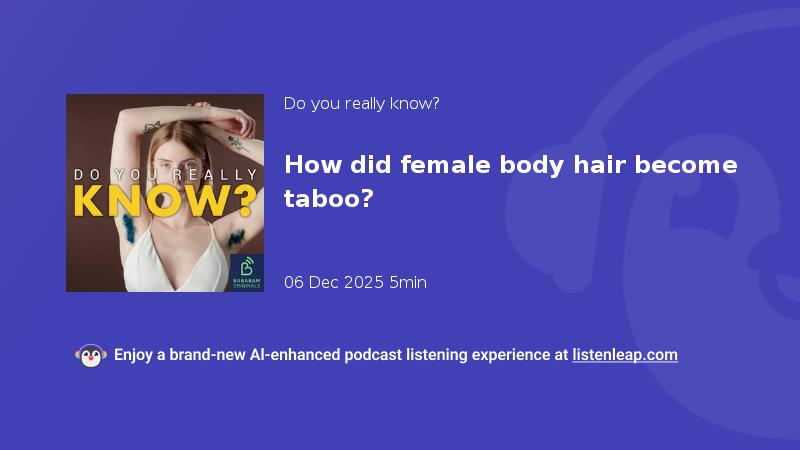
While the human body is equipped with approximately "5 million hair follicles," regardless of gender, the social perception of body hair is heavily skewed. Biologically, body hair serves essential "functions," such as "regulating body temperature" and "protecting sensitive parts of our bodies from infection." Despite these utilitarian roles, modern society has imposed a rigid standard, particularly for women, where the presence of hair is frequently viewed as a deviation from aesthetic norms.
Historical Context: From Purification to Gendered Control
Body hair removal is not a modern invention; it dates back to ancient civilizations. In cultures like the Mesopotamians, Hebrews, and ancient Indians, hair removal was practiced as a form of "purification." In Ancient Greece and Rome, it functioned as a marker of "social class," where the ability to remain hairless was a luxury afforded only to the wealthy. Crucially, in these early eras, the practice was not strictly gendered—both men and women participated. The shift toward a gender-specific taboo is a relatively modern phenomenon.
The Roots of Modern Taboo: Evolutionary Myths and Commercialization
The transformation of female body hair into a source of shame can be traced to the 19th and 20th centuries. Charles Darwin’s The Descent of Man suggested that reduced body hair was linked to being "sexually attractive," a concept that was later weaponized by medical experts and advertisers. By the 20th century, the strategy shifted to aggressive marketing. Advertisers began labeling underarm hair as "embarrassing" and "unsightly" to drive the sales of beauty products. A pivotal moment occurred in 1915 when Gillette introduced its "first female razor," effectively standardizing the expectation of hairlessness. This trend was further cemented during World War II, when a "shortage of nylon stockings" forced women to prioritize leg hair removal as a social standard.
The Impact of Media and Pop Culture
The stigmatization of pubic hair followed a similar path, accelerated by the introduction of the bikini and the rise of pornography. The normalization of hair removal procedures, such as the "Brazilian," was significantly bolstered by influential pop culture touchstones like the TV show Sex and the City and the public personas of celebrities such as "Victoria Beckham and Eva Longoria."
Challenging the Status Quo
Despite the pervasive nature of these beauty standards, the narrative is shifting. Feminist movements have long argued that women should possess the "right to choose" how their bodies appear. Furthermore, the contemporary "body positive movement" and the increasing "acceptance of gender fluidity" have begun to dismantle these outdated expectations. Today, more young women are actively embracing their natural body hair, signaling a potential end to the long-standing taboo that has dictated women's grooming habits for over a century.
Deep Learning with ListenLeap


