

[The Evolution of the Taboo: How Female Body Hair Became a Gendered Social Construct]-[How did female body hair become taboo?]
📋 Summary
The Evolution of the Taboo: How Female Body Hair Became a Gendered Social Construct
The Biological Reality of Body Hair
Despite the prevailing societal pressures, the biological reality remains that human bodies are naturally covered in hair. According to HealthNine.com, humans possess approximately 5 million hair follicles, a figure that is remarkably consistent across both men and women. From a biological perspective, body hair serves vital functions: it assists in regulating body temperature—either by keeping us warm or retaining sweat to facilitate cooling—and provides a protective barrier for sensitive areas such as the eyes and genitals, guarding them against infection.
Historical Context: Purification and Social Class
Contrary to the belief that hair removal is a purely modern phenomenon, humans have engaged in the practice since ancient times. In civilizations such as the Mesopotamians, Hebrews, and ancient Indians, hair removal was often viewed as a form of "purification." In ancient Greece and Rome, the absence of body hair served as a marker of "social class," as the poor simply could not afford the resources required to remove it. Crucially, in these historical contexts, hair removal was not a gendered practice; both men and women participated in it equally.
The Shift to Gendered Social Control
The transition of body hair into a gendered issue is a relatively modern development, tracing its roots to the second half of the 19th century. A significant intellectual shift occurred with Charles Darwin’s The Descent of Man, in which he proposed that modern humans have less body hair due to evolution, suggesting that individuals with less hair were inherently more "sexually attractive." This evolutionary narrative, combined with medical experts linking hair to various "physical and mental health problems," laid the groundwork for the modern stigma.
The Commercialization of Beauty Standards
In the 20th century, the taboo surrounding female body hair was aggressively weaponized to market beauty products. Advertisers began using pejorative language, describing underarm hair as "embarrassing" and "unsightly" to manipulate consumer behavior. This trend originated in the United States and rapidly permeated the Western world. In 1915, Gillette introduced its first female razor, effectively launching a campaign to make every visible part of a woman's body "hair-free."
External factors further accelerated these norms. During the Second World War, a shortage of nylon stockings in the U.S. forced women to expose their legs, turning leg hair removal into a societal "norm." Similarly, the taboo regarding pubic hair intensified in the latter half of the 20th century, driven by the introduction of the bikini, the rise of pornography, and the mainstream popularization of the "Brazilian" wax, fueled by media icons like Victoria Beckham and shows such as Sex and the City.
Challenging the Taboo: Feminism and Body Positivity
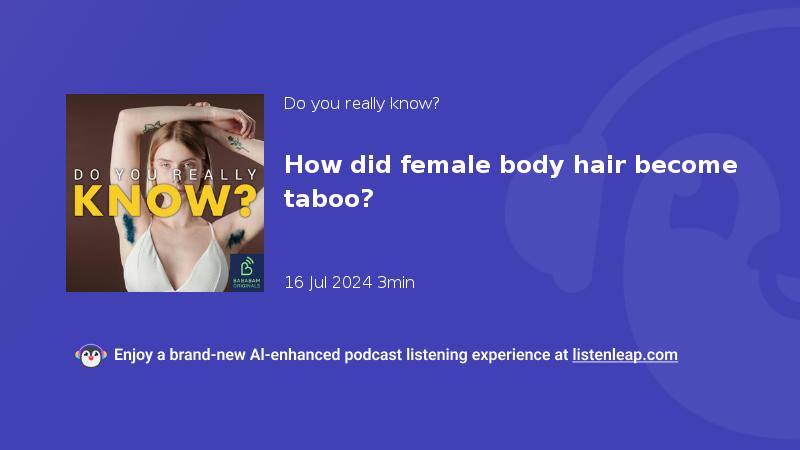
For decades, feminists have challenged these restrictive beauty standards, advocating for bodily autonomy and the right of women to "choose how their bodies are." The landscape has begun to shift since the turn of the century. The rise of the "body positive movement" and a growing societal acceptance of "gender fluidity" have fostered progress. Increasingly, young women are rejecting these historical myths, leading to a new era where natural body hair is being embraced rather than hidden.
Deep Learning with ListenLeap


