Welcome to English Listening Channel.
Hello, everyone.
Have you ever thought about this?
What if you need to go to a hospital when you are traveling abroad?
Maybe you feel sick.
Maybe something hurts, but your English is not very good.
You might think, how can I explain my problem in English?
Can I really talk to a doctor?
In today's video, you will watch a short and simple story about this situation.
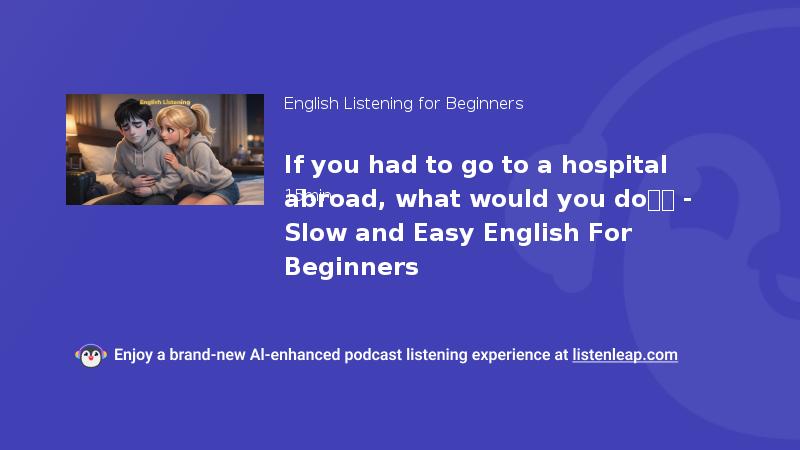
Ken is traveling abroad, and he doesn't feel well.
With the help of his friend Ellie, he goes to a clinic and talks to a doctor using very simple English.
Don't worry, the story is slow and clear, so you can relax and enjoy listening.
Before we start, I have a small question for you.
Please listen carefully and try to find the answer.
Where does Ken hurt?
The answer is very easy.
It is just one word.
If you find the answer, please write it in the comments in English.
All right, let's start the video.
Are you ready?
Okay, let's begin.
Ali, I don't feel well.
What's wrong?
You don't look good.
My stomach hurts.
It really hurts.
Oh no.
When did it start?
Since last night.
I woke up and my stomach was hurting a lot.
Since last night?
That's a long time.
Does it still hurt now?
Yes.
I think it's getting worse.
The pain is here.
This part.
Did you eat something bad yesterday?
I ate some street food at the market.
Maybe that?
Maybe.
Do you feel sick?
Does your stomach feel bad?
A little.
And I feel very, very tired.
I couldn't sleep last night.
Do you have a fever?
Do you feel hot?
I don't know.
Maybe.
I feel warm.
Let me touch your head.
Hmm, you are a little warm.
Ken, I think we should go to a clinic, a small hospital.
A clinic?
But my English is not good.
How can I talk to a doctor?
I'm worried.
I understand.
But listen, you don't need perfect English.
Just tell them where it hurts and when it started.
That's enough.
Just where it hurts and when it started?
That's all?
Yes.
And you can point.
You can use your hands.
Like this.
The doctor will understand.
Okay.
That makes me feel a little better.
Let's find a clinic.
Good.
I'll be with you.
Don't worry.
Okay.
Thank you, Ellie.
Let me look on my phone.
I'll search for a clinic near here.
Is there a clinic near here?
I hope it's not far.
Let me see.
Yes, there's one.
It says it's about 10 minutes by taxi.
10 minutes by taxi.
That's close.
Good.
And it's open now.
Many people say it's a good clinic.
That's good.
Let me ask the hotel staff about it.
Good idea.
Excuse me, my friend is sick.
Is there a clinic near this hotel?
She said there is a good clinic near here.
It's very close, many travelers go there, many travelers, so they know how to help travelers.
Yes, she said, the doctors are very nice.
Oh really, do we need an appointment?
I mean, do we need to call first?
I asked her.
She said no.
No appointment.
We can just go.
We can just go?
That's good.
We don't have to wait.
Right.
She also said the doctors there see many travelers.
They speak English and they are very kind.
So don't worry.
Okay.
That makes me feel a little better.
Let's go.
Let's take a taxi.
I'll ask the hotel to call one.
Let's go now.
I don't want to wait.
Of course.
We'll be there in 10 minutes.
It'll be okay, Ken.
Thank you, Ellie.
I'm glad you're here.
Of course.
I'm here for you.
Let's go.
Hi.
I'm not feeling well.
My stomach hurts.
I'm sorry to hear that.
Don't worry.
We will help you.
Can I have your name, please?
My name is Ken, Ken Tanaka, T-A-N-A-K-A.
Thank you, Ken.
And when is your birthday?
March 15, 1992.
Thank you.
Are you from here or are you traveling?
I'm traveling.
I'm from Japan.
I see.
When did you come here?
About five days ago.
I'm going home in three days.
Okay.
Do you have travel insurance?
Insurance for your trip?
Yes, I do.
I have the paper.
One moment.
Here.
Thank you.
I'll make a copy and give it back to you.
Okay.
Thank you.
Now, please fill out this form.
Just write your name, your birthday, and what is wrong.
For example, where does it hurt?
When did it start?
Okay.
I can do that.
Should I write in English?
Yes, please.
But don't worry.
Simple words are fine.
Alright, stomach hurts.
And since last night.
Is that okay?
That's perfect.
Short and clear.
Okay.
Done.
Thank you.
Now, please sit over there and wait.
The doctor will call your name.
Okay.
Sit there and wait.
Got it.
Thank you.
It won't be long.
Maybe 15 minutes.
15 minutes.
Okay.
Thank you.
Okay, I gave them the form.
Now we wait.
Good.
How are you feeling?
My stomach still hurts, but I'm okay.
I'm just a little nervous about talking to the doctor.
I understand.
But the doctor will ask you questions.
You just answer.
Short answers are fine.
You don't need long sentences.
Right.
Short answers.
Yes, no, here, since last night.
Like that?
Yes, exactly.
And one more thing.
If you don't understand something, it's okay.
It's okay?
Yes.
You can ask the doctor to say it again.
Just say, sorry, or could you say that again?
Could you say that again?
Okay, I can say that.
And you can also say, Could you speak slowly, please?
Doctors hear this a lot.
They are happy to speak slowly for you.
Could you speak slowly, please?
Okay, I'll remember that.
That's very useful.
They will call your name when it's your turn, so listen carefully, okay?
Okay.
Do you want some water?
Yes, please.
Water would be nice.
Here.
I asked for this at the front desk.
The reception desk.
Thanks.
Mr. Tanaka?
Ken Tanaka?
The doctor is ready for you.
Hm?
Sorry?
Was that my name?
Yes.
Mr. Tanaka.
The doctor is ready for you now.
Oh.
That's me.
I'm sorry.
I didn't hear well.
Could you say that again?
Of course.
The doctor is ready.
Please come this way.
Thank you.
Hello, Ken.
I'm Dr. Smith.
Please sit down.
Thank you, doctor.
So Ken, what is wrong today?
Tell me, where does it hurt?
My stomach hurts here, okay.
When did it start?
Since last night?
Since last night okay, does it hurt all the time, or does it stop and then come back?
It stops and comes back, But today it hurts more.
Almost all the time.
I see.
Can you show me where it hurts?
Please point.
Here.
This side.
Okay.
Do you have a fever?
Do you feel hot?
A little, I think.
I feel warm.
Okay.
Do you feel sick?
Does your stomach feel bad?
Yes, a little.
Sometimes I feel like the food wants to come up.
But it doesn't come up?
No, it doesn't.
Okay, good.
Now, do you have any allergies?
Allergies means, is there any medicine that is bad for your body?
No.
No allergies.
Good.
That's good to know.
Are you taking any medicine now?
No.
Nothing, okay.
Did you eat anything different?
Something you don't usually eat?
Yes, i ate street food at a market.
I think maybe that was it.
That might be it.
Okay ken, i want to check your stomach.
I'm going to press softly like this tell me if it hurts.
Okay, here.
Does this hurt?
No, that's okay.
How about here?
Yes, that hurts.
Okay, thank you.
That helps me a lot.
I think I know what this is.
Let me tell you.
Ken, I have good news.
It's not serious.
Really?
It's not serious?
No.
I think it's from the food you ate.
Your stomach is upset.
That means your stomach doesn't feel good right now.
Okay.
Don't worry.
This happens to many travelers.
It's very common.
Many people get this.
You'll be fine.
Oh, good.
I was so worried.
See, Ken?
I told you it would be okay.
Yeah, yeah, you were right.
Thank you, Doctor.
Now I'll give you some medicine.
It will help your stomach.
Take this medicine two times a day.
Two times.
We say twice a day.
Twice a day.
Okay.
Morning and night?
Yes.
Take it after you eat.
So after breakfast and after dinner.
After breakfast and after dinner.
Got it.
And take it for three days.
This is very important.
Even if you feel better after one day, please don't stop.
Take all the medicine.
I want to make sure for three days, even if I feel better, don't stop, right?
That's right.
Okay, I understand.
Good.
Also, eat simple food for the next few days.
Rice, soup, bread, bananas.
Okay?
No spicy food and no oily food.
Oily means food with a lot of oil, like fried food.
No spicy food and no oily food.
And what should I drink?
Drink a lot of water.
That's very important.
Lots of water, okay.
And one more thing.
If you feel worse or if the pain gets stronger, please come back.
If I feel worse, come back.
Okay.
But I don't think that will happen.
You should feel much better tomorrow.
Just rest and take the medicine.
Thank you so much, doctor.
You are very kind and very easy to understand.
You're welcome, Ken.
You did a good job.
You told me everything I needed.
Take care and enjoy your trip.
Excuse me.
We're done.
How much is it?
Let me check.
It's $85.
That's for everything.
The doctor visit and the medicine.
$85.
Okay.
Can I pay by card?
Yes, of course.
Credit cards are fine.
Great.
Here you go.
Thank you.
One moment, please.
Okay.
All done.
Thank you.
Can I get a receipt, please?
A paper that shows how much I paid.
Of course.
Here is your receipt.
Thank you.
I need this for my insurance, so I can get my money back.
Sure.
The receipt has everything.
The doctor's name, the date, and the cost.
Perfect.
Thank you very much.
You're welcome.
Feel better soon.
Good job, ken.
You talk to the reception staff, the doctor, everyone all in english.
Well, you helped me a lot, not really.
You did most of it yourself.
You answered the doctor's questions, you asked for a receipt.
You did great, maybe.
Okay, i want to make sure i remember.
Let me check one more time The medicine twice a day after meals for three days, right?
That's right.
After breakfast and after dinner, for three days.
And simple food, rice and soup, no spicy food, no oily food, and lots of water.
Exactly.
Perfect.
Good.
Let's go back to the hotel.
I want to rest.
Let's get a taxi.
You know what, Ellie?
I feel better already.
Not my stomach.
That still hurts a little.
But in my head, I feel much better.
Really?
Yes.
I was so nervous about going to a clinic in English.
And?
How was it?
It was much easier than I thought.
The doctor asked simple questions, and I just answered.
Short answers were enough.
Right.
I didn't need long sentences.
I didn't need difficult words.
Simple English is enough.
That's right.
At a clinic, you just need simple words.
Where it hurts, when it started, yes or no.
That's all.
Yeah, I learned that today.
And I can always ask them to speak slowly.
Could you speak slowly, please?
That's not rude, right?
Right.
That's just smart.
And you can always ask again.
Could you say that again?
See?
Simple English.
Simple English.
I like that.
Okay, the taxi is here.
Let's go.
Let's go.
And Ellie?
Yeah?
No street food tonight.
No street food tonight.
Just rice and soup for you.
I know, I know.
Let's go back to the hotel.
Let's go.
How was it?
I hope this video helped you feel more confident about going to a hospital in English.
Now, let me ask the question one more time.
Where does Ken hurt?
Did you find the answer?
The answer was said many times in the story.
If you know it, please write one word in the comments.
By answering in English, even with just one word, you are practicing English output, and that is very important.
On this channel, I share stories in slow and easy English to help beginners learn step by step.
If you enjoyed this video, please like it, leave a comment, and subscribe to the channel.
Alright, that's all for today.
Thank you very much for watching.
I hope to see you in the next video.
See you next time.
Bye!