Welcome to Spotlight Advanced.
I'm Roger Bassig.
And I'm Megan Nolet.
Spotlight uses a special English method of broadcasting.
It is easier for people to understand, no matter where in the world they live.
It is 1936.
An animal is walking behind bars in a zoo on the island of Tasmania.
This animal is a strange one.
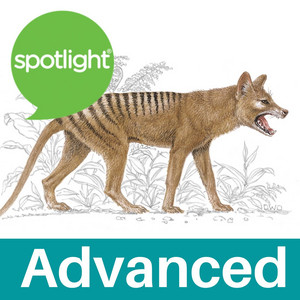
It looks a little like a dog, but it has dark stripes running down its back like a tiger.
And it can open its mouth very wide, almost 80 degrees.
Its tail is long and thin with very little hair.
The animal smells the floor behind the bars.
Then it looks out at the people watching it.
It is called a thylacine.
It is also known as a Tasmanian tiger.
It has been named Benjamin, and it is the last of its kind.
In several weeks, Benjamin will die.
With his death, the Tasmanian tiger will become extinct.
It will no longer exist anywhere on the earth.
This would be the end of most animals.
Once an animal goes extinct, there's usually no hope of bringing it back.
But the Tasmanian tiger may be different.
And today, scientists are working on a technology that once seemed impossible.
They are hoping to bring the Tasmanian tiger back from extinction.
Today's Spotlight Advanced is on the de-extinction of the Tasmanian tiger.
The Tasmanian tiger is very important to the Australian island of Tasmania.
It once lived all over the Australian continent, but around 3000 years ago the tigers began to die out there.
By the 1800s they were gone from most of Australia.
Europeans began settling in Tasmania in 1825.
By that time there were only 5,000 Tasmanian tigers left.
This animal was also special.
It was a marsupial.
Marsupials give birth to their young very early in life.
Female marsupials have special bags of skin, or pouches, as part of their bodies.
When a tiny marsupial is born, it lives in this pouch.
The tiny baby is able to drink milk inside its mother's pouch and continue to grow.
The baby can leave and return to its mother's pouch for months.
The Tasmanian tiger was the largest meat-eating marsupial.
Sadly, Europeans in Australia did not understand how special the Tasmanian tiger was.
When they arrived in Tasmania, they thought the Tasmanian tiger might be dangerous.
They blamed it for killing their farm animals.
They thought it might even hurt children.
So they began hunting it.
The government even paid money for Tasmanian tiger skins.
When people understood that they had made a mistake, it was too late.
By 1936, there was only one Tasmanian tiger left.
Humans had hunted the Tasmanian tiger to extinction.
But the Tasmanian tiger's memory is still very strong in Australia.
Since its extinction, it has become a symbol of Tasmania.
It is the official symbol of the Tasmanian state.
It is even the symbol of the island's cricket team.
This may be one reason why scientists are trying to bring this tiger back.
It is important to Tasmanian identity.
Andrew Pask is a scientist at the University of Melbourne.
He is also the head of a laboratory called TIGGR.
It is responsible for one attempt at bringing the Tasmanian tiger back.
Pask spoke to Al Jazeera News about his reason for trying.
I think there is nothing that nears the amazingness of the Tasmanian tiger.
It was an amazing, beautiful marsupial, but humans viciously hunted it to extinction.
We owe it to the tigers to spend the time and money to return them to their environment.
It is a way to repair some of the wrongs we have done in the past.
PASC's goals are very challenging.
No one has ever brought an animal back from extinction before, though other attempts have been made.
PASC's goal is to try a different method.
His project will start with DNA taken from the remains of Tasmanian tigers.
DNA is a special chemical found in most living things.
Each individual animal has its own special DNA, but each kind of animal also has DNA that it shares with other animals that are the same kind.
This is called the animal's genome.
Using the Tasmanian tiger DNA, PASC hopes to find what its genome looked like.
He also hopes to do the same for another animal called the fat-tailed dunnert.
The fat-tailed dunnert is a mouse-like marsupial that eats meat like the Tasmanian tiger did.
The dunnert has DNA that is a lot like the Tasmanian tiger's.
By comparing the two, Pask will be able to see where they're different and he will try to change the DNA in the cell of a dunnert.
If he succeeds, the cell will be the same as the Tasmanian tiger's.
From there he will place the cell inside a dunnert egg, and that egg could grow into a baby Tasmanian tiger.
For Pask and others like him, there are no negative signs to bringing back the Tasmanian tiger, and his project has gained millions of dollars from investors.
But there are still many difficulties in the way.
Other scientists have questions.
Some argue that it is Simply not possible.
They argue that the Dunnart's DNA is far too different from a Tasmanian tiger's to change.
Some say that even if the project worked, it would not create a true Tasmanian tiger.
Others believe that the project is troubling.
Other kinds of animals in Tasmania are dying every day.
But less money is going to help these animals than for an already extinct animal.
They argue it makes more sense to help animals that are still alive, such as the Tasmanian devil.
Others are not sure if a new Tasmanian tiger would be able to live without human help.
Carol Freeman is an animal studies researcher at the University of Tasmania.
She points out that the procedure involves animal experimentation and she is afraid that these experiments will cause animal suffering.
She spoke to Scientific American about her own concerns.
The whole conversation is about bringing this animal back.
But concern for the individual animals is not really talked about.
Their suffering is not right for such an unsure result.
It would be many years, if ever, that these Tasmanian tigers could have anything like the life they may have had in the wild.
Even with these difficulties, Pask is positive his ideas will win out.
He is sure that he can and should bring back the Tasmanian tiger.
He even believes it could happen within the next 10 years.
He spoke to the cable news network about what he hopes.
Our final goal with this technology is to restore this animal to the wild.
They had a very important part in nature.
So our final hope is that you would be seeing them in Tasmania again one day.
What do you think about PASC's project?
Do you think it is possible?
Do you think it is a good idea to bring an animal back from extinction?
We want to hear your thoughts.
You can leave a comment on our website or email us at spotlightenglishcom.
You can also comment on Facebook at facebookcom.
Slash spotlightradio.
The writer and producer of this program was Dan Christman.
The voices you heard were from the United States.
All quotes were adapted for this program and voiced by Spotlight.
You can listen to this program again and read it on the Internet at www.spotlightenglish.com.
This program is called Hope for the Tasmanian Tiger.
You can also get our programs delivered directly to your Android or Apple device through our free official Spotlight English app.
We hope you can join us again for the next Spotlight program.
Goodbye.