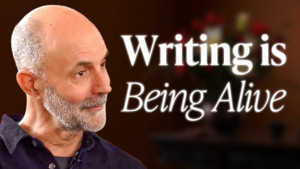
Henry Schucman, a poet, a novelist, an essayist, and a longtime meditator.
I like the line that no poet begins as a philosopher, but by writing poetry, every poet becomes a philosopher.
Because poetry is a way of being alive in the world.
It's a way of opening your heart to the wonder and beauty that's all around us, so that we can experience the fullness of reality.
Wonder, romanticism. the two words I'd use to summarize the conversation you're about to listen to.
What was your original draw into the written word?
Was it a need to express?
Was it a love for the written word?
What was it?
It was the recognition that there was another way of being alive than the one I knew.
And somehow I got wind of that through getting to know a tramp.
You know an old guy who wandered the highways and byways of England.
And there were a lot of them.
How old were you at this time?
I was 12, 13, 14, around that.
I got to know him when I was 12.
Knew him better the summer I was 13 and 14, those summers.
He would come to the valley where we had a cottage outside Oxford actually that we'd go to some weekends and in the summer
And he would come to that valley in the spring and stay till autumn and he's called Speedy and I actually started to get to know him and he had this strange energy and presence about him that was unlike anybody else I knew and he just I felt I recognized he was alive in a different way and one summer, after I'd been out, you know, hanging with him a bit And being in the land out in the north of Oxford, this was a beautiful countryside valleys and hills.
I came back and I was looking at the street in Oxford outside my window as night was falling.
And suddenly there was this sort of just a different energy in me.
And I knew it wanted me, or I knew the thing to do.
A line formed in my mind, a phrase just came, grabbed a notebook and a pen and i wrote the first phrase and it just kept going and i just wrote it saying what it told me to say.
You know, as it were, and it was a way, and at the end of it i was, i didn't know what had just happened to me.
I was alive and awake, in a way i never had been before trembling, and i felt i'd managed to say something about the scene, the beauty of the evening, of the street under my window.
I'd managed to say something about it that I didn't previously know.
I wanted to say, although I knew I wanted to say something
So it was like a different way of actually appreciating the world.
Do you feel like you were channeling something?
Like when you read about say, the prophets and the Bibles, like the Spirit of God descended on them and then they spoke message from an exterior source, or do you feel like it was a more interior thing, where maybe the it sounds like this was a bit more of a frantic, mad dash of writing, but sometimes there's a sense of achievement or an accomplishment where you've translated felt senses into concrete words.
In the process of editing refining, you were able to illuminate something that you'd never been able to express, which one was.
It was more the second it was.
I mean, it wasn't, it wasn't frantic, it was just a lot of pure energy, you know peaceful powerful, pure energy.
And the question is that i don't really i couldn't say, you know, came from some other entity or something.
I don't think that at all, but it did come from a part of me that i did not have conscious control over or conscious access to.
I mean, i believe that you know, we're much of our lives, we're walking on this surface.
All the seething energy and all the juice and all the real life is just under what our egoic self wants to know, and in some way i let that through.
At that time there was a part of me that was in love with the world already And I kind of had maybe had intimations, but I didn't know that it could speak.
And if I had tried to write the poem, it wouldn't have been right.
And that's remained true to me all these decades later.
I don't write the poem.
If I want, if I sit down thinking oh, it'd be good to write a poem about X.
Well, that's a good subject for a poem.
Let me do it.
It won't work.
It never works.
What works is it comes up from some other source that you know.
That's not to say just because it it comes in a more unconscious way.
They're all brilliant or something not at all.
But but all the ones that have been what i want a poem to be have not come through my own deliberate machinations.
That's also not to say there isn't an editing process as well.
There can't.
There's a lot of tweaking and often a poem will come and i'll tinker with it for a year and at the end of the year it's almost the same as it was at the beginning and that'll be.
But i'll have to go through that process of being sure it's landing with that uncovering.
Do you feel like you were?
I don't want to use a word that's too strong, but i'm going to use a strong word because i think it'll elicit a reaction.
Do you feel like you were destined to be a writer?
In that sense like?
Do you feel like the henry, form of being, was the writer?
But that same sort of general principle can show up for a painter and a musician and a writer?
Or do you feel like you consciously chose I'm going to be a writer, as opposed to these other artistic mediums?
I would say that the way it has felt for me, especially as a youth you know, a young man was that i was discovering that that's what i needed to do and that's what i needed to be in life.
And i had a very early clarity about that, i mean, when i i wrote poems through my teens.
Then i went traveling.
I went, like my dad, you know, had a colleague at his college who was from argentina and he he set up a job for me and a friend in argentina.
And when, when we'd finished our schooling, before we went to university, we went out there and worked for a few months and then backpacked and while i was backpacking i wrote my first book.
Where in argentina were you?
Uh, we were in two places.
One was outside on the pampas, called navarro outside uh, Buenos Aires, a couple hours from there.
And then up in the north, near Salta, in the north of Argentina.
What are those cowboy people called again?
The gauchos.
The gauchos, there we go.
That's in Argentina, exactly.
But, you know, I wanted to let, somehow, let that land appear on the page.
My friend who I was traveling with was a photographer.
You know, we were 18, you know, we turned 19 while we were there.
We thought we were going to write a book.
You know what a crazy idea, with his photos and my writing.
And actually we did.
But I remember early on, I was kind of trying to deliberately record what we'd done in the day.
And it just felt, oh, this is, I don't want to do this.
I'd done it for several days.
And then one evening, after coming in from being out working all day in the land out there, I came in, opened up my notebook to write, I thought, another rather dull account of the day.
And suddenly this thing in me just switched on.
It knew I wanted to write about the impact this place was having on me, just the place.
And I remember I wrote this first night.
There's something ghostly about this place place, you know, that was just my opening line and it got me into talking about these huge sycamore trees and eucalyptus trees and the vast grassland and i just i managed to get out of the way and let a much larger energy come through that wanted to evoke what it found beautiful about this place.
As you tell that story, i'm thinking about painting, and i just went to this exhibit of Monet's paintings in Venice.
It's a striking exhibit because the way that they set it up was you start off and you experience photography and sort of time-lapse videos of Venice.
And then what happens is you go into different ways that people have depicted Venice.
John Ruskin really focused on the details, various Italian painters who are focused on the architecture and the people, and the gondola, boats and whatnot.
And then you get this shift into Monet, who isn't trying to capture Venice in a precise way, but is giving you his impression, the impressionistic idea of venice, and there's something that is less real about it but also so much more real.
It captures the emotional realness of venice but not the concrete reality of venice.
And you realize as you go through this exhibit, you're looking at the same buildings, the same rivers, the same gondolas, the same people and, But somehow you're seeing all these different ways of capturing what's in front of you.
And it's so clear in painting.
But what you're saying is that you can do the same sort of thing in writing.
That's beautifully put.
It's a perfect analogy because obviously there's a lot of writing that is meticulous and accurate.
And it's about recording stuff and being able to relay information accurately.
Right.
Darwin's Journals.
Yeah, you know, and that's fantastic.
And all kinds of nonfiction relaying of information that must be done carefully.
Sure.
That's one world of writing.
There's another totally different world of writing, which is much more.
It's either poetry or it's prose that is very infused with a poetic vision and with a poetic purpose, which is, I think, much more for the writer to be finding their way of conveying what something means to them, what the emotional spiritual philosophical, even impact of something they've either gone through or that they're looking at, or that they're in one way or another experiencing what the actual experience for them is like, and the opportunity of that, and the reason why I believe it's really valuable, is that we've all got that same capacity actually to open up and experience the world in a deeper, more visceral, more alive, awake way.
And when a writer is conveying that, likewise a painter, no doubt a musician as well, whatever other arts, it wakes it up in us.
In other words, the purpose is to convey an experience.
Right.
As I'm hearing that, I'm thinking wow, this person was able to capture something about the world that I've seen a trillion times but never actually seen.
And so you're getting invited into their perception of reality.
But then it begs the second question, which is, what is the equivalent for me?
How do I uniquely see life?
It wakes up that part in us that wants to be awake and that needs a little trigger to do that kind of waking up.
I mean, waking up meaning...
That we become alive, to the fact that we're having this sensory experience of being human beings hearing seeing feeling, emotion and feeling stuff and thoughts too.
We're waking up to an awareness of our actual human experience, which is the great gift.
At some point.
You know, whatever may happen, who knows?
But it will end.
And while we got it, It's the great gift to be consciously alive.
Do you feel like something about the modern world?
Suppresses that we live in a very left brain world ruled by logic and reason, and I was talking to some friends the other night about my own struggle to express my heart in this world.
I feel a fear of sincerity sometimes and almost like I have to close the door shut on my heart in order to get things done in the world.
And it feels like it's bigger than me.
It feels like it's something about the structure of the modern world itself and this sort of global scale machine that we live inside of.
Yeah look, i i don't know that it's exclusive to the modern world.
It might be, but i suspect that the very fact that there are spiritual traditions yeah, that have been working against that, that are three thousand plus years old, suggests to me that it's an old human problem and it may be associated with civilization quote unquote emerging, you know five six seven, eight thousand years ago.
I don't know.
But I think there's something about.
I mean just to take an example, like the ancient Greeks, you know who I studied a lot when I was a youngster.
They said that There's two kinds of knowing.
There's two kinds of understanding.
One they call logos and one they call mythos.
This is in Socrates and Plato.
It's not you know.
We have this idea that in some that you know that Socrates and Plato really locked us down into this left brain thing.
And it's not true at all.
It's not true because they they recognized one way of knowing is thinking analyzing, breaking things down.
That's the logos they call it.
You know we might translate that as sort of study or something like that.
But they also thought you have to have this other side mythos, and that meant whatever the world of myth you know all they had a great rich myth cycle mysteries, the Eleusinian mysteries.
Nobody quite knows what happened in them, but some kind of ritual processes, believing in the gods and worshipping the gods.
That was a recognition that, while there's some aspects of life that we can study, there's a whole world also that will forever be mysterious.
And we want to be staying open somehow to both and using both, and I think it is probably true that over somewhere I suspect it's really the industrial revolution that this got this mythos side started to get closed down may also be the quote-unquote enlightenment of the 18th century, you know, where science became much more sort of predominant, which is a great thing, but actually not to the exclusion of the mystery, you know then, the mystery is the mystery of actually existing.
What is this moment where i'm alive?
What is it?
And if we come back to that and this is why I've been a lifelong meditator, because it's a process of coming back to right now and recognizing much more clearly what is going on here
What does it look like?
What does it feel like?
Just being aware of this moment and also recognizing that there's a great mystery in the heart of it, which is What is this consciousness that is conscious of experience right now?
So I think you know that writing on that more poetic side is absolutely a way of reigniting our recognition of the mystery.
Yeah, I think of the way that a flower blooms in the spring.
I was at a bar in Portland a few months ago and I did what I always do.
I went, found the best Guinness nearby of where I was.
And so I go to this bar and there's all these sort of quotes on the ceiling.
And one of them was a quote from William Blake.
It's a poem.
And it starts to see the world in a grain of sand and heaven in a wildflower, to hold infinity in the palm of our hand and eternity in an hour.
Yeah.
And you hear that and maybe you hear that or you read it and it does nothing for you.
But sometimes what it did for me is I was like, oh, my goodness.
And it was like a flower in spring that just completely bloomed.
And I was like, oh, my goodness.
You can see all of reality in the smallest things if only you would dare to look at it.
And if only you had the channel inside of your mind that was awake and receptive to the expansiveness of the most ordinary things.
And somehow that poem just did it for me.
And it's this funny thing where, with the mythos, sometimes you'll get it and you'll have this sort of universal awareness.
But unlike the Logos knowledge, it's much harder to grasp.
It's not graspable.
It's sort of expansive and wondrous and mysterious.
And it sort of calls you in to explore it and investigate it and to actually build a relationship with that new knowledge that you've uncovered.
You put it beautifully.
I couldn't agree more.
It seems to me like it's like...
One side is like a focus microscope or a magnifying glass.
You're looking closely, intently, and you do control the range of vision, the depth of field.
You're controlling it, you're studying something.
On the other hand, there's this awareness that is boundless, that's always here in every moment.
And I think the healthy thing probably is to, you know, have some kind of balance, or some people are more drawn one way and some people are more drawn the other way.
But I think, to be able to switch between the two, to be able to come into the place where we've let go of our control, our hope to control and our definitely more contracted range of vision.
We've let go of that.
And you're absolutely right.
I think it does take that little bit of almost fear and then courage to go over the brink and to let go.
And I find actually often when I'm writing at my best meaning I'm not really in control of it.
But man, there's something I'm writing and it's better than I could ever come up with if I thought about it.
When that's happening, I've gone through a little fear barrier that, am I ready for this?
And next thing I know, I am.
Tell me about the fear barrier.
I like that turn of phrase.
Yeah, I mean, I just have noticed it often that when, for example, I mean with a poem, I've got some something's cooking, something's brewing, and I recognize it.
And it's like, am I ready to let go?
Am I ready to sort of submit to what wants to come, you know, which sure is.
I assume it's part of me, but it is still part of me that i don't have control over, and if i try to have control over it it won't be able to speak freely.
So i've got to let go of control and there's a little bit of a of a fear, like a hump, of to get over, a little bit of a barrier to go through.
And then the energy is there that's much deeper than the energy that I could come up with consciously.
Does that make sense?
Yeah.
And it prompted a weird conversation with myself, as you were saying that, which was all the best things I've ever written and produced came from that release.
Therefore, the thing that I should do is always surrender to that flow.
But there is something in my mind and in many of our minds that try to control, that try to retain the fear barrier.
And what I'm trying to figure out this was the conversation that I was working through with myself is why wouldn't the mind let the release happen?
Why does the mind like to grasp and control and defend?
I think that's its job.
I think its job is to control and defend.
It's, you know, the left I can't exactly remember the details, but I know Left logic, right the opposite.
Yeah exactly, and you know we're even go chris would not approve of that.
Yeah we're we're um, we're basically, you know, we're on the hunt for, for the goodies, the prey, or whatever, you know, the things we want to eat sure, and we're on the lookout for threats, And so that balance between the two requires control.
You know, and there's so much in us that we're, you know, evolutionarily programmed to be, you know, whatever it is, we're 19 times more likely to be aware of a threat than we are of a reward.
You know, or I can't remember exactly, how it works, but the negativity bias is very strong.
The threats go deep, you know, and so it's that balance instinct is to stay in control.
But i think that the i want to say, like the vatic quality, the calling of a poet, the calling of a, of a writer, i think, in the deeper sense of the word, not just to convey her information, the one who's prepared to meet the world in a new way and to let it somehow speak through him or her or them.
That can't be done with the mind that wants to control.
I think of songs that I've heard about despair and grief and sadness and sorrow and whatever else.
And the thing that I always think about is that, in order to make that music, in order to write those lyrics, you need to go farther than most people are willing to go into what you would call difficult emotions.
And then you just capture a sliver of that and you almost like a messenger from another world.
You bring it back to people who say i've captured a fraction of what i sensed.
And then the ordinary people who haven't been there, they've said wow, how did you do that?
And it helps them, you know it helps them because it's proof that somebody's been through this and they've conveyed it really deeply and thoroughly.
I could, i could, should i do a little poem?
I got on.
I would love very hard times, please.
Yeah, it's called frozen lake please, and there's the image in it is of a frozen lake you know that you can cross, but there's this great deep, dark gulf beneath it.
And did you write this?
Yeah, yeah.
Frozen Lake.
It has an epigraph from a Sufi, Sheikh Abu Sayyid.
Allah says, the broken ones are my beloved.
The broken ones are my beloved.
Frozen Lake.
When I think of friends who've been through the worst, through the dread love lives with, through the terrible fear anxiety can only dream of, I feel sorry for the rest, for those who had it all as they'd hoped, who crossed the frozen lake from one side to the other never guessing the great dark beneath.
But those for whom the lake cracked and opened, who fell into its unspeakable night while still walking upright in the light of this world.
But those for whom the lake cracked and opened, who fell into its unspeakable night while still walking upright in the light of this world, whose hearts burst and met its waters.
For them there is no consolation, nor is any needed.
For them there is no consolation, nor is any needed.
That one came after I'd been through a very, very difficult time, which basically was about somebody I'm very, very close to them having a very difficult time.
That was absolutely gutted me that they were going through, the hardship they were going through, and I couldn't have written it at the time of the first onslaught of grief and shock.
It was a little after distance.
You know, as Wordsworth said, emotion recollected in tranquility.
That's the secret ingredient of poetry is that it goes to the depths of And of course it's not only grief and shock.
It can be great wonder and awe and thorough, thorough delight.
But it does it when the system has recalibrated and can sort of go there and really inhabit that experience and not be overwhelmed by it.
And I think that's one of the, graces that poetry gives.
It allows us, as a poet, to digest our life, to know what we've lived through, to be able to really have our life by virtue of, as it were, living it a second time.
Whether it's the hardest things or the best things, the moments of deepest grace that fall on us.
We can live through them a second time when we write about them, but it's almost like that's the way to actually live them, that's the way to know I have come this way, I have been through, I have been along this path, that I've been along.
If I simply go along it, I don't really I mean as a writer I feel I don't really get the recognition of truly what I've lived through.
I get that when I relive it through writing it.
Well, also with a poem, with a motif that you had there around the frozen lake, and I already know, after hearing that one time, that I'm going to think of that motif, of the people you said you'll have the words for it, the people who made it across the ice, which is actually what we think we want, but there's when, sometimes it's the fall into the cracks, and then you talk about the sense of hope and the fire of life that you maintain through that, that motif.
It's not just that you can relive that in the past, but that motif can carry you through difficult moments in the future.
Yes, yes, that's exactly right.
If I had sat down I said, Henry, it's time to write a poem about what you've been through.
Come on, let's do it.
It wouldn't happen.
No way.
I didn't plan it.
Is there a turn of phrase from that that you really like?
And I'm curious to hear where you think that came from.
For example, you talked about the, would you say the fear that anxiety can only dream of?
That really resonated with me, the motif of the frozen lake.
Is there a part of that poem?
I'm just curious to think about how you see your own poems and how you relate to your own poems.
Yeah, thanks for asking that.
I mean, there was a bit.
Honestly, the bit that got me was that walking, going through an unspeakable night while you're still walking upright in the light of this world.
That was...
I was really happy that came, because that actually caught my experience really well.
I felt that you know, here I am still going through my days and this night has fallen on us.
You know it's a very difficult thing.
Some people I'm very close to were going through and it was a sense of like life goes on, but we're in a kind of night of darkness of this difficulty, immense difficulty, And I can't tell you how many people have written to me and come up after an event when I shared that poem.
They knew exactly what I was talking about.
And actually it may have been really a very different circumstance, very different circumstance for them.
But they recognize that experience.
They're like, you know, a deep, deep shock and grief in life.
And I'm still going through life.
And that again I just, you know, I just I was letting the thing in me that does the writing speak?
Because if I mess with it, it doesn't get to speak.
Well, I think that this is, it's a sister of scripture.
And what I mean is, so I choked on some food in February and it was very, very scary.
I was home alone.
I ate a piece of steak.
It got caught in my throat.
Sarcophagus, I think is what it's called.
Esophagus.
Yeah, esophagus.
Thank you.
Sarcophagus is like ancient Egypt.
Yeah, eventually it will be one.
So I got caught there and I'm freaking out.
I'm knocking on my neighbor's doors.
I'm like, you know, I need you to do the Heimlich maneuver.
I call 911.
They end up coming to my apartment.
It's very scary.
And then I spent the night in the hospital.
And I'm a Christian.
And what happened was when I was there, the only... wall that I could lean on was scripture.
And lines like in the book of James.
It says count it all.
Joy, my brothers and sisters, when you face trials of various kinds.
And I've wrestled with that so many times over the years.
Why would I count it all joys when I face trials?
I don't want suffering.
I don't want that at all.
Get the suffering away from me.
But one of the reasons why I was drawn to Christianity is that there is a way of making sense of suffering.
And all this is to say that I think that when you find these motifs, whether they be through faith, whether they be through poetry, whether they be through music, whatever it is, they can become these cycles that ground you in states of moments of extreme difficulty and suffering, without which it's a lot harder to go through these things.
Yes, yes.
You know, I'm just thinking, flashing back on the ancient Greeks again.
Why...
Did they like to go and watch tragedies, disaster befalling people?
Why did they like it?
And Aristotle said it's because they get purged, cleansed of their own pity and fear.
It highlights the emotions of pity and fear.
Pity we don't use the word so much but deep sympathy empathy compassion, you know, and great fear, both when they're really heightened through watching the characters on the stage go through what they go through.
We feel it.
We feel it almost as if it's real for us, you know.
And the same thing with movies.
We go to movies and we read novels and people go through, in which people go through very difficult things.
Why?
Because somehow it shows us that we can go through those things And come out wiser.
Yeah, I had a friend who very dear friend, he did the landmark for him.
And I said, Hey, how was I said, Oh, you know, it's fine.
But there was one thing that was really interesting.
Everybody got up in front of the room, and they shared their biggest struggles.
And he said that once you hear other people's struggles, you then realize, oh my goodness, I'm dealing with that and other people's struggles seem so easy to fix.
But then all of a sudden it's the blindness to your own struggles goes away.
Yes.
And...
Once again, this is a virtue of good literature.
It's for once we can step outside of our own narcissism and we can see what's going on in other people's lives.
Whether it's for me, I struggle so much with shame.
And so when I see shame in somebody else's life, the way that they're trying to protect against negative judgment, I'm like what are you doing, dude?
But then when it's my own life, I just can't see it.
I think that was actually going to bring up the word shame as you were talking just now, because I think That's absolutely right.
We somehow usually are ashamed of our own emotional difficulties and the challenges in our lives, the things that we find hard, and seeing others having the empathy evoked through literature if we're talking about writing, you know, and through drama as well, of course, and storytelling generally seeing others go through their difficulties and recognizing that actually the proper response to that is empathy and compassion.
It, it can help with our own shame, you know, and i, i must admit um, Shame was a huge part of my earlier life.
I mean, I'm sure I'm still wired for it.
I just feel it less these days.
I don't mind making fun of myself.
I don't really care so much how I look.
But back in all the way through my early life and into my first part of my adulthood, I had a lot of shame.
And actually, you know, in childhood that came because I had terrible eczema as a kid, starting from infancy right into my late 20s, even early 30s.
Yeah, you described it as war-torn skin.
Once you said that, I was like, oh my goodness, I could see it.
Yeah, it was really savage.
I was in hospital quite often for it as a youngster.
And it left a lot of shame.
I mean, other things too also.
And certainly you don't need a disfiguring skin condition in order to have shame in our culture, alas.
But I really kind of got through it at some point.
And I think writing was a big part of that.
I wrote about it.
I wrote about it very frankly.
In what way?
Well, I wrote one of my books.
One Blade of Grass is very open about my skin problem and how meditation came around and helped me with it.
I've written poems about it.
I talk about it when I'm teaching meditation to people.
Let's talk about meditation.
So when you are meditating...
I'm curious to hear about how felt senses that are presumably abstract and interior become concrete, words on the page that are exterior, and what that evolution is like.
Yeah well, I could definitely say, like meditation helped no end with the process that we've already been talking about whereby, You know, letting go of control and allowing something else, something deeper, with us to do the speaking, to do the writing.
Yes.
To let a poem through, to let a paragraph through, to let a chapter through, whatever it is.
Let that do it.
And this is not to say, definitely not advocating zero editorial role, zero role for editing.
Of course not.
But I think in the flow of a first draft, you want to let it be happening by itself.
But meditation is again and again, it's a lesson in reducing control.
Meditation is kind of hell if you're trying to control it, which most people are, and you know i certainly was for years trying to make it what i thought a good meditation was and then gradually gradually it's.
You know that that controlling part softens and recognizes it can take a back seat.
You can just let it.
Really, you're just letting experience be what it is when you meditate and you're allowing I mean whether you've got a method like the first meditation I did for years was TM, where you have a mantra.
That's transcendental meditation.
You have a little sound that you repeat in your mind.
And, of course, you'll do it very imperfectly.
You'll go wandering off and forget all about it.
Sort of, oh, wait, I'm supposed to be doing this mantra.
And you come back and do it a bit more.
Wander off again and do it a bit more.
But actually, in that process of trying to do it, mind wanders, trying to do it again, mind wanders.
In that process.
Gradually we're settling more within a 20-minute meditation, but also in the course of a year, of doing it every day.
You're settling.
It's fractal.
Yeah, exactly, exactly.
The same process that's happening within the 20 minutes is also happening in 12 months.
And in 10 years, the same thing is happening.
We're gradually settling.
And we're getting more and more access to the deeper stuff.
You know, David Lynch, the movie maker, who's a great longtime meditator.
Yeah, catching the big fish.
Exactly.
You want to go deep to get the big fish.
I think it's the same with writing.
There's a lot of.
I was inspired as a youth by all the Writers, who were meditators Jack Kerouac, Allen Ginsberg, you know, Gary Snyder.
The Beats Peter Matheson.
It's so funny that Jack Kerouac was a meditator, because I think of Jack Kerouac as the mad dash you know, like fabulous Roman yellow candles or whatever he says.
Burn, burn, burn, baby.
Yeah.
And.
It's striking that that comes from the same mind as meditation, because I think of Kerouac as almost being the opposite of meditation.
So what am I missing?
Letting it through.
He knew how to let it through.
Whatever that wild energy was that he got onto the page, he knew how to let it through.
And, you know, he did a lot of, they called it Zazen, the Zen meditation.
Zazen is sitting Zen or sitting meditation.
He did a lot of it.
He'd go off to those fire huts.
You know where they would be watching for fires and three months on their own meditating.
You know, he was a big meditator.
But that's how, that is how actually, you know, you could, I mean, I understand what you're saying.
You think this is, meditation is all about mellow and still and calm.
Exactly.
That's what I'm thinking.
No, actually it's letting things come through.
Does the word erupt feel right.
It can do sometimes.
That's exactly what it's like, that you're just.
You know there's no, there's.
You're really good at just letting the energy come through.
You can become much better at that, and that's actually.
I remember actually Natalie, Natalie Goldberg, an old friend.
I remember her talking about this friend of hers.
She was she's a meditator too, you know, and she was telling me once about this friend of hers And she'd sometimes go on writing retreat with just the two of them to write their books.
And this friend was a detective writer.
Like Sherlock Holmes?
I don't really know.
But, you know, but murder mystery.
Sure, sure.
OK, cool.
Yeah.
And she said Natalie was astonished.
She's sitting there, this friend, she's looking at her writing.
So sort of prim and quiet and innocent, looking with her little ankles crossed, writing very still.
And she's murdering people on the page.
There's blood and guts happening.
But look at her.
You would never know.
And I think it's sort of like that.
The meditation allows us to drop deeper into whatever this human psyche is, beyond what we think it is.
That's where the deeper stuff can come from.
What's coming to mind for me is that There is the self, and that part of what you're trying to do is reduce the number of ways that you're scared of yourself in order to be able to go there and experience that.
Because now that you're talking, I'm like man.
I'm so scared of what I would think, what I would feel in all sorts of ways.
And I think we all are.
And that part of what meditation is, part of what writing is, is Going there.
Yeah.
Yeah going beyond where we want to go.
I feel I'm a little conscious of maybe Over simplifying it.
It's not just that that alone.
I think probably isn't enough to make somebody a great writer.
Sure, you know, there's a whole lot of sort of Training and schooling that needs to have happened.
I think in terms of what we've read, you know how we've been informed by what we've read, and How'd you go about doing that?
Well, I was lucky in one sense that I had this real Oxford education, where we started learning languages at a young age so that we could read literature of other languages, not just English.
So you learned ancient Greek?
It started with French at the age of seven, Latin started at eight, Greek started at nine, all the way through.
And then I also learned Russian from the age of 14, bit of German when I was 12.
I mean, by the time I was 18, it basically has sort of pretty working knowledge of kind of four languages Apart from English.
And then when I started doing my PhD in ancient Greek, It was in ancient Greek but I actually had to read.
It was crazy.
I had to read seven or eight languages.
I mean meaning that my supervisor could assign me reading in French Italian Spanish, Portuguese they're just assumed you got them.
Latin and Greek.
I happen to have Russian and, And he wanted me to learn German.
You're like a relic from an ancient world.
We can't do that with TikTok brain now, Henry.
It's a whole other thing.
But I think the learning of those languages and the reading of literature obviously a lot of English, but also in other languages I think it forms a voice.
And there's still, how do you access that?
That voice is ready to be deployed, to be unleashed.
But you still got to know how to let it speak. and not get in the way of it.
And then again.
Beyond that, of course, there's a great editing process as well, which is how do you work, rework material, work with material without damaging its sort of authenticity and authority?
But you've got to do that as well.
Is there something that we can talk about that's concrete?
I'm curious to hear how you rework something and what that process was like, because i know what you mean.
There's a certain energy and vitality to a first draft, and then you can work on it and make it better, or you can work on it and squash the spirit of what came out the first time.
Yeah, that's well put.
I mean, i would say that what i tend to do is i just start reading and then oh my gosh no, that doesn't work, you know.
And then okay, so rather than just oh, i know what to say, i'll go just make sure that i'm in the right mindset for rewriting, which means that i've sort of got back into the original spirit of it and then i can redo it.
But if i do it from too much of a different vantage, there is a danger that I'll actually blithely and sort of blindly desecrate something or massacre something that was actually really good about it.
And I didn't realize it.
And I've actually excised.
I remember one of my editors or publishers was a great poet in the UK, Robin Robertson.
And he'd say, you know, you don't want to cut live flesh. was his way of putting it.
You've got to get the feel for what is actually a living part of this thing.
I must not amputate, you know, and that must be there.
And I just think it takes a lot of time.
It takes me much more time actually to do the rewriting process than the initial writing, usually.
It depends on the book as well.
But by and large, I want to read it without thinking, ew, why did I say that?
How is it different for prose versus poetry?
It's so much easier with poetry.
So much easier.
So much easier.
But you haven't got to worry about plot.
I think in fiction, I've written three or four books of fiction.
That was hardest for me, plot.
Memoir is easier because you don't really deal with plot exactly.
You deal with some kind of trajectory.
But it's sort of much more organic and it's much more congenial to a poet, I think, but with but the poetry, you know, it's this very contained thing and it doesn't it.
One doesn't work.
I mean, whatever i've got 500 others to work on, you know, and uh, i think that's probably the way for most poets, that i know that they have a continual um sort of supply of fresh material happening and either there's a folder of absolutely raw poems, there's a folder of semi-worked and There's a folder I don't know whether this is ever going to work and there's a folder of these I think are kind of getting close to finished.
And I'll just go in.
It's easy to go in and, can I read this straight through?
There's one Scottish poet, Norman Maclean, who said something like I know a poem is finished when it feels to me like it took as long to write as it takes to read.
It's that natural.
And another one, Norman McCaig, maybe that's who it was, said it should feel like it took as long to write as it takes to smoke a cigarette.
In other words, it feels completely like it just flowed out by itself.
Of course, that may be 38 drafts.
Never the case at all.
Yeah, sometimes you read writing that's stilted and over-edited and it's like there's just writing with right angles.
Do you know what I mean?
Yes, I do.
I do.
You know, that's something that D.H.
Lawrence really taught me.
In his best books, which are, I think, his travel writing and his poems.
You feel the ink still wet, like he just wrote it yesterday.
You know, I remember when I was 18 I read his book Mornings in Mexico, which is a series basically, of essays about New Mexico.
That's why I'm here, basically.
Because of D.H.
Lawrence?
Yeah, totally.
I came out here to write a book about him when I was 29, Savage Pilgrims.
And it ended up being different.
It wasn't just about D.H.
Lawrence.
But that's why I was here.
And reading him, reminiscing about New Mexico when he was in Sicily.
You know, that was a fantastic passage.
When he just is remembering taos and santa fe, when the mountains here from far, far away, just evoking it like with a making you feel like you're present yourself.
And to your point about distance, i don't think it's a surprise that hemingway wrote best about America while he was in Paris.
Right, and vice versa right right, and then you know, de Tocqueville, the Frenchman comes to America and he's able to see what's happening in America better than the Americans and there's an emotional distance.
But then there you're talking about a geographical distance with Sicily and New Mexico.
Yeah Yeah, I mean, I think it comes back to that emotion, recollected in Tranquility, of Wordsworth that you know.
Wordsworth wrote these phenomenal passages about the memories of certain parts of the Lake District or of climbing Mount Snowdon and stuff, not when there.
I mean, he wrote about Mount Snowdon in 1804, 1805.
Which is where?
That's in Book 13 of the Prelude.
Okay.
Sorry, Snowdon is in Wales.
That's what I was asking.
Got it, okay.
And he wrote about a trip to Mount Snowdon that he'd made, I think, in the late 1790s.
So, you know, seven, eight years later.
Sure.
He wrote this incredible passage about being there.
And of course, it's like I think it's again that there's this part of us whatever that part is for each of us that is doing all this digesting and filtering and refining of experience and when our, our role is to recognize when it's ready to speak and let it speak, and then you get this magic can come out that that um, If it sat down at the end of the day and thought well, I better write about that trip up Mount Snowdon we did yesterday, because that was awesome.
That's just not how it happens.
I'm getting the image of Hot Wheels, you know, when you have the cars and the car gets revved.
It goes, vroom, vroom, and it goes, doo, woo, you know what I mean?
Right, right, right.
So when do you feel like it's always Hot Wheels style writing?
Or do you ever feel like, maybe when you're writing fiction or the memoir or whatever else like sometimes you just got to turn on the ignition, put the car in drive and get going?
Yes, I know.
It can be that too.
The strike while the iron is cold.
I was a, you know, I wrote for my living for 20 odd years.
It was probably five to six days a week or something.
It was, I mean, it was what I did.
And I was doing, I was writing, I wrote three travel memoirs.
I wrote three or four books of fiction.
I say three or four because they were published differently in the US and the UK.
And I wrote magazine stories and I did all that.
The one you wrote about Santa Fe, I loved.
Oh, thanks.
Great.
Yeah, I like the line about I don't know if it was from you or somebody else, but how Santa Fe is like.
Provence in America.
Sort of the light of Santa Fe is the same that the Impressionists saw down there in the 19th century.
That is said to be what brought the Cinco Pintores, the five painters from the East Coast, to Taos in the 1890s.
And they were the kernel of the kind of artistic community that developed in Taos and Santa Fe from the 1900s roughly onwards.
I cut you off.
Go back to the writing discipline with the different mediums.
Yeah, you know I would.
I mean I had projects, you know that I just I had to finish or I wouldn't get paid.
And I would get up in the morning and I loved writing in coffee shops.
I used to live in New York, actually, for a while.
Oh, wow.
And I'd go... This was in the 90s, early 90s.
And I'd go down to a favorite diner, you know, and just write for three or four hours.
You know, and...
Sometimes I'd write in the apartment I was subletting.
But I would, you know, I'd just have to kind of work at it.
And a mixture of first draft and second, third, fourth draft and working on it.
What would you if you were coaching somebody who's stuck and they're struggling to do that consistency?
They're kind of waiting for the spark.
Would you say, hey, sometimes you've got to force it out.
Sometimes you need to sit down and you need to not get distracted and put in your two hours.
What would you say to them in a moment like that?
I think if somebody wants to be a writer, they've got to get into the habit of doing it, basically daily.
Maybe it doesn't have to be seven days a week, but surely five or six.
You don't want to let that slip too much.
If you want to be a writer, if that's your metier um, if you're really stuck you can't just sort of, i think you can't really.
You don't want to just force yourself to write about something you think you should write about.
You should do probably, or you might do.
It's like balzac, the great first novelist.
He always started with what he called automatic writing.
Automatic writing.
He'd make himself just cover a couple of pages with gobbledygook, didn't matter what, but that got the engine turning over.
I did a lot of that back in the day.
I would just start writing, I'd just start writing about whatever, and I'd keep my pen moving.
Ed Sheeran says something similar.
He says that you turn on the tap and at first it's dirty water and the dirty water has to come out, but then the clean water comes out later and you just need the tap to be on long enough to get the clean water later on.
I think that's absolutely true.
I would agree with that.
I know this is perhaps going a little bit against what I said earlier, but I think it is really valuable to have a regular flow of writing coming out of you.
If you look at, say, Coleridge, same time as Wordsworth, He wrote a ton of prose.
He wrote over 6,000 newspaper articles.
I mean, he's known as a poet.
And he wrote massive amounts of non-fiction stuff about philosophical subjects.
And he wrote all his poems.
And he wrote a prodigious amount of letters.
Letters.
Every day.
He was writing these 10, 20-page letters to friends on top of all that other stuff.
Wow.
And so I think there's a...
There's a value in just being in the habit of it.
So you learn to live in the world of writing.
And yeah, Ezra Pound said, of Thomas Hardy, the great British novelist and poet.
Actually Hardy's best work, I think, is his poetry.
Up until the age of 60, he basically wrote novels.
Although as a young man he wrote poems and he wanted to be a poet, but then the novels took off and he wrote them.
But then at the age of six, he said, enough of this.
Now I want to do my poems.
And he then got back to poetry.
And the first or second poetry book he put out in his late 60s or 70s, I can't remember exactly.
Ezra Pound was living in London at the time.
And he read this book of hardest poetry, so different from his own and what he was trying to do in his poetry.
He read hardest poetry and he said, ah, poetry.
There is the clarity of a man who was first written three million words Meaning all those novels.
Yep.
There's the clarity.
Yeah Actually hardest poems are magnificent almost all of them 914 or whatever it is.
They're one of the great bodies of poetry that have come to be, I think, in our world.
And But it's true.
He had sort of so much of that water had already flowed.
He used that Ed Sheeran analogy.
I love it.
The water ran clear.
Man, it ran clear.
Yeah.
And what you're saying there is.
It doesn't just happen over the course of a writing session, but also over the course of a lifetime.
Exactly.
Exactly.
I think that's true.
And there's a fractal thing.
I was about to say that.
I like it.
I was about to say that.
I want to try playing a game here.
What I want to do is I want to ask you about the different mediums that you've written in.
And I want to hear the first lesson that comes to mind of what you've learned from writing in that medium.
Okay.
Start with fiction.
Yeah.
Okay.
The first lesson is you just got to be into your primary character.
Primary character.
You know, what is it about them that really speaks to you and engages you and you care about?
They should have an immediate practical problem and they should have a deeper spiritual philosophical, emotional problem as well.
Both.
And you may not know it immediately what that deeper one is, but you've got to come to it.
What's an example of that?
Well, I mean Pierre Bezoukhov in War and Peace, you know opens with him in that drinking party where they're all doing crazy drinking games and he doesn't want to be doing it.
He doesn't really feel part of it.
And what is his deeper thing?
This deeper thing is that he wants to know how to live in a way that fulfills his soul.
He doesn't even know what his soul is, but he believes he's got one.
He's a seeker who wants to find out the deep spiritual significance of being alive.
And you feel it more and more as the book goes on.
Okay, that's another one.
But let me think.
That is a great answer.
I'm totally satisfied with that answer.
Yeah, but there was something else I wanted to say.
Let me see if I can remember it.
Oh God, I know what it is.
Yes.
Bring it on.
Oh my gosh.
The third most important character in every work of fiction is the place.
Let the place inform the story.
The place is everything.
If you don't get that The fiction is going to be missing something vital.
Tell me more.
I mean, again, look at any great fiction writer.
Jane Austen, George Eliot, Tolstoy, Chekhov.
The place is absolutely rock solid.
The place is exuding the human story.
The human story... is intrinsic to that place.
And that place is intrinsic to the human story.
All the greatest fiction knows that place is the bedrock.
The narrative that emerges among the humans, it emerges from that place.
I mean, look at Homer, you know, classics of early Western canon.
It's all about the Aegean.
You couldn't say hey, I think we should set this in yorkshire right, it's not going to work that.
The way the land is, the olive trees, the vineyards, the deer that they shoot, it's all in the wine.
Dark sea, you know, it's all, it's the aegean.
Yeah, i mean, i just got back from harry potter world at universal studios, but you can't have harry potter without hogwarts exactly, which is kind of scotland.
The train that shoots them off is kind of a is actually the old train that used to go up to Scotland and they sort of CGI'd it or whatever they did.
Tell me about memoir.
Yeah well, I've only written one real hardcore memoir and what was critical for me was knowing what it was about.
That it wasn't about Henry's life, it was about Henry's journey into Zen, why that journey needed to be made and how that journey happened.
It was not about henry, it was about this very particular thread and there's a lot of other things that ancillary things that got stripped away and some ancillary things that became auxiliary, that were therefore allowed to be in because they helped the main thread.
So you gotta know what's the heart, what is the precise subject?
I remember i would say i mean, i don't know.
Yeah, did you come to that over time or do you feel like you started with that?
I didn't want to write that book.
I had no intention to write that book.
I'd given up writing.
In the course of my Zen journey I came to a very for me it was a very deep place through my practice of infinite silence.
That was so beautiful.
For the first time in my conscious memory, I didn't need to write.
And I never imagined that was possible.
I'd always had this burning little itch inside me.
Like a compulsion.
You could call it a compulsion, but i i think of it more as a sort of as this interesting little knot in me, that that that was a part, something a little, you know, angst was in there, but a longing was in there, desire was in there, a kind of yearning and a hankering and a something beautiful also, like the possibility of something beautiful being allowed to speak.
You know, that was kind of me and kind of not me.
You know, all of that was in there and I lived by letting it happen.
You know, it was absolutely central to how I lived and I'm very glad I did, because it was deeply therapeutic, it was very expansive and enlivening, it brought a lot of joy to me and it sustained me actually, you know physically, because through happily fortunately blessedly, actually making a living from it for a long time, you know.
But when this thing happened, this real, you know I don't know really what the right terminology is, but some kind of profound shift happened through my practice, through the blessing of the great teachers I've had in my spiritual path and so on, I just was silenced and it was as if I joined the great silence and there was No need to speak, including no need to write.
And I never knew that would happen.
I became a hospice worker.
I started taking meditation into jail and the maximum security prison here as well.
And then I was invited, I was appointed as a teacher actually of Zen.
And for 10, 12 odd years, that was the heart of my life.
What would happen is i'd be the great, but there is a but.
I'd be sitting, you know, doing my morning meditation, and a line would come to me unbidden.
I said no, that's okay, just let it go sit, and then it might come back.
Or another line might come, don't worry, just let it go.
And after a while i mean we're talking probably two or three years or something, I don't know I just thought OK, I'll just capture that and keep a notebook beside me.
And I'd write the line and it would just keep delivering and suddenly there's three pages written.
And it would be reflection on some part of my past that had brought me to this ocean of silence.
And I decided I'll just let it happen.
I'm not going to do anything with it, but I'm not going to block it.
And, you know, I don't need to do another book.
And at a certain point, a friend was talking to me about, what's happened to your writing?
This is probably, you know, four, five, six years in.
I said, you know, I don't need it anymore.
And I'm busy here actually teaching in this place and guiding a community here.
And I go to Germany three times a year to share the practice there as well with others.
But I said but you know, actually I have been writing some stuff but I'm not going to do anything with it.
Why not?
I don't need to.
Yeah, but what's it about?
I said well, it seems to be sort of about the path I've followed and that's brought me to a shift in how I sort of feel about my spiritual life, meaning really about my whole life.
I said, well, don't you think some people might want to read that?
Well, I don't know.
I don't want to get caught up in all that writing stuff.
Anyway...
And conversations happen with this friend and then another friend.
Eventually, I think, OK, I'll take a look at it.
And I type it up, some of it.
I say, oh, my gosh, there's quite a lot here.
And I share it with an editor friend.
And she says, well, how much more of this have you got?
And at that time, I had probably 60,000 words or something.
Oh, yeah, that's basically a book.
It's basically a book.
It became kind of three quarters of a book or something.
But I realized i would just see i did without totally non-attached, no attachment to outcome.
I let this editor uh, sort of have a little input.
She shared it with an agent.
The agent said, oh my gosh, this is great, and uh, and she found a publisher for it.
So i let it happen.
Nice, i let it happen and, And I'm glad I did, because I do hear from a lot of people saying it's really inspired them on their meditative path, which I think is a healthy path.
So I'm happy about that.
Poetry.
Oh my gosh.
Poetry is so close to meditation.
It's the closest because it is about the immediate experience of the moment.
Whether that moment is about a memory, it's capturing what's happening, or it's responding to what's happening in the moment.
Now, as the I mean you could probably say this in some sense of the other kinds of writing as well maybe, but it's particularly poignant and particular to poetry that it is about attentiveness in the moment.
You're listening to what your deeper voice, that comes from deep within your body, is telling you about your experience right now, including that that experience might be one of remembering.
So, in other words, if you're remembering something and that's part of the poem you're tracking what it is to be remembering that particular event or episode or place or person in the moment.
So poetry is absolutely a tracking of present moment experience.
I mean that doesn't sum it up, but that's an essential part of it that you're somehow riding the crest of this very moment of experience.
And you're finding that, I think, for a poet you could not do it in a more complete way than you can by writing a poem.
The poem enables you to do it in a way that you could not more thoroughly do it.
Yeah, koans are a whole lot of matter.
Koans are these... Which I don't understand.
That's good.
You're not supposed to.
I hadn't thought about koans in five years before I started prepping for this.
Teach me about koans.
Well...
I'll do what I can.
But in a certain way, they have to teach you themselves.
But they are these little enigmatic phrases from Zen.
And they're usually from the 7th, 8th, 9th centuries in China, typically.
And they may be a question or they may just be a bizarre statement.
And in Zen...
If you want, you know, you can meditate with them.
In other words, you're doing your meditation and now and then you just bring a koan in.
And the reason for doing them is something like this that they're usually something that was said or done by an enlightened master way back when.
As I said, 6th, 7th, 8th century China.
Some actually are from the time of the Buddha in India back in 5th, 4th, 3rd centuries B.C.
And so it'll be some enigmatic statement and you bring it in, but it's enigmatic because it came from the enlightened experience of one of these old masters.
When you say enigmatic, do you mean that it's a puzzle?
I mean, it's not to be solved like a puzzle, but it doesn't usually make sense.
Like there's a famous one is what is the sound of one hand?
The complete one is, you know, the sound of two hands clapping.
What is the sound of one hand?
So it sort of scrambles logic, really.
Another is, does a dog have Buddha nature?
And the master answers, moo, which literally means not.
But the student just sits with the sound moo.
It means absolutely nothing.
Yes, in Chinese and Japanese it means not, but you don't worry about that.
You just sit with this little sound, mu, in your mind.
So there's no What's actually happening in the process of sitting with the koan.
I mean ideally is that sooner or later it carries us into the mystery of quote-unquote enlightenment, from which it came.
So somehow it carries us to the same state of wonder awe expansiveness openness vastness boundlessness, that the Master who uttered it was in.
That's kind of the logic of them, that they're not for the faint of heart because they're designed to take us to shifts that we couldn't anticipate.
Is the word paradox?
It is relevant, right?
Yes, it's.
It's striking.
I was thinking about this before we sat down.
It's striking that every spiritual tradition has at its bedrock truth, some sort of paradox.
That's going on yes, and it's weird because we think of truth as two plus two equals four.
The logical truth yes, but then there's paradoxical truths that You become comfortable with and settle into and begin to see over time in all sorts of spiritual traditions.
Yes, it's true.
And I think it makes perfect sense because you know the root.
The etymology of paradox is beyond thought.
Paradox beyond thinking.
Is that Greek?
Greek.
Yeah.
Beyond thinking.
So paradox is where our ordinary thought processes get scrambled.
They don't work there.
How about that?
And so that is again back to the mystery, the mythos, the world.
Knowing the world not through thinking.
Knowing the world through immediacy of intimate contact.
Right.
And once the thinking gets scrambled, you get a freshness of perception.
Exactly.
And I must say one thing that actually I wanted.
I didn't really do much prep for this conversation, but a little bit.
And I was thinking.
One thing I really want to convey and I'm not sure I have actually is that for me, writing from the earliest times was about greater intimacy with the world.
It gave me like that first time I wrote a poem.
What it really gave me was a greater intimacy with my experience of the world.
So I felt closer to this world, more part of it.
And that was actually, I think, right through my own writing life.
That was really the thing.
Now, when you say that, I'm thinking of the natural world.
I'm thinking of plants and flowers and trees and blue skies, but you're shaking your head.
No, it doesn't have to be.
It can certainly be those, but it can be the beauty of a city street.
I remember when I was 14, just writing about a snowfall.
And seeing how beautiful it was, the silence that the snow had brought in a city.
And, in the evening, a lamp on a wall, this kind of shoe of light, shoe-shaped like the sole of a shoe,
It's cast onto the wall it was hung from.
How beautiful that was.
And then, you know, the stillness and the motion of the snow coming down.
You know it's intimacy with the world and and koans i would say, in zen generally and meditation generally, is that also that intimacy with the world?
Well, snowfall is a funny one, because last night here in santa fe it was, it was, it was kind of a blizzard type thing and i kind of felt resistance to it.
And now i'm like wow, what if i was trying to describe the blizzard, the way that the snow fell on the streets, the way that The snow sounds as it hits the ground and changes the sound of a place?
And all of a sudden, rather than resisting, you're kind of welcoming reality into your mind.
And that, to me, gets to what you're saying about intimacy.
Exactly.
And that line that you just said there, the way the snowfall changes the sound in a place that ignited something for me, just to hear you say that.
Because you'd think that it's mostly a visual thing.
But actually, what about the auditory side of snow?
I totally agree.
And scent.
And the scent too, exactly.
So any ways that as a writer we bring something to life for ourselves, it'll probably do it for a reader, a listener as well.
It expands our sense of wonder and appreciation and intimacy with that person, because then you get to share it.
God is it.
God is in the details.
Yes, you know they say devil is in the devil is in the details.
But actually god is in the details.
Yeah, the wonder is in the details, the character lives in the details.
What you were just saying about that cleaning i was thinking that's how character comes to life in fiction and in memoir is through that kind of the writer having that kind of appreciation and conveying it through those kinds of details.
Then the reader gets the beginnings or the evocation of character.
On snow, do you want a poem?
Yes, I want as many poems as you're happy to share.
Let me do a first snow.
First snow.
It's as if for so long, so much longer than you realized You haven't had a chance to draw breath, to be yourself, to come home to who you are, to the you who has been waiting so patiently, so quietly, all this time.
While you went off and fought battles.
You thought you had to fight until now, at last, you greet yourself as if, for the first time, half strangers to one another.
While in the fireplace the seasoned wood crackles to itself and outside the snow of a perfect first day of winter sifts down over this small city, settling on all the gardens of the neighborhood.
Wow.
What really stuck with me there was the importance of word choice, crackles and sifts.
I mean cause, even when you read crackles, you did crackle with your fingertips and it showed me how much, how embodied writing a word like that can be.
You don't do this unless it's a full body experience, I think.
Yeah.
Yeah.
That's one thing that we poets try, try to do.
Yeah, is in body, so that we feel it in the body.
I mean, I think in a way, the real poet is the body, not the mind.
The body uses the mind.
Say more well again, they're coming from underneath the mind, they're coming from that within us which has an intimate relationship with the world, which is the body.
The body is made of the same stuff as the world.
Whatever we may think this particular skin bag is, it's made of the chemistry of the world.
It's made of atoms and molecules and it's made of the various elements, chemical elements of the world.
So we are made of the same stuff as the world.
And our mind is this marvelous gift of awareness.
And, of course, it can learn these incredible cultural gifts like language.
But if it gets caught up too much in that, it loses the fact that it's some kind of emergent property of the body.
The body is an emergent property of the earth.
So poetry is tracking back to the body as part of the earth.
I mean, I think that's why again, great poetry, like great fiction, is spoken almost, I feel, by the land, by the world around us.
I used to teach at the Institute of American Indian Arts here in Santa Fe, teach poetry.
I remember one time there was a student who was from the northwest from Kodiak Island.
Okay, west of Seattle?
Yeah, north, way off, way off beyond Alaska.
Oh, wow.
That is north, north and west, west.
And she had a word in a poem.
I said, what is it?
It was a native word, you know, in their language.
What does that mean?
She said, it's my whale song.
I said, what do you mean it's your whale song?
Well, every year we go out to meet our ancestors.
We paddle out in our canoes. and meet the ancestors in the sound and their ancestors are whales.
And sometimes a whale gives a person a song.
That's the name of my whale song.
So that kind of, I mean, you know, that's a step beyond, but that kind of relationship with the world where somebody could be available to a whale somehow imparting something you know that's i mean we in the west in the western world don't think like that but we do have poets you know and we have great writers and they in some way are letting land topography speak through them yeah i think you know and and places that not even exclusively natural like when you read wordsworth on london He's letting that great city speak through him and show itself through his availability.
I wanted to close by asking you about the heart and what it means to write from the heart and what it means to live from the heart.
Well, can I read another one that speaks right to that?
Every single poem that you want to read, the answer is yes.
Okay.
Here is a poem from the heart about a dear one, A dear something very close to me, having a hard time.
What's it called?
About the heart.
It's called Rain at Night.
Rain at Night.
Rain at Night.
Who says our dark night can't be beautiful?
Tonight there is only the rain.
All day it hasn't stopped.
Falling over this house, over these streets.
The rain has undone our city.
I think of the monk who sat through so many nights of rain.
In the end, there was nothing left, just rain falling all through the world.
And it was then he understood.
Tonight we keep a candle burning for a dear one who is in trouble, who might not make it, and we keep our door open to the night and the rain.
And the rain keeps whispering that it can't tell the living from the dead.
It meets them, it kisses them just the same.
And what if no one ever lived or died and there's only this rain falling through the dark and the world?
That's Rain at Night.
That came out of the heart.
That was a broken heart and a tender heart and an open heart and a whole heart all at once.
And I didn't intend to write that poem.
I was simply listening to a rainfall, long, long rainfall.
It's funny that you say long, long rainfall, because what stuck with me is the way that that poem distorts time.
With the living and the dead and the infinity of that rainfall.
Yes.
And to your point, you were talking earlier about perception.
I think when you're fully aware of time, it almost evaporates.
Yes, yes.
And I feel that in that poem.
Wasn't it Elliot, T.S.
Elliot who said, the present moment is shot through with rays of infinity.
Whoa.
And I think this again speaks to meditation as well.
Because meditation is...
If it's anything concrete, it's a training in coming back to just now, only now.
And that helps the poet.
I'm sure of it.
I think it helps a writer coming back to just now, just this moment.
And I think a poem can help a listener also come back to just this moment.
It was so good to meet you.
Great to meet you too, david.
Thank you.