
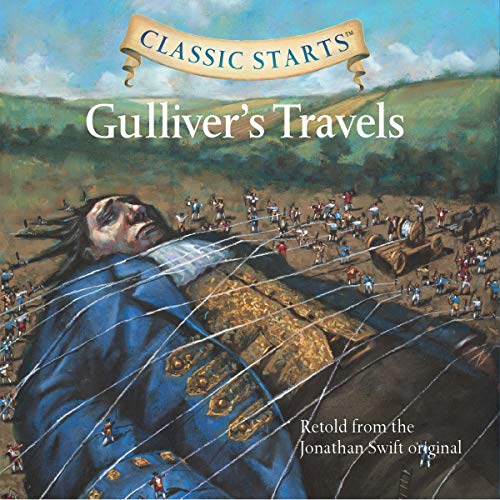
[The Flight of the Man-Mountain: Betrayal and Exile in Lilliput]-[Gulliver's Travels - Part 05]
📋 Summary
The Perilous Politics of Lilliput: A Summary of Chapter 4
In this pivotal chapter of the narrative, the protagonist, known as the "Man-Mountain" or "Quinbus Flestrin," finds his position in the empire of Lilliput transformed from a celebrated hero to a condemned traitor. This transition serves as a stark commentary on the volatility of royal favor and the absurdity of political machinations.
The Curious Nature of Lilliput
Before detailing his escape, the author provides a brief ethnographic observation of the Lilliputians. He notes that the "common height of the natives is somewhat less than six inches." Their cultural practices are equally distinct, particularly their funerary rites. The Lilliputians "bury their dead with their heads directly downward" due to their belief that the world is flat and will eventually "turn upside down" in 11,000 years. They operate under the conviction that, by burying their dead in this orientation, the deceased will be found "standing on their feet again" upon the world's reversal.
The Articles of Accusation
Despite his contributions to the empire, the protagonist discovers that "Skyresh Bagalam" has orchestrated a plot against him, resulting in formal "articles of accusation" for high treason. These charges reveal the absurdity of the political climate:
- Refusal of Conquest: The first article condemns the Man-Mountain for refusing to "reduce that empire [Blefuscu] to a province" and kill the "exiles," citing his "unwillingness to destroy the freedoms and lives of an innocent people."
- Diplomatic 'Treason': The second article accuses him of aiding ambassadors from Blefuscu, deemed "servants of a prince who was recently an open enemy."
- Unauthorized Travel: The final charge involves his intent to travel to Blefuscu, claiming he acted with only "verbal permission" from the Emperor.
The Deliberation of 'Mercy'
Perhaps the most chilling aspect of the chapter is the court's discussion regarding the protagonist's fate. While some suggested the brutal method of "setting my house on fire at night" and riddling the author with "poisoned arrows," the Secretary urged "mercy." In a grotesque display of irony, this "mercy" consisted of "putting out both of my eyes" to keep the protagonist useful as a laborer. If that failed, they planned to "starve me to death" and have the subjects "cut my flesh from my bones" to dispose of the remains. The court viewed this as an act of "great compassion," a sentiment the author dryly remarks he found "quite harsh."
Escape to Blefuscu
Realizing that standing trial was a "risky option" and rejecting the violent alternative of destroying the empire, the author chose to flee. He sent a final letter to the Secretary and departed for the coast. Using a "large man of war" to transport his belongings, he navigated to Blefuscu. Upon his arrival, he was greeted by the Emperor and the royal family. He maintained his dignity, choosing to remain silent about the treachery he had escaped, though he was left to sleep "on the ground with only a blanket," marking a humble end to his time as a giant among the Lilliputians.

Deep Learning with ListenLeap


