NPR. This is The Indicator from Planet Money.
I'm Darin Woods. And I'm Weyland Wong.
One in ten couples found each other online.
But it feels like we're in the middle of a dating app backlash.
It's certainly not hard to find critics.
What were your experiences?
Overall bad. People are out there not actually dating on dating apps.
They don't know how to date.
It's hard to find people that you connect with online dating.
Mostly felt like it was a game I had on my phone.
People have always griped about online dating, but these complaints are now hurting business.
Match Group owns Tinder, Hinge, and OK Cupid.
And its share price has been walloped over the last couple of years.
It's plummeted more than 75 percent.
According to Morgan Stanley, downloads for swipe -based dating apps like Grindr, Bumble, and Tinder are stalling or falling.
One exception is Hinge.
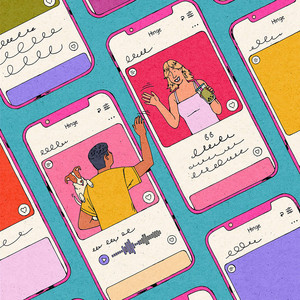
Amidst this whole dating app rethink, more and more people are using this particular app promising long -term love.
And so for Love Week on The Indicator, we are talking to Hinge CEO Justin McLeod.
After the break, the dating app backlash and how one company is trying to stay relevant in 2024.
And we even get a Nobel Laureate's advice on dating.
This message comes from Organic Valley, a dairy cooperative of small organic family farms dedicated to protecting where your food comes from through organic farming.
When you choose Organic Valley, not only do you get creamy, delicious organic dairy, you help protect thousands of acres of land and all the plants and animals that call it home.
Learn how Organic Valley is protecting where your food comes from and see how your milk money can make a difference at ov .coop.
Support for NPR and the following message come from Yarl and Pamela Mohn, thanking the people who make public radio great every day and also those who listen.
To investigate how online dating companies are grappling with disillusioned users, we wanted to speak to the CEO of Hinge because while Hinge isn't as popular as its competitor Tinder, it is growing faster.
Hinge is similar to Tinder, essentially swiping yes or no on short profiles.
It asks for a little more information and uses an algorithm and machine learning to curate a range of people who might be good matches.
It's almost like a Spotify playlist of potential lovers.
But like all dating apps, people have problems with it, like Marcus Hamilton in New York.
The conversation will be good for a minute and it goes nowhere.
Dead end conversations.
And getting users to talk is something Hinge's CEO Justin McCloud has thought a lot about.
When we looked at that problem, what we found was that that was a result of a small number of users matching with a large number of people can't field all of those matches and chat with all those matches and so it's creating a frustrating experience for them and frankly it's not a very good experience
for the people who match with too many people.
There are a tiny number of romance billionaires out there and a lot of love porpoises.
Inequality in dating is real.
Yeah, and one of those people with a lot of matches is Sophie Bridges, a woman in LA.
I was very overwhelmed with the volume and there was literally no way to actually plan to meet up with the number of people in the messages.
Oh Sophie, what a nice problem to have.
Brag! Sophie is the dating 1%.
But you know, still it's not a great user experience.
And so Justin wanted to improve both Marcus and Sophie's time using the app.
Hinge has been working on this for over the last year.
It came up with a feature called Your Turn Limits.
The app now blocks you searching for more people if you haven't replied to eight of your matches.
Fair. Justin said the feedback from users was surprisingly positive.
We got our first inklings of this during user testing when people started asking, how much are you going to charge me for this?
We're like, charge you for this.
No, no, no, this is not...
Everyone's going to have this experience.
The matches to dates increase by like more than 20 % with that feature.
So it's like a pretty big swing.
Right, so this is an important point, which is at some point you've got to move past those conversations and actually start going on dates.
Kylie Fisher is on dating apps in New York.
People just want to chit -chat versus actually meet up, which I don't need pen pals, you know?
Throw away your quill.
Kylie doesn't want to hear from you.
Yes, this is complaint number two.
A lot of our users, I think, can often struggle even to get to, you know, the first date.
We publish a what works guide in the app, but that all just sits in a guide somewhere.
Most people don't read it, or if they do read it, the chance that they're going to apply it or apply it well in the app is kind of not super high.
Being able to deliver tailored advice to you based on how we're seeing you operate in the app, I think, is going to be really transformative to be able to give you those nudges and guidance along the way to help daters become more successful.
Okay, I'm imagining Clippy, but maybe it's a cupid version of Clippy saying, hey, you're letting the conversations flag.
Like, keep at it, you know, something like that?
Well, hopefully not quite Clippy, but I do think, integrated into the experience.
So it's like the app would interact with you personally and say, hey, you're chatting too much, ask them out for a date.
Yeah, it hasn't actually launched yet, but that's the rough idea.
Okay, so you've had some matches, been on some dates, but you're still suspicious about whether or not the app is treating you fairly.
The third major complaint from users, which particularly applies to Hinge, is...
The algorithm... The algorithm is weird, like...
I have no idea how the algorithm works.
...distrust of the algorithm that shows profiles to you.
Some people we spoke to wondered if they were getting ranked by some kind of attractiveness score.
And the answer here is really interesting.
One of the reasons we wanted to talk to the Hinge CEO is that part of the app uses an algorithm that was part of an economic Nobel.
It's called the Gale -Shapley algorithm.
This algorithm tries to match you with your most preferred, available person, like you might want someone else, but sorry, they don't like you back.
Ouch. Unrequited love is the worst.
This can hurt. When Hinge shows you someone that is maybe not as attractive as you hoped, some users have been wondering, is there a secret attractiveness score behind the scenes?
It's not that. We build personalized taste profiles based on what we've seen from you in the app and how you shaped your preferences.
So it's not about...
There's not some ranking system like that.
I've got to admit, I didn't find this answer entirely satisfying, Waylon.
Not some ranking system.
A personalized taste profile.
So we called up one of the Nobel laureates who uses a lot of the Gale -Shapley algorithm in his own work for things like matching medical school graduates with hospitals to work at, or, as we covered in a previous indicator episode, sorority rush.
Hello, Professor Roth.
Hi, how are you? Alvin Roth, professor of economics at Stanford University.
And while he has never had anything to do with Hinge, he agrees with Justin.
He says the Gale -Shapley algorithm just tries to learn who you like and don't like and who someone else prefers.
The algorithm doesn't give you a ranking, but what it does is it gives every person a preference.
So we're trying to put together menus where we at least want to be able to get matchings that are mutually acceptable from the alternatives we show.
And, plus, like Alvin adds, it's not like tastes are linear, like one to ten.
You might reject all people that are, I don't know, into heavy metal, but accept a lot of people that are into country music, and someone else might have the opposite preferences.
Okay, so no attractiveness score per se, but someone more appealing to more people will have more people to choose from.
Yeah, and Alvin has some advice that transcends dating apps.
When you talk to shadchanim, to matchmakers in the Jewish tradition, one of the first things they say is, the hardest part at the beginning is to convince your clients, you are not a ten.
You are not a movie star.
They say, once we get over that, there's lots of great matches happening, but you have to understand that it won't be a movie star who you match with because you don't look like a movie star yourself.
Hi, truth. Speak for yourself.
I'm the spitting image of Florence Pugh.
And with all the dating app Backlash and also the opportunities from advancements in artificial intelligence, Justin does think the app is ready for a reboot.
I do think that dating is far from a solved problem.
It's such an interesting thing to start to imagine using theory and relationship science around compatibility and all these things to really help guide people towards the right person for them.
And we're at the very beginning of that process.
Hinge is doing something right.
The app, after all, has growing user numbers, and revenue is up 50 % from a year ago.
A lot of singles might hate the apps, but they still use them.
All right, so you've got a taste of one economist giving you advice, not a 10.
But for Love Week, tomorrow we have an entire episode dedicated to relationship advice from an economist.
Stay tuned. It's just Al Roth saying, you're not a 10.
You're not as cool as you think you are.
This episode was produced by Julia Ritchie with engineering by Kwesi Lee.
It was fact -checked by Cierra Juarez.
Kate Kincanen edits the show and the indicator is a production of NPR.
This message comes from Grammarly.
The work week can be fast -paced and it's hard to focus on getting everything done.
93 % of professionals report that Grammarly helps them get more work done.
Download Grammarly for free at Grammarly .com slash podcast.
Support for NPR comes from NPR member stations and Eric and Wendy Schmidt through the Schmidt Family Foundation, working toward a healthy, resilient, secure world for all, on the web at the Schmidt dot org.
This message comes from Deal.
Deal has helped over 35 ,000 businesses simplify global hiring, onboarding, payroll and compliance.
Visit deal .com to learn more.
That's D -E -E -L dot com.