Hi, Rebecca Shear here. Before we get to our story, exciting news.
Circle Round is going back on tour. with live recordings across the united states our first stop Sunday, October 5th in Parker, Colorado at the Pace Center.
And Circle Round Club members are invited to a special post-show meet and greet with me and composer Eric Shimalonis.
Get your tickets at wbur.org slash circle around and click on events.
We're announcing more tour stops soon, so stay tuned.
We look forward to circling around with you live.
Produced by the iLab at WBUR Boston. What's something you dream of doing?
Maybe you dream of flying to the moon or writing your own book or just making the world a better place.
We're about to meet a character who has a dream of his own, but when he's told he'll never achieve it...
He's determined to prove the naysayers wrong.
Wee! I'm Rebecca Shear, and welcome to Circle Round, where storytime happens all the time.
Today our story is called The Fisherman's Leftovers.
Versions of this tale originally come from the island nation of Japan in East Asia.
Some really great people came together to bring you our adaptation of this folktale. including Broadway actor Marc de la Cruz.
Marc was most recently seen playing the title role in Hamilton.
So circle around, everyone, for the Fisherman's Leftovers.
On a small green island in a vast blue sea, there lived a young man named Hiroshi.
Hiroshi was raised in a fishing village, and from the time he was a boy, he loved watching the river. brave brawny fishermen return from the ocean, their big, stretchy nets teeming with tuna, flounder, and mackerel.
So when Hiroshi grew old enough to start working, He knew exactly how he wished to earn his living.
I'll be a fisherman! The best fisherman this village has ever seen.
But Hiroshi's older brothers, who already worked as fishermen themselves, weren't so sure.
You, Hiroshi? A fisherman? But look at your scrawny arms.
Look at your tiny torso! If you want to haul in heavy nets of fish each day, You need to be strapping and strong.
Like us. No offense, little one, but you're so small, we could squeeze you into a can of sardines.
With plenty of room to spare! It was true.
Hiroshi was small for his age, but he had a big heart. and even bigger dreams.
And he refused to give up his dream of becoming a fisherman.
So when Hiroshi heard that his brother's fishing boat needed a new cook, he knew just what he would do.
I'll get them to hire me. I'll work extra hard cooking wonderful food in the boat's galley.
Once I prove myself, maybe my brothers will let me help out with the daily catch.
Hiroshi applied for the job, and he got it. mainly because no one else wanted to chop vegetables and cook rice in a broiling hot kitchen while the fishing boat rocks and rolled in the middle of the sea but Hiroshi didn't mind it in the least.
His first day on the job He spent hours preparing a tasty meal of steamed rice, fluffy omelets, and pickled vegetables.
But when he presented the meal to his brothers, all they did was complain.
Gosh, Hiroshi. Took you long enough to cook that meal.
Don't you know that we're busy people? We have fish to catch.
Lots and lots of fish. We don't have time to wait around for a slowpoke like you.
Hiroshi tried his best to smile. I understand. and I promise from now on I'll cook much faster but About those fish, I was thinking...
Once I've been working on the boat for a while, do you think I could join you up on deck? and help you bring in the catch?"
Hiroshi's brothers exchanged a look, Then, all at once...
They doubled up with laughter. Oh, that's a good one.
Oh, hooray. Oh, surely. You must be joking.
Oh, do you really think a pint-sized fellow like you You can't help us bringing the catch.
You're no bigger than a fish yourself, little one.
Or just one tub from that net. And you fall overboard with a splash.
Oh! Hiroshi's cheeks burned as his brothers chuckled and snickered at his expense.
Eventually, the fishermen calmed down enough to gobble down some food, Then they clambered back up to the deck to catch fish.
As Hiroshi cleared their plates, he noticed his brothers had left a lot of food behind.
Wow. I guess those fellas really were in a hurry.
Look at all these leftovers. It would be a shame to just throw this food away.
But there's nowhere on this boat to store it.
We need every bit of extra space to stow the fisherman's catch.
Hiroshi thought for a moment. Suddenly, he had an idea.
I know! I'll toss the leftovers overboard and feed them to the fish.
After all, if it weren't for those fish, none of us could make a living.
These table scraps will make a marvelous thank you gift.
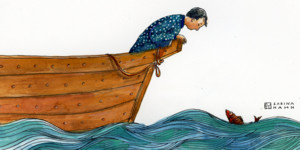
So Hiroshi gathered up the leftovers, brought them up on deck, then leaned over the side of the boat poured the food into the water below.
Here you go, fish! Enjoy this delicious feast!
And thank you! When Hiroshi's brothers saw what their younger sibling was doing, they scoffed and smirked.
Hum. You really think the fish can hear you, little one?
Or understand what you're saying? Oh, come on, guys.
Surely it's just a matter of time before the fish will just... jump out of the water and thank our little friend here.
Thank you, Hiroshi. Thank you for feeding us.
Thank you so much. Hata Hiroshi paid his brothers no mind, and from then on, after every meal, He collected all the leftover food and dropped it into the sea, calling out to the fish like they were his dearest companions.
Here you go, friends. A gift of thanks from me to you.
Hiroshi's brothers drove the boat farther out to sea than usual in hopes of catching even bigger fish.
They sailed for seven days and seven nights And after every meal, Hiroshi thanked the fish by dropping morsel after morsel of leftover food into the water.
On the seventh night, the fishermen dropped anchor and the boat floated in place.
The men were so exhausted from their week-long excursion that they fell asleep right after dinner. snoring away in their bunks.
Hiroshi, meanwhile, scrubbed the pots and pans and tidied up the galley.
Then, as usual, he piled the fishermen's leftovers in a basket, and went up on deck.
My goodness! Look at the sky! I've never seen the stars and moon shine so bright.
Hiroshi turned over his basket and tipped its contents into the water.
Gather around, friends. Enjoy this wonderful dinner.
And thank you. Then he went down to his bunk to get ready for bed.
But just as he was about to climb under the covers...
Wait a minute. Is it just me, or is the boat not moving?
I mean, I know we dropped anchor tonight.
But even with the anchor down, we still rock back and forth on the waves.
Now it feels as if we're... beached on dry land.
Hiroshi raced out of his cabin and sprinted up to the deck.
And as he leaned over the boat's rail and looked down, he felt the hair on the back of his neck stand on end.
Oh my goodness! Am I dreaming? The ocean, it's gone.
What do you think? Is Hiroshi really caught in a dream?
Or has the water truly vanished? We'll find out after a quick break.
Support for Circle Round comes from Indeed.
You just realized that your business needed to hire someone yesterday.
How can you find amazing candidates fast, easy, Just use Indeed.
There's no need to wait. You can speed up your hiring with Indeed. and Circle Round listeners will get a $75 sponsored job credit. to get your jobs more visibility at indeed.com slash circle round.
Just go to indeed.com slash circle round right now.
Support the show by saying you heard about Indeed on this podcast.
Indeed.com slash circle round. Terms and conditions apply.
Hiring? Indeed is all you need. side. What are Circle Round listeners saying about the Circle Round Club, the newest membership opportunity for superfans like you?
Here's a taste. I love being in the circle around the club because the snuggle times are perfect for me. for when you want to listen to Circle Round, but you don't have that much time.
Grown-ups, get your Circle Round superfan signed up today at WBUR.org slash CircleRoundClub.
I'm Rebecca Shear. Welcome back to Circle Round.
Today our story is called The Fisherman's Leftovers.
The Fisherman's Leftovers Before the break, we met Hiroshi, a young man who dreamed of becoming a fisherman like his older brothers.
They said Hiroshi was too small and weak to haul in the fishing nets. but they did hire him to cook meals on their fishing boat.
Following every meal, Hiroshi dropped the fishermen's leftovers overboard as a thank you gift for the fish.
And one particularly starry night, after Hiroshi tossed the usual scraps of food into the sea, He peered over the rail of the boat and noticed that the sea had disappeared.
Oh my! I can't spot a single drop of water anywhere!
All I see is... Miles and miles of sand.
Have we run aground on some unknown island?
Did the ocean suddenly dry up? What's going on here?
Hiroshi didn't want to wake his brothers from their slumber.
So he found a rope ladder, lowered it over the boat's rail and climbed down.
Indeed, the moment his feet touched solid ground, he knew it was true.
Somehow the boat was stuck on a beach. But the sand on this beach...
There's something different about it. Maybe it's the way the moonlight is shining down on it.
But I swear, it looks like gold. Glittering, sparkling gold.
Hiroshi knelt down and scooped up a handful of the shimmering sand.
He brought his hand close to his face and squinted his eyes.
Honestly, if I didn't know better... I'd say this sand is actually made of gold.
You know what? To remember this amazing night, I'm going to save some of this sand and keep it as a souvenir.
Hiroshi fetched a bucket from the boat and filled it with glistening sand.
Then he returned to his cabin and hid the bucket under his bunk before falling fast asleep.
Hours later, as the sun lifted its fiery head over the horizon, Hiroshi popped his eyes open.
It was time to cook his brothers some breakfast.
But as he lay in bed, he realized the boat was moving again.
It was rocking and rolling, drifting and swaying with the motion of the sea.
Somehow we're back on open water. Boy, oh boy, I can't wait to tell my brothers everything they missed while they were asleep.
Hiroshi waited until the fishermen finished their breakfast.
Then he followed them up to the deck where he told them all about the glittering beach of golden sand.
Okay, hold your horses, little one. You're actually saying that the ocean disappeared? last night?
And our boat was standing on miles and miles of sand?
Sand that looked like gold? That's right.
And the way that sand twinkled in the moonlight I've never seen anything so beautiful in my entire life.
The fishermen narrowed their eyes. Little one, your brain sounds as scrambled as an egg.
Perhaps all this time out at sea has messed with your head!
Is it time we sent you home? Hiroshi crossed his arms.
No, brothers. It isn't time you sent me home.
I'm telling you, the golden sand was real.
If only there were some way I could show it to you.
Wait a second, there is a way. Wait here!
Hiroshi dashed down to his cabin and reached beneath his bed.
And do you know what he pulled out? You guessed it, the bucket of sand.
Then he raced back up to his brothers on the deck.
Here. Look at this! I filled this bucket while I was on the beach last night.
Doesn't the sand look exactly like real gold?
When the fisherman beheld the bucket of sparkling sand, their jaws dropped open.
My goodness little one this sand doesn't just look like real gold this said is is real gold.
Hiroshi's brothers grew quiet. And then, Next thing Hiroshi knew, the hulking fishermen were looming over him. their eyes flashing with greed.
You must give us some of that gold, little one.
After all, we're the reason you have a job.
We share our boat with you. so you should share your gold with us.
That's right. Hiroshi didn't know what to do.
His brothers were so much bigger than he was. and here they were reaching and grasping for his bucket, trying to snatch some gold.
But then... gentlemen a voice suddenly rang out across the dancing waves and the fishermen froze in their tracks.
Because they knew exactly who that voice belonged to. the goddess of the sea.
Listen, men. That gold doesn't belong to you.
It belongs to Hiroshi. I've given it to him as a gift.
Hiroshi bowed his head. I thank you, Goddess of the Sea, most humbly.
But why give me such a generous gift? What did I do to earn these riches?
Don't you know, Hiroshi? It's a gift of thanks.
After all... You've spent days, weeks, months offering your leftover food to the fish of the sea to my children.
You've shown selflessness, compassion, and kindness.
And those virtues deserve a reward. Wouldn't you say so, gentlemen?
The fishermen blushed and bowed their heads.
They knew the goddess of the sea was right.
And never again did they poke fun at their youngest brother.
When the fishing boat finally returned to the village, Hiroshi quit his job as a cook.
He used his new gold to build his own boat so he could sail out on the water and catch fish and feed fish whenever his generous heart desired.
. . . Now it's your turn. What do you dream of doing when you grow up?
Maybe you want to become a Broadway dancer or a world-class scientist.
Maybe you want to fly a plane, teach in a classroom, or run your own farm.
Whatever it is, find some paper and draw a picture of you achieving your dream.
Show your picture to someone you have fun with.
A family member, a friend... And then, if you'd like, show it to us.
Have a grown-up snap a photo of your drawing, then email it to circleround at wbur.org.
This week's story, The Fisherman's Leftovers, was adapted by me, Rebecca Scheer.
It was edited by Catherine Brewer. Circle Round's original music and sound design is by Eric Shimalonis.
Our artist is Sabina Han. Want to color while you listen?
Sabina has drawn a black-and-white picture for all 100-plus Circle Round stories.
Ask a grown-up to visit our website, wbur.org slash circleround, and click on Soundtrack and... coloring pages special thanks to this week's actors Theodore Chin Robert Fung Edward Hong, Dolores King-Williams, and Mark De La Cruz.
Mark De La Cruz has appeared on Broadway in If Then with Idina Menzel and Anthony Rhett. whom you might remember from our episode, The Sultan's Figs.
Mark was most recently seen playing Alexander Hamilton in...
Hamilton. Our featured instrument this week was the shamisen.
You can learn more about this traditional Japanese stringed instrument and see a photo of Eric Shimalonis playing it on our website.
Again, that's wbur.org slash circle around.
Never want to miss an episode of Circle Round?
Why not subscribe? Grown Ups, you can find us on Apple Podcasts or wherever you get your podcasts.
And please leave us some stars, write us a review, or just tell your friends about the show.
Circle Round is a production of WBUR, Boston's NPR station.
I'm Rebecca Shear. Thanks for circling around with us.
One of the best things about creating Circle Round is hearing from listeners like you.
Circle Round fans have been telling us about their favorite Circle Round stories. and we're excited to share some of their voices with you.
My name is Cassius. I live in Oaxaca, Mexico.
My favorite story is the one in the sky because I like it.
When they cook, put them in the stove. My name is Ellie and I live in Canada.
My favorite story was the mad pie. And my favorite part was the carriage and the castle.
I'm Mabel, and I'm from Morgan. And my favorite story. with a tan and paint brush because the mean one doesn't be fair. to the other one.
Did someone mention an episode you missed?
No problem. You can find every single Circle Round story on our website.
That's WBUR.org slash Circle Round, or wherever you and your grown-ups get your podcasts.