Ted Audio Collective You're listening to Ted Talk's Daily where we bring you new ideas to spark your curiosity every day.
I'm your host Elise Hugh.
I am some sort of mosquito magnet.
Even if everyone else I'm with can avoid getting bitten and I somehow wind up with my legs and arms just dotted with itchy bites.
But leaving itchy swollen bites is the least of the harms the mosquitoes can do.
Mosquitoes carry malaria, a prolific killer of children and pregnant women.
Medical entomologist Abdullah Diabati is doing something about it.
He shares his scientific endeavor to target the entire mosquito population after a quick sponsor break.
Support for the show comes from Capital One.
Thank you with Capital One helps you keep more money in your wallet with no fees or minimums on checking accounts and no overdraft fees.
Just ask the Capital One Bank guy.
It's pretty much all he talks about in a good way.
He'd also tell you that this podcast is his favorite podcast too.
Aw, really? Thanks Capital One Bank guy.
What's in your wallet? Terms apply.
See CapitalOne.com slash bank.
Capital One NA member FDIC.
Support for the show comes from Brooks.
My friends at Brooks sent me amazing new Go 16s that I have been running with.
The Go 16 has made me feel lighter and more energetic when I run out the door in the morning.
They have soft cushioning through a technology called the Nitrogen Infused DNA Loft V3.
It offers just the right softness.
There's also engineered air mesh on the upper side of the shoe that provides the right amount of stretch and structure.
It'll turn every day miles into every day in door fins.
That sounds good, right?
Let's run there. Visit BrooksRunning.com to learn more.
Support for the show comes from Mint Mobile.
You know when you discover a new show that's worth binging or a song that you play on repeat and you have to share it with your friends so they can experience how awesome it is just as you have?
It's kind of what it feels like when you discover that Mint Mobile offers premium wireless for $15 a month when you purchase a three month plan.
It's such an awesome deal.
There's no way that you can keep it to yourself and that's why I'm telling you all about it.
Say bye-bye to your overpriced wireless plan and switch to Mint Mobile.
All plans come with high speed data and unlimited talk and text delivered on the nation's largest 5G network to get this new customer offer and your new three month premium wireless plan for just $15 a month, go to MintMobile.com slash talks.
That's MintMobile.com slash talks.
Cut your wireless bill to $15 a month at MintMobile.com slash talks.
$45 upfront payment required equivalent to $15 a month.
New customers on first three month plan only speed slower above 40 gigabytes on unlimited plan additional taxes fees and restrictions apply.
These days we're surrounded by photo editing programs.
Have you ever wondered what something or someone actually looks like under all the manipulation?
It's me Elise and this October I'm giving a TED Talk in Atlanta about finding true beauty and a sea of artificial images.
I'm so excited to share the stage with all the amazing speakers of the TED next conference and I hope you'll come and experience it with me.
Visit go.ted.com slash TED next to get your pass today.
And now our TED Talk of the day.
Mosquitoes. I don't know about you but I don't have a good relationship with them.
A friend of mine said one day if you think that you are too small to make a big difference, you've never spent a night with mosquitoes in a room.
But I don't have any mosquitoes in my pocket to release tonight.
So it's going to be fine.
So let's start. As unbelievable as it may sound.
Malaria is as old as humankind.
And malaria once was a public health issue all over the world.
But then it has been successful tackle in the US and Europe.
And yet the case later, malaria still kills millions of people in Africa and in Asia.
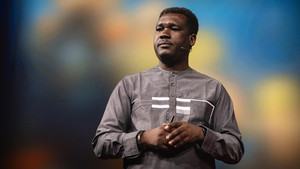
Why? I'm Abdullah Jabate, a medical anthropologist from the Institute of Research and Science and Technology.
I'm here today flying all the way from Bukina Faso to tell you that we might be closer than ever to eliminate malaria in Africa.
Thank you. Malaria is tightly linked to poverty.
But then you have no idea of how much expensive is it to be poor.
There are 200 million cases worldwide that hand up suddenly every year with about 600,000 deaths.
And this is not a random collection of statistics on a piece of paper.
Behind each of these 600,000 deaths, there is a personal tragic story, sometimes behind closed doors.
Most of these deaths happen in Africa.
Children and pregnant women bear the highest burden.
And I'm a fortunate child who malaria survivor.
When I was a kid, I used to think that my dad was a superhero.
I could see him leaving the house every morning at 6, riding his bicycle to the farm, working very hard all day long.
We did not have much for living.
But who said you need more to be happy?
But when happiness hangs by a thread, it doesn't take much to turn your life around.
My son, in my dad, got deeply shaken the day I got struck down by malaria.
I was three or four years old.
As we used to say in my country, kids may not end up in the complexity of suffering.
But pain has no age. And God, I wasn't pain.
I can still clearly see myself laying down there on the bed with high fever and suffering.
I could not eat anything, throwing up all the time.
Will survive? Will not.
The psychological trauma my parents were going through was unbearable.
But against all odds, I survived.
But can we say today that we are done with malaria because they are about to survive and made it all the way down to Vancouver?
If I say yes, no one can blame me.
That is a liar because many children are still dying of malaria.
The real question then is, why have we not been able to defeat it so far?
Well, because malaria is a complex parasitic disease that plays on three grounds.
Plus modium, the pathogen, anopheles, and the vector, and human, the victims.
Each of these elements is very complex on its own.
And the interaction makes it even more complex to devise interventions that are really effective.
But of course, we are trying.
Currently, there are two vaccines to humanize people, but the heavy logistic to deliver this vaccine may not allow us to reach their full potential.
Badness and the face-hand treatment are both frightening by insecticide and drug resistance, meaning that our best intervention has started to fail.
And there is a general consensus today that without additional new tools, we may never cross the last mile of malaria elimination.
And this is exactly where I come in.
My colleagues and I, at Target, malaria are working on something called gene drive, a way to control mosquito population and alpha-malera transmission.
So what is gene drive? It's a natural molecular mechanism that augments the frequency of certain gene in the population beyond the normal Mendelian inheritance.
So what does that mean? If you take any gene, in natural circumstances, it has only 50% of chance of being transmitted to the next generation.
Meaning that, if the parents have 100 babies like in mosquitoes, only 50 of them will get the gene and the other 50 will not.
But not all gene behave this way in nature.
Some gene have found a very clever way to bypass this law and can augment their own prospect to up to 90%.
So, gene are said to drive, and so the name gene drive.
How we must promise in stringing affect female fertility by targeting a gene called double sex.
This gene is responsible for the sex determination in mosquitoes.
And so disrupting the double sex gene may affect the sexual development for adult mosquitoes and their reproduction.
Now, it may sound counterintuitive to affect female fertility and spread a gene of interesting multipopulation at the same time.
But it's working. We target a specific region of the gene called double sex that affects only female.
Male bearing these modified gene are not affected at all.
Female with just one copy of the altered gene are fully fertile.
However, female bearing two copies of the modified gene cannot lay eggs, fail to bite, and also have the physical characteristic of both male and female.
It's called a suppression strategy.
Once these mosquitoes are releasing the field, they're going to spread the gene of interest to the wild population, and this is going to reduce dramatically their reproductive capacity.
Fewer mosquitoes mean less malaria transmission until it stops.
Mathematical model predicts that releasing such mosquitoes in the field is going to stop malaria transmission in just 20 generations.
That's mean in two years.
And the technology is sustainable, cost effective, and easy to deploy.
As the release mosquitoes will do the job themselves by finding the last hiding pocket of wild mosquitoes to convert.
Fantastic. The only problem.
Gene Drive has never been tested anywhere in Africa.
And while the technology brings a lot of hope, it also carries its share of fear and skepticism to the world.
The pathway from the bench to the field is not straightforward and is full of pitfall.
Maybe mosquitoes in the field will develop resistance to the spread of the transgene, or maybe two countries don't agree, but the release mosquitoes do not respect the human borders.
Or also, maybe there are risk to the environment.
And finally, the community that we are working with need to feel comfortable about this technology and give us the green light to operate.
And now back to the episode.
And so for such, target malaria has adopted an incremental approach step by step whereby we will start releasing first non-gene drive mosquitoes.
Meaning that the gene of interest here cannot self-propagate and will just go extend in a few generations.
The gene drive, the exposure of this gene to the environment is incrementally augmented in a way that we start first with small cages and big indoor cages in Europe.
And then these mosquitoes are sent to Bukina Faso where they are tested in a contained facility first and subsequently in a big indoor small cage field release.
Now the general mosquitoes are going to be tested in an open field.
Only after this is a preliminary step and the potential risks have been looked at very carefully and also additional research questions have been developed to address this risk if any.
Now the question, how far are we from releasing gene drive for two five years?
But let me tell you this, gene drive mosquitoes are already in the lab and releasing them in the field is not going to take us more than 30 minutes.
But we need five years to get ready for this 30 minutes and why is that?
The answer is simple. Because we need to engage the community and get the social license to operate.
And so if there is one thing that you cannot afford the luxury to miss is the stakeholder engagement.
I cannot just pop up in a bucket of mosquitoes on the assumption that my scientist is working for the public good.
It will not take anyone a PhD to understand if we are respectful or their value or not.
We need to engage the community and then could develop the technology with them.
And so for that, we've built our engagement strategy on the pyramidal structure, starting with the villages where we operate all the way to the top with the government officer.
The engagement is done step by step.
It's done in an inclusive way and also is done in full transparency.
It is an gentleman, there is one more thing that needs to be done before Gindraff can be released in the field in Africa.
That is capacity building.
Gindraff holds a lot of promises.
But if we not take us anywhere, if we African are unable to run it on our own.
Sadly, the technical platform in Africa is really very poor.
And this has to be solved before we can really beat malaria.
And so for that, we've set up in Bukina Faso a well-bound funded center of excellence on vector bone disease, like malaria.
And also with additional fun from the Gate Foundation, we are building a critical mass of neck generation scientists all over the continent to fill the knowledge gap and the know how gap as well.
In April 1969, a child was born in a remote village of Bukina Faso.
Like any other child of the world, it has dreams and expectation.
Sadly, however, I was to come to learn.
The place where we are born in on this planet very often affect your perspective on life and may even set the path you need to walk through into your future.
That shouldn't be the case.
We are all citizens of the world.
Our dreams and aspirations should not be constrained by the place where we are born.
And this is the reason why I became a scientist.
To offer endless possibility to any child anywhere on this continent, so that they can see the future with hope.
But there is no hope if you are cut short with malaria.
But target malaria is here to fix that.
The world free of malaria is our vision.
And I will say yes, we can.
Thank you for your attention.
The Talks Daily is brought to you by Progressive.
Progressive helps you compare direct auto rates from a variety of companies so you can find a great one, even if it's not with them.
Quote today at Progressive.com to find a right that works with your budget.
Progressive casualty insurance company and affiliates comparison rates not available in all states or situations.
Support for the show comes from LinkedIn.
LinkedIn ads allow you to build the right relationships, drive results, and reach your customers in a respectful environment they are not getting barraged.
This is very targeted. You will have direct access to and build relationships with a billion members, 180 million senior level executives, everyone is on a LinkedIn, it seems like, and 10 million C level executives.
You will be able to drive results with targeting and measurement tools built specifically for B2B in technology, LinkedIn generated 2-5 times higher return on ads spent than other social media platforms.
You will work with a partner who respects the B2B world you operate in, 79% of B2B content makers said LinkedIn produces the best results for paid media.
Start converting your B2B audience into high quality leads today will even give you a $100 credit on your next campaign.
Go to LinkedIn.com slash TED audio to claim your credit that's LinkedIn.com slash TED audio.
Lesson Conditions apply LinkedIn, the place to be to be.
That was Abdullah Diabati at TED 2024.
If you're curious about TED's curation, find out more at TED.com slash curation guidelines.
And that's it for today.
TED Talks Daily is part of the TED audio collective.
This episode was produced and edited by our team Martha Estefanos, Oliver Friedman, Brian Green, Autumn Thompson, and Alejandra Salazar.
You is mixed by Christopher Faisy-Bogan, additional support from Emma Taubner, Daniela Balarezo, and Will Hennessy.
I'm Elise Hugh. I'll be back tomorrow with a fresh idea for your feed.
Thanks for listening.