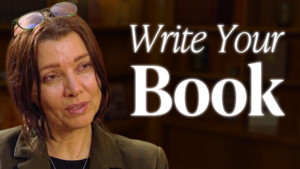
Alif Shafak has a way of writing that's lush, that's enchanted.
Because what she does is she writes about real things in the world.
Water houseboats, whatever it is, and things that are ordinary, that we stop seeing, and she infuses them with life and wonder so that we can see the world fresh again.
Alif has written more than 21 books and she's the president of the Royal Society of Literature, which has had fellows like Jared Tolkien, Rudyard Kipling, WB.
Yeats, Margaret Atwood.
And you'll notice that her writing advice is different from what you normally hear.
She wants to help you splash your personality onto the page, how to write with soul and how to unlock your wild, wild imagination, to do it day in and day out, until you're left with a finished piece of writing.
Okay, let me show you this new tool that I've been using to write called Sublime.
And they're the sponsor of this episode.
And what I'm going to do is I'm going to show you how I use Sublime to write this post on X, which got almost a million impressions.
So it started off with the basic note-taking stuff.
I was just throwing notes in.
But it's the stuff that came after that was really unique.
That's what makes Sublime special.
You'll see here that I had this mind map.
And that allowed me to begin to see connections that weren't even there.
And I was blown away by this.
And then it didn't just end there.
Sublime has the save one, discover 100 feature where you can just put in a piece of information and all of a sudden it just starts recommending things.
It's like having a research assistant that actually has good taste.
And these are put in there by actual human beings.
And so now I had the mind map, I had all the related ideas and I really started to think about how am I actually going to structure this piece?
And Sublime helped me see parts of my structure that I didn't even realize were there to see how ideas were actually connected.
See, Sublime is built by people who care about creativity and beauty, and not just productivity and efficiency.
And you can feel that as you use the app.
So if you want to use Sublime in your own writing well, you can go to Sublimeapp and use the promo code PIREL and they'll give you 20 off.
All right, let's get to the episode.
You know, genre names can be kind of unhelpful and kind of annoying, but I think that Magical Realism is actually a pretty good genre title okay.
Because I think that it explains your work and what I admire about it, which is taking the ordinary and almost making it enchanted or filling it with wonder.
And I was thinking, kind of really paying attention to how I felt as I was reading your work.
And it made me realize just how closed off we get to the world that we live in.
And we stop seeing all the mysteries that are inside of it.
And what I just really admire about How you go about your craft is that you inject enchantment back into the world.
And so that's what I want to talk about today.
Well, I so appreciate your words, you know.
Thank you.
Maybe I might have a slight disagreement about the concept, magical realism.
Great.
Only because, and I wonder if it will make sense to you what I'm saying.
But only because, when I think of life, when I think of the city of Istanbul, for instance, if I may give you an example, Istanbul is not a city that says OK, this is the box of the East.
This is the box of the West.
It does not say this is the category of humor and this is the category of sadness, or here's the magic part and here's the reality, part right.
What it does instead is it combines everything constantly in the wildest way possible.
So it's a city of so many contrasts, but everything condensed sometimes in one moment, in one scene.
For instance in Istanbul.
You might come across a very sad moment, but underneath there's a layer of absurd.
I wouldn't call it funny, perhaps, but you know, the humor that comes with absurd.
Or the opposite, there's such a funny moment, but underneath, my goodness, there's so much sorrow.
So I guess what I'm trying to say is In my mind I do not separate these categories like here's the domain of magic and here's the domain of reality.
That's my only opposition to the term magical realism, because it assumes that there's a duality, whereas I think in life.
There is magic in every moment, every breath.
There is magic also in this room.
And I'm longing maybe for another word, another category to describe my work and the works of many other writers.
Yeah, I think that.
What happens though, is we go about our lives and things become like our left brain takes over.
Things become about utility.
They become about definitions, about categories.
And.
Rather than seeing the beauty and the wonder in objects, you stop seeing that.
And I think a lot of times when people try to re-inject magic or wonder into whatever it is, you get into the realm of cliche or things feel cheesy.
And so how do you not do that?
Well, I think at the end of the day, as writers, we need to follow our intuition, our heart.
And the moment we start thinking about what will people say, how they're going to react.
Are the readers going to like this?
Are the editors going to like this?
That is really a very dangerous road.
And I say this as a Turkish writer who had to deal with a lot of nonsense when my books have been published internationally.
Sometimes I've been prosecuted, investigated, targeted.
So if I start thinking about what the reaction to the story that I'm writing will be like, probably I won't be able to write.
And therefore for me as a novelist, the best way forward is to remain inside that imaginary world that I am constructing and to believe in it with all my heart.
So really those characters become my friends.
That imaginary world becomes my reality.
Only when the book is done and I give it to my editor.
Then I can have panic attacks as to what people might say.
But it's too late.
The book is born and it's free.
It's free of worries the way it should be.
So I guess all I'm trying to say is all these adjectives that we use, the labels that we use, the categories that we use.
All of that happens later.
But within the process of writing, you need to keep it as pure, as independent, as free as you can.
The biggest lie that writers will tell themselves is, ah, I'll remember that later.
No, I mean, there's so many times when I'm listening to a podcast that want to save something and I just never end up saving it, because typing it into the phone is just too much work, you know.
Well, I found a great solution to that problem.
It's called Podcast Magic, and they're the sponsor of this episode.
So what do you do?
Super easy.
Say you're listening on Apple or on Spotify.
If you find a bit in this conversation that you really like, just take a screenshot of it and then email it to podcast magic at sublimeapp.
If you email it like a minute later, you'll get an email back with the transcript, the context, all the information that you need, and then that way you don't need to write down all the information.
So if you find something in the conversation that you really like well, check out podcast magic.
All right, let's get to the interview.
So can you take me to month four, month five you're in a novel.
The characters have become your friends.
You've created this imaginary world.
Take me to the.
What's going on in your life?
Like, what's any given tuesday like, and what are you feeling?
What are you experiencing, what are you thinking?
Well no, two days are exactly the same.
Um and, with all due respect, i think sometimes um, it's only a small number of writers of a certain age perhaps, or a background, who are very proud of their precise schedules.
But for all the rest of us, what we are doing is we're juggling, aren't we?
Like everyone else does in every other profession?
The difference is, of course, unlike many other professions when you're a writer, this is not a job.
You don't leave it behind the door.
You don't do it nine to five.
It's with me day and night.
It seeps into my dreams.
So I guess what I'm trying to say is I don't have precise schedules.
But what I do every day is I read.
What I do every day is I take notes.
It doesn't mean that every note that I take will go into a book.
And it doesn't mean that everything that I write when I'm writing a book will be in the final cut.
So there's a lot of deleting and erasing as well.
But what I'm trying to say is there's a continuity of reading, researching, learning and writing.
But in terms of precise schedules, I don't believe in those, because we're mothers, we have many other responsibilities.
So we carve out a space for ourselves.
If I cannot write in the day, I will write at night.
If I cannot write at night, then I will try to do it the next morning.
But that's always my passion.
Do you feel like you write differently during the day versus the night?
The night is interesting.
I'm nocturnal.
Yeah, I like the night.
Although as we get older, I think it becomes a bit more difficult to work long hours at night.
But I've always liked working at night.
How do you feel like the work is different?
I think you have more time to listen to the voices coming from the page.
That said, I'm speaking with a little bit of caution because I don't like extreme silence.
I cannot work in silence.
I feel very uncomfortable when there's too much silence around me.
Maybe it is the impact of Istanbul only because I lived in a very noisy neighborhood, which was even noisier at night than during the day.
But I usually put on my headphones.
I usually choose a heavy metal song.
Which I think is absolutely hilarious that you listen to heavy metal.
Yeah.
Who do you like?
I'm a metalhead.
I've always been a metalhead since my early youth.
It never abandoned me.
That's so cool.
But what has changed over the years is I think I moved towards subgenres of heavy metal.
So I usually listen to melodic death metal.
I love industrial metal, a bit more gothic, metalcore.
I like many Nordic bands, Scandinavian bands, but I'm also very open to discovering many bands from all over the world.
And it's such an amazing scene, or kingdom, I should say that of the heavy metal world, because it's so dynamic, so creative.
Always new bands are coming.
So when I like a song that speaks to me in that moment, I can listen to that song on repeat, maybe 70 or 80 times.
It becomes a loop.
I don't jump from one song to the next.
I stay with that song and it becomes like circles and circles.
And that's how I zoom in and zoom out.
And then I'm in a different place.
No, it's when what's the point of the heavy metal?
Is it that you like the music?
Is it that it makes it more you more generative?
What's going on there?
I think heavy metal is so honest.
It's so raw, you know, it's all about raw emotions.
And I love the dialectics, the contrasts, particularly in melodic death metal.
And you know the clean vocals, with the contrast a bit more guttural, the harshness, the intensity of it.
It's not pretentious.
It is what it is.
And actually I think it's a myth to believe that, to think that people who listen to this kind of music are aggressive souls.
Many metalheads are actually very gentle souls, including many, many metal musicians, heavy metal musicians.
So I think it's always been a genre that spoke to me.
And when I listen to this kind of music, maybe I feel calmer.
I can definitely relate to that.
I actually find I feel often the most calm in the most busy environments, but that's not where I want to go here.
You were talking about writing from the heart.
Can you explain to me what that means, the difference between the mind and the heart, their different personalities and what it feels like to pull from the heart?
Again, I'm a little bit cautious because at the end of the day, we use these words in a very narrow way.
How do we differentiate the mind?
Where does the heart start?
Where does the gut end?
The human being is much more complicated and everything is interconnected, of course.
But for the sake of this, maybe building an argument, I can tell you that The mind, the rational mind, I think, has always more constraints.
It's more aware of identity politics.
It's more aware of boxes.
It's more anxious.
Whereas the heart, particularly our ability to empathize with others, is definitely so much bigger, broader now and deeper
So I want to make the heart my guide.
But also I want to share with you maybe one more point.
I think broadly speaking, there are two different ways of writing a novel.
In the one, the writer is a bit like an engineer.
You know you want to have a great plot, you want to construct everything, you want to know how the characters are going to behave beforehand.
So in a way, the author is in charge, in control, and there's a lot of cerebral activity going on.
I have a lot of respect for authors who write that way, but it's not my way.
I like the second way in which you write with your intuition.
You're a little bit drunk.
You don't quite know what you're doing.
You take risks.
You know, you don't know what that character is going to do in the next five chapters, or you allow a side character to take over.
And you're more lost inside the text as an author.
You're not above the text.
But for me to be able to feel that kind of confidence and take the plunge because you're literally jumping into something without quite knowing what you're doing
For me to be able to feel that kind of confidence, I do a lot of learning beforehand.
So I read a lot.
I research a lot and I listen a lot.
I try to become a learner in life.
Tell me about listening.
What do you mean?
Well, to me, this is very important.
I think writers, we writers need to be two things, excuse me, all our lives.
We need to be good readers and we need to be good listeners.
When I say good readers, I believe our reading lists should be eclectic.
Let's read anything and everything that speaks to us.
So good readers isn't just read the classics, the Dostoevskys, no, read everything.
Read everything.
Definitely, let's read the classics.
Let's read Dostoevsky, Anna Ahmatova and Tolstoy and many others.
But if there's a particular book that speaks to us in that moment in time, let us not say oh, is this highbrow literature.
Is it lowbrow literature?
Who makes those distinctions?
You know, where do those dualities come from?
I think graphic novels are amazing.
They open up our imagination.
I think cookbooks are amazing.
They tell us so much about cultures.
But equally, let's read political philosophy.
Let's read neuroscience, water science.
Let's have interdisciplinary conversations.
Let's keep the curiosity of the mind alive.
I've always believed in being intellectual nomads.
We shouldn't have comfort zones.
I think the mind is always more nourished when we dare to leave our comfort zones.
So, for instance, when a novelist becomes interested in neuroscience, or when a scientist is drawn to poetry, or when a poet falls in love with film theory, or when a director is interested in political philosophy, you know, those moments, I think, are the best, when our mind is open to learning.
And by listening, what I mean is not everything is found in written culture.
And there's so much knowledge in this world that is transferred through oral storytelling ballads folktales legends, riddles.
We should not belittle that world.
To the best of my ability, I would love my work to bridge written culture and oral culture.
Mm-hmm.
And then also with listening.
There's a lot that is shared, that isn't spoken, that you can hear when you're really listening carefully.
Like one of the things that if you really listen to somebody, what they don't say is as important as what they do say.
And you would think of listening as when they're going, but sometimes the pause actually tells you more than anything that they actually said.
Yeah, that is absolutely so true.
I mean, when I listen to people, I try to listen to two things.
What they're telling me, of course, but how they're saying what they're saying.
The choice of words, the pauses, the silences.
And I think those are just as important things.
Again, particularly if you happen to be a storyteller from a country like Turkey, where we have lots of silences, lots of ruptures.
I've always believed that you can't only be interested in stories as a writer.
You also need to start paying attention to silences.
And in that sense, maybe being a novelist is a bit like a linguistic cultural archaeologist.
You have to dig deep through layers. of memory and amnesia, you know, stories and silences.
You're talking about listening and I want to get into characters in terms of what makes a character believable, in terms of their strengths and their weaknesses, in terms of how they look, how they act, how they feel and in terms of how they speak.
And it's so hard to categorize these things, but there's a felt sense of what makes a person real versus what makes a person fake.
And I would imagine that it requires a deep listening to have an intuitive sense for when a character feels true versus false.
Yes, I think how we connect with characters is a big part of the writing process.
But, if I may perhaps add this, I've never believed in heroes, like I've never believed in absolutely brave, absolutely good characters or seeming opposite.
I think as human beings, we're all on a... some type of spectrum.
And maybe as a writer, I'm always intrigued by that moment when a timid person suddenly shows courage, or a very brave person.
There comes a moment when they're so scared.
Those are the things that draw my attention a lot.
And also the change in our characters.
We're all going through a metamorphosis.
I mean, Ovid, of course, got this so right at a very early time.
But it's those transformations, those metamorphoses that I'm always drawn to.
And the periphery, if I may put it in these terms, more than the centre.
I think I'm more interested in the periphery more than the seen, what remains unseen, more than what's heard.
The unheard has always called me.
So then, when you're thinking about the change, the transformation in a character, you were talking about how writing for you is more intuitive.
It's not so planned.
Are there times when you're thinking through that change deliberately?
Like what happens when it's not working?
You're like, oh, I'm trying here, but there's something off about this.
Like, what do you do?
Do you kind of descend into I'm going to have the imagination fix this?
Or is it like, let's map this out.
Let's see what's going on.
I think it doesn't matter whether it's your first book, fifth book, tenth novel.
We always and always go through valleys of anxiety, mountains of depression.
This is not a linear, steady progress.
Undoubt and self-doubt, they're big parts of the writing journey.
That's what I learned over the years.
One week you might feel like, okay, I got this.
I'm writing an amazing story.
It's going to be great.
And then the next week you're crawling on the floor and everything you've written previously is so bad you just chuck it away.
So that also happens.
And I'm not saying that there isn't any planning, there isn't any plot or structure.
Of course, those things are incredibly important.
For instance, when I was writing, There Are Rivers in the Sky.
Literally, I had to hold these three storylines in my hands at the same time.
So it's not like I finished one storyline and then I started another, and then I started another that were written simultaneously.
So it felt like weaving a braid, you know, like a hair braid.
And that requires a lot of thinking, taking notes, you know, your arrows.
But I guess what I'm trying to say essentially is that you have to trust also your intuition and you have to also understand that we don't control everything as writers.
This is not a completely rational process.
I'm not denying the existence of reason and intellectual activity.
But sometimes as you keep writing, you discover a lot about yourself.
So there's a self-discovery as well.
There's an irrational element as well.
That's what I'm trying to say.
It's a much more complicated process.
Yeah, i spent um, i spent last week with some of my friends.
Kids were just hanging out at disney world for a few days and you know, kids always want you to tell them a story.
Right, and i was reflecting on the time with kids because i just like hanging out with kids.
I've always gotten along with them well and one of the things i've noticed is i'm in a real state of play, like i'm just kind of imagining and just kind of going with the flow, doing whatever.
I don't feel like i think in the same way and It's funny because when you're in that state of mind, stories kind of can flow out of you.
If you're in that state of play and you're kind of surprised by what you can come up with.
And sometimes, once you try to plan the thing, once you try to hey, let me, you know, press this person, the mind just goes numb.
Absolutely.
It really resonates with me, everything you said.
That's why I believe we writers, we're a mess in our daily lives, you know, we're full of anxieties and this and that, but when we sit down and when we start writing, we become wiser.
You know, not because we're wise in our daily lives, but because we tap into something that is bigger than us, that is older than us and that is definitely wiser than us.
And what we tap into is this ancient and universal, timeless and placeless art of storytelling.
It's so old.
It doesn't belong to a single ethnicity, class, region, religion.
It really belongs to all humanity.
And I think as human beings, we're all story telling creatures.
Not only that, we're story remembering creatures.
Yes.
That is so interesting.
What we remember of the past is often it just goes hand in hand with emotions and stories.
Those are the things that remain so deeply within us.
And again.
Neuroscience explains those connections in the mind between emotions, memories and stories.
So I think we just have to tap into that beautiful old, ancient art of storytelling.
You were talking about the braided fish tank and you have a way with metaphors and analogies.
I don't actually quite know the difference.
Then there's similes.
One is like, like, or as, but whatever you understand what I'm saying.
And I highlighted this one.
It had been drizzling since the early hours, clouds hanging over the city, the color of a neglected fish tank.
And that seems to be in terms of all the things that I like about your writing.
One of the things that you do best.
And now that I'm thinking about it, what a, Good metaphor can do is two things.
The first is it can help you see something that might be hard to see.
And the second is it puts a kind of emotional hue on whatever it is that you're describing that we can innately feel.
But, you know, the senses, to activate all the senses, it's so important for me.
When I was writing 10 minutes 38 seconds in the strange world.
There's a reason why I'm mentioning this book.
The character we know.
Right away she's dead, the very first page.
But her brain is active and alive for a few more minutes after the heart has stopped beating.
So, within those limited minutes, as she remembers her past, the question for me as a writer was how do you remember?
And I think we often remember via smells tastes,
Of course, Marcel Proust, he wrote about this better than anyone could.
It's a very central theme to literature.
Sometimes you dip your you know cookie or mudland into a cup of tea and that takes you back to childhood, it takes you back to your grandmother and so on.
But my point is the senses.
They're so important.
So how we see, how we taste, how we hear the sound of the universe, everything is alive.
Do you find that some senses are easier to activate than other ones?
I feel like when I'm writing, those senses are more active.
Whereas, of course, in our daily life, the rational mind takes over.
But when you're writing, and that's one of the many reasons why I love literature so much And I always associate it with freedom.
In our daily lives.
If we say well, I was drinking a glass of water and then the water spoke to me, people will think you've gone bonkers, right.
But in fiction, you can say, well, actually, this drop of water has a story to tell.
You know, it has been traveling since time eternal.
We haven't discovered any new sources of water.
It's the same drops of water in the River Mississippi, the River Gange or the River Thames or the Euphrates.
The same drops of water circulating over and over, the same water that we have in our bodies.
One of us might have shed us tears or the same water that we drink in our glass.
So my point is you can tell a story and you're not stopped by the rational, logical mind, because there's more to the world.
There's more to the universe we're living in.
Yeah, I mean, you do a beautiful job with it.
In Water, I collected three sentences.
The first is that you wrote for unlike humans, water has no regard for social status or royal titles.
Water is the consummate immigrant, trapped in transit, never able to settle.
And my favorite one, water hardens in adverse circumstances, not unlike the human heart.
And there was another one now that we're talking about it is you had this description of water is falling, and it was almost like the water has fallen from the sky but hasn't landed on a tree, almost as if it hasn't decided where it's going to land.
And all of a sudden you're just thinking of water, and water is just infused with this enchantment and this range of what it could be.
It's like spreading out your imagination.
And I'm sitting there reading it and I'm like how does she get there?
Like i don't understand how your mind got there kind of makes me a little teary, because it's so like, it's so beautiful, you know.
Yeah, thank you.
That really means a lot to me.
I think it's It's at the heart of the art of storytelling.
It's not something that I do personally.
We're all born into a box of identity.
We're born into one place in time, one religion, one ethnicity, or this or that.
And we're so used to looking at the world from that angle, from that window.
This is what we are taught, right?
Right.
But art and literature, they hold us by the hand and they say, come with me.
Let's see what's beyond that box.
And that's why I passionately believe in this.
It's a pity that we usually emphasize the autobiographical element aspect of literature.
And please don't get me wrong.
I have a lot of respect for that.
What do you mean when you say that?
What I mean is, when we teach creative writing in so many workshops, the very first thing that is being taught to students is write what you know.
And people then start thinking understandably.
They say, well then, I need to write about what happened to me.
You know, what's my story?
And again, there are so many amazing, wonderful works of literature that started from that point.
So this is not a criticism at all.
I have a lot of respect for autobiographical books.
But where I criticize, where I disagree, is literature cannot be solely reduced to the autobiographical books.
It is more than that.
So there's also transcendental or what I call transcendental aspect to it.
And by that, I mean, sometimes you tell your story, but sometimes it's not about your story.
It's about the other.
You become the other.
And then you become another, another.
And you keep making these journeys.
This to me is so important.
You try to go beyond those boxes.
You try to dismantle the dualities.
And then you realize the person I regarded as my other is actually my brother, my sister.
It's me.
I am the other.
There's not much difference.
So it just dissolves those dualities.
That aspect of literature is so crucial to me.
To what level do you feel like you sometimes become another character, like you become Arthur?
Like I am actually that person.
You know, like it's on Halloween.
If you see someone who's really in costume, they talk like the person.
And for a second it's almost as if they actually are Thomas Jefferson or Amiga Earhart or whoever it is.
To what level do you feel like you become that person?
I do feel like I become that person because otherwise I cannot write about that person.
But, that said, you also need to hear the relatively smaller characters in your heart, or those characters that might not look very nice.
You need to try to understand.
This is not about judgment.
We are not judging our characters.
We try to understand them.
Equally, you need to understand a tree sometimes.
I wish you had seen my agent's face when I told him there's a talking tree years ago.
I said, I'm writing this new novel and there's going to be a tree in it and this tree is going to talk.
And I saw for a moment this flicker of panic and anxiety in his eyes, which I understand, of course.
He's very supportive always.
But he was worried for a moment, and I was worried too, because if you have a talking tree inside a literary novel and if it doesn't work, the whole thing collapses, the whole structure collapses.
But I believed in that tree.
I heard that voice inside my mind and my soul, Really, day and night.
And to me, she sounded and it was a sheet tree.
She sounded so convincing.
So I just wanted to follow that voice.
I couldn't resist that voice.
So you have to identify.
You feel like it's harder to take risks like that as you become more successful?
Or do you feel like now that you've written 21 books, whatever it is, it actually becomes easier?
It's always hard.
It's always hard.
It's always hard.
And it never gets any easier.
Yeah.
And what is the hard coming from?
Is it from a personal fear of failure?
Is it from the critique of the editor, the critique of the culture?
What direction is that coming from?
I think writing is hard.
Writing does have suffering in it.
When I'm writing, I'm always a little bit miserable.
But if I'm not writing, I'll be more miserable, you know?
That said, I also enjoy it so much.
Otherwise, you wouldn't be able to do it.
The word compulsion comes to mind.
Yeah, it's stronger than us, right?
You just have to do it.
It's art.
It's literature.
The impulse is so big.
Yeah.
I have so many fears and anxieties, and there are these when I feel miserable and I'm like why am I doing this to myself?
Why couldn't I choose a simpler subject?
Why am I making it difficult for myself?
All these questions you ask yourself.
But at the end of the day, I think what is stronger than all these questions is the love of literature.
If that love is there, but in everything we do in life, if love guides us, if you really love what you're doing, only then we can keep doing it.
Otherwise, writing is really not easy.
As we get older it doesn't get any easier.
Perhaps it becomes harder and harder, and that's something we don't talk about enough.
How do you let me know if you disagree with the framing?
But How do you?
When I think of your writing, I almost think of like soft bed sheets.
Like your writing, it doesn't just do the job, but it's cozy.
It's kind of comfortable to, to, to be in.
Whereas then you read at least your you know your literature, whereas then you read more nonfiction style writing.
And it's just, it's a little bit more coarse, like that there's right angles.
It really serves a purpose.
And I'm interested in the way that writing softens, because I think that that's a bit of what poetry does.
Is what you do is you trade off, you give up clarity, singularity of meaning.
And then what you get is you get.
The writing can mean more things, and it has.
It becomes beautiful, but it's softer.
You said, I mean, your question is really important to me.
And you said something that very much resonates with me the singularity of meaning.
And how do we go beyond that?
To me, that's so important.
I don't like these clashing certainties.
We live in an age of clashing certainties.
Whereas I think in art and literature, there's nuance, there's pluralism, there's multiplicity.
Of course, as a writer, I have my opinions, I have my values, you know, all of that.
And I care about these issues.
I care about silences.
I care about minorities.
You know, there are many things we can talk about.
But when you're writing, you cannot preach anything.
That is so off-putting.
Oh, that's awful.
I don't like that at all.
I don't like it when writers try to teach something or lecture.
I really don't know the answers myself.
The only thing I know is that there are questions that I care about.
And it feels important to me to deal with these questions.
But you do it in such a way that you open up a space of plurality, multiplicity and nuance.
And then you need to take a step back as a writer.
Then you need to leave the answers to the readers.
Because every reader is going to come up with their own answer.
Readers are not passives.
You know, no two readings are ever the same.
You take two friends, dear friends, they share everything, every little secret.
They read the same book, but they wouldn't read it in the same way.
Or couples who've been married for 45 years, 50 years, they read the same book.
One of them loves it.
The other one hates it.
Why?
Because every reader brings their own gaze into the story.
We create the meaning together.
And I, as an author, I have to respect that diversity of answers.
So no preaching, no teaching, no lecturing, nothing like that.
It's just a space of nuance, freedom and multiplicity that I'm after.
When you're editing and you go to a place where you produce a sentence that you're really proud of.
How does that process unfold?
I think I do simultaneous editing as I keep writing.
But that said, there comes a moment when you start working with your editor.
And it is a blessing for an author to work with an editor who understands her or understands him.
A book, of course, is a.
On the cover you see only the, the name of the author.
But we work with a team of people, in the sense that not only in in i'm not only referring to the editorial process but every moment, you know the cover design the, the copy editors, who are amazing people.
We never in the public space recognize their work, but these are the people who find the mistakes.
They say Well.
For instance, you mentioned this hotel in the year 1943, but in the year 1943 that hotel did not have green curtains.
It had pink curtains, so be careful.
That's so interesting.
You know they love fiction with such passion.
Or translators who translate our work into other languages.
And I'm really, I feel very grateful to everyone in this industry.
But that said, when you are writing, you are alone.
It's the loneliest form of art.
I think it was Walter Benjamin who called it the loneliest kind of art.
So the storyteller is alone.
And I do a lot of editing, rethinking, polishing.
I never walk a straight linear path.
It's always jumping back and forth.
And I always think in more cyclical, circular timelines rather than linear.
Besides writing, what forms of art move you?
Art moves me in general.
I mean, music, dance, cinema.
I love cinema, the visual arts, a sculpture.
I mean the very fact that a sculptor can turn marble into almost into liquid, like water, like yeah, it's just mesmerizing that, the fluid nature of human movements.
How can you turn stone into that?
So, art in general photography, it's i.
I love the arts and i and i think we need more interdisciplinary conversations between artists and writers.
We don't have enough of that.
Yeah.
Well, I think one of the things that art can do is it, for once, takes us back to a state of youthful awakening.
And, you know, when you're in a state of awe, you have completely forgotten about all of your life.
You are so Struck, awestruck.
That's why we have that word.
You're so struck by whatever's in front of you.
And then you just become a kid again.
The single most embarrassing photo of me that exists, that has been taken the last 10 years ago, is there's this room at the Met in New York and it's all of these sculptures of women dancing.
And I'm in there and I'm like mirroring, just doing whatever with way less flexibility.
But that proves my point.
Like I would never just do that.
But something about.
You know what I said to my friend.
I said there's so much movement in this room.
And he goes, dude, there's no movement in this room.
But I was like, no, there's so much movement in the room.
Do you know what I mean?
Yeah.
And I think that that's what art can do, is it, can it?
Just It warps us back into a place where we're like children again and there's imagination and wonder.
Absolutely.
I love the example you gave.
I could almost see it in my mind's eye.
And that's the beauty of it, because when we were children, we were not afraid of calling ourselves artists, poets.
Well, those categories don't exist, to your point.
It's just being.
But it's just organically part of life.
And children ask the deepest questions, actually, about life, death, God, mortality.
They're not afraid of asking those questions.
But as we grow up, we start to, you know, censor ourselves.
And little by little, it withers away, that creativity goes.
If I may share this with you, I used to go to give talks.
I also published a children's book in Turkey which gave me the chance to talk to young readers like six years old, seven years old.
If you speak to a Turkish or a Jordanian or a Lebanese child that age, they are no different whatsoever than a Canadian French, Norwegian child, right?
At that age, children have a natural ability to, you know, to be creative.
And if you ask in a room full of children, are there any artists in this room?
So many hands go up.
All of them artists.
Are there writers in this room?
They're writers, poets, they're poets.
And I think at that age girls are a little bit more perhaps vocal, you know, than boys at that early age
So I would then go and give talks at high schools or for older students, 16 year old, 17 year old.
And then everything would have changed.
Now, if you ask, in a room full of young students teenagers adolescents, are there any writers in this room?
No hands go up.
Are there any poets, you know, painters?
Again, no hands.
And girls have become timid.
Why?
Because we taught them be careful how you sit, how you talk, the length of your skirt, the sound of your voice.
You will be judged.
Once you will be judged, you will be categorized, you will be put in a category.
And so that fear we internalize, that fear of judgment, and little by little that kills our creativity.
To me, it's very essential that we encourage each other and we remind each other of the innate, the natural creativity and imagination that we all had as children, before the society and the traditions and so on started chipping it away.
Can you tell me more about poetry and how you read a poem, how you feel a poem and then how that ends up in the writing that you, that you produce?
You know, i think poetry is the The ultimate barrier for an immigrant.
As you can hear in my accent, I'm not a native speaker.
English for me is an acquired language.
I started learning English around the time I was 10, 11 years old.
Spanish was your second language.
And this was your third, huh?
That's true.
Spanish was my second language at the time.
And of course, when you're an immigrant, there's always a gap between the mind and the tongue.
The mind runs faster.
And the tongue in its own clumsy, awkward way tries to catch up, but never quite can.
And that gap is very frustrating.
If we can learn not to be intimidated by that, it can also be inspiring, because you don't take anything for granted.
But when it comes to poetry, I think particularly writing poetry or hearing the melody, the cadence, the rhythm of the words.
That is an immense challenge.
That said, I love poetry.
So I try to read not only in my mother tongue, which is Turkish, but also I read a lot of poetry in English.
Yeah.
The poem that I know that you like that most reminds me of your work is the William Blake line to see the world in a grain of sand, to hold infinity in the palm of your hand.
And heaven in a wildflower.
You know, like that, that that that is so, I think, the challenge of awakening.
You know, even you see kids and they'll see the smallest thing.
They'll go just imagine something very big.
They don't need the universe to imagine something as expansive as the universe.
They can see the universal in the most particular ordinary objects.
And I think that that's a lot of what poetry does, is it?
It reduces the claustrophobia of our own minds.
Beautifully said.
And you're so right.
I mean, we take it for granted.
But a grain of sand, a drop of water, the seemingly small, the seemingly insignificant, actually says so much about the universe, because everything is interconnected.
So sometimes that small thing might be a microcosmos and it does talk about the macrocosmos.
It's a bit mystical perhaps, this approach.
But I've always been interested in those ancient philosophies, ancient poetry that just pays attention to the world, pays attention to details and does not take things for granted.
This also is important when we approach nature.
You know, a tree, a creek, a stone, they're extraordinary.
You know, we can't take it for granted.
We're not above nature.
We're not outside nature.
We become so arrogant as human beings and we have turned ourselves into consumers of nature.
But if I may give you an example, if you talk to, for instance, some grandmothers in Asia Minor, in the Middle East, the Balkans, the Levant, For example, when I was writing, There Are Rivers in the Sky.
I did a lot of research about the Yazidi minorities.
As you know, the Yazidis are one of the most maligned, misunderstood and persecuted minorities in the Middle East.
And they don't have a written holy book or there isn't much written literature about them.
It is a community in which memory is mostly carried on via oral storytelling.
Okay.
So you have to do a lot of listening to understand, to connect.
And I've spoken with many grandmothers particularly.
I'm very grateful because they shared their stories with me.
But the reason why I'm mentioning is because I noticed after a while that in the month of April, if children are running around jumping up and down as children do, the grandmothers gently warn them.
Why?
Because according to them, in the month of April, the earth is pregnant.
And so when you walk, you need to walk softly.
You need to tread gently.
Now, to our rational modern minds, this is just an irrational thing.
But of course the earth is pregnant.
But of course the earth is pregnant.
And then you're going to see all these flowers blooming the fruits, and we're going to appreciate it.
But this idea that you need to tread gently because it's alive, you know, you can't stomp on it.
Only a culture that has not disconnected itself from nature can come up with this kind of storytelling.
And I think sometimes we're so obsessed with novelty, with the modern, with the new inventions, that we forget there's a lot of wisdom in the ancient teachings all around the world.
Yeah.
As you look at English, what do you think English speakers what can't English access that Turkish can?
Every language, I think, has its own amazing strength.
I love the English language.
I'm in love with the vocabulary of the English language.
It really is a challenge for me.
If I may put it in these terms, I think some novelists are more plot-driven.
Some novelists are very much character driven.
And then there's a smaller number, relatively smaller number, of novelists for whom language is the biggest passion.
But they're not poets.
They're writing prose.
I am in that group.
So for me, language has always been a big, big passion.
I wrote my first four novels in my mother tongue, which is Turkish.
So for me to, and then I switched about more than 20 years ago now, I started writing in English.
So for me to in a way abandon my mother tongue, it really felt like cutting off my hand.
You know, the hand that I write with.
It was very, very challenging.
But I wanted to do this because I needed freedom.
I needed some cognitive distance.
I love what you said.
Another great metaphor.
You said sometimes, in order to see something more clearly, you step away from the painting rather than the closer.
Absolutely.
That's how it feels, because writing in English, put a little bit of distance.
It's like taking a step back away and then you look at the painting and you see it more closely.
You see it from a completely different angle.
Perhaps it brought me closer to the land where I come from, writing in English rather than in Turkish.
And I'm not generalizing.
I'm not saying that everyone should do this or anything like that.
But in my case, for my personal history, this is what worked best.
Now, coming back to English, I love it when in the English language you use the word chutzpah.
I love that word.
I love it too.
Or you use the word kismet and nobody says wait a second.
The first one is a Yiddish word and the second is an Arabic word, and they shouldn't be part of the English language.
Of course, nobody says that because they are organically part of the English language.
Language is a river, you know, and you need to allow it to flow.
Whereas in Turkey, we have Turkifiedar language.
So many words coming from Arabic origin or Persian origin, sometimes other minority backgrounds as well.
We have taken those words out.
So as a result, our vocabulary shrunk quite a bit.
I cannot help but notice these differences.
But at the end of the day, all I can tell you is my connection with the Turkish language is very emotional.
It's the language of my childhood, my grandmother.
I really love it dearly.
My connection with the English language is more intellectual, more cerebral, and I feel like I need that too.
And I realized if my writing has sorrow, melancholy.
I still find these things much easier to express in Turkish.
But humor, which I love, not condescending humor, but compassionate humor.
So humor, irony, satire, I find that much easier in English.
Earlier, you were talking about writing as if you were drunk almost being drunk inside of the story.
Can you paint that picture of what that feels like for me?
It's difficult to paint that picture because I'm just surrounded with the story.
I'm not above the story.
I'm not looking at these characters from some height.
I'm inside the story.
And they become my companions.
And we're on this road together.
That's how I feel.
I try to stay in that zone for as long as I can, as deep as I can.
The novel as a genre is where I feel most at home, most free and where I feel like I can be multiple.
We all contain multitudes, like Walt Whitman said so beautifully, so eloquently, but we forget this.
And again, we live in a world which doesn't allow us to be multiple, let alone celebrate that multiplicity.
But when I am inside the novel I feel like can celebrate it.
You know, i can bring out that multiplicity.
Yeah, what's the job i think to?
To have the.
I feel like that is the jump, because there's living inside the different characters and then, like you're saying earlier, moving in between the different stories.
There's so many different moods and affects in a novel that I think being able to do that just seems like the first thing you'd see in a job description.
It feels like a ridiculous way to put it, but that's kind of how I'm thinking about it.
Well, true.
It's also a bit like nomadic experience.
You have to journey from the psyche of one character to the next and then back and forth.
So you can't be sedentary.
You have to be quite nomadic spiritually, intellectually.
I really think it's a very humbling exercise for the human soul.
As we spoke about earlier, we're always looking at the world from our perspective, from our truth.
But when we read a book, when we write a book in the case of the reader, for a few hours, for a few days weeks, we leave that comfort zone behind and we journey into the existence of another person, the same for the writer.
That's really a very humbling exercise.
You learn to look at the world from shifting perspectives.
And by the time we come back to ourself, I'm hoping we're a little bit wiser, a little bit perhaps more mature.
So there are things that fiction really can teach us, not in a preachy way, but in a very gentle, quiet way.
I think it's a little bit unfortunate that in the English language we use the word fiction as if it were the opposite of fact.
Right.
You know, we trace its etymology all the way back to Latin, to invent, you know.
It's weird, isn't it?
It is.
So it's not like that in every language.
Then people rightly so, they think, well, fiction is the opposite, the antithesis of reality.
So you read fiction when you want to escape reality.
I do not agree with that.
I think fiction is very interested in truth.
And it does bring us closer to truth, but it does it in its own way.
I want to read this to you because I think it really gets to the core of how you see writing differently from most people.
You know, if you think of writing class, what do you think of?
You think of grammar, syntax, punctuation, five paragraph essays.
But you say no.
What a writer needs is first and foremost is freedom the freedom to read, freedom to write, freedom to be.
A culture that values books libraries literacy literature, imagination and the universal art of storytelling, which actually is one of the things I've noticed about London.
Lots of statues of artists, which I think is cool.
A country that does not intimidate, prosecute or exile its creative minds with forces of censorship persecution, disinformation and oppression.
A society that does not ban books, target librarians, and remove books from libraries.
So let's start with the first part, about freedom, and then we'll get to the second part, about the roots, or really the soil that a culture needs in order to produce artistic fruit.
Well, freedom is so important, because when you don't have the freedom to write, the freedom to read, the freedom to access books, so much is taken away from us.
You know, how can imagination flourish under these circumstances?
And I wanted to write that article because I also wanted to be able to say we can't take the freedom for granted.
We can't say it's always there.
Sometimes it isn't out there.
Again where I come from.
For something you write, whether you touch history or sexuality or gender or politics, For a sentence you can be sued and put on trial.
You can have prosecutors asking for three, five years in prison for fiction.
You can have fictional characters being defended in court.
So I've experienced all of these things.
So I think a part of me does not take the freedom to write or the freedom to read for granted.
What I want to do is I want to throw out the names of different writers who I know have inspired you.
And I want to hear what you've taken from them, either in terms of the craft itself or what they've taught you about life.
Wonderful.
Walter Benjamin.
I love Benjamin.
I mean, he really shaped me in so many ways.
I read Benjamin recently.
I started reading Benjamin at a relatively young age.
But of course, he's another writer that you can discover in one sitting.
Incredible mind, the collage.
You know the diversity of his interests culture history philosophy, the visual arts.
I'm very interested in the interdisciplinary nature of his thinking.
I think he was one of the greatest public intellectuals of the time.
And yeah, I've always a soft spot in my heart.
What was the book that he never finished that you really like?
Oh.
The arcades project.
Of course, it's a massive, massive project.
And again, it's like a collage of, but how do you read a city?
How do you walk in a city and pay attention not only to its monuments statues streets, but to the ruins, to what has been lost, what is gone but still somehow is present through its absence?
It is Benjamin in a way that showed me how to think in that way.
And this is very important because, again, when you live in a city like Istanbul.
I was about to say that.
I love, you know, those remnants, ruins, absences.
So he's an amazing reader of the urban world.
Well, that's what's cool.
So I've never been to Istanbul.
But my sense of Istanbul is I think of it as a very layered city.
Maybe.
And it's layered in terms of all the different cultures of people that have been there.
You know you think of Muslim on top of Christian, and just how you the city might forget in certain places.
But the amnesia does not seem to exist in the same way in terms of the architecture in the buildings.
Yeah.
Yeah, indeed.
And it's interesting.
You know, it's layers upon layers of history, but also layers upon layers of forgetting.
And the way history is taught to us, I always think, is his story meaning the stories of a few sultans, or Shegul, Islam's men at the top of the religious hierarchy.
And that's about it.
Other than that, there are no individuals in that kind of narrative.
But the moment you start asking questions about seemingly ordinary people, as a writer, for instance, the moment you start asking but where are the stories of women?
Why don't we have, you know, streets named after women?
Why don't we have any visible, you know, placards or statues, anything that honors their lives?
There's a big silence there.
What was the ottoman empire like for a peasant woman who had no access to power or authority?
What was it like for a prostitute?
What was it like for a concubine who was not necessarily the sultan's favourite in the harem?
Then there is a silence.
But equally, what was the empire like for an Armenian silversmith, or an Arab peasant, or a Kurdish farmer, or a Jewish miller, a Greek sailor?
You know, these were the main minorities at the time.
Again, there are big, big silences.
So I think you have to pay attention to what is written, but also what is forgotten.
Yeah, it makes me realize how much of politics is actually a battle over what we're remembering.
Sure.
There's a choice of what we're going to prioritize, what we're not going to prioritize.
Who's going to be on the statues, who's not going to be on the statues?
What are the stories that we're going to teach children?
What are the songs that we're going to sing?
And I think a lot of our fights are about that.
Memory is important, but not because we want to be stuck in the past.
That is not healthy either.
But my point is, if we cannot remember, we cannot repair.
And really what we cannot repair keeps coming back again and again.
It is an illusion to think that time is always, or history is always linear a progressive, steady march.
We want to believe that the arc of history bends towards justice.
But there's no such guarantee.
Maybe in reality there are more cyclical repetitions than linear progress.
So I want to question that understanding of time.
The time used by storytellers, I think, is more cyclical.
It's close to the time of nature.
And the Greeks were, of course, very wise about this.
They talked about chronos, the chronology time. which is the one we can measure.
But then they talked about kairos, which is deep time.
And that is the time of storytelling.
And you look at the world from a completely different angle.
So we have to remember that if you have the word for it, I mean, if we had more words to describe time, for instance in the English language, maybe our notion of time would be quite different now.
Can you tell me a little bit more about the difference between the two?
Kronos and kairos.
Yeah.
So Kronos is more measurable.
It's easy to calculate.
You can depend on clocks and calendars and schedules.
But Kairos is deep time.
And you need to pay attention to Kairos if you're interested in the stories of nature.
Maybe the journey of a rock.
You can't just measure it with that tiny element of time.
You have to look at millennia.
You have to look at this long durée of time.
I've always believed that storytellers should be interested in a much more cyclical notion of time.
If I may give an example, I sometimes think this beautiful river, which very much shapes London, the Thames, is a zombie river, isn't it?
It's a zombie because not that long ago it was declared biologically dead.
You know, 150 years is actually nothing in the history of the world.
It's a very short amount of time.
So not that long ago, this beautiful river was declared dead.
But it has come back from the dead.
Why was it declared dead?
Because of the way human beings mistreated the river.
It was full of filth and sewage to such an extent that back then people thought From now on no species, no biospecies, can ever survive in a water this dirty.
And yet here we are today, and the Thames is full of life.
It is home to more than 250, close to 300 biospecies.
But instead of admiring the river, respecting the river, as we're speaking right now, in the name of money, in the name of profit and greed, Once again water companies are pumping sewage into the same river, and it is happening right now.
So when you follow the journey of a river, is it really linear time or are we talking about a much more cyclical time?
It makes you wonder.
Yeah.
I remember reading one time that in the Christian tradition Easter kind of is the closest that you get to Christ in the year in terms of the resurrection.
And you would think, under the chronos idea of time, that every single day you're farther and farther from the resurrection.
But there's a way that easter actually brings you back to it and then you go away from it.
And i, we can feel those kinds of different ways of thinking about time in our hearts, even if we can't measure them with tools Absolutely.
And I think a part of us understands maybe we can't quite name it or describe it, but it's so close to our hearts because you know, when you look at the moon, the movements of the moon, the crescent, how it becomes the full moon, how it waxes and wanes.
There are cycles in nature.
As women, we understand this perhaps better.
But all of this is ancient, ancient knowledge.
The problem is we have disconnected ourselves completely from those old philosophies, that beautiful poetry.
And that's why I think we have become very arrogant, because we think we're the cleverest species and we don't need anyone else, but in reality we're only a tiny part of a very delicate ecosystem.
One day, human beings might cease to exist on this planet, but there will be mountains, there will be trees.
I mean, these are very, very old beings.
Maybe trees are more sentient than we recognize.
Science is now telling us that trees are actually more sentient than we thought for a long time.
Now large language models are being used to trace how maybe different animals in nature communicate with each other.
So actually, there's so much more to nature than we know.
Our knowledge of it is still quite limited.
Yeah.
Tell me about Rumi.
So I have a lot of love for Rumi's poetry.
We're talking about a poet who lived more than 800 years ago.
It's that long.
Yeah.
And I think it is fascinating that his poetry is so timeless in a way or transcends centuries ago.
Sometimes I jokingly think.
You know, we Turks like to believe that Rumi belongs to us because he lived in Anatolia, he lived in Konya.
So he's our Rumi.
But the Afghans, for instance, they say no way, he's our Rumi, because originally his ancestors came from Belk.
And there are very interesting stories about how. with caravans of camels.
They brought books.
They carried books.
Books were so important for them as a family.
So many Afghans will say, well, he's our Rumi.
But the Persians, for instance, will say, he wrote in Persian.
He's definitely our Rumi.
And then there are some poems of Rumi written in Greek.
So the Greeks might also say he's our Rumi and so on.
But what I'm trying to say is The beauty of Rumi is that he's nobody's Rumi in my opinion, but everyone's, all humanity's, because his message, his poetry is so universal.
It really transcends boundaries and boxes and borders.
But the same, I think, for many other poets, many other mystics who lived in very different parts of the world without seeing each other, without ever meeting Rumi.
But the fact that they were saying similar things is very interesting to me.
Virginia Woolf.
Virginia Woolf.
Massive love, massive love for Virginia Woolf.
She really played an important role in my life, not only as a novelist, but also as a public intellectual.
And I use this word as a positive word.
Here in the UK, when you say public intellectual, people often see it as a sign of hubris or arrogance.
But I disagree.
I would like to see more public intellectuals, people who have dedicated their lives to knowledge, to furthering knowledge, furthering wisdom.
I have a lot of respect for that.
I would love to see more women public intellectuals, Young people welcomed as public intellectuals, working-class public intellectuals or minority background public intellectuals, and so on.
So I use it in a very positive way.
Virginia Woolf is someone who thought deeply, who cared deeply about many issues that are still very relevant today, from war to what does it mean to have a nation?
Militarism violence togetherness, all of these concepts that we're still dealing with.
But primarily as a novelist, I think she left a big impact on me, particularly reading Orlando.
I never forget the first time I read Orlando.
Until then, I didn't know you could write novels like that.
It was almost fluid, everything transcending geography time, temporal borders, cultural borders, gender.
She just...
Went for it.
And then she called it an autobiography or biography.
It's fascinating the way she played, the way she refused to be boxed in.
She's a very interesting author for me.
Everything she's written, I'm interested in.
I thought this was an interesting way to think about religion and spirituality.
Obviously not the only one, but I never really framed it in these terms.
That religion could be something that's institutional, dogmatic, masculine, and spirituality have a tenor that's more fluid, personal, and feminine.
Yes, I'm interested in this.
I'm not a religious person at all.
And the way sometimes religiosity divides humanity between us and them and assumes that us is closer to truth or closer to God than them, is not very close to my heart.
I don't want to think in dualistic terms.
But I am interested in spirituality and I don't know what to call that, to be honest.
What I am cautious about is certainties.
The moment people are very certain of their truth, And then they close the door on the other.
I'm very cautious about that.
I think people who are absolutely certain of their religiosity, they want to get rid of doubt.
But faith without doubt is a dogma and dogmas are very dangerous.
But equally, people who are very sure of their atheism, they want to get rid of faith.
Whereas in life there is faith, and I think faith can also be a secular concept.
It doesn't always have to be a religious concept.
For instance, when you start writing a novel, you really don't know what you're doing, but something tells you to keep going.
For me, that's a secular act of faith.
When you fall in love with someone, you don't know if that person is the right person for you, But you do.
You do go with it.
That's a great example.
It's a secular act of faith.
So death do us part is an act of faith.
It is an act of faith.
When you move to another country again, you don't know what you're doing, or another city, for instance but you do it.
It's not the rational mind that's speaking.
So there are all these secular acts of faith in life that we cannot brush aside.
So I guess my point is rather than the certainty of people who are very sure of their religiosity or the certainty of people who are very sure of their atheism.
I am interested in something different.
And maybe that is agnosticism.
Maybe they're agnostics or maybe they're mystics who are a bit like misfits.
They were walking a very thin line between faith and doubt, sometimes falling a little bit, but trying to keep going.
I am interested in people who are not afraid of saying, I don't know.
I don't have all the answers.
I'm still learning.
This whole life is a learning journey.
I like that.
I think there's a certain humility to that, that we have forgotten in this age of information.
Unfortunately, we've started to think that we know everything or we know something about everything.
And we forgot to say, I don't know.
When you think, think of a such an expansive question around religion and spirituality and the rich question and potential in a question like that, and then think of let's pretend that's a very rich question for your very top of mind question in what way does that make it Into your book like?
Do you feel like your books are ways to grapple with those sorts of questions?
Do you do it through characters, to do it through stories?
It's an interesting question.
These are all important questions for me.
But, as we talked about a little bit earlier, it's important that you bring these questions, you approach them with honesty, give it your best as a writer.
Then you open up a space of multiplicity and plurality.
You can have different characters with different opinions and you can't judge them.
You can't look, you know.
It's like the omniscient.
Yeah.
Well, but you're not.
It's a long debate in literature.
I mean, Flaubert wanted to be like God in his writing, completely invisible.
For instance, I'm always interested in how writers approach their writing.
But my point is we're not there to judge our characters and definitely we're not there to preach.
So you open up these questions, but you also need to recognize that different people are going to come up with different interpretations, differently.
All I'm saying is I care about these questions.
I care about these issues that we're talking about.
Cities.
You feel it's as if you have a straw that allows you to drink from the well of cities.
Because I was talking about writers and how they've influenced you.
But I feel like cities have influenced you just as much as the writers.
That's so true.
I mean...
Maybe it started in Strasbourg in France.
That's where you were born.
That's where I was born, but I did not live there for a long time because my parents got separated.
So I have this interesting relationship with the French language and with France through its absence in my life.
Sometimes, you know, absences also shape us, not only presences.
So I feel like the French language was in my hands once.
It's like sand between my fingers.
It just slipped away.
And then I grew up in Ankara next to my grandmother, excuse me, my maternal grandmother.
And this was a very conservative, very inward looking, very patriarchal neighborhood where I really felt like we were the odd ones out.
I couldn't fit in.
But that said, my grandma was a matriarch.
I was going to say, she was very different from that.
Very different and played an important role in my life.
And she was a very wise human being.
So then I moved to Istanbul on my own.
I fell in love with Istanbul.
I thought I would live in Istanbul forever.
I had so much love for the city.
And I still carry that love with me.
But also it was a very difficult place for a writer and I needed freedom.
I moved to London, become a Londoner over the years, and I love this city dearly.
In between, of course, there was Madrid, Boston.
I lived in Michigan.
I lived in Arizona.
The desert taught me a lot.
Living in Arizona connected me with nature in a very different way.
So you're absolutely right.
Cities shaped me in many ways.
All right.
One more.
Tell me about James Baldwin.
James Baldwin is so close to my heart.
I have this candle, votive candle, in my library that says James Baldwin, patron saint of exiles and poets.
Always Baldwin's work, fiction primarily, of course, but also him as a thinker, as a public intellectual writer, always has been of interest to me.
And as you know, of course, Baldwin, he calls himself a commuter.
I call myself a commuter inspired by him.
And he was someone who thought deeply about home, belonging, exile.
As a black gay man in America at the time, with liberal opinions, he found it very, Very difficult, you know, and I think there are lots of things that he questioned when he lived in Paris, when he lived in Istanbul.
He came to Istanbul and spent a long time there.
Throughout his life, I think Baldwin's work has always been important in my heart.
I want to close with a more melancholy topic, which is sadness and writing about sadness and feeling sadness.
It's an easy emotion to run away from.
But I think, in order to have the depth that you have in your writing, it's one that you need to engage with.
Yes, we have to engage with sadness, sorrow.
And I'm not claiming it's easy because you identify so much with your characters and with the story.
It really affects me and my psychology.
Wow.
But I guess I've always been interested in this dialectical relationship between melancholy and sorrow and in a nice way we're drawing a circle and coming back to where we started.
I think in life, just like there's magic in reality and there's reality in magic, there is also a symbiotic relationship between melancholy and humour, for instance.
I love humour, compassionate humour, not condescending humour, not the kind of humour in which the writer situates himself or herself above and makes fun of people.
Not like that.
But a compassionate humour that tries to understand our weaknesses and follies just Being human.
Each and every one of us is struggling in so many different ways.
So a more all-embracing kind of humor, I think, is our oxygen.
And I think there's a lot of humour in my writing, as well as melancholy.
This was a little bit hard for me to explain at the beginning to my editors, mainly because the subjects I deal with are heavy and difficult.
Sometimes people didn't expect to find humour in the same book, in the same pages.
But because of exactly what we talked about, about Istanbul, you know, being a city that mixes everything.
Life mixes everything.
And I think we need the oxygen of humor.
It's equally important to me.
Well, it's been so good to meet you and You just have the most compassionate, warmest heart.
And it's cool to see the writing that you do, spend some time with the person behind that writing.
And I'm just very grateful.
Thank you.
It's been an immense pleasure for me.
I'm so grateful.
Thank you so much.
Really enjoyed it so much.
Thank you.
Cool.