You're listening to TED Talks Daily, where we bring you new ideas to spark your curiosity
every day.
I'm your host, Elise Heu.
We have just started something special, a new original series called TED Intersections.
It features speakers and experts taking on subjects at the intersection of their expertise.
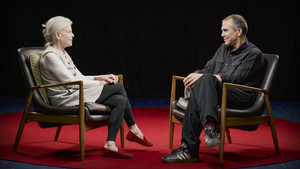
On this episode, conservationist Christine McDivitt-Tomkins and theatre director Amir
Nizar Zawabi.
The two of them come from divergent disciplines, but overlap when it comes to the ways they
think about the changing planet and living creatures, the possibility of systems-level
change and how to start a movement after the break.
Like TED Talks?
You should check out the TED Radio Hour with NPR.
Stay tuned after this talk to hear a sneak peek of this week's episode.
And now our TED Talk of the Day.
Amal, which is my first project, was a refugee child that traveled.
She was a puppet, but she was a refugee child.
One of the most beautiful moments from my point of view was recently on the border of
Mexico and the United States.
There was a big line of immigrants, asylum seekers, refugees.
I don't want to get into the political titles, but people that are leaving a country in order
to find a better life.
They were standing in the sun in the Sonora Desert, and Amal arrived out of nowhere because
we were walking there.
And there was a beautiful moment where the border police, the American border police,
and the children of the immigrants and the immigrants themselves all had the same look
on their face.
And the look was full of love.
And I think that moment suddenly, they all became one thing for a brief second.
It only lasted a second.
I wouldn't have actually understood that, except I've seen Amal, and this really had
a tremendous impact on me because you're taking all the feelings and expressions that
we have standing on the ground, and we all know what they are, but then you elevate this.
Even though she's a puppet, she transcends everything that we, really the only languages
we have on the ground, and transcends that and walks straight over the top of how we
behave day-to-day.
That moment was a huge moment of optimism for me.
Well, I can see that.
Will you talk a little bit about the herd, do you mind?
The herds.
We're creating a big migration of life-sized puppet animals made from recycled materials,
mainly cardboard.
And we're going to start in Central Africa, in the Congo Basin, which is in many ways
the cradle of civilization.
And we're going to journey from Congo, from Kinshasa, all the way to Tromsa, in the north
of Norway, in a long, long, slow journey of migration.
The animals are leaving because the world is becoming too hot, so they're going to...
The animals leave because they are early warning signs of a systematic collapse.
And the animals leave and walk through our cities to remind us, remind us of beauty.
I think beauty is a big word, an important word.
They remind us of what happens when we work together, because this project is obviously
about a huge network of collaborations between people, and that we can achieve impossible
things, even ridiculously impossible things.
But you know a lot about ridiculously impossible, right?
So that's the idea behind the herds.
And we're starting in the spring of 25, so it's quite close.
And yeah, me, come and walk with me.
I'm going to.
With lots of puppet animals.
No, I'm going to.
I'm going to take one of the gazelles, and I want to walk, I want to do the stint where
they get far enough into the Sahara that they can't go any farther, and then they appear
on the northern side.
I can't wait.
And my thumb is out.
I'm going to hitchhike on a paper camera.
That's right.
Wow.
Amal was very, very powerful, not just because she was beautiful and very big.
I think the pure genius of the people who created Amal Hanspring Puppet Company was
to create a perfect storm of vulnerability and fierceness.
She's completely vulnerable as a structure.
She's a stilt walker hanging above and can collapse at any second, and that's visible.
People see that she's not stable, but she's also huge and fierce, which leads me to my
next question to you in a way, because you are, in many ways, a mixture of vulnerability
and fierceness, right?
I think you took your personal pain and flipped it into this huge power to change things.
And I think that opens up so many interesting points for me in questions I want to ask you
of how do you do that?
How do you take loss and pain and grief and turn it into this all-consuming, positive
power to change the world?
Because you are changing the world.
You know, I grew up in a family where our father was super clear, all of his kids.
He didn't care what we did, but make sure you're great at it.
So I had that kind of firepower drilled into me when I was little.
And then Patagonia, Yvon Chouinard, who wanted to start making clothes, he just said, oh,
here, invent this company.
So I like starting things at zero.
I like things that are difficult.
I like, I don't know if that's a personality trait or something, but the work that
Tompkins Conservation does today is essentially supporting our legacy groups, rewilding Chile
in that country and rewilding Argentina and expanding the work we've done for the last
30 years out into the rest of the continent in terms of rewilding and land and sea
conservation.
Doug and I worked in all these projects for 25 years.
And then when he died suddenly, it's no secret.
I just wanted to go with him, not kill myself, but just walk into the same lake and vanish.
And yet we have all of these people, these team members, they're like family.
You have been through wars with him.
You have, you have, you're living in these very isolated places and you're building
schools so the kids of the team members can go to school locally.
And, you know, you're creating these villages and the power of a village, as I'm sure you
know, is I think perhaps one of the great strengths of human bonding.
And so I finally thought, what am I doing?
I have to turn this into something else.
And then it was just like that.
Just get up and you just don't stop.
I don't know.
I think there are elements of our character and personality that only when they're at
their, that your skin is so burned that you are in communication with a part of yourself
that is almost never called upon.
But you have it.
And in many ways, you're on autopilot at first.
You just start doing and pretty soon the doing becomes a form in itself and the loss, it
doesn't retract itself, but somehow it starts to add in to the doing.
And so that, you know, grief is like learning to speak a second, third, fourth language
and eventually acting on things that you believe in and you're relentless about.
That begins to take the same power that this grief had at one point.
Something like that.
And now back to the episode.
How do you deal with no?
Because I'm sure in creating these huge parks, there were many no's, there's many
walls to bash your head against and they don't always crack.
You know, we haven't had so many no's.
We've worked with 12 different presidents and I think we've created a national park
with every one of them.
But we have had, you know, very difficult times when people thought we were
creating new Jewish states, even though we were raised as Anglicans or new military
base for Argentina or a nuclear waste dump for for the United States.
So we had years when it was quite dangerous and a lot of death threats.
Phones were tapped for years and years and things like that.
But I think you just keep your shoulder to the ground and keep doing exactly what
you said you're doing and eventually, eventually, people begin to understand
that maybe what they've been talking about is what they're actually doing.
And you have to earn people's trust.
You have to, I think, I think that's the, that's a huge part of the job is showing
up and doing exactly what you say you're going to do and you do it year after year
after year after year.
And pretty soon you're starting to change culture.
You're starting to change how society looks at their own jewels of their country
and go something like that.
Are you an optimist now after, you know?
Yeah, I'm not an optimist for this century because I think what's already begun
is in terms of climate impacts, the great extinction crisis.
I get asked this a lot and it's usually couched in a do you think climate, the
fear of climate chaos is real and I'm so in shock by that question because if people
really understand that hundreds of millions of people today are affected by the change
in their climate, whether it's drought, it's monsoon, it's all these swinging
extremes going back and forth.
And if you're on an island in the Southern Pacific or if you're in the Sudan, the
South Sudan, Northern Kenya, these things are happening and it's very hard to slow
this train down.
And so in the short term I'm very concerned, as David Attenborough says, the vast
majority of people who are influenced and affected by climate change are the very
people who have no say in it and they're the very people who can't get out of the
way. And so yeah, I already have this sense of tremendous pain that these things
are underway and I think this is going to be a very difficult next 50 years, 80 years.
And I think somehow I'm more optimistic about the next century because we will have
gone through this calamity as a world people and I hope that humans finally figure out
that they have no choice, they have to live within the confines and boundaries of natural
systems. That's how I see it.
I'm actually very hopeful.
I know this coming from, I'm an optimist, I'm an optimistic pessimist.
Obviously coming from where I come, there's no reason to be optimistic.
But I do believe in mankind.
I think we will come to our senses.
We usually do it too late, a bit too late, but somehow we do it on the brink and we pay a
price. And I think we are paying a price.
It's not theoretical. Walking with a mouth through Europe, you see people that have left
because of climate change.
This is not theoretical.
And it will also, and I think that's part of the reason why I'm, I don't know if optimistic is
the right word, but we don't know what the effects are.
That's right.
There is a bit of, we are protected, it will happen to the Global South, which is not
necessarily true.
It's happening now in the Global South because these are weaker communities, the
infrastructure is weaker, there's not enough fat on the body.
That's right.
But who knows what will, how it will hit.
I agree with you.
You know, I study economics and petroleum futures and all kinds of strange things, trying
to understand like at what point are we going to really understand the real impacts of
things. And you know what black swans are, they are these unanticipated consequences that
have no, there's no, there's no warning, like for instance, if you look at the fall of the
Berlin Wall and if you take yourself to early, mid-September, 1989, nobody thought the Berlin
Wall would come down.
And early October, it's finished.
And so these black swans exist, they're unanticipated consequences.
So I agree with you.
We don't, we can't know today how this is all going to unfold.
And therefore, I think you and I work on things regardless of how we see the immediate
mid-range and long-term outcomes.
It's not going to change what you do when you get up at night because you don't actually
know how it's going to unfold.
But, but, but, and I think and that's true to war and nature.
The minute it's over, life starts in all its vivacity and all its beauty, you know, you
see a fire and a second later, the forest starts again, kicks in again.
In the midst of the terrible devastation that's happening in my homeland, there's children
playing. And even in the rubble, I saw a beautiful video of children sliding down a slab of
concrete of a demolished house.
And the laughter and the joy was incredible inside all this misery.
And I think life is very powerful.
And that's what keeps me optimistic in these very, very frightening times.
And I'm not talking only about my homeland.
I'm talking about our faith as mankind, as humankind.
What keeps you awake at night?
What are you thinking about?
A lot of things keep me awake at night.
I come from Palestine, so the year was especially tormenting.
I've lost friends.
The situation back home is very, very dire and very that keeps me awake at night.
But I think that our lack of compassion is what drives me and in many ways drove me to
become a theater practitioner when I was a young kid in Palestine.
And I chose the tool I know best, which is storytelling, to create compassion.
And I think there's a lot of connection between the lack of compassion to our fellow man,
but also to our climate, to our environment, to our spaces, to the other creatures that
live with us on this ever-rotating planet.
And I think they're very connected.
All these issues are connected for me.
I can't separate the violence that is ensued now in my home from the violence that is
ensued on climate.
And of course, they're also connected because the engine is very similar.
Yeah, I completely agree.
I think that the devastation of human communities through war or all sorts of injustice and
inequity is exactly the same phenomenon that's happening with the non-human world as well.
There are so few people who really pull the levers and run kind of the globalized economy
and so on and so forth.
But if we believe that all life has intrinsic value, which I think we do believe that, then
it's very painful, as you say, in human societies, and it's extremely painful in the
non-human world as these species blink out.
And some of them, millions and millions of years on this planet, and in the blink of
an eye, in geologic time, they're gone.
And of course, if you pull way back, the species are rising and falling, but I have a lot of
trouble staying so quite so understanding when we know what's taking place in the human
and non-human world.
And the number of decisions within boardrooms around the world don't reflect the price that
life is having to pay for this lifestyle, who very few enjoy.
What is the solution?
Good question.
Or is it a mix of solution?
Yeah, I think it's always a mix of solutions.
I think I study collapse of human civilizations as a hobby, not as my life's work.
And I think we really change under crisis.
I think humans tend to not do what's absolutely necessary until they have no choice but to
act.
And I'm talking about people who really have an impact, whether it's on the economic side,
really any area.
And I think that we're not there yet, but I think that we'll be forced to change the way that
we're behaving.
And I think it will be swift, as these things often are.
And that's just what I think.
I think we won't change until we're forced to.
I agree completely.
And I think that both on the political level and on the I think that all my work, from my
point of view, is prepping, is prepping us to that, prepping us, prepping myself, my immediate
community, my audience that is preparing us to change, is preparing us to the expansion of the
heart that has to come when change happens.
Amir, thank you for talking to me.
Chris, thank you very much.
You're a true inspiration.
I am saying this with lots of friendship and love to what you do and who you are.
And I'm grateful.
This is one of the first of what will be a thousand conversations.
Inshallah.
Inshallah.
I'm Elise Hugh.
I'll be back tomorrow with a fresh idea for your feed.
Thanks for listening.
Jennifer Vail studies friction and how to deliver just the right amount of it, like when you get a flu shot.
If friction was working against you so much that that needle is having to be pushed multiple times and harder and
harder because the stopper is getting stuck, you would definitely know the hidden role of friction in our lives.
That's next time on the TED Radio Hour from NPR.
Subscribe or listen to the TED Radio Hour wherever you get your podcasts.