NPR. This is The Indicator from Planet Money.
I'm Darien Woods. And I'm Adrian Ma.
Joining us this week on The Indicator is none other than NPR's Chief Economics Correspondent, the one, the only, Mr.
Scott Horsley. Great to be here.
The horse. Nice to see you.
And Scott, you are back just in time to join us for another edition of Indicators of the Week.
We are here, as always, to bring you the most fascinating snapshots from the week of economic news.
And today, we are digging into...
The cost of living.
We're also going to look at getting the lead out of Holmes pipes.
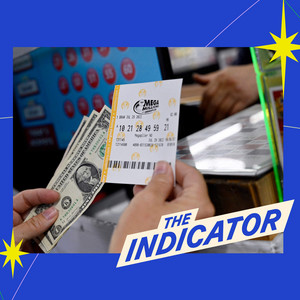
And the Mega Millions.
That's all after the break.
This message comes from the Center for U .S.
Voters Abroad Foundation.
If you're a U .S. citizen living abroad, the Center for U .S.
Voters Abroad Turnout Project's online form will walk you through requesting your ballot in just five minutes.
Visit internationalvoter .com.
This message comes from Wwise, the app for doing things in other currencies.
Send, spend, or receive money internationally and always get the real -time, mid -market exchange rate with no hidden fees.
Download the Wwise app today or visit wwise .com.
Tease and fees apply.
This message comes from Indiana University.
Indiana University performs breakthrough research every year, making discoveries that improve human health, combat climate change, and move society forward.
More at iu .edu slash forward.
All right. It's indicators of the week.
And Scott, you know, we are obsessed with checking in on the latest consumer price index.
And that's what you have for us today.
That's right. A CPI for September came in at 2 .4 percent.
That's how much the cost of living has gone up over the last 12 months, according to the Labor Department's inflation yardstick.
The good news is that's the smallest annual increase in more than three and a half years.
The not so good news is that even though inflation's coming down, it's not coming down as fast as many of us had hoped.
Right. So anybody who's done calculus knows that the first derivative is good, the second derivative is not so good?
We're slaying the math club crowd today.
Or are we into the third derivative?
Yes. Well, I mean, I guess this leads us to the other thing that we are often obsessed with this on the show, which is the Federal Reserve and what they're going to do about interest rates.
That's right. The Fed is counting on inflation, cooling off so it can keep cutting interest rates.
And this week we got minutes from the most recent Fed meeting, which showed policymakers were divided about how fast those rate cuts should happen.
They are increasingly confident that inflation's headed back towards their target of 2 percent, but it's taking its time in getting there.
For example, gasoline prices have come down a lot over the last year, but in September, falling gasoline prices were more than offset by rising rents and grocery prices.
So sticker shock in the grocery aisle is still a thing.
Yeah. The grocery prices continue to be a pain point for many people.
Of course, most of us shop for groceries every week, so we are constantly reminded how high prices are.
And even though grocery prices had been pretty stable in recent months, in September we saw a pretty big increase, led by a jump in the price of eggs.
New and used car prices were also up last month, and auto insurance just keeps going up, even before you factor in the likely cost of these most recent hurricanes.
And the question on a lot of people's mind is, are wages keeping up with inflation?
On average, yes. Wages have been going up faster than prices for the last 17 months in a row now, so workers are catching up to the cumulative effects of the high inflation we've had over the last several years.
Also this week, we learned that Social Security recipients will get a cost -living increase of 2 .5 % next year.
That COLA is based on the average inflation rate in July, August, and September.
Now, that's on top of the 3 .2 % COLA that retirees got earlier this year, and a whopping 8 .7 % COLA back in 2023.
Thank you, Scott. Darien, why don't you go next?
So, my indicator is 9 million.
That's how many homes in the US are connected to lead pipes for their drinking water.
And this week, the Environmental Protection Agency announced a rule that all lead pipes would have to be replaced in 10 years.
Lead is definitely not something you want in your drinking water.
No, not at all. As we probably already know, lead is really harmful for children, especially.
It lowers IQ, it can cause ADHD.
Perhaps less known is its links to heart disease in adults as well.
Which, I mean, makes you wonder maybe like why they decided to use lead in these pipes to begin with.
Lead does have its positives.
It's a useful metal.
It's bendable. It's resistant to corrosion.
But if the pipes have been in the ground for decades and decades, they can start to corrode and taint the water.
That said, I know getting all those lead pipes out of the ground and getting cleaner water to all those houses is going to probably be expensive, right?
Yeah, the EPA estimates the rule will cost around $2 billion each year.
But that $2 billion pales in comparison to the benefits.
The EPA estimates that those benefits are going to be worth more than $20 billion a year.
Okay, so that's like a benefit to cost ratio of more than 10, right?
And usually, if the benefit to cost ratio is more than one, a thing is a good idea.
Which means, if the EPA's calculations are correct, I guess this is kind of a no -brainer.
Yeah, and the press release from the White House had this wonderful statistic that I love.
That this new rule could save a cumulative 200 ,000 IQ points that could otherwise be lost in children.
I could use a few of those.
I'm not sure if these are retrospective allocation, guys, sorry.
Yeah, it's probably too late for me.
Okay, my indicator of the week is, get ready for it, one in 302 million.
Those are the odds of winning the jackpot in the mega -millions.
And I assume everybody's familiar with what the mega -millions are?
Yeah, some kind of lottery.
I've seen the commercials.
Yeah, basically, you pick six numbers, and these numbers are drawn at random from a big machine filled with bouncing balls, and the more numbers that you correctly guess, the more you win.
And the reason this is my indicator of the week is that mega -millions recently announced that they're raising the price of a ticket.
So currently, it costs about $2 to $3 to play, but starting next April, it'll cost $5 per ticket.
I guess that's another inflation.
I don't think that shows up in the government statistics, but why is the price of lottery tickets going up?
I also was thinking like inflation, maybe?
I mean, that's like, it would be a pretty steep inflation rate.
You know, it's like basically double.
So I put that question to Joshua Johnston, who is the director of the board that oversees the mega -millions game.
And I asked like, hey, what gives?
It really was a player demand based on all the research that we've done.
Bigger jackpots and more prizes, and that's what we wanted to offer them.
Yeah, by increasing the price of a ticket to $5, the jackpot builds up more quickly, and the amount of prizes they offer will be larger too.
For example, we had a draw on Tuesday night.
Someone won $10 ,000.
In the future, they will now win at a minimum $20 ,000.
And their odds of winning that prize, have they changed?
Yes, the odds will change.
I'm not going to share exactly what the odds will be.
Are they getting better or are they getting worse?
They're getting much better.
Partly this will be because they're removing one of those bouncing balls, and fewer balls means the players have a slightly better chance of guessing the right one.
So the odds have gone from astronomical to ever so slightly less astronomical.
Yeah, slightly less than astronomical.
I think that's right.
While they do expect the price hike to drive away some players, they also expect revenue to increase by 25%.
Joshua is quick to add, that money does not just go to prizes.
And so let's say you have what we call a non -winning experience.
It's a great... Isn't that a great way of saying it?
A non -winning experience?
Losing ticket, okay.
No, no, a non -winning experience.
So you've got a non -winning experience.
That $5 goes right back into the community.
A non -winning experience.
But there you go, yeah.
The money from the non -winning experience goes to compensating the retailers and to things like parks and pre -K and scholarships and the like.
So there you go. Don't waste your money.
That is it for indicators of the week.
Thanks, Scott. Hopefully this was not a non -winning experience for you.
It's always a jackpot when I'm on the indicator.
Oh! Nicely played. This episode was produced by Angel Creares with Engineering by Valentino Rodriguez Sanchez.
It was fact -packed by Sierra Juarez.
Cake and Cannon edits the show, and The Indicator is a production of NPR.
This message comes from Indiana University.
Indiana University performs breakthrough research every year, making discoveries that improve human health, combat climate change, and move society forward.
More at iu .edu slash forward.
When voters talk during an election season, we listen, we ask questions, we follow up, and we bring you along to hear what we learned.
Get closer to the issues, the people, and your vote at the NPR Elections Hub.
Visit npr .org slash elections.